


How Do I Earn Side Income From Renting Out My Car?
How do I earn side income from renting out my car?
You earn side income from renting out your car by listing it on a peer-to-peer car sharing platform, such as Turo, setting a daily price and the days it is available, and letting guests book it through the app. The platform handles the payment and provides insurance cover under the plan you choose, and you keep a share of each trip price, 70, 80, or 90 percent on Turo's United States plans. It works best if you have a car you do not need every day, because a car that sits in the driveway most of the week can earn money instead of just costing you payments, insurance, and upkeep.
This post is educational only. It is not financial advice, and it does not promise any income. The figures in this guide come from Turo's own published plans and from guides checked in November 2026, and platform terms change, so check the platform's own pages before you list a car.
Is renting out your car right for you?
Renting out your car makes sense if you have a second car you rarely use, you work from home and need the car only a few days a week, or you are still paying for a car that spends most of its time parked. In those cases, renting it out can help offset the monthly payment, insurance, and upkeep. It makes less sense if you need the car every day, or if the car is old, unreliable, or expensive to repair. A guest who breaks down on a trip is a bad review and a repair bill, not side income. Be honest about how many days a month the car is truly free: ten free days is a real side income, and two free days is not. Also think about wear: every rental adds miles, servicing, tyres, and depreciation, so a car that earns 300 dollars a month but needs 200 dollars of extra servicing and cleaning is not earning 300 dollars.
Step 1: Check that your car qualifies, and that you are allowed to rent it out
Each platform sets its own rules, and they change. For Turo in the United States, guides checked in November 2026 report that a car generally needs to be no more than 12 years old, have fewer than 130,000 miles, be worth no more than 200,000 dollars, and have a clean title, with no salvage or total loss history. Turo operates in the United States, Canada, the United Kingdom, France, and Australia, and the rules differ by country, so check the rules for your own market on Turo's own pages before you assume your car qualifies. Before you list, check two things many beginners skip. First, call your insurer and ask what happens if you rent the car out: your personal car insurance usually does not cover commercial rental, and the platform's cover applies during the trip, not necessarily before or after it. Second, if you have a loan on the car, read the loan terms or call the lender, because some loan agreements do not allow the car to be used for commercial rental.
Step 2: Understand how the platform pays you
Turo does not charge hosts a flat commission. It offers earnings plans, and the plan you choose sets both how much of each trip price you keep and how much you pay if the car is damaged. Since January 7, 2026, Turo's United States plans are: More peace of mind, where you keep 70 percent of the trip price and pay up to 250 dollars toward an eligible damage claim; Balanced, where you keep 80 percent and pay up to 1,500 dollars; and More earnings, where you keep 90 percent and pay up to 2,750 dollars. Each plan includes up to 750,000 dollars in third-party liability insurance, physical damage reimbursement, and basic roadside assistance, under a policy issued to Turo by Travelers. Turo says United States hosts averaged 10,489 dollars per car in 2025, about 874 dollars a month, before costs. That is Turo's own figure, and its own footnote says it has not been reduced for ownership costs such as maintenance and insurance. An average is not a promise: some cars earn far more, some earn nothing. Turo pays hosts by direct deposit through Stripe, and guests book and pay through the app, so you do not collect cash from guests.

Step 3: Price the car fairly
Look at similar cars in your area before you set a price. Search the platform for your car's make, model, and year, in your city, and note the daily prices and how many reviews each car has. A car priced far above similar cars will sit empty. A car priced far below them will book, but you will earn less and may attract guests who treat it badly. Start near the middle of the range for similar cars, and adjust after a few trips: if the car books out weeks ahead, the price is probably too low, and if it gets views and no bookings, the price is probably too high or the photos are weak. Set your availability honestly, block the days you need the car, and keep the calendar up to date. If you travel often, set a minimum trip length, such as two or three days, so you are not cleaning the car for a dozen one-day trips.
Step 4: Prepare the car and write a good listing
Clean the car properly, inside and out, before the first photo and before every trip. Fix small problems first: a warning light, a slow tyre leak, a broken wiper. Take clear photos in daylight, from every angle, including the interior, the boot, and the dashboard. Write a description that answers the guest's questions: the make, model, and year, how many seats, whether it has Bluetooth or a reversing camera, where pickup happens, and what the mileage limit is. Be honest about scratches and wear, and photograph them. Take photos of the car, the fuel level, and the mileage before every handover, and again when the car comes back. That record is your protection if a guest damages the car or returns it with an empty tank.
Step 5: Handle handovers, guests, and problems
Most hosts meet the guest for pickup and return, or offer delivery to a nearby place such as an airport or station for a fee. Agree the pickup time and place in the app, not by text message alone, so there is a record. Show the guest the car, point out anything unusual, and confirm the fuel level and mileage together. Communicate clearly and quickly: answer booking requests fast, because slow replies lose bookings. If the car comes back damaged, dirty, or with a warning light, report it through the platform at once and include your before and after photos. Do not try to settle damage privately for cash, because that leaves you with no record and no cover. Keep the car serviced on schedule, and keep receipts. A car that is serviced and clean gets better reviews, and better reviews get more bookings.
The real costs: work out your net income, not just the trip price
The trip price is not your income. Your income is what is left after the platform's share, the cleaning, the extra servicing, and the wear. A simple way to count it is: trip price, minus the platform's share, minus cleaning, minus extra servicing and tyres, minus any delivery cost, equals your net before the car payment. The car payment, insurance, and tax are costs you would have anyway, but the rental income should at least cover them and leave something over, or the work is not worth it. Also plan for downtime: a car that is being repaired is not earning, and a car booked solid for a month will need servicing sooner. Keep a small fund for repairs, and do not count on every free day being booked. A car booked 10 days a month is doing well.
Taxes, records, and the fine print
Rental income is usually taxable, so keep a record of every trip, every payout, and every cost: cleaning, servicing, fuel you paid for, and any platform fees. Set money aside for tax as you earn it, and talk to a tax professional about how rental income is treated where you live and what costs you can deduct. Rules differ by country. Read the platform's terms before you list: know what the damage cover excludes, such as wear and tear, loss of hosting income, or a replacement vehicle while yours is repaired, and know the mileage limits, the extra charges for going over them, and what happens if a guest returns the car late. If you rent the car out regularly, check whether your city or state treats it as a business, since some places require a permit or registration.
Alternatives if renting out your car does not fit
If your car does not qualify, or you need it every day, there are other ways to earn from it. Car wrap advertising pays drivers to carry ads on their car, with reported pay from about 100 dollars a month at the base level to 450 to 1,500 dollars a month for drivers who drive a lot. Driving for a ride or delivery app pays per trip plus tips, but it uses your time as well as your car. None of these is passive, so compare them on net income, not on the headline number. Our other side income guides cover options that need no car at all, such as babysitting and cleaning houses.
Common mistakes to avoid
The first mistake is counting the trip price as income. The platform's share, cleaning, and servicing come off first, and the net is often far smaller than the headline number. The second mistake is skipping the insurer and the lender. If your insurance does not cover rental use, or your loan forbids it, one claim can cost more than a year of rental income. The third mistake is pricing too low to fill the calendar. A busy calendar at a low price earns less than a half-full calendar at a fair price, and it wears the car out faster. The fourth mistake is poor photos and a thin listing. Guests choose the car they can see clearly. The fifth mistake is trusting an out-of-date guide. Platforms close, plans change, and fees move, so check the platform's own pages before you list. The sixth mistake is no record keeping. Without before and after photos, a mileage note, and a record of costs, you cannot prove damage, claim a cost, or work out whether the side income is actually making money.
Worked example: one car, 10 booked days a month
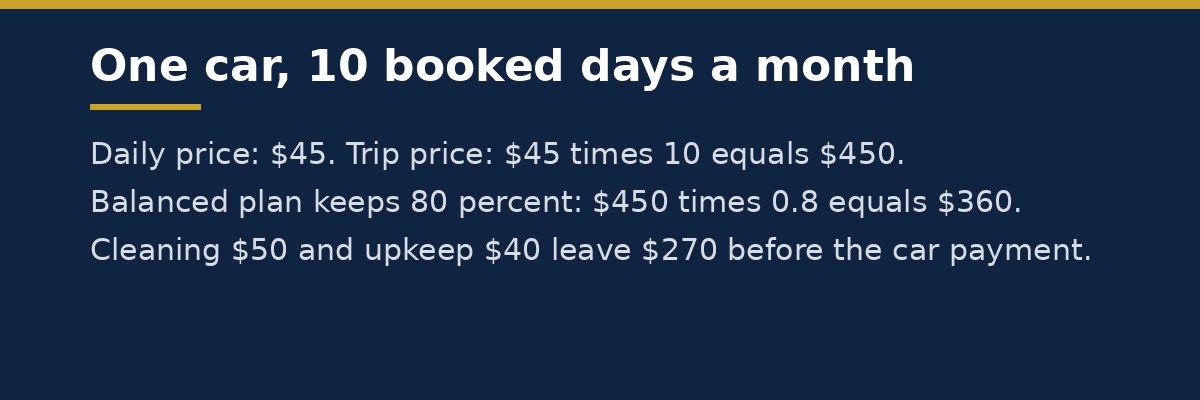
Anna has a second car, a mid-size sedan, that she uses only on weekends. She lists it on Turo at 45 dollars a day and chooses the Balanced plan, where she keeps 80 percent of the trip price and pays up to 1,500 dollars toward an eligible damage claim. In a typical month, the car is booked for 10 days. The trip price is 45 dollars times 10 days, which equals 450 dollars. Her share is 80 percent of 450 dollars, which is 360 dollars. Her costs for the month are cleaning at 5 dollars per handover, with 4 handovers, which is 20 dollars, plus a car wash and vacuum at 30 dollars, which is 50 dollars of cleaning in total, and 40 dollars set aside for extra servicing and tyres. Her net before the car payment is 360 minus 50 minus 40, which equals 270 dollars.
Anna's car payment is 320 dollars a month, so the rental income does not cover the whole payment, but it covers most of it, and she still uses the car herself on weekends. If the car were booked 15 days a month at the same price, the trip price would be 675 dollars, her 80 percent share would be 540 dollars, and after the same 90 dollars of costs she would keep 450 dollars, which would cover the payment and leave 130 dollars over. The lesson is in the gap between the trip price and the net: a 450 dollar trip price sounds like 450 dollars of income, but after the platform's share and the costs, it is 270 dollars. That is still useful side income, but it is not a salary, and it only works because Anna's car was sitting unused anyway.
Frequently asked questions
How much can I earn renting out my car?
Turo says United States hosts averaged 10,489 dollars per car in 2025, about 874 dollars a month, before costs. Your result depends on your car, your city, your price, and how many days it is booked. Count the net after the platform's share, cleaning, and servicing, not the trip price.
Which platform should I use to rent out my car?
In the United States, Turo is the main peer-to-peer platform still operating. Getaround, HyreCar, and Avail have shut down, so ignore guides that still recommend them. Check Turo's own pages for the current plans, rules, and availability in your country.
What does Turo keep from each trip?
It depends on your plan. On the United States plans, you keep 70, 80, or 90 percent of the trip price, and you pay up to 250, 1,500, or 2,750 dollars toward an eligible damage claim.
Does my car qualify for Turo?
For the United States, guides checked in November 2026 report that a car generally needs to be no more than 12 years old, have fewer than 130,000 miles, be worth no more than 200,000 dollars, and have a clean title. Rules differ by country, so check Turo's own pages for your market.
Is my car covered by insurance when a guest drives it?
Each Turo earnings plan includes up to 750,000 dollars in third-party liability insurance, physical damage reimbursement, and basic roadside assistance during the trip. Your own personal insurance usually does not cover rental use, so call your insurer before you list.
Do I pay tax on rental income from my car?
In most places, yes. Keep a record of every payout and every cost, set money aside for tax, and talk to a tax professional about how rental income is treated where you live.
Conclusion, and your first step today
Renting out your car can be a useful side income if the car is free for enough days, it qualifies on the platform, and the net income after the platform's share and the real costs is worth your time. The trip price is not the income. The income is what is left after the share, the cleaning, and the servicing.
Your first step is simple. Tonight, look up three cars like yours on Turo in your area and write down their daily prices and how many reviews they have. If the prices and the demand look real, check with your insurer and your lender next. Those two calls decide whether the idea works at all.
This post is educational only. It is not financial advice, and it does not promise any income.
