

How Do I Start a Side Hustle Step by Step?
A side hustle is a small job you do outside your main job to earn extra money. It can be freelance writing, tutoring, dog walking, or helping a local business with social media. You work on it in your spare hours, and you keep your day job while it grows.
To start a side hustle, pick one skill you already have, turn it into one simple offer for one type of buyer, set a clear price, tell 30 people about it in one week, and deliver the work well. The worked example below shows how 5 hours a week at $25 an hour adds up to $500 a month.
What Is a Side Hustle, in Simple Terms?
A side hustle is paid work you do on the side. It is not your main job, and it is not a full business yet, although it can grow into one. You start small, with hours you already have free, and you earn money from a skill or service someone needs.
It is different from a second part-time job: an employer sets your hours and pay, while with a side hustle you choose the service, the price, and the hours. You do not need a big idea, a loan, or a website. Most side hustles start with a service, not a product, because a service needs no stock and no upfront cost. Our guide on how to start a side income with no money explains why.
Step 1: Pick One Skill You Already Have
Start with what you can already do. A side hustle works fastest when the skill is real, even if it feels ordinary to you. The things friends ask you for help with are often the best clues.
Common examples are writing, design, tutoring, bookkeeping, fixing computers, cleaning, dog walking, cooking, photography, and social media help.
Write down three skills, then ask of each one: would someone pay for this? If friends or co-workers have already asked you to do it, the answer is probably yes. Our guide on how to turn a skill into side income walks through this test, and our guide on how to choose a side income that fits your skills helps you compare options. Even a hobby can work; our guide on how to turn a hobby into side income shows how to tell. Pick just one skill.
Step 2: Choose One Buyer With One Problem
A side hustle earns money when it solves one clear problem for one clear type of person. "I help everyone with everything" is not an offer. "I write product descriptions for small online shops" is an offer, because the buyer and the problem are both clear.
Finish this sentence to find your buyer: "I help [type of person] with [one problem]." For example: I help busy parents with weekly meal prep. I help small shops with product photos.
Think about who already has this problem and who can pay to fix it. A busy small business owner is often a better buyer than a friend who wants a favour. Write your buyer and their problem down where you can see it.
Step 3: Package It as One Simple Offer
Turn your skill and your buyer into one simple offer. An offer has four parts: what you do, who it is for, what they get, and what it costs. Keep it short enough to say in two sentences.
Here is an example: "I write five product descriptions a week for small online shops, 100 words each, delivered by Friday, for $125 a week." The buyer knows exactly what they get, when they get it, and what it costs.
A good offer is specific. A vague offer, such as "I do writing," makes the buyer do the thinking. Write your offer in plain words. If a stranger could not understand it in ten seconds, simplify it. You do not need a logo or a website yet. If you want a fast start, our guide on what side income you can start in one weekend shows how to go from idea to first message in two days.
Step 4: Set a Price and a Time Limit
Many beginners undercharge because they feel new. But a price that is too low earns you very little and can make buyers doubt the quality. A fair starting price is better than a bargain price.
Set your first price from your time. Pick an hourly rate, then multiply it by the hours the job takes. In this guide, we use $25 an hour as a starting rate. A 5-hour job at $25 an hour costs $125.
You can charge by the hour or by the job. Charging by the job is often easier for buyers, because they know the total cost upfront: "$125 for five product descriptions" instead of "$25 an hour." Put a time limit on your offer too. Five hours a week is a good start for most people with a full-time job. Write your hours in your calendar and treat them as fixed. Your start-up cost can be zero, because you already have a phone, a laptop, and an internet connection. Do not spend money on a website or tools before you have earned your first dollar.
Step 5: Tell 30 People in One Week
Your side hustle will not find buyers by itself. The fastest way is to tell people you already know. You do not need ads or a big social media following.
Make a list of 30 people: friends, family, former co-workers, neighbours, local shop owners, and people in groups you belong to. Send each of them a short, personal message saying what you do, who it helps, and what it costs, and end with one question, such as "Do you know anyone who needs this?"
Here is an example: "Hi Sara, I write product descriptions for online shops, five a week for $125. If you know a shop owner who struggles with product pages, could you pass my name along?"
Send about five messages a day for a week, and change a line or two each time so it sounds personal. Expect most people to say nothing, a few to say they will think about it, and one or two to say yes. That is normal. One yes is all you need to start. Our guide on how to find your first freelance client has more ideas for where to look and what to say.
Step 6: Deliver, Get Paid, and Ask for a Review
When your first client says yes, agree on the work in writing before you start: what you will deliver, when, and what it costs. This protects both you and the client.
Then do the work well and deliver it on time. For a first client, on-time delivery matters more than perfection. If a problem comes up, tell the client early, not on the deadline day.
For a small first job, ask for payment when the work is delivered, by bank transfer or a payment app. For a bigger job, ask for half upfront and half on delivery. Write down every payment, with the date and the client name, because you will need these records for tax.
After the work is done, ask for two things: a review you can show future buyers, and the name of one other person who might need your service. A good review from a real client is worth more than any advert. If the client is happy, ask if they want the same work next week.
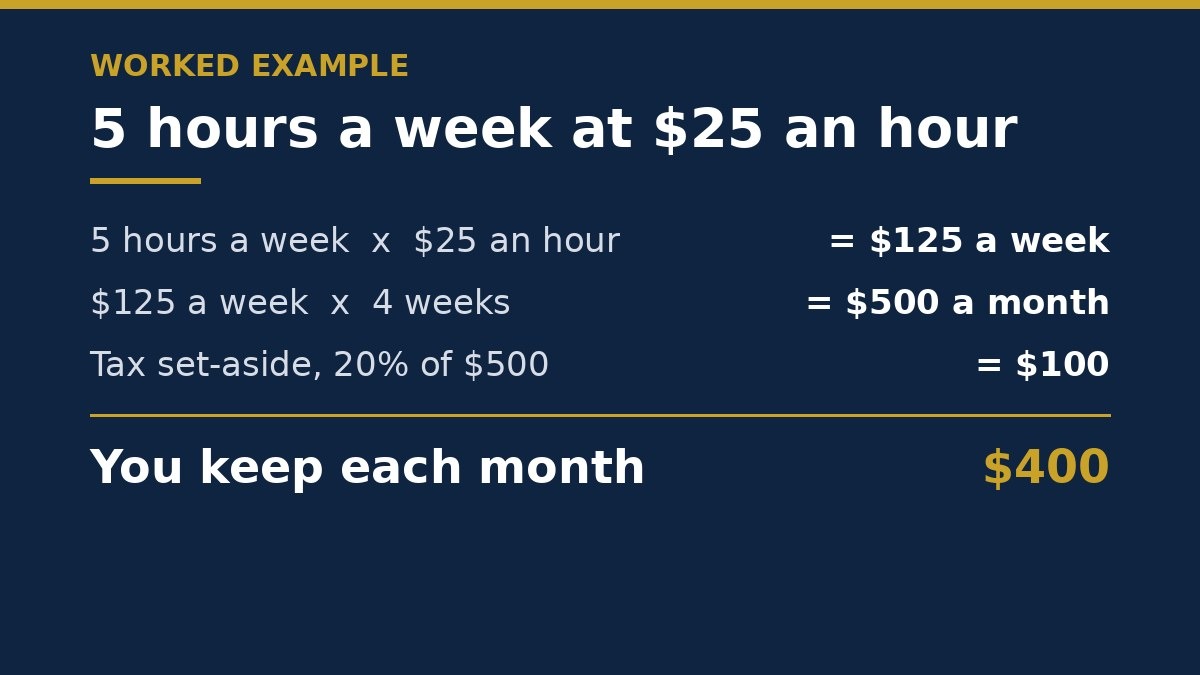
Worked Example: 5 Hours a Week at $25 an Hour
Here is a worked example using a freelance writing service. The same math works for any hourly service, so change the rate and hours to match your own skill.
The offer: five product descriptions a week for an online shop, at $25 an hour, taking 5 hours a week.
- Hours per week: 5
- Hourly rate: $25
- Weekly earnings: 5 times $25 equals $125.
- Monthly earnings, using 4 weeks: $125 times 4 equals $500.
- Yearly earnings, using 52 weeks: $125 times 52 equals $6,500.
Now set money aside for tax. Set aside 20 percent of every payment when you earn it. On $500 a month, 20 percent is $100, which leaves $400 a month to keep.
- Monthly earnings: $500
- Tax set-aside, 20 percent: $500 times 0.20 equals $100.
- Money to keep each month: $500 minus $100 equals $400.
Start-up cost is $0, because the writer already owns a laptop and an internet connection, and the client came from personal messages.
Now look at growth. After a few months, the writer raises the rate to $30 an hour and works 10 hours a week, with two regular clients.
- Hours per week: 10
- Hourly rate: $30
- Weekly earnings: 10 times $30 equals $300.
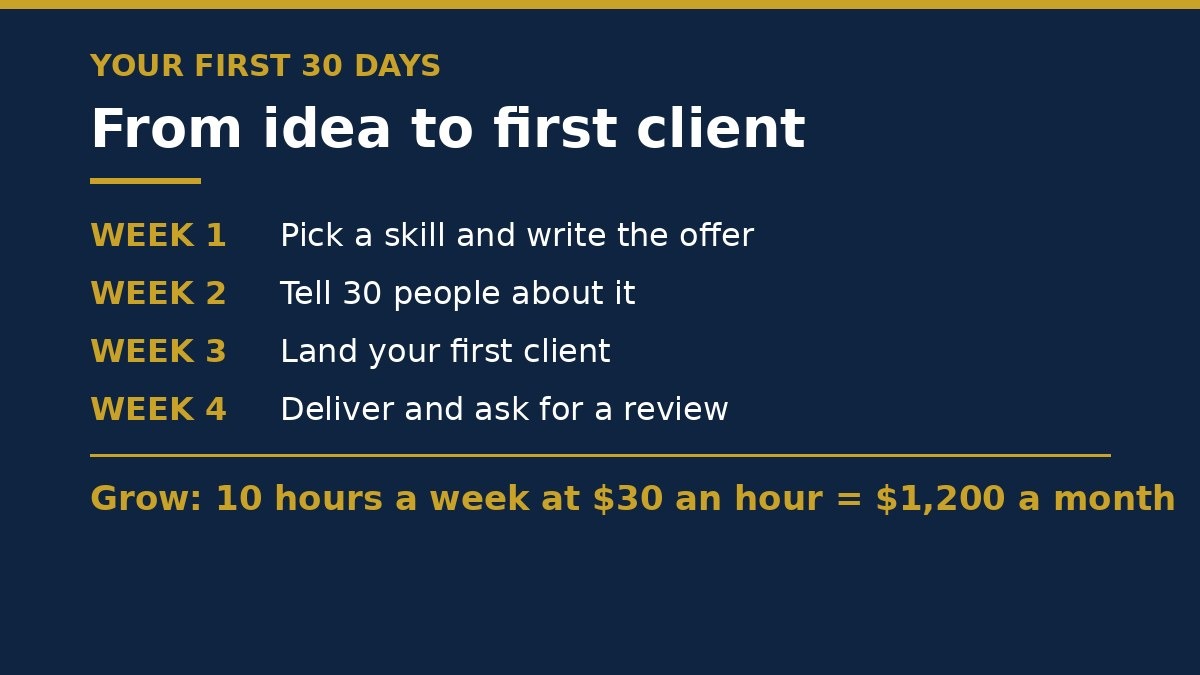
- Monthly earnings: $300 times 4 equals $1,200.
- Yearly earnings: $300 times 52 equals $15,600.
- Tax set-aside, 20 percent: $1,200 times 0.20 equals $240.
- Money to keep each month: $1,200 minus $240 equals $960.
That growth needed no new skill and no big investment, just one more client, five more hours a week, and a small rate rise.
Your First 30 Days, Week by Week
Week 1: Pick your skill and write your offer. List three skills, choose one, name your buyer and their problem, and write your offer in two sentences.
Week 2: Tell 30 people. Send about five messages a day and answer every reply the same day.
Week 3: Land your first client. Follow up once with anyone who showed interest. Agree the work in writing, confirm the price and the deadline, and start the job. If no one has said yes yet, send 10 more messages to new people.
Week 4: Deliver and ask for a review. Finish the work on time, get paid, and record the payment. Ask for a short review and for one introduction. Then decide: keep the same hours, add a second client, or raise your price slightly.
If you reach the end of 30 days without a client, do not quit. Go back to step 2 and check your buyer and your offer. The most common fix is a clearer offer.
How to Handle Tax on Side Hustle Income
Side hustle income is usually taxable, so plan for it from the first dollar. Set aside 20 percent of every payment in a separate savings account, and do not spend it. In the worked example, that is $100 a month on $500 of earnings. If your tax bill turns out lower, the extra money is still yours.
In the United States, people who work for themselves generally pay self-employment tax on top of income tax. The IRS page on self-employment tax explains that the tax is 15.3 percent, made up of 12.4 percent for Social Security and 2.9 percent for Medicare. That is one reason a 20 percent set-aside is a sensible habit: it covers the self-employment tax and leaves room for income tax too.
Keep simple records from day one: client name, date, what you delivered, and how much you were paid. A notebook or a simple spreadsheet is enough.
As your side hustle grows, it helps to write a short plan. The U.S. Small Business Administration has a free guide to writing a business plan that covers what you offer, who your customers are, and how the money works. This is general information only, not tax advice. Tax rules change by country and state, so talk to a qualified tax professional about your own case.
Mistakes to Avoid When You Start a Side Hustle
- Trying five ideas at once. One skill and one offer finds a client faster.
- Spending money before earning any. Do not buy a website or tools before your first payment.
- Having no price in writing. Agree the price and the delivery date before you start.
- Waiting until it feels perfect. Your first offer needs to be clear and sent to real people, not perfect.
- Forgetting tax. Set aside 20 percent of every payment from the first dollar.
- Ignoring your day job rules. Check your contract first, and keep side hustle hours outside work hours.
- Giving up after one quiet week. Send more messages before you decide the idea does not work.
Frequently Asked Questions
How much money do I need to start a side hustle?
For a service side hustle, you can start with $0. You already have a phone, a laptop, and an internet connection, and your first clients come from personal messages.
How long does it take to earn my first dollar?
For most beginners, two to four weeks from the first messages to getting paid. Week 1 is for writing your offer, week 2 is for telling 30 people, and week 3 is often when the first client says yes.
How many hours a week does a side hustle take?
Five hours a week is a realistic start for most people with a full-time job. At $25 an hour, 5 hours a week earns $500 a month. Add hours only when the work is steady and you can handle it.
Do I need a business licence to start a side hustle?
It depends on where you live and what you do. A simple freelance service often needs no licence to start, but some trades and cities have their own rules. Check your local council or city website first.
Can I start a side hustle while working full time?
Yes, and most people do. Keep side hustle hours outside your day job hours, and check your contract for rules about side work. Start with 5 hours a week, and grow the hours only when the income is steady.
How much money can I make from a side hustle?
It depends on your rate, your hours, and your clients. In the worked example, 5 hours a week at $25 an hour earns $500 a month, or $6,500 a year, and 10 hours a week at $30 an hour earns $1,200 a month, or $15,600 a year. The math is the same for you: hours times rate, minus a tax set-aside, equals what you keep.
Conclusion
Starting a side hustle comes down to six steps: pick one skill, choose one buyer with one problem, package one clear offer, set a price and a time limit, tell 30 people in one week, and deliver the work well. In the worked example, 5 hours a week at $25 an hour earns $500 a month, with $100 set aside for tax and $400 to keep. Start this week, send five messages tomorrow, and let your first client teach you what to do next.
This article is for general information and education only. It is not legal or financial advice.
