


How Do I Earn Side Income From Cleaning Houses?
How do I earn side income from cleaning houses?
Cleaning houses is a simple side income with low startup costs, flexible hours, and steady demand. People always need their homes cleaned, and many will pay someone else to do it. You need no degree, no licence in most places, and less than 300 dollars of supplies to start. You need to be thorough, reliable, and trusted in someone else’s home.
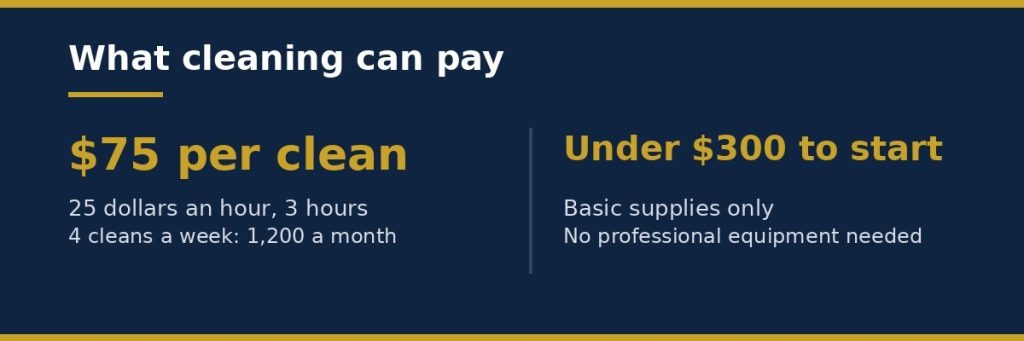
Pay varies by city and by job. In expensive cities, cleaners can charge 20 to 45 dollars an hour or more, or 60 to 200 dollars or more per job. The worked example below uses 25 dollars an hour, which is a simple example rate, not a promise. At 25 dollars an hour, one 3-hour clean pays 75 dollars, and 4 cleans a week pays 1,200 dollars a month.
This post shows how to start, what to charge, what you need, where to find clients, and how taxes work. It is educational only. It is not financial advice.
Step 1: Check that cleaning fits you
Cleaning fits you if you like tidy spaces, you notice details other people miss, you can work on your feet for a few hours, and you can be trusted alone in someone else’s home. You do not need experience. You need care, speed, and reliability.
It does not fit if you dislike physical work, if you have allergies to cleaning products, or if you cannot commit to the times you promise. Clients book a cleaner they can rely on, week after week. If you cancel often, you will lose clients fast.
You can start part time, with a few cleans a week, around a job or classes. Many cleaners start with 2 or 3 clients, then grow by word of mouth.
Step 2: Get your supplies for under 300 dollars
You do not need professional equipment to start. Most clients already have a vacuum cleaner and basic supplies, or you can bring your own. A simple starter kit costs under 300 dollars.
A starter kit usually includes: a caddy to carry supplies, all-purpose cleaner, glass cleaner, bathroom cleaner, floor cleaner, microfibre cloths, sponges, gloves, a scrub brush, a duster, and trash bags. If you bring your own vacuum, a light one is enough to start.
Buy the basics first, and add more as you earn. Do not spend 1,000 dollars on equipment before your first client. Your first clients care about a clean home, not about the brand of your mop.
Ask each client what they prefer. Some want you to use their products, because of allergies or pets. Some want eco-friendly products. Write down what each client wants, and bring the right supplies for that home.
Step 3: Set your rate
You can charge by the hour or by the job. By the hour is simpler for a beginner. By the job is better once you know how long a home takes, because you earn the same even when you get faster.
In expensive cities, 20 to 45 dollars an hour or more is common, and 60 to 200 dollars or more per job. In cheaper areas, the rate is lower. Check what cleaners charge where you live by looking at profiles on Homeaglow or Turno, or local listings, and set your rate in the same range.
Worked example, using an example rate of 25 dollars an hour. One clean takes 3 hours, so it pays 25 times 3, which is 75 dollars. Four cleans a week pay 75 times 4, which is 300 dollars a week. Over 4 weeks, that is 1,200 dollars a month.
If you charge by the job instead, a small flat might be 60 dollars, and a large house might be 150 dollars or more. Work out how long each home takes, and set the job price so your hourly rate stays fair. For example, if a 150 dollar job takes 5 hours, your rate is 30 dollars an hour, because 150 divided by 5 is 30.
Do not charge far below everyone else. A very low price worries clients, because it suggests you will rush or skip details. Charge a fair rate, and win clients by being thorough and reliable.
Step 4: Find your first clients
Start with people you know. Tell family, friends, neighbours, and coworkers that you clean houses. Ask them to tell others. Your first clients will almost always come from someone you know, and a personal recommendation is the strongest advert you can get.
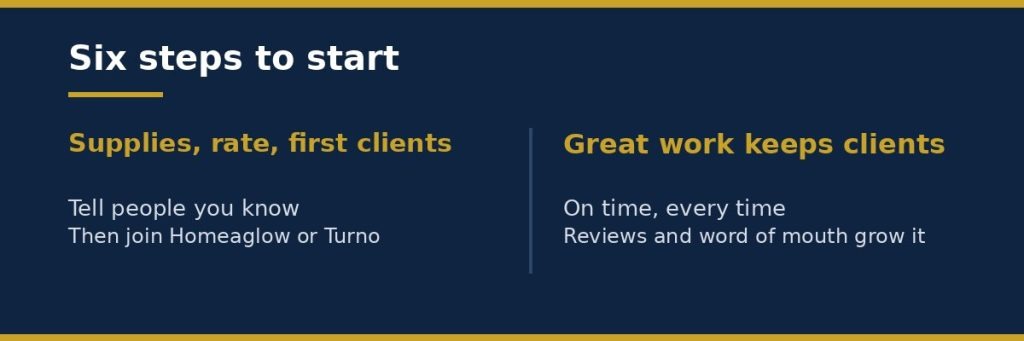
Then join a platform. Homeaglow and Turno are the main ones for cleaners in the United States. Create a profile with a clear photo, your experience, your rate, and your availability. Reply quickly to requests, because clients often pick the first good cleaner who answers.
Also try local places: community boards, neighbourhood apps, and parent groups. A short note that says what you offer, your rate, and your area is enough. Offer the first clean at your normal rate, and let the work speak for itself. Do not offer free cleans to strangers, because it attracts the wrong clients.
After each job, ask for a short review, and ask the client to tell a friend. Reviews and word of mouth are what grow a cleaning side income. One happy client who tells two friends is worth more than any advert.
Step 5: Do great work, and keep clients
Cleaning is a trust business. Clients let you into their home, often when they are not there. Three habits keep clients for years.
First, be on time, every time. If you are late, tell the client before you are due, not after. Reliability is the number one reason clients stay.
Second, clean the same way every time, and check your work before you leave. A simple checklist helps: kitchen, bathrooms, floors, dusting, bins, and a final walk through. Clients notice the details, like clean mirrors and empty bins, more than they notice speed.
Third, respect the home. Do not open drawers or cupboards you were not asked to clean. Do not use the client’s phone or computer. Lock up when you leave, and tell the client if anything broke, straight away. Honesty builds trust faster than anything else.
Consider insurance once you have regular clients. A small business liability policy for cleaners is not expensive, and it protects you if you break something valuable. It also tells clients you are serious. Check the options where you live before you buy.
Step 6: Handle the money and the taxes
Keep records from day one. Write down every job: the date, the client, the hours, and the pay. A notes app or a small spreadsheet is enough. At the end of the month, add it up, so you know what you earned, and what you spent on supplies.
For taxes, the rule in the United States is that if you earn 400 dollars or more in net self-employment income in a year, you usually need to report it and pay self-employment tax. That includes cleaning income. Keep your receipts for supplies, because they are business costs, and they reduce the income you pay tax on. Set aside a share of your pay for tax, often around 20 to 30 percent as a planning figure, and check the current IRS rules for self-employed people, or ask a qualified tax professional if you are unsure.
Related reading in the Side Income cluster: how to earn side income from pet sitting, how to find your first freelance client, how to track side income for tax in simple terms, and what side income you can start in one weekend.
Frequently asked questions
How much do house cleaners earn?
It varies by city and by job. In expensive cities, 20 to 45 dollars an hour or more is common, and 60 to 200 dollars or more per job. At an example rate of 25 dollars an hour, one 3-hour clean pays 75 dollars, and 4 cleans a week pays about 1,200 dollars a month. Check local rates where you live.
How much does it cost to start cleaning houses?
Less than 300 dollars for a basic starter kit of cleaning supplies, if the client provides a vacuum. You do not need professional equipment to start. Add more supplies as you earn, and consider liability insurance once you have regular clients.
Where do I find cleaning jobs?
Start with people you know, then join platforms like Homeaglow and Turno, and try local community boards and neighbourhood apps. Reply quickly, keep a clear profile with your rate and availability, and ask happy clients for reviews and recommendations.
Do I need a licence to clean houses?
In most places in the United States, you do not need a special licence to clean houses as a sole cleaner. Rules vary by city and state, so check the rules where you live. If you hire other cleaners, or you work for a company, the rules can be different.
Is cleaning houses good side income?
Yes, for the right person. The startup cost is low, the hours are flexible, the demand is steady, and the pay is real. The work is physical, and you need to be reliable and trusted in other people’s homes. If that fits you, it is one of the simplest side incomes to start.
How do I get my first cleaning client?
Tell everyone you know that you clean houses, and ask them to pass it on. Join Homeaglow or Turno, and post on a local community board. Your first client usually comes from someone you know, or from a platform where a client is already looking.
Conclusion, and your first step today
Cleaning houses is a simple side income: less than 300 dollars to start, flexible hours, and steady demand. Get your basic supplies, set a fair rate for your city, start with people you know, then join a platform, and do great work every time. At an example rate of 25 dollars an hour, 4 cleans a week pays about 1,200 dollars a month.
Your first step today is to buy or gather your basic supplies, and to tell three people you know that you clean houses. Those two moves start the work, and the first client usually follows.
Sources
Internal Revenue Service, self-employed individuals and tax obligations: https://www.irs.gov/businesses/small-businesses-self-employed
Disclaimer: This article is for education only. It is not financial advice, and it does not guarantee any result. Pay rates and rules vary by location, and you should check the rules where you live, and speak to a qualified professional if you need personal advice, before making a financial decision.
