

How Do I Negotiate a Debt Settlement?
How do I negotiate a debt settlement?
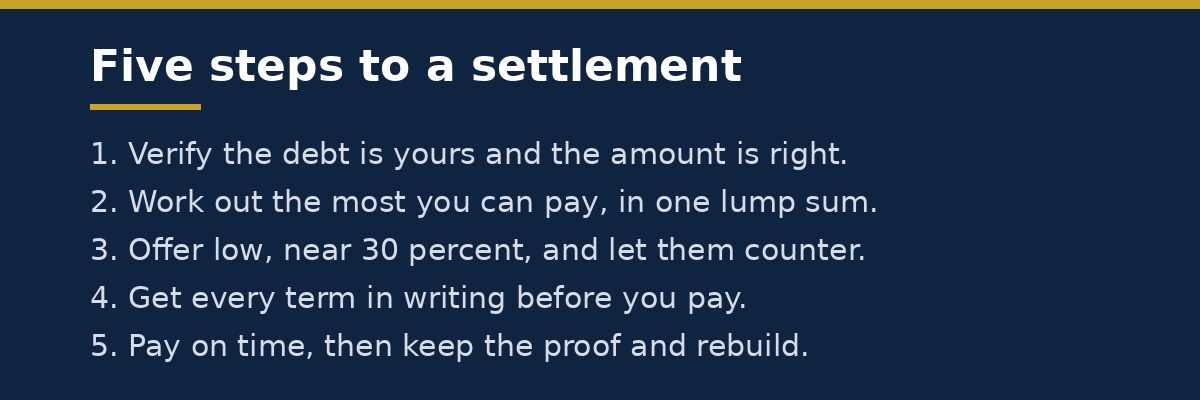
You negotiate a debt settlement by first checking that the debt is really yours and the amount is right, then working out the most you can pay, then calling the creditor or collector and offering less than the full balance, usually as one lump sum. Start low, near 30 percent of the balance, and expect a counter offer. Never pay anything until you have the agreed terms in writing, including how the account will be reported. This guide is about the negotiation itself: the steps, the call, the offer, and the paperwork. Our guide to what debt settlement means in simple terms explains the idea itself:
This post is educational only. It is not financial advice, and it does not tell you to settle any particular debt. Settling can hurt your credit score, and forgiven debt can have tax consequences, so read the risks near the end before you decide.
What a debt settlement really is, in one paragraph
A debt settlement is an agreement where a creditor accepts less than the full amount you owe and treats the rest as settled. You pay the agreed amount, and the creditor closes the account. It is not the same as paying the debt in full, and it is not the same as a payment plan that covers the whole balance over time. Settlement usually applies to unsecured debts, such as credit cards, personal loans, medical bills, and old utility bills. It is usually a last resort: if you can pay the full balance, even slowly, that is normally better for your credit.
Which debts you can settle, and which you cannot
Before you spend time preparing an offer, check that the debt is the kind creditors will negotiate on. Creditors will often negotiate on credit card debt, personal loans, medical bills, and old phone or utility bills, because no asset is tied to them and the creditor would rather take part of the money than risk getting nothing. Some debts follow a different process: tax debts go through the tax authority’s own program, student loans have their own repayment programs, and child support and court fines are generally not negotiable in a private settlement call. Also check who holds the debt now: it may still be with the original creditor, or it may have been sold to a debt collection agency, which often buys old debts for a small part of their face value and may accept a lower offer.
Step 1: Verify the debt before you offer anything
Your first move is not to offer money. It is to confirm the debt is real, the amount is right, and you actually owe it to the people contacting you.
If a collector contacts you, the law in the United States requires them to send you a written validation notice within five days of first contacting you, showing the amount owed and the name of the original creditor. You then have 30 days to dispute the debt in writing and ask for verification. The Consumer Financial Protection Bureau explains this process in its guide to negotiating with a debt collector. If you dispute within that window, the collector must stop collection activity until it provides verification. Check your own records too: look at your credit report and your old statements, and check that the balance and the account number match.
If you owe the debt, also check the statute of limitations for your state. Every state sets a deadline for how long a creditor can sue over an unpaid debt, usually three to ten years from your last payment for credit card debt, depending on the state. Once the deadline passes, the debt becomes time barred, which means a collector who sues would lose if you raise the deadline as a defence. Making even a small payment, or admitting in writing that you owe the debt, can restart that clock in many states, so find out where you stand before you pay anything or put anything in writing.
Step 2: Work out what you can really afford
A settlement offer only works if you can actually pay it. Write down your monthly take-home pay, subtract your essential costs, housing, food, utilities, transport, insurance, medicine, and minimum payments on other debts, and what is left is the most you can put toward a settlement, either as a lump sum or over a few months. Do not offer money you do not have, and do not offer money you need for rent or food. Lump sum offers work better than payment plans almost every time, because creditors prefer cash now, and a lump sum usually gets a lower percentage accepted. If you cannot afford a lump sum yet, save for a few months first in a separate savings account, and do not tell the creditor you have it saved until you are ready to make the offer. Set a firm maximum before the call, and write it down. That number is your walk-away line.
Step 3: Prepare your file and your script
Build a small file for each account you plan to negotiate: the account number, the current balance from the most recent statement, the name of the creditor or collector, and any letters they have sent you. Have a pen and paper ready to write down the name of the person you speak to, the date and time, and exactly what they offer. Prepare a short script, so your first two sentences are ready: “I am calling about account number 123456. Because of a job loss, I cannot pay the full balance. I would like to settle this account. I can pay 2,400 dollars as a lump sum to resolve this debt. Would you accept that?” Keep your hardship explanation to one or two sentences. Stay calm and polite, even if the other person is firm. You are asking for a business deal, not begging for a favour.
Step 4: Make the call and negotiate
Ask to speak to the right department. The first person who answers often cannot approve a settlement, so ask for the settlement department, the loss mitigation department, or the hardship department. State your offer clearly and with confidence. Start below where you expect to land: if you aim to settle at 40 percent, open at 25 or 30 percent. Guides that track real settlements often suggest opening at 30 to 40 percent for a lump sum, with creditors countering at 50 to 60 percent. On a 10,000 dollar debt, that means opening at 3,000 to 4,000 dollars and being ready to go up to 5,000 or 6,000 dollars. Never agree to an amount you cannot pay: a broken settlement agreement usually restarts collection, and you lose the money you already paid toward it.
Expect pressure. The collector may say the offer is too low, may push for the full balance, or may warn you about legal action. Stay with your number. You can say, “That is the most I can pay as a lump sum. If you cannot accept it, I will have to look at other options.” You do not have to answer every counter offer at once, and you can ask for time to think. If the first call fails, try again another day. A different representative may have more room to move, and your position may be stronger once the debt is older.
Step 5: Get the agreement in writing before you pay
Before you make any payment, get the terms of the settlement in writing from the creditor. The written agreement should state the amount you will pay, the date it is due, that the payment settles the account in full, and how the creditor will report the account to the credit bureaus. The Consumer Financial Protection Bureau gives the same advice: record the agreement, including any promise to stop collection efforts and forgive the rest of the debt once you complete the plan. Do not pay by giving the collector direct access to your bank account. Pay by a method you can trace, such as a cashier’s check or a money order, and keep the written agreement, the payment receipt, and the final statement showing a zero balance together, in one place, for years. Check your credit report a month or two later: the account should show as settled, with a zero balance. If it still shows the old balance, send the creditor a copy of the written agreement and ask them to correct it.
What to know about debt settlement companies
Debt settlement companies offer to negotiate for you, but they charge for it. Fees often run 15 to 25 percent of the enrolled debt, and the company may ask you to stop paying your creditors and save money in a special account instead. While you save, your accounts fall further behind, late fees grow, and your credit score falls further. Some companies promise more than they can deliver.
The Consumer Financial Protection Bureau warns against companies that charge money in advance to settle your debts. If a company asks for a large fee upfront, walk away. Doing it yourself costs no fee, and you control the timing and the offer. If you have many debts or feel overwhelmed, a nonprofit credit counsellor is usually a safer first step than a for-profit settlement company.
The two costs people forget: credit and tax
Settling a debt for less than you owe usually lowers your credit score, because the account will be reported as settled rather than paid in full. The damage is often smaller than the damage from months of missed payments, and your score can recover over time as you pay new bills on time.
The second cost is tax. In the United States, forgiven debt of 600 dollars or more is usually treated as taxable income, and the creditor may send you a Form 1099-C. There are exceptions, for example if you were insolvent when the debt was forgiven. Tax rules differ by country and by situation, so talk to a tax professional before you settle a large debt, and set some money aside in case a tax bill follows.
Common mistakes to avoid
The first mistake is offering money before verifying the debt. If the amount is wrong, or the collector cannot prove you owe it, you may pay a debt that was never yours. The second mistake is paying before you have the deal in writing. A verbal promise is hard to prove, and without a written agreement you may pay and still face collection for the rest. The third mistake is settling a debt that is about to become time barred. If the statute of limitations has nearly run out, paying could restart the clock, so check the date first. The fourth mistake is offering your maximum at once. If you open at your top number, there is nowhere to go when the creditor counters. Open low and move up slowly. The fifth mistake is forgetting the tax bill. A 4,000 dollar saving on a settlement can turn into a smaller saving once tax is counted, so plan for it.
Worked example: Sara settles an $8,000 card debt
Sara owes 8,000 dollars on a credit card. She lost her job six months ago, the account is 120 days past due, and she has saved 4,000 dollars in a separate account from selling items she no longer needs and from part-time work. First, Sara checks the debt: the collector’s letter matches her last statement, 8,000 dollars and the same account number. She checks her state’s statute of limitations. Her last payment was six months ago, so the deadline is years away. The debt is real and worth settling. Sara decides her maximum is 4,000 dollars, the full amount she has saved.
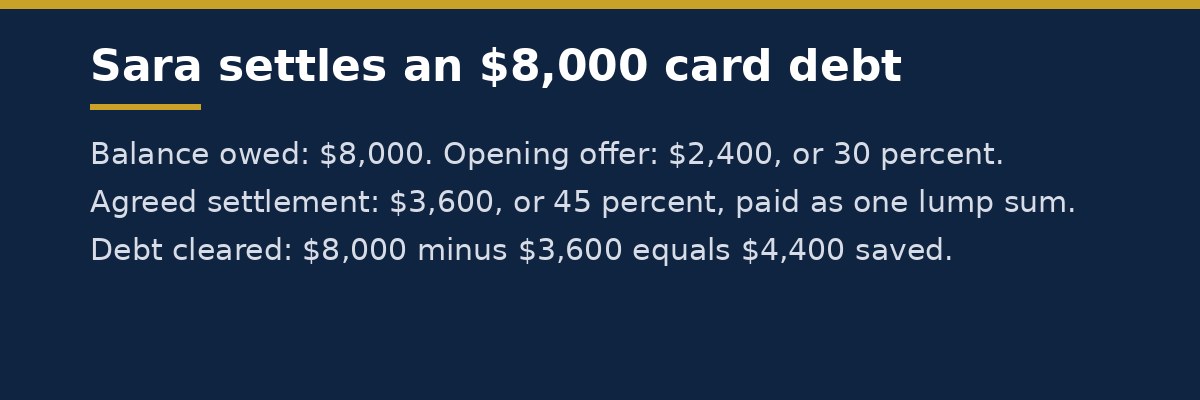
She calls the collector and asks for the settlement department. She explains in one sentence that she lost her job and cannot pay the full balance. She offers 2,400 dollars as a lump sum, which is 30 percent of 8,000 dollars. The collector counters at 5,000 dollars. Sara says she cannot pay that, and offers 3,000 dollars. The collector counters at 4,000 dollars, her maximum. Sara asks for a short pause, then offers 3,600 dollars, which is 45 percent of the balance, and says that is her final offer. The collector accepts.
Sara asks for the agreement in writing before she pays. It states she will pay 3,600 dollars by a set date, the account will be settled in full, and the creditor will report it as settled with a zero balance. Sara pays by cashier’s check and keeps the receipt with the written agreement.
The math is simple: Sara owed 8,000 dollars and paid 3,600 dollars, so she saved 4,400 dollars, and she still has 400 dollars left from her savings. Her credit report will show the account as settled, not paid in full, and she sets aside some of the 400 dollars in case a tax form follows for the forgiven 4,400 dollars.
Frequently asked questions
How much should I offer to settle a debt?
For a lump sum, open at 30 to 40 percent of the balance and be ready to meet near 50 percent. On a 10,000 dollar debt, open at 3,000 to 4,000 dollars and possibly settle near 5,000 dollars.
Can I negotiate a debt settlement myself?
Yes. Call the creditor or collector, offer less than the full balance, and get the deal in writing before you pay. Doing it yourself avoids the 15 to 25 percent fees settlement companies often charge.
Will debt settlement hurt my credit?
Yes, usually. The account is reported as settled rather than paid in full. A settled account with a zero balance is still better than an unpaid account, and your score can recover as you pay new bills on time.
Should I pay a lump sum or ask for a payment plan?
A lump sum usually gets a bigger discount and finishes the debt at once. A payment plan costs more and fails if you miss a payment. If you cannot afford a lump sum yet, save for a few months first.
Do I have to pay tax on forgiven debt?
In the United States, forgiven debt of 600 dollars or more is usually treated as taxable income, and you may receive a Form 1099-C. There are exceptions, so check with a tax professional.
What if the creditor says no?
Thank them, end the call, and try again later, or try a different department. Debts often become easier to settle as they get older.
Conclusion, and your first step today
Negotiating a debt settlement is a process, not a single phone call. Verify the debt, work out what you can afford, open low, and get everything in writing before you pay. Your first step is simple: tonight, pull your most recent statement for the debt you want to settle, check the balance and the account number, and write down the most you can pay as a lump sum. That number is the start of your negotiation.
This post is educational only. It is not financial advice.
