


What Is Value Investing?
What is value investing?
Value investing is buying a stock for less than the business behind it is actually worth, then waiting for the market to recognise that worth. A value investor studies a company’s earnings, assets, and debts, works out a fair value for the business, and only buys when the share price sits clearly below that fair value. The gap between the price and the fair value is called the margin of safety, and it is the cushion that protects the investor when the estimate is wrong.
This post is educational only. It is not financial advice. It does not tell you which stocks to buy, and it is not a recommendation to invest. Investing can lose money, and past results do not promise future results.
Where value investing comes from
Value investing began with Benjamin Graham and David Dodd, two professors at Columbia Business School who started teaching their framework in 1928 and published it in their 1934 book, Security Analysis. Graham followed it with The Intelligent Investor in 1949, a book many investors still read today.
Graham’s idea was simple, and it went against the mood of his time. A stock is not just a price on a screen. It is a part of a real business, with real earnings, real assets, and real debts. The market price can swing far above or far below what the business is worth, because the market reacts to fear, excitement, and news. A value investor uses those swings. When fear pushes a good business below its worth, that is the time to look closely.
Graham’s most famous student was Warren Buffett, chairman of Berkshire Hathaway, who is often called the most famous value investor of all time. Buffett added one idea of his own: look for a durable competitive advantage, which he called an economic moat, a reason customers keep coming back that rivals cannot easily copy. A cheap stock in a weak business is not a bargain. A fairly priced stock in a strong business can be.
The core idea: intrinsic value and margin of safety
Every value investor tries to answer one question: what is this business actually worth? That answer is the intrinsic value, an estimate of the company’s true worth based on its assets, its earnings power, and its future cash flows, independent of what the market says today.
Intrinsic value is an estimate, not a fact. Two careful investors can study the same company and reach different numbers. That is why value investors demand a margin of safety: they only buy when the price is clearly below their estimate, not just slightly below it.
The Motley Fool explains the gap in plain numbers. If a stock is worth 100 dollars and trades at 80 dollars, the margin of safety is 20 percent. Most value investors look for a margin of safety of at least 20 to 30 percent. In other words, they want to buy 1 dollar of business value for 50 to 80 cents, as the investing regulator FINRA puts it: buy 1 dollar of stock for 50 cents, and over time you should make money.
The margin of safety does two jobs. First, it protects you when your estimate is too high, because you paid less than the business was worth even if the business is worth less than you thought. Second, it gives you room to profit when the market eventually agrees with you and the price rises toward the true value.
The four numbers value investors check first
Value investors use a few simple ratios to screen for bargains. None of them proves a stock is cheap on its own, but together they point to where a closer look is worth it.
The price-to-earnings ratio, or P/E, divides the share price by the company’s earnings per share over the last 12 months. A P/E of 8 means you pay 8 dollars for each 1 dollar of yearly earnings. A P/E of 40 means you pay 40 dollars for the same 1 dollar. A low P/E can mean a bargain, but it can also mean the market expects earnings to fall, so it is a starting point, not a verdict.
The price-to-book ratio, or P/B, divides the share price by the book value per share, which is the company’s net assets divided by the number of shares. A P/B below 1 means the share price is below the net value of the company’s assets on paper. Graham and Dodd originally looked for exactly this: companies trading at a discount to book value.
The debt-to-equity ratio compares what the company owes with what its owners have put in. A company with little debt can survive a bad year. A company loaded with debt can collapse in one. Value investors prefer businesses that can pay their bills from their own earnings.
Free cash flow is the cash a business has left after paying for the things it needs to keep running. A company with steady free cash flow can pay dividends, pay down debt, or buy back its own shares. A company with no free cash flow is living on borrowed money or borrowed time.
A value investor also reads the business itself, not just the numbers: does it earn steady profits, does it have loyal customers, does it face new rivals, and is its management honest and careful with money? The numbers open the door. The business decides whether you walk through it.
How to find value stocks, step by step
Step one: start with a stock screener. A screener is a free tool on most broker and finance websites that lists companies matching the numbers you choose, such as a P/E below 15, a P/B below 2, and low debt. The screener gives you a shortlist, not an answer.
Step two: check the business behind each number. Read what the company sells, who buys it, and who competes with it. A cheap price means nothing if the product is dying or the rivals are stronger. Look for steady earnings over several years, not one good quarter.
Step three: estimate the intrinsic value, roughly. Beginners often compare the company’s P/E with its own past P/E and with the P/E of similar companies. If the company usually trades at a P/E of 18 and now trades at 10, while its earnings are steady, that gap is worth understanding.
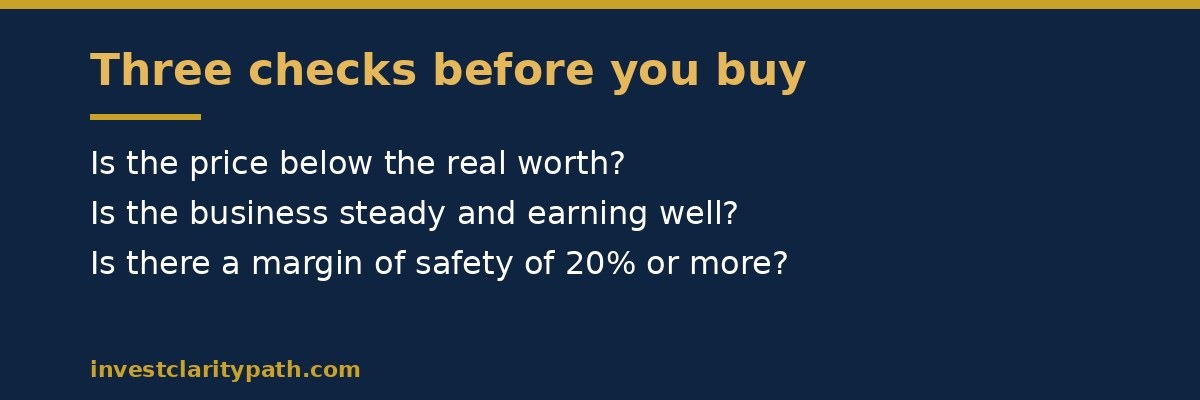
Step four: demand a margin of safety. Only consider buying when the price is at least 20 to 30 percent below your estimate of worth. If the gap is small, wait. There is always another opportunity, and patience is part of the strategy.
Step five: buy slowly and hold for years. Value investing is a long-term approach. The market can ignore a good business for months or years, and a value investor waits. FINRA notes that value investors usually sell only if the stock becomes grossly overvalued or the business fails to meet expectations. Low turnover is part of the point.
Value investing versus growth investing
Value and growth investing are often framed as opposites, but the real difference is what you are paying for. Our guide to growth and value stocks explains the split in detail:
A value investor pays for what a company is today: steady earnings, real assets, cash flow. A growth investor pays for what a company might become tomorrow: fast sales growth, new markets, future profits. Value stocks are often mature, stable businesses that pay dividends. Growth stocks are often younger companies that reinvest everything and pay little or no dividend.
Value investing also differs from market timing, which is trying to guess the market’s next move. A value investor does not predict the market. The investor studies one business at a time, and buys only when the price is right. Our guide to market timing explains why guessing rarely works for beginners:
The trap: when cheap is not a bargain
The biggest danger in value investing is the value trap: a stock that looks cheap on the surface but is priced fairly, because the business is getting worse.
A value trap usually shows one or more of these signs. Earnings have fallen for several years, not just one bad quarter. The dividend has been cut, or the company has stopped paying it. Debt is rising while sales are flat or falling. A new rival, a new technology, or a new rule is taking the company’s customers away. Management keeps promising a turnaround that never arrives.
The defence against a value trap is to ask why the price is low, and to demand a real answer. If the whole market fell and dragged a good company down with it, that can be an opportunity. If the company’s own business is shrinking, the low price may be fair, and the stock may get cheaper still. If the business fails to meet expectations, the honest move is to sell, learn, and move on.
Worked example: Harbor Tools Co., a made-up company
Harbor Tools Co. is a fictional company, invented for this example. It is not a real stock, and this is not a recommendation to buy anything. The numbers show how the ratios work.
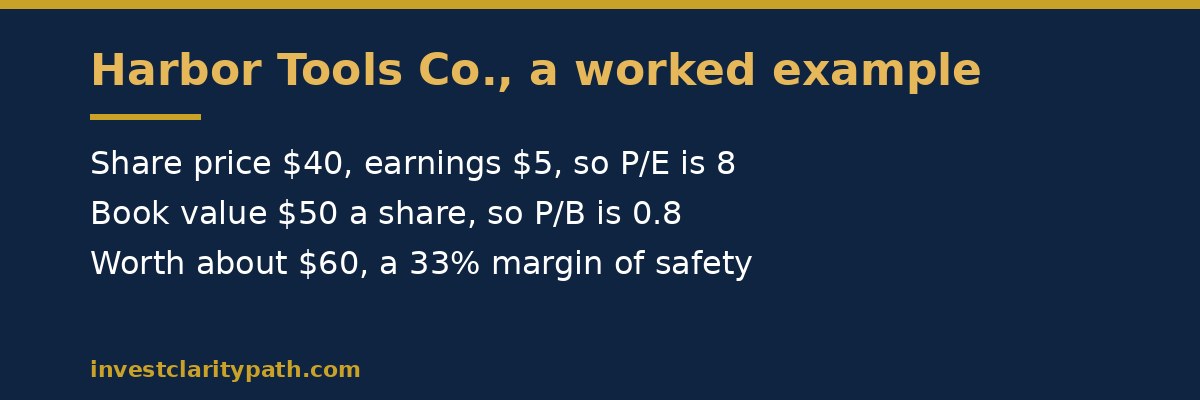
Harbor Tools makes hand tools and sells them to hardware stores. Its share price is 40 dollars. Its earnings per share are 5 dollars a year. Its book value per share is 50 dollars.
First, the P/E ratio. Share price divided by earnings per share is 40 divided by 5, which is 8. You pay 8 dollars for each 1 dollar of yearly earnings. If similar tool companies trade at a P/E of 16, Harbor Tools looks cheap by comparison, at half the usual price for the same earnings.
Second, the P/B ratio. Share price divided by book value per share is 40 divided by 50, which is 0.8. The shares trade below the net value of the company’s assets on paper, which is the classic Graham and Dodd signal.
Third, the intrinsic value. After studying the earnings, the assets, and the steady demand for tools, our example investor estimates the business is worth about 60 dollars a share. That is an estimate, not a fact, and a real investor would show the working behind it.
Fourth, the margin of safety. The estimate is 60 dollars and the price is 40 dollars, so the gap is 20 dollars. Divide the gap by the estimate: 20 divided by 60 equals 0.333, or about 33 percent. That clears the usual 20 to 30 percent target.
Fifth, the outcome if the market agrees. If the price rises to the estimated worth of 60 dollars, a holding of 10 shares bought at 40 dollars costs 400 dollars and becomes worth 600 dollars, because 10 times 60 equals 600. The gain is 200 dollars, or 50 percent. If the price never rises, the investor still owns a business earning 5 dollars a share, and the dividend, if the company pays one, keeps coming.
But the example also shows the risk. If Harbor Tools loses a big customer, earnings fall to 3 dollars a share, and the intrinsic value drops to 36 dollars, below the 40 dollar price paid. The bargain becomes a loss. That is why the margin of safety matters, and why one stock should never be a beginner’s whole portfolio.
Common mistakes to avoid
The first mistake is buying a stock only because its P/E is low. A low P/E can mean a bargain, or it can mean the market expects earnings to collapse. Always ask why the ratio is low.
The second mistake is confusing a falling price with a bargain. A stock that fell from 100 dollars to 40 dollars is not automatically cheap. It is cheap only if the business is worth more than 40 dollars. Price history is not value.
The third mistake is ignoring debt. A company with heavy debt can look cheap on earnings and still go bankrupt. Check the debt-to-equity ratio before you buy.
The fourth mistake is having no margin of safety. Buying at full estimated value leaves no room for error, and estimates are always wrong by some amount. Wait for the discount.
The fifth mistake is selling too soon. Value investing needs time. If the business is still sound and the price is still below worth, impatience is the enemy, not the market.
Frequently asked questions
What is value investing in simple terms?
Value investing means buying a stock for less than the business behind it is worth. You study the company’s earnings and assets, estimate a fair value, and buy only when the share price is clearly below that value, with a margin of safety.
What is intrinsic value?
Intrinsic value is an estimate of what a business is truly worth, based on its assets, earnings power, and future cash flows, independent of the current share price. It is an estimate, not a fact, and different investors can reach different numbers for the same company.
What is a margin of safety?
The margin of safety is the gap between a stock’s price and its estimated intrinsic value. If a stock is worth 100 dollars and trades at 80 dollars, the margin of safety is 20 percent. Most value investors look for at least 20 to 30 percent.
What is a good P/E ratio for a value stock?
There is no single good number, because a fair P/E depends on the industry and the company. Value investors usually look for a P/E below the market average and below the company’s own past average, then check the business before deciding. A low P/E alone never proves a bargain.
What is a value trap?
A value trap is a stock that looks cheap but is priced fairly, because the business is getting worse. Earnings fall year after year, debt rises, or a rival takes the customers. The defence is to ask why the price is low and to sell if the business fails to meet expectations.
Who invented value investing?
Benjamin Graham and David Dodd, professors at Columbia Business School, developed value investing from 1928 and published it in Security Analysis in 1934. Warren Buffett, Graham’s most famous student, is the best-known value investor.
Conclusion, and your first step today
Value investing means buying a business for less than it is worth, with a margin of safety to cover your mistakes, and waiting for the market to catch up. It starts with Graham and Dodd, runs through Buffett, and rests on four numbers: P/E, P/B, debt, and free cash flow. The trap is the cheap stock in a dying business, and the defence is to ask why the price is low before you buy.
Your first step is simple. Today, pick a company you understand, find its share price, its earnings per share, and its book value per share, and work out its P/E and P/B with the formulas in this guide. Do not buy anything. Just practise the math, and see whether the numbers tell a story worth reading further.
This post is educational only. It is not financial advice, and it is not a recommendation to buy any stock.
