


How Do I Earn Side Income From Babysitting as a Beginner?
How do I earn side income from babysitting as a beginner?
Babysitting is one of the simplest side incomes to start. You need no money to begin, no special equipment, and no business. You need to be good with children, reliable, and trusted by parents. Most beginners start with family and friends, then move to babysitting platforms, where parents are already looking for sitters.
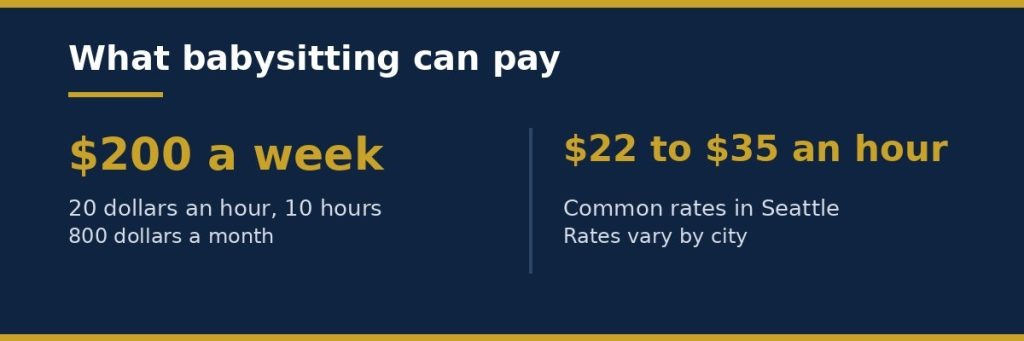
Pay varies by city, by the number of children, and by your experience. In expensive cities, sitters can charge 22 to 35 dollars an hour or more. In cheaper areas, the rate is lower. The worked example below uses 20 dollars an hour, which is a simple example rate, not a promise of what you will earn where you live. At 20 dollars an hour, 10 hours a week pays 800 dollars a month.
This post shows how to start, what to charge, where to find families, the safety steps parents expect, and how taxes work. It is educational only. It is not financial advice.
Step 1: Check that babysitting fits you
Babysitting fits you if you like children, you are patient, you can stay calm when a child is upset or hurt, and you can be trusted in someone else’s home. You do not need a teaching degree. You need common sense, reliability, and care.
It does not fit if you dislike children, if you cannot commit to the hours you promise, or if you need money today, because the first clients take time to find. If that is you, pick a different side income from our beginner guides, and come back to babysitting later if you change your mind.
You should be at least 16 in most places to babysit for pay, and many parents prefer sitters who are 18 or older. Check the rules where you live, and check what the platforms you plan to use require.
Step 2: Get the safety basics before your first job
Parents trust sitters who are prepared. Two steps make you stand out from other beginners.
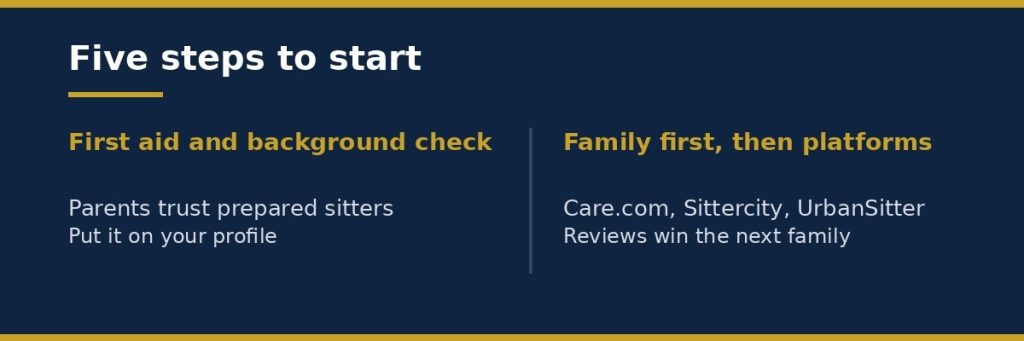
First, take a first aid and CPR course for children. The American Red Cross and many local providers offer babysitter training and first aid courses, often in one day, and often online for part of it. Put the certificate on your profile. It tells parents you can handle a cut, a burn, or a choking emergency.
Second, get a background check. Babysitting platforms like Care.com, Sittercity, and UrbanSitter usually run one for you, or ask you to complete one, before you can take jobs. If you work privately, offer to pay for your own background check and show it to the family. It costs little, and it removes the biggest worry a parent has.
Also ask the family for the essentials before every job: the children’s ages and allergies, the parents’ phone numbers, the address, the bedtime, and what to do in an emergency. Write it down. A sitter who asks these questions looks professional, and parents notice.
Step 3: Set your rate
Your rate depends on your city, the number of children, and your experience. In an expensive city like Seattle, rates of 22 to 35 dollars an hour or more are common. In a smaller city, the rate is often lower. Check what sitters charge where you live by looking at profiles on Care.com or Sittercity in your area, and set your rate in the same range.
A simple way to start: charge a base rate for one child, and add a few dollars an hour for each extra child. For example, 18 dollars an hour for one child, and 3 dollars more per hour for each extra child. That is a clear, fair rule, and parents understand it.
Do not charge far below everyone else to get work. A very low rate worries parents more than it attracts them, because it suggests you are not serious. Charge a fair rate, and win jobs by being reliable, prepared, and good with children.
Worked example, using an example rate of 20 dollars an hour. If you babysit 10 hours a week, you earn 20 times 10, which is 200 dollars a week. Over 4 weeks, that is 800 dollars a month. If you babysit 5 hours a week, you earn 100 dollars a week, or 400 dollars a month. If you babysit 15 hours a week, you earn 300 dollars a week, or 1,200 dollars a month.
Those numbers are examples, using 20 dollars an hour and 4 weeks a month. Your real pay depends on your rate, your hours, and your city. Use the same math with your own rate to work out what babysitting can pay you.
Step 4: Find your first families
Start with people who already know you. Tell family, friends, neighbours, and coworkers that you babysit. Ask them to tell other parents. Your first two or three families will almost always come from someone you know, and their recommendation is worth more than any advert.
Then join a platform. Care.com, Sittercity, and UrbanSitter are the main ones in the United States. Create a profile with a clear photo, your experience, your rate, your availability, and your first aid certificate. Apply for jobs that fit your hours, and reply quickly, because parents often pick the first good sitter who answers.
Also try local places: community boards, school notice boards, parent groups, and neighbourhood apps. A short note that says what you offer, your rate, and your experience is enough. Do not share personal details in public posts, and meet new families in a safe way, ideally with a parent present at first.
Keep every family happy, and ask for a short review after a few jobs. Reviews are what win you the next family, and they matter more than anything else on a platform.
Step 5: Handle the money and the taxes
Keep it simple, and keep records. Write down every job: the date, the family, the hours, and the pay. A notes app or a small spreadsheet is enough. At the end of the month, add it up, so you know what you earned.
For taxes, the rule in the United States is that if you earn 400 dollars or more in net self-employment income in a year, you usually need to report it and pay self-employment tax. That includes babysitting income. If you are paid through a platform, you may receive a tax form. If you are paid in cash, you still need to report it. Keep your records, set aside a share of your pay for tax, often around 20 to 30 percent as a planning figure, and check the current IRS rules for self-employed people, or ask a qualified tax professional if you are unsure.
Do not spend all of what you earn. Set the tax share aside in a separate pot on the day you are paid, so it is there when tax is due.
Related reading in the Side Income cluster: how to earn side income from pet sitting, how to find your first freelance client, how to track side income for tax in simple terms, and the simplest side income for beginners.
Frequently asked questions
How much do babysitters earn?
It varies by city and experience. In expensive cities, 22 to 35 dollars an hour or more is common. In cheaper areas, it is less. At an example rate of 20 dollars an hour, 10 hours a week pays about 800 dollars a month. Check local profiles on Care.com or Sittercity to see the rate where you live.
Do I need a certificate to babysit?
You do not always need one by law, but a first aid and CPR certificate, and a babysitter training certificate, make parents far more likely to hire you. Many platforms also require a background check. Both are cheap, quick, and worth doing before your first job.
How do I find babysitting jobs with no experience?
Start with family and friends, and offer to babysit for free once or twice to get experience and a recommendation. Then create a profile on Care.com, Sittercity, or UrbanSitter, and apply for jobs that fit your hours. Mention any experience with younger siblings, cousins, or volunteering with children.
Is babysitting income taxable?
Yes, in the United States, babysitting income is usually taxable, and if you earn 400 dollars or more in net self-employment income in a year, you usually need to report it and pay self-employment tax. Keep records of every job, set aside a share for tax, and check the current IRS rules, or ask a qualified tax professional.
What should I charge for two children?
A common approach is a base rate for one child, plus a few dollars an hour for each extra child. For example, 18 dollars an hour for one child, and 3 dollars more per hour for each extra child, so two children is 21 dollars an hour. Set the rule clearly on your profile, so parents know before they book.
Is babysitting a good side income for students?
Yes, it is one of the best for students, because the hours are often evenings and weekends, which fit around classes, and you need no money to start. The pay is real, the work is flexible, and the experience with children and families is useful for many jobs later.
Conclusion, and your first step today
Babysitting is a simple side income: no money to start, flexible hours, and real pay. Get a first aid certificate and a background check, set a fair rate for your city, start with family and friends, then join a platform, and keep records for tax. At an example rate of 20 dollars an hour, 10 hours a week pays about 800 dollars a month.
Your first step today is to tell three people you know that you babysit, and to look up a first aid course near you. Those two moves start the work, and the first family usually follows.
Sources
Internal Revenue Service, self-employed individuals and tax obligations: https://www.irs.gov/businesses/small-businesses-self-employed
American Red Cross, babysitting and child care training: https://www.redcross.org/take-a-class/babysitting/babysitting-child-care-training/babysitting-classes
Disclaimer: This article is for education only. It is not financial advice, and it does not guarantee any result. Pay rates and rules vary by location, and you should check the rules where you live, and speak to a qualified professional if you need personal advice, before making a financial decision.
