

What Is a Debit Card vs a Credit Card in Simple Terms?
A debit card spends money you already have in your bank account. A credit card borrows money that you pay back later. That one difference changes almost everything else: what happens if you overspend, what happens if the card is stolen, whether the card builds your credit history, and what the card costs you.
The two cards can look identical, and they can carry the same Visa or Mastercard logo, but the logo only names the payment network that moves the money. What matters is where the money comes from. This guide explains both cards in plain words, compares them side by side, and shows when each one is the better choice. It is educational only. It is not financial advice.
How Each Card Pays
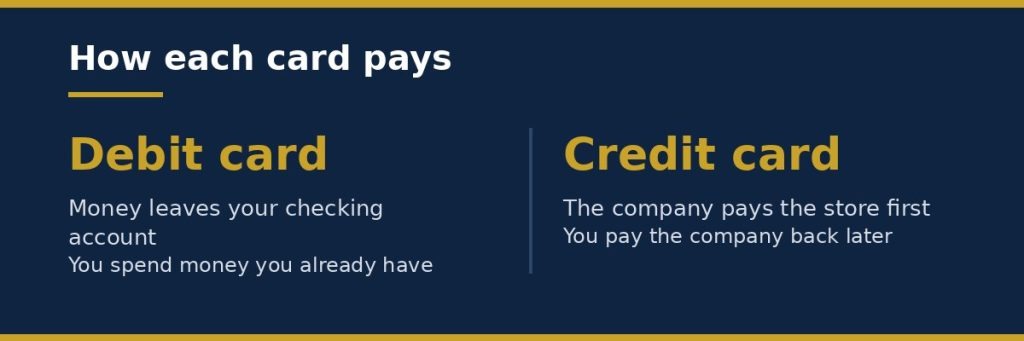
With a debit card, the money comes straight out of your checking account. When you pay, you are spending your own money, and your balance drops right away. If you buy shoes for 120 dollars and you have 400 dollars in checking, your balance becomes 280 dollars as soon as the payment clears. The math is simple: 400 minus 120 equals 280.
With a credit card, the card company pays the store and lends you the money. You owe the company, not the store, and you pay it back by the due date on your monthly bill. If you buy the same shoes for 120 dollars on a credit card, your checking balance does not change at all. Instead, you get a bill for 120 dollars, due about three to four weeks later. Pay the full 120 dollars by the due date, and the shoes cost you 120 dollars, nothing more. Pay less than the full amount, and interest starts on what is left.
That is the core difference, and everything else follows from it.
Debit Card vs Credit Card: The Main Differences
- Source of the money. A debit card takes money from your checking account. A credit card borrows money from the card company, up to your credit limit.
- Overspending. With a debit card, you generally cannot spend more than is in your account, and the purchase is simply denied. The exception is overdraft: some accounts let a purchase go through anyway, and then you must replace the money and pay an overdraft fee. With a credit card, spending more than you have is the normal design, because you are borrowing. The limit is your credit limit, not your bank balance.
- Interest. A debit card never charges interest, because you are not borrowing. A credit card charges interest on any balance you carry past the due date. Pay the full bill on time, and you pay no interest. Carry a balance, and you pay interest every month until it is gone.
- Fees. A debit card can bring overdraft fees and, at some banks, a monthly account fee. A credit card can bring late fees, interest charges, and sometimes an annual fee. Neither card has to cost you anything if you use it carefully, but the credit card has more ways to cost you money.
- Credit history. A debit card does not build your credit history, because you are not borrowing. A credit card does, because the card company reports your payments to the credit bureaus. Paying on time helps your credit score. Paying late hurts it. Our guide to What Is a Credit Score in Simple Terms? explains what a score is and why it matters.
- Rewards. Debit cards rarely offer rewards. Credit cards often offer cash back or points, but rewards are only worth it if you pay the full bill every month. Interest on a carried balance costs far more than any reward you earn.
- Fraud protection. The law protects both cards, but the protection is stronger for credit cards, as the next sections explain.
When to Use a Debit Card
A debit card is the better choice when you want to spend only what you have. It works well for everyday spending, such as groceries, fuel, and small purchases, because the money leaves your account at once and you cannot drift into debt by accident. It is also the natural choice when you are working on a tight budget, because your balance is the guardrail. When the money is gone, the card stops working, and that is the point.
A debit card is also the right tool for getting cash from an ATM, since it draws from your own account. Using a credit card for cash, called a cash advance, usually brings a fee and interest from day one, with no interest-free period.
One more good use: paying for things when you do not want a bill later. Every purchase shows up in your balance the same day, which makes it easier to stay in control.
When to Use a Credit Card
A credit card is the better choice in three situations. First, for online shopping and travel, where the stronger fraud protection matters. If someone uses your credit card number without your permission, it is the card company’s money at risk while the dispute is sorted out, not money missing from your checking account. Second, for building credit history, because on-time payments are reported to the credit bureaus and a debit card is never reported. Third, for large planned purchases you can pay off in full by the due date, where the interest-free period gives you a few extra weeks to hold the cash.
A credit card is a bad choice when you cannot pay the full bill. If you buy something you cannot afford and carry the balance, the interest adds up fast. It is also a bad choice for cash advances, and for spending that your budget cannot cover.
The rule is simple: use a credit card only for purchases you could pay for with the money already in your account. If you follow that rule, you get the protection and the credit history, and you never pay interest. If you break it, the card starts working against you. How Do I Pay Off Credit Card Debt? explains how to clear a balance if one has already built up.
What Happens If a Card Is Lost, Stolen, or Used Without Your Permission
This is where the two cards differ most, and the difference comes from federal law. The Consumer Financial Protection Bureau explains the rules plainly.
For a credit card, you are not responsible for unauthorized charges if someone stole only your card number. If the card itself was lost or stolen too, you could be responsible for up to 50 dollars, and only for use that happens before you tell the card company. In practice, most card companies apply a zero liability policy, so you pay nothing for charges you did not make.
For a debit card, speed matters much more, because the money taken is your own money, gone from your checking account until the bank puts it back. If you report a lost or stolen debit card within two business days of learning about it, your liability is capped at 50 dollars. If you wait longer, you could be responsible for up to 500 dollars. And if you do not report an unauthorized transfer within 60 days of the statement that shows it, you could be responsible for transfers that happen after that point. While the investigation runs, the money is missing from your account, and bills that depend on it can fail.
That is why many people use a credit card for online shopping and a debit card for everyday spending in person. If a thief gets your credit card number, your checking account is untouched. If a thief gets your debit card number, your rent money can disappear for days or weeks. The CFPB’s advice is the same for both cards: watch your accounts closely, and report anything suspicious as soon as you see it. You can read the CFPB’s guidance on what to do when card data is stolen.
Do Debit Cards Build Credit?
No. A debit card does not build your credit history, because you are not borrowing money. The bank does not report your debit card spending to the credit bureaus, and no record of it appears on your credit report. That is not a flaw in the card. It is simply not a lending product.
If building credit is your goal, a credit card used carefully is the tool for it. Pay the full bill on time every month, keep the balance low compared with your limit, and never miss a payment. A single missed payment can hurt your score for months. What Happens If I Miss a Credit Card Payment? explains the fees, the interest, and the credit damage a late payment can bring.
There is no shortcut. A debit card will not help your score, and a credit card will only help if you pay it properly. If you are not ready to pay a credit card in full each month, build the habit with a debit card first, and add a credit card later, when the habit is solid.
Worked Example: The Same 120 Dollar Purchase, Two Ways
Here is the math for a 120 dollar pair of shoes, paid two ways. These are example numbers only, to show how the costs compare.
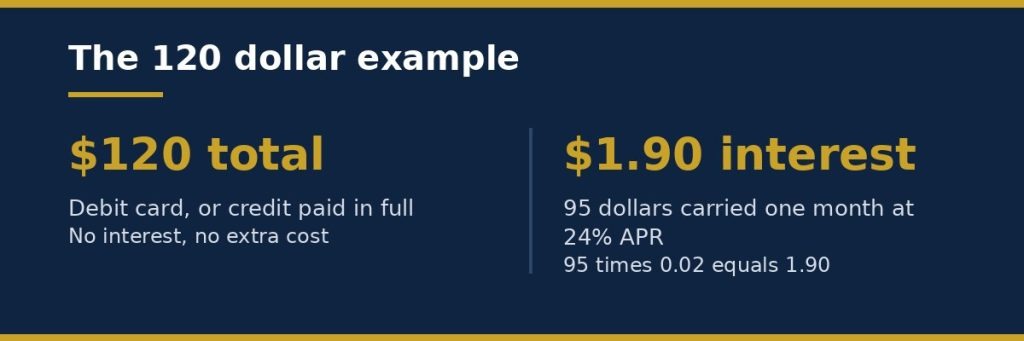
With a debit card, you pay 120 dollars from checking, and the purchase costs 120 dollars. There is no interest, no bill, and no extra charge. Total cost: 120 dollars.
With a credit card, you pay the 120 dollar bill in full by the due date, and the purchase also costs 120 dollars. Total cost: 120 dollars. So far, the two cards cost exactly the same.
Now suppose you pay only 25 dollars of the credit card bill and carry 95 dollars to the next month. At an annual interest rate of 24 percent, the monthly rate is 2 percent, because 24 divided by 12 equals 2. Interest for one month on 95 dollars is 95 times 0.02, which is 1.90 dollars. That seems small, but it repeats every month on the shrinking balance, and it grows if you keep adding purchases. Over a year, carrying a balance on a card with a 24 percent rate is expensive, and it is why the card company is happy to let you pay only the minimum.
The lesson is not that credit cards are bad. It is that the interest-free period is the whole benefit. Pay in full, and the card costs nothing. Carry a balance, and the same purchase costs more every month. If you already carry a balance, a balance transfer card can sometimes move the debt to a lower rate, but the real fix is a plan to pay the balance down.
How to Choose Which Card to Use
Use this short checklist before you pay:
- Can I pay this purchase in full by the due date? If yes, a credit card gives you stronger fraud protection and builds credit history. If no, use a debit card, or wait until you can afford it.
- Is this an online purchase, a hotel, or a rental car? A credit card is usually safer, because a hold on a debit card can freeze your own money for days.
- Am I trying to control spending? A debit card keeps you inside your balance. A credit card needs discipline, because the limit is not your money.
- Do I need cash? Use a debit card at an ATM. Never take a cash advance on a credit card if you can avoid it.
If you are choosing a bank account as well as a card, How Do I Choose a Bank Account as a Beginner? walks through fees, minimums, and online access. And if you want your money to be protected while it sits in the bank, Is My Money Safe in a Bank, and What Does Insurance Mean? explains deposit insurance in plain words. What Is Direct Deposit, and How Does It Work? explains how your pay lands in checking.
Frequently Asked Questions
Is a debit card safer than a credit card?
No, not for fraud. A credit card has stronger legal protection. If someone uses your credit card without permission, you are not responsible for the charges, and your own money never leaves your account. If someone uses your debit card, your own money is gone until the bank returns it, and your liability depends on how fast you report it.
Can I use a debit card to build credit?
No. Debit card spending is not reported to the credit bureaus, so it does not build a credit history or a credit score. Only borrowing products, such as a credit card or a loan, build credit history, and only when you pay them on time.
What happens if I spend more than I have with a debit card?
Usually the purchase is denied. The exception is overdraft: some accounts let the purchase go through, and then you must replace the money and pay an overdraft fee for each transaction. You can ask your bank to turn off overdraft coverage for debit purchases, so the card simply declines instead.
Do credit cards always charge interest?
No. If you pay the full bill by the due date every month, you pay no interest. Interest only starts on a balance you carry past the due date. Cash advances are the exception: they usually start charging interest on the day you take the cash, with no interest-free period.
Which card should a beginner start with?
Start with a debit card, because it keeps you inside the money you have. Add a credit card later, when you can pay the full bill every month without fail. Use it for one or two regular purchases, pay it in full, and let the on-time payments build your credit history slowly.
Conclusion
A debit card spends money you already have. A credit card borrows money you pay back later. That single difference decides the cost, the risk, and the effect on your credit history. A debit card is simple, safe for everyday spending, and impossible to fall into debt with, as long as overdraft is off. A credit card gives stronger fraud protection and builds credit history, but only if you pay the full bill on time, every month.
Most people end up using both. Use the debit card for everyday spending and cash, when you want the guardrail of your own balance. Use the credit card for online shopping, travel, and planned purchases you can pay off in full. And whichever card you use, check your statements every month, and report anything you do not recognise right away.
This article is for general information and education only. It is not legal or financial advice.
