


How Do I Earn Side Income From Selling Printables?
How do I earn side income from selling printables?
You earn side income from selling printables by designing a useful digital file once, such as a planner, a budget tracker, or a wall art print, listing it on a marketplace where buyers already search, such as Etsy, and letting the marketplace deliver the file to each buyer after payment. You create the file once and it can sell many times, with no stock, no packing, and no shipping. The work is upfront: picking a narrow niche, making a file buyers actually need, and writing listings that match the words buyers type.
This post is educational only. It is not financial advice, and it does not promise any income. Most sellers earn a small amount per sale at first, and total income depends on price, listing count, and buyer traffic. Treat the first month as a test.
What a printable is, and why it works as side income
A printable is a digital file a buyer downloads and prints at home, or at a copy shop. Common examples are daily planners, weekly planners, budget trackers, debt payoff trackers, meal planners, wedding invitation templates, kids' activity sheets, resume templates, wall art, and party decorations. The buyer pays, gets a PDF or PNG file, prints it, and uses it.
For the seller, the economics are simple. A well-made printable bundle might take 4 to 8 hours to design. You list it for 5 to 15 dollars. If it sells 200 times, that one afternoon of design work has brought in 1,000 to 3,000 dollars in sales, before fees and tax. The file does not run out, and you do not pack a box for each order.
Etsy is the usual marketplace for this, because buyers already go there looking for printables, and Etsy delivers the digital file to the buyer automatically after payment. That built-in demand is the main reason beginners start on Etsy instead of building their own shop first. Our guide to selling digital products as a side income covers the wider idea of selling files online.
Step 1: Pick a narrow niche buyers already search for
The biggest beginner mistake is designing something general, such as a plain weekly planner, and competing with thousands of identical listings. Pick a narrow niche where you can be the clearest answer to a real search.
Good niches have buyers with a clear need and a reason to buy again. Planners and organisers are evergreen: daily planners, weekly planners, goal trackers, habit trackers, and meal planners. Finance and budget trackers sell well too: debt payoff trackers, savings challenges, and monthly budget worksheets. Wedding and event templates sell at higher prices: invitations, table cards, place cards, and seating charts. Kids' activity sheets and wall art sell to parents, teachers, and buyers decorating a room.
Pick one niche and one buyer. "Budget planners for single parents" is a niche. "Planners" is not. Look at what already sells in that niche, read the reviews, and find the gap: a missing size, a missing page, a confusing layout, or a use case nobody covers. Your first product should fill that gap. To validate it, search Etsy itself for the words buyers would use, and look at how many results appear and how many sales the top shops show. If every result is a big shop with hundreds of sales and no clear gap, pick a narrower angle. If nobody is selling it at all, ask whether buyers are even searching for it.
Step 2: Design your first printable
The most common tool for making printables is Canva, because its drag-and-drop editor lets you build a polished design without graphic design experience. The tool matters less than the result: a file that is clear, useful, and easy to print. Export at 300 DPI for print quality, never at 72 DPI, which looks blurry on paper. Provide the sizes buyers expect: US Letter and A4 for planners and trackers, and the common print sizes for wall art. Test print every file yourself before you list it, and check that nothing is cut off at the edges and that the text is big enough to read. Design for one use, not for everything: a budget tracker that does one job well beats a 40-page bundle where half the pages never get used. Make your first product small and good, 5 to 10 pages with a clear purpose, and bundle later once you know which pages buyers use. Use only your own designs and words. Do not copy another seller's layout, do not use trademarked characters or brand logos, and do not use fonts or images you do not have the right to sell.
Step 3: Open your Etsy shop and understand the fees
To sell on Etsy, open a shop at etsy.com/sell, choose your shop language, country, and currency, connect a bank account for Etsy Payments, and add a card for your Etsy bill. There is a one-time set-up fee to open a shop, and each listing costs 0.20 dollars and stays live for four months.
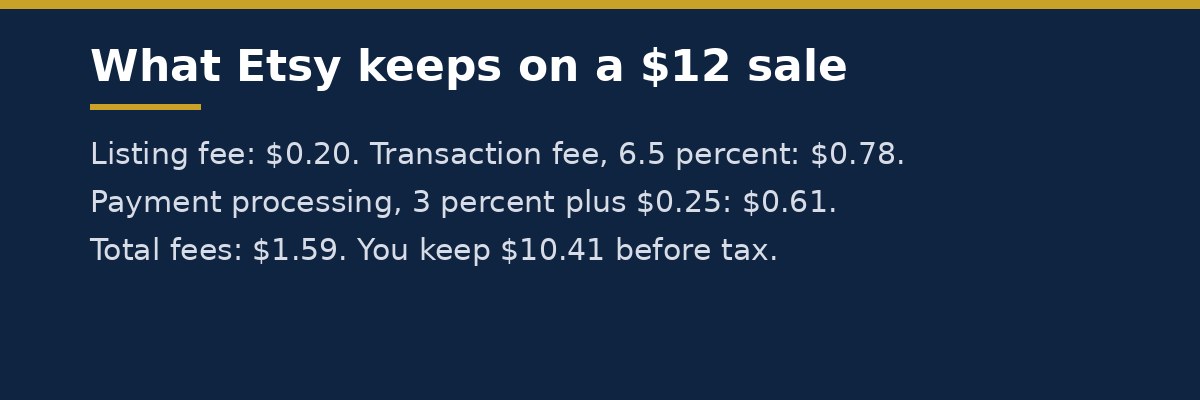
The fees on each sale are the part most beginners underestimate. For a United States seller, Etsy charges three mandatory fees: a 0.20 dollar listing fee, a 6.5 percent transaction fee on the order total, and a payment processing fee of 3 percent plus 0.25 dollars per order. On a digital download there is no shipping, so the fees are charged on the price alone. Note that a digital listing is usually listed with a large quantity, so the 0.20 dollar listing fee is charged again after each sale, which makes it a per-sale fee in practice.
Work out the fees before you set a price. On a 12 dollar planner, the fees are: listing fee 0.20 dollars, transaction fee 6.5 percent of 12 dollars, which is 0.78 dollars, and processing fee 3 percent of 12 dollars plus 0.25 dollars, which is 0.36 plus 0.25, or 0.61 dollars. Total fees are 0.20 plus 0.78 plus 0.61, which equals 1.59 dollars. You keep 12 minus 1.59, which is 10.41 dollars, before tax. That matches the worked fee examples published by Etsy fee guides for a 12 dollar digital download.
Low prices are the trap. On a 3 dollar sale, the flat fees take a much bigger share than on a 12 dollar sale, which is why many guides suggest 5 dollars as a floor price. A single page can sell for 2 to 6 dollars, a planner for 8 to 25 dollars, and a bundle for 15 to 50 dollars or more. Price for the value of the finished file, not for the cost of the paper, because there is no paper.
Etsy also runs Offsite Ads, which can add a 15 percent fee, or 12 percent once a shop makes 10,000 dollars in a year, on orders that came from Etsy's advertising. Check the current terms in your seller dashboard before you rely on any fee number, because fees change.
Step 4: Write listings with buyer words
A listing is a small sales page. It needs a title, photos, a description, and tags that match what buyers actually type. Use the words from your niche research, not clever words: if buyers search for "weekly budget planner printable", put those words in the title. Photos matter more than anything else on Etsy. Show the printable in use: a flat photo of the page, a mockup on a desk, and a close-up of the detail. Show every page in a bundle, and show the sizes included. Write the description to answer the buyer's questions: what is included, how many pages, which sizes, which file types, how they download it, and how they print it. Say clearly that it is a digital download, not a physical product, and that nothing will be posted to them. Use all the tags Etsy allows, and make them specific, such as "debt payoff tracker" and "monthly budget printable".
Step 5: Publish 15 to 20 listings in your first month
One listing rarely sells. Etsy rewards shops with a range of listings, and each listing is another chance to appear in search. A common plan is to publish 15 to 20 listings in the first 30 days: variations on your niche, such as the same planner in different colours, a single page and a bundle, a weekly version and a monthly version. Most beginners who publish 15 to 20 optimised listings see a first sale in 2 to 6 weeks. If nothing sells after six weeks, look at the numbers: which listings get views, which get none, and what buyers search for that you do not cover. Fix the titles and photos on the listings that get views but no sales, and replace the ones that get no views at all. Keep a simple record from day one: each sale, the price, the fees, and the payout. Set aside 25 to 30 percent of payouts for tax, because Etsy does not do that for you.
How much can you really earn?
Be honest about the range. Beginners often make a small profit per sale at first, and total income depends on price, listing count, and traffic. Some guides report that new sellers make upwards of 400 dollars a month, while established shops can earn far more, but those figures are reports from other sellers, not a promise. Your first month is a test, not a salary.
The math that matters is per listing. If a 12 dollar planner keeps 10.41 dollars after fees, then 50 sales in a month keep 520.50 dollars before tax. That is 10.41 times 50, which equals 520.50 dollars. If the same planner sells 10 times, you keep 104.10 dollars. The lever is not the price alone. It is the number of listings, the quality of the photos, and the match between your title and the buyer's search. Do not quit your job for printables, and do not borrow money to start. The startup cost is low: a shop set-up fee, 0.20 dollars per listing, and your time.
Common mistakes to avoid
The first mistake is pricing too low. A 2 dollar listing looks cheap, but after fees you keep very little, and the buyer may assume it is low quality. The second mistake is copying a bestseller. Etsy buyers can tell, other sellers can report it, and a copied listing has no reason to rank above the original. The third mistake is listing once and waiting. One listing is a lottery ticket. Fifteen listings in one niche is a shop. The fourth mistake is using trademarked words, characters, or brand names to get traffic. It can get the listing removed and the shop closed. The fifth mistake is ignoring the numbers. If you do not track fees and tax, a month of sales can look like profit and still leave you short. Write every sale down, and set the tax money aside at once. The sixth mistake is treating a printable as passive income from day one. The file sells while you sleep only after you have done the work: the design, the listing, the photos, and the ranking.
Worked example: one budget planner bundle, month one
Maya is a beginner. She picks one niche, budget planners, and designs one bundle: a monthly budget worksheet, a weekly spending tracker, a debt payoff tracker, and a savings challenge, 8 pages in total, in US Letter and A4, exported at 300 DPI. She tests prints every page at home.
She opens an Etsy shop, lists the bundle at 12 dollars, and writes the listing with buyer words: "monthly budget planner printable, debt payoff tracker, savings challenge". She adds photos showing every page and a mockup on a desk. Over the first month she adds variations until she has 18 listings: the full bundle, the single pages, and two colour versions.
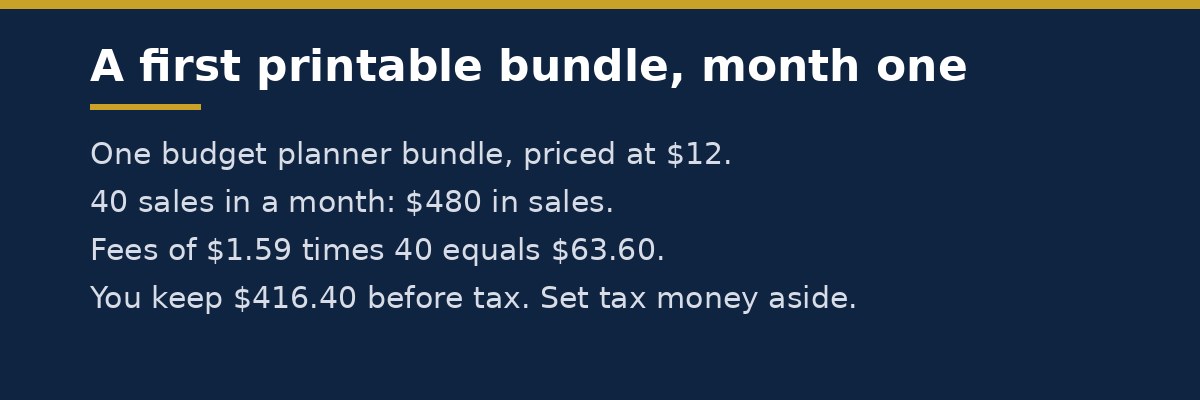
In that first month, the bundle sells 40 times. Sales are 40 times 12 dollars, which equals 480 dollars. Fees are 1.59 dollars per sale, so 40 times 1.59 equals 63.60 dollars. Maya keeps 480 minus 63.60, which equals 416.40 dollars before tax. She sets aside 25 percent for tax, which is 104.10 dollars, and keeps 312.30 dollars after that set-aside. That is 416.40 minus 104.10, which equals 312.30 dollars.
Maya does not call that 312.30 dollars profit yet, because she has not counted her time. She spent about 12 hours designing the bundle and writing the listings. But the file is now listed, the photos are done, and the same bundle can sell again next month with no new design work. That is the point of a printable: the first sale pays for the work, and the later sales are the reward for it.
Frequently asked questions
Can you make money selling printables on Etsy?
Yes, many sellers do, but most earn a small profit per sale at first, so total income depends on price, listing count, and traffic. Single pages sell for 2 to 6 dollars, planners for 8 to 25 dollars, and bundles for 15 to 50 dollars or more.
What printables sell best on Etsy?
Planners and organisers, budget and debt payoff trackers, wedding and event templates, kids' activity sheets, and wall art sell consistently. A narrow niche with a clear buyer does better than a general planner.
How much does it cost to start selling printables on Etsy?
The startup cost is low: a one-time shop set-up fee, 0.20 dollars per listing, and your time. Design tools such as Canva have a free version. The main cost is the hours you spend designing and listing.
What do I need to sell a printable: Canva, PDF, or something else?
Canva is the most common tool for beginners. Export planners and trackers as PDF, and wall art as PNG or JPG, at 300 DPI. Provide US Letter and A4 sizes where buyers expect them, and test print every file before you list it.
How long until my first sale?
Most beginners who publish 15 to 20 optimised listings see a first sale in 2 to 6 weeks. If nothing sells after six weeks, check which listings get views, fix the titles and photos, and replace the ones that get no views.
Do I need to pay tax on printable income?
In most places, yes. Etsy does not set tax money aside for you, so set aside 25 to 30 percent of payouts and talk to a tax professional about how side income is treated where you live.
Conclusion, and your first step today
Selling printables is a slow-build side income, not a quick win. Pick one narrow niche, design one useful file well, price it after the real Etsy fees, and publish 15 to 20 listings in your first month. Then watch the numbers, fix what does not sell, and add more of what does. Your first step is simple: tonight, search Etsy for one niche you know well, such as budget trackers, and write down the five listings that sell best and the gap they leave. That gap is your first product.
This post is educational only. It is not financial advice, and it does not promise any income.
Sources
- Printify, How to make passive income on Etsy in 2026
- Vonza, Etsy Fees for Digital Products Explained
- Kittl, How Much Does Etsy Take Per Sale? The Complete 2026 Fee Breakdown
- Savvy Cash Flow, How to Sell Printables on Etsy: Step-by-Step Guide
- Gelato, Selling printables on Etsy: A complete guide to making money
