


How Do I Stop Using Credit Cards to Pay Bills?
How do I stop using credit cards to pay bills?
You stop using credit cards to pay bills by first finding the gap between your income and your spending, then building a small cash buffer of 300 to 500 dollars, then making the card hard to use: take it out of your wallet, delete it from apps and online accounts, freeze it in the issuer’s app, and move your bills to a debit card or bank payment instead. The goal for the first month is simple: zero new charges, not a zero balance.
This post is educational only. It is not financial advice, and it does not tell you to close any particular account. If your income does not cover your basic costs, that is a different problem from a spending habit, and this guide covers that too.
Why you keep reaching for the card
Most people do not use credit cards for bills because they love interest. They use them because the card is frictionless: tap, done, and later you deal with it. There are usually two reasons, and they need different fixes. The first is a habit: the card is saved everywhere, and swiping is easier than checking the balance. The second is a gap: your income genuinely does not cover your bills, so the card fills the hole each month. A habit can be fixed with friction and a plan. A gap needs a budget change, lower costs, more income, or outside help. Many people have a bit of both, so this guide works through the gap first, then the habit.
Step 1: Find the real monthly gap
Before you change anything, find the number. Look at the last two or three months of card statements and separate every charge into three groups: current normal spending, such as groceries, gas, utilities, and routine medical costs; optional spending, such as restaurants, shopping, and entertainment; and real emergencies, such as an urgent car repair or an unexpected medical bill. Do not count the old balance or the interest in this step. You are measuring new spending only.
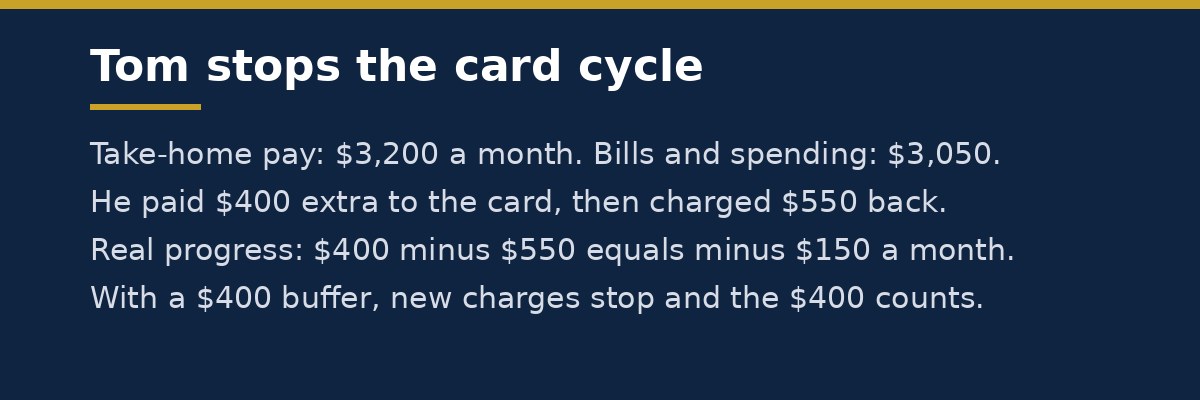
Now compare. If you paid 400 dollars extra toward the card last month but charged 550 dollars of new spending in the same month, your real progress was not 400 dollars. It was 400 minus 550, which is minus 150 dollars. The balance went up, even though you paid extra. Paying down a balance while still charging is like trying to empty a bath with the tap still running.
Write down the gap: how much new spending lands on the card each month, and how much of it is essential. That number tells you what your budget and your buffer need to cover.
Step 2: Build a small buffer before you push harder on debt
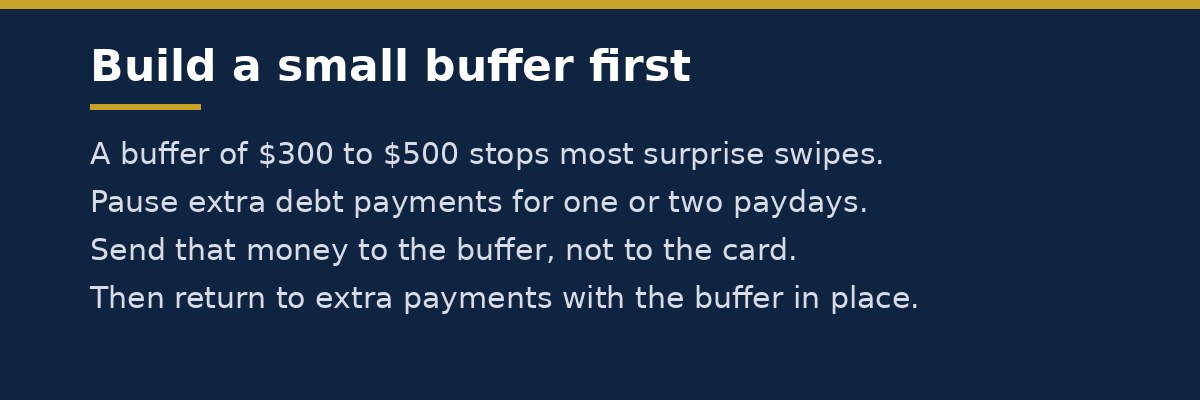
You do not need a fully funded emergency fund to stop using the card. You need a small, boring cash buffer that keeps you from reaching for plastic when life wobbles. A common target is 300 to 500 dollars if your expenses are fairly stable, or 500 to 1,000 dollars if your income changes from month to month or you have children, a car, or medical costs.
To build it fast, pause your extra debt payments for one or two paydays and send that money to the buffer instead. Sell a few unused items and send that money to the buffer first, not to the card. Cut one category for a short time, such as dining out or subscriptions. Keep the buffer in a separate savings account, or a separate bucket in your bank app, so you can see it and do not spend it by accident.
This step feels wrong to many people. Pausing extra payments looks like giving up. It is not. It is stabilising. Once the buffer exists, you can go back to aggressive payments with far less backsliding, because the next surprise bill has somewhere to go other than the card.
Step 3: Make the card hard to use
Willpower alone rarely works, because the card is designed to be easy. Change the environment so that not using the card is the easy option.
Take the cards out of your wallet and leave them at home, in a drawer you rarely open, or in a lockbox. Remove the card details from your phone wallet, your browser, and shopping apps, and turn off one-click checkout. Go through your last two statements and move every recurring payment, such as utilities, insurance, and phone, to your debit card or to a direct bank payment, so those charges stop landing on the card by themselves. Freeze the card in your issuer’s app if that option exists: a freeze is reversible, costs nothing, and stops new charges while keeping the account open. That matters, because closing a card can change your credit utilisation and the age of your accounts, which can lower your credit score. Experian notes the same trade-off: stopping use is usually better than closing the account outright, and an unused card may eventually have its limit reduced or be closed by the issuer. Keep one card accessible but not convenient, only for a real emergency, and write down what counts as an emergency before you need one.
Step 4: Switch to debit, cash, or a weekly limit
With the card out of reach, you need a spending system that works without it. Pick one and try it for a month. The debit-only week is the simplest start: use your debit card for groceries, gas, and household needs for one week, after moving a set amount into checking that covers those categories. When it is gone, you pause spending. Cash envelopes work well for trouble categories: if you overspend on food or small treats, pull cash for those categories only, and when the cash is gone, spending stops. Weekly limits beat monthly budgets for most people, because a month is too long to hold in your head. Set a weekly number for each variable category, such as 150 dollars for groceries, 50 dollars for gas, and 25 dollars for fun money. If you spend it early, you wait until next week.
Step 5: Fix the timing of your bills
Sometimes the monthly totals are fine and the dates are the problem. Rent leaves on the 1st, insurance on the 3rd, the card payment on the 5th, utilities on the 6th, and your paycheck arrives on the 8th. On paper you have enough money. On the 6th, you are broke, so the card covers the gap.
If this sounds familiar, ask your providers whether due dates can move. Many will shift a due date by a week or two if you ask. Or reserve part of the previous paycheck for the early-month bills, instead of treating everything left after payday as spendable. A small working buffer in checking, starting at 300 dollars and growing to 500 dollars, also fixes most timing problems. It is separate from the emergency buffer: the checking buffer handles normal timing, and the emergency savings handles abnormal surprises.
Step 6: Pay the old balance without adding new charges
Once new charges stop, the old balance starts to shrink for real. Keep paying at least the minimum on every card, every month, on time. Then put any extra money toward the card with the highest interest rate first, or the smallest balance first if quick wins keep you going. Our guide to paying off a personal loan faster uses the same idea for loans:
If your budget cannot cover the minimums and the essentials at the same time, do not hide from it. Call each card company and ask about a hardship plan, a lower rate, or a temporary reduced payment. Many have programs for people who are struggling, but you usually have to ask. A nonprofit credit counsellor can also help you build a plan and talk to creditors for you. Our guide to paying debt or saving first can help you decide where your spare money should go:
Watch the interest. A card balance of 3,000 dollars at a high rate can add more than 60 dollars a month in interest, which is money that buys nothing. That is why stopping new charges matters more than the size of any one payment.
When the problem is income, not habit
If you have cut the optional spending, fixed the timing, and still cannot cover the essentials without the card, this is not a discipline problem. Your income does not cover your costs, and no amount of friction will fix that. Start with the big costs: housing, transport, and food. Ask your landlord or lender about a short-term plan before you miss a payment. Check what benefits you can claim, such as food assistance or utility help in your area, and ask a local help line, such as the 211 service in the United States, about support near you. Look for extra income, even a few hours a week, and sell items you no longer use. Our guide to budgeting when income drops walks through the same steps in detail:
If debt is making it hard to stop using cards, professional support may be the missing piece. A nonprofit credit counsellor can help you build a budget and a repayment plan, and is a safer first step than a for-profit debt settlement company. Do not take a new loan to pay off the card unless you have a clear plan and have checked the real cost. A balance transfer card, for example, only helps if you can pay the balance before the low-rate period ends:
Common mistakes to avoid
The first mistake is paying extra on the card while still charging. The net progress is what counts, and charging more than you pay means the balance grows. The second mistake is closing your oldest card at once. Closing an account can raise your credit utilisation and shorten your credit history, which can lower your score, so freeze the card instead and decide about closing it later. The third mistake is building no buffer and then being surprised by the next bill. A 300 dollar buffer is small, but it is the difference between a surprise and a swipe. The fourth mistake is setting a budget so tight it cannot survive a normal week. Keep a small amount of fun money in the plan. The fifth mistake is waiting too long to ask for help. Lenders, landlords, and assistance programs can do far more before a payment is missed than after.
Worked example: Tom stops the card cycle
Tom takes home 3,200 dollars a month. His fixed bills are 2,400 dollars: rent, utilities, phone, insurance, transport, and minimum debt payments. His variable spending is 650 dollars: groceries, gas, and household items. His total spending is 3,050 dollars, which leaves 150 dollars a month. That is 3,200 minus 3,050, which equals 150 dollars.
For months, Tom has paid 400 dollars extra toward his card each payday, then charged about 550 dollars of groceries, gas, and small bills back onto the same card before the month ends. His net progress is 400 minus 550, which is minus 150 dollars a month. The balance grows by 150 dollars a month, plus interest, even though he feels like he is paying it down.
Tom changes the plan. First, he pauses the extra payment for two paydays and builds a 400 dollar buffer in a separate savings account. Second, he takes the card out of his wallet, deletes it from his shopping apps, and freezes it in the issuer’s app. Third, he moves his phone and insurance payments to his debit card. Fourth, he sets weekly limits: 150 dollars for groceries, 50 dollars for gas, and 25 dollars for fun money, which is 225 dollars a week, or about 900 dollars a month at most, and he aims to spend about 650 dollars of it.
After one month, Tom has charged nothing new to the card. He pays the minimum of 90 dollars, plus the 150 dollars he has left after his spending, which is 240 dollars toward the old balance, and the balance falls by 240 dollars instead of rising by 150 dollars. The swing is 390 dollars a month: 240 dollars of real progress, plus 150 dollars of new charges that no longer happen. That is 240 plus 150, which equals 390 dollars.
Tom’s balance is still there, and it will take time to clear. But the tap is off, the buffer is in place, and every payment now counts. When his income rises or his costs fall, he adds the extra money to the same payment, and the balance falls faster.
Frequently asked questions
Should I close my credit cards to stop using them?
Usually not at first. Freezing the card, taking it out of your wallet, and deleting it from apps stops the spending without the credit score effects of closing an account.
How much buffer do I need before I stop using credit cards?
A starter buffer of 300 to 500 dollars covers most surprises if your expenses are stable. If your income changes from month to month, aim for 500 to 1,000 dollars.
What if I need a credit card for emergencies?
Keep one card accessible but not convenient, for example in a drawer at home, and write down what counts as an emergency before you need one. A car repair that stops you getting to work counts. A sale does not.
Can I use a debit card instead of a credit card for everything?
For most daily spending, yes. A debit card works at the same shops and online checkouts, and the money leaves your account at once, which makes overspending harder to miss.
What if my income does not cover my bills?
Then the fix is not willpower. Cut the big costs first, ask lenders and providers about hardship plans before you miss a payment, check what benefits and local help you can claim, and talk to a nonprofit credit counsellor.
How long does it take to break the habit?
Most people need a few weeks for the new system to feel normal, and a few months before it feels automatic. The first month is the hardest, because every saved card and auto-payment has to be moved once.
Conclusion, and your first step today
Stopping credit cards for bills is not about swearing off cards forever. It is about stopping new charges for one month, so your payments finally count. Find the gap, build a small buffer, make the card hard to use, and fix the timing of your bills. Your first step is simple: tonight, open your last card statement, add up the new charges from the last month, then take the card out of your wallet and delete it from one shopping app.
This post is educational only. It is not financial advice.
