


How Do I Buy Stocks as a Beginner?
How do I buy stocks as a beginner?
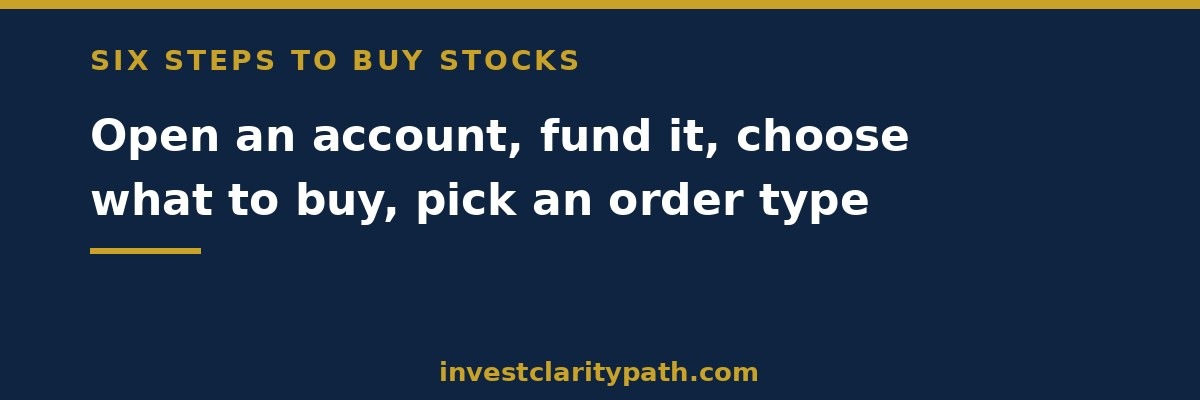
Open a brokerage account, add money to it, choose what to buy, and place your order. The six steps are: open and fund a brokerage account, decide what to buy, decide how much to spend, choose a market order or a limit order, place the trade, and keep adding money over time. Most beginners start with a low cost index fund rather than a single stock, because one fund holds hundreds of companies at once. You can start with as little as 5 dollars at many brokers, using fractional shares.
Buying a stock means buying a small piece of a real business. If the business grows over years, your piece is worth more. If the business struggles, your piece is worth less. That is why the steps before the trade matter more than the trade itself: an emergency fund first, a brokerage account you understand, and a plan to keep investing regularly, not once.
This guide walks through each step in plain words, shows a worked example with real math, and explains market orders, limit orders, and fractional shares. It names no specific stock to buy, because this post is educational only. It is not financial advice, and it is not a buy or sell recommendation.
Before you buy: two checks that come first
Do not buy stocks with money you need next month. Two checks come before any trade.
First, build a small emergency fund. If you have no cash cushion, a surprise car repair will force you to sell your investments at whatever price they happen to be, which may be a bad price. Aim for at least 1,000 dollars to start, then build toward one month of expenses, then three to six months. Investing can wait a few months while you build the cushion. It will still be there.
Second, pay down high interest debt. A credit card charging 20 percent interest costs you more each year than stocks usually return. Paying that card down is a guaranteed return, while stocks are not guaranteed at all. If you have credit card debt, clear it, or at least get it under control, before you put money into stocks. Learn the order in our guide on paying debt or saving first.
If both checks are done, you are ready. The money you invest should be money you will not need for at least five years, because stocks rise and fall in the short term and need time to recover from falls.
Step 1: Open a brokerage account
A brokerage account is the account you use to buy stocks. You cannot buy stocks without one, unless a company offers a direct stock plan, which most beginners should skip. Opening an account online takes about 15 minutes and needs your personal details, such as your name, address, date of birth, and tax number.
When you compare brokers, check four things. First, the cost. Many brokers now charge no commission to buy and sell stocks and exchange traded funds, but check for account fees, transfer fees, and fund expense ratios. Second, fractional shares. A broker that offers fractional shares lets you buy a slice of an expensive stock with 10 or 50 dollars, which matters when one share costs hundreds of dollars. Third, the range of investments. A good beginner broker offers stocks, exchange traded funds, and index funds in one place. Fourth, support and tools. Look for clear pricing, a simple app, and help pages written in plain words.
You will also be asked what type of account you want. A standard taxable brokerage account has no tax break but no withdrawal rules either. A retirement account, such as an IRA or a 401(k), gives a tax break but has rules about when you can take the money out. Many beginners hold both: a retirement account for the long term, and a standard brokerage account for money they may want sooner. Learn how retirement accounts work in our guide.
Your money in a brokerage account is protected in a specific way. In the United States, the Securities Investor Protection Corporation, SIPC, protects up to 500,000 dollars of securities and cash in a brokerage account if the brokerage firm fails. SIPC does not protect you against a fall in the value of your investments. That protection is about the firm, not the market.
Step 2: Fund your account
Once the account is open, add money to it. The usual way is an electronic transfer from your bank account, which takes one to three working days. Some brokers also accept checks or wire transfers. Set up an automatic transfer on payday, even a small one, so investing happens without a monthly decision.
Step 3: Decide what to buy
This is the step beginners find hardest, and it is where most mistakes happen. There are two broad choices.
The first choice is a single stock: a share in one company. A single stock can grow fast, but it can also fall fast if that company has a bad year. One company is one bet, and beginners often do not have the time or skill to judge which companies will win.
The second choice is a fund: an index fund or an exchange traded fund that holds hundreds of companies at once. One purchase buys a small piece of all of them. If one company falls, the others cushion it. Most beginners start here, because it spreads the risk without needing to pick winners. Learn what an index fund is in our guide. Learn how an exchange traded fund differs from a stock in our guide.
A simple beginner approach is to put most of your money in a broad low cost index fund, and only a small part, if any, in single stocks you have researched. That way your result does not depend on one company. This is an educational description of how many beginners invest, not a recommendation for you. Your choice should fit your goals, your time horizon, and how much risk you can accept.
Before you buy any single stock, ask three questions. What does the company sell, and do I understand it? Does it make a profit, or at least have a clear path to one? What could go wrong, and would I still hold it if the price fell 30 percent? If you cannot answer those questions, you are guessing, not investing.
Step 4: Decide how many shares to buy
Decide how much money to spend first, then work out the shares. Divide the amount by the share price. If you want to invest 500 dollars in a fund priced at 50 dollars a share, you buy 10 shares. 500 divided by 50 equals 10.
If the share price is high, use fractional shares. If a stock costs 500 dollars a share and you have 100 dollars to invest, you buy 0.2 of a share. 100 divided by 500 equals 0.2. You own a slice, and it rises and falls by the same percentage as a whole share.
Do not put all your money into one stock at once. A common beginner rule is to invest a fixed amount every month, whatever the market is doing. That way you buy more shares when prices are low and fewer when prices are high, without trying to time the market. Learn why timing the market rarely works for beginners in our guide, and learn what the stock market is in our simple guide.
Step 5: Choose a market order or a limit order
When you place a trade, you choose an order type. Beginners need only two.
A market order tells your broker to buy immediately at the best available price. It is the simplest choice, and it is usually the best one for buy and hold investors buying a fund or a large well known stock. The price you pay may differ slightly from the price you saw on screen, because prices move every second, but the difference is usually small.
A limit order tells your broker the maximum price you are willing to pay. The trade only happens if the price falls to your limit or below. Use a limit order when you want to control the price, for example if a stock is moving fast and you do not want to pay more than a set amount. If the price never reaches your limit, the trade never happens, and your money stays in the account.
Here is a simple example. A stock is trading at 50 dollars. You place a market order for 10 shares, and you pay about 500 dollars, plus or minus a few cents per share. Or you place a limit order at 48 dollars, and the trade only happens if the price drops to 48 dollars or below. If it stays at 50 dollars, nothing happens.
Worked example: Sara buys her first stocks
Sara is 28, has a 1,500 dollar emergency fund, no credit card debt, and 500 dollars she can invest and leave alone for years. She opens a brokerage account with no commission on stock and fund trades, and she transfers 500 dollars from her bank account.
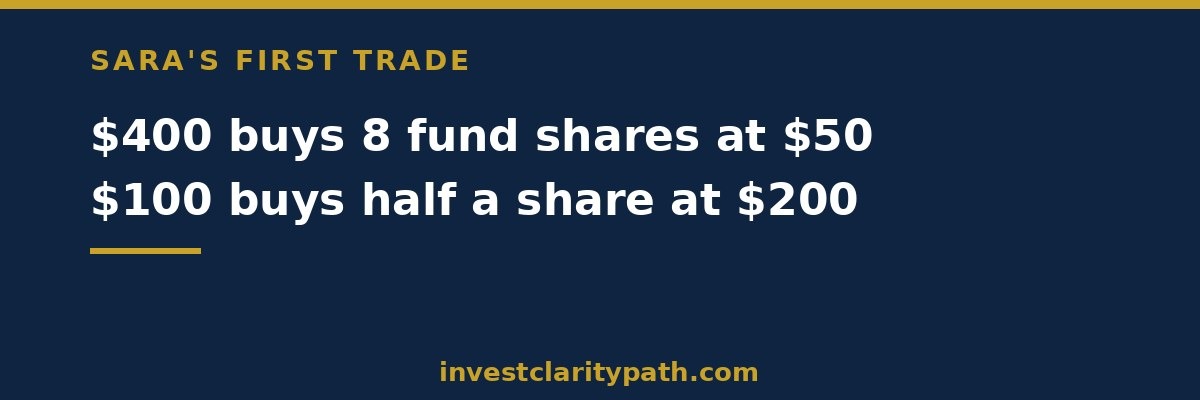
Sara decides to put 400 dollars into a broad low cost index fund and 100 dollars into one company she has researched and understands. The index fund is priced at 50 dollars a share. 400 divided by 50 equals 8 shares. The company stock is priced at 200 dollars a share. Sara has 100 dollars, so she buys a fractional share: 100 divided by 200 equals 0.5 of a share.
Sara places a market order for the index fund, because it is a large fund and the price moves slowly. She places a limit order at 200 dollars for the company stock, because she does not want to pay more than the price she researched. Both orders fill on the same day.
Sara sets an automatic transfer of 100 dollars a month into the brokerage account, and she buys more of the index fund each month. She checks the account once a quarter, not every day, and she does not sell when the market falls. After one year, she has invested 500 dollars plus 12 times 100 dollars, which is 1,700 dollars in total, and her account holds the shares she bought along the way.
The numbers in this example are an illustration, not a forecast. The fund and stock prices are made up for the math, and real prices will differ. What matters is the method: emergency fund first, no high interest debt, a broad fund at the core, a small amount in one researched company, and regular monthly investing.
Common mistakes to avoid
The first mistake is buying a stock because someone online said it will double. Tips are not research. If you cannot explain what the company does and how it makes money, do not buy it.
The second mistake is putting all your money in one stock. One company can fall 50 percent in a bad year. A broad fund spreads that risk across hundreds of companies.
The third mistake is trading often. Every trade feels like progress, but frequent trading usually means higher costs and worse timing. Buying and holding a broad fund, and adding money monthly, beats most active trading for beginners.
The fourth mistake is panic selling when the market falls. A 20 percent fall feels terrible, but it is normal in investing, and selling locks the loss in. If your plan was right before the fall, it is usually still right after it.
The fifth mistake is investing money you need soon. Money for rent, a house deposit next year, or a holiday in six months belongs in a savings account, not in stocks. Stocks are for money you will not need for at least five years.
Frequently asked questions
How much money do I need to buy stocks?
You can start with as little as 5 dollars at many brokers, using fractional shares. A more useful starting point is 100 dollars a month, invested regularly. The amount matters less than the habit and the time you give it.
Do I need a broker to buy stocks?
For most beginners, yes. An online brokerage account is the easiest way to buy stocks. Some companies offer direct stock plans that let you buy shares from the company, but a brokerage account gives you more choice in one place.
What is the difference between a market order and a limit order?
A market order buys immediately at the best available price. A limit order buys only if the price falls to your maximum or below. Beginners usually use market orders for broad funds and limit orders when they want to control the price they pay.
Should a beginner buy single stocks or index funds?
Most beginners start with a low cost index fund, because one fund holds hundreds of companies and spreads the risk. Single stocks can come later, in small amounts, once you can research a company properly. This is general education, not a recommendation for you.
Can I lose all my money buying stocks?
If you buy one company and it fails, you can lose most or all of that investment. If you own a broad index fund holding hundreds of companies, losing everything would need almost every company to fail at once, which has not happened. But all stock investing carries the risk of loss, and no return is guaranteed.
Conclusion, and your first step today
Buying stocks as a beginner comes down to six steps: open a brokerage account, fund it, decide what to buy, decide how much to spend, choose a market or limit order, and keep adding money over time. Start with an emergency fund, clear high interest debt first, and put a broad low cost index fund at the core of your plan. Sara’s example shows the shape: 500 dollars to start, 400 dollars in a fund at 50 dollars a share for 8 shares, and 100 dollars in a fractional share of one researched company.
Your first step today is simple. Check your emergency fund and your debts. If both are in order, open a brokerage account, compare the costs, and set up an automatic transfer of an amount you can afford every month. Then learn what the stock market is before your first trade.
This post is educational only. It is not financial advice.
Sources
- The Motley Fool, Step-by-Step Guide to Buying Stocks in 2026
- NerdWallet, How to Buy Stocks Online
- FINRA, Stocks
- SIPC, What SIPC Protects
