

Is It Better to Pay Debt or Build Savings First?
Is it better to pay debt or build savings first?
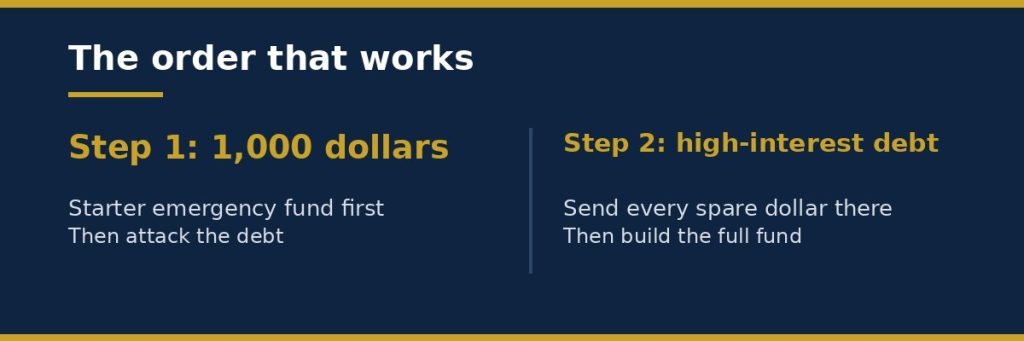
Do both, in the right order. First, build a small starter emergency fund of 1,000 dollars. Then, pay off high-interest debt, like credit cards. Then, build your savings up to a full emergency fund of three to six months of costs. That order protects you from new debt while you pay off old debt, and it stops high interest from eating your money.
If you pay debt first with no savings at all, the next car repair goes straight back on a credit card, and you are back where you started. If you save first and ignore a credit card at 24 percent interest, the interest costs you far more than the savings earns. The order above avoids both traps.
This post gives you a simple decision framework, a worked example with real numbers, and the exceptions to the rule. It is educational only. It is not financial advice.
The short answer: the order that works for most beginners
Here is the order, step by step.
Step 1: Save a starter emergency fund of 1,000 dollars. This is your buffer. It covers small surprises, like a car repair or a medical bill, so they do not go on a card.
Step 2: Pay off high-interest debt. High interest means roughly above 10 percent a year. Credit cards are the usual case. Pay the minimum on everything, then send every spare dollar to the highest-interest debt first, until it is gone.
Step 3: Build your full emergency fund to three to six months of essential costs. Rent, food, utilities, transport, insurance, and minimum payments. Three months if your job is stable, six months if your income is less certain.
Step 4: Then split your money between extra debt payments and longer-term savings goals, like a house deposit, or investing, in whatever order fits your goals.
Most beginners get stuck because they try to do everything at once, or they do it in the wrong order. This framework removes the guesswork. You only have to decide which step you are on.
Why high-interest debt usually comes before savings
The math is the reason. Compare a credit card and a savings account side by side.
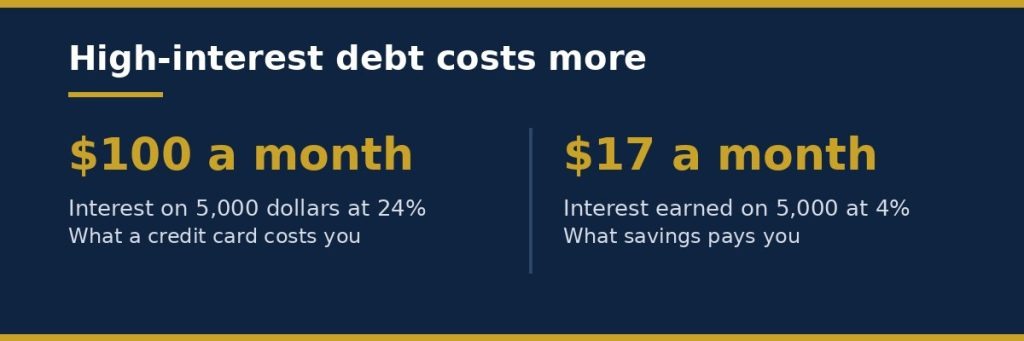
Take 5,000 dollars of credit card debt at 24 percent interest a year. The interest on that debt is about 100 dollars a month. That is 5,000 times 24 percent, which is 1,200 dollars a year, divided by 12 months, which is 100 dollars a month.
Now take 5,000 dollars in a savings account at 4 percent interest a year. The interest you earn is about 17 dollars a month. That is 5,000 times 4 percent, which is 200 dollars a year, divided by 12 months, which is about 17 dollars a month.
So the same 5,000 dollars costs you about 100 dollars a month as debt, and earns you about 17 dollars a month as savings. The gap is about 83 dollars a month in your favour if you pay the debt first. That is why high-interest debt comes before building savings beyond the starter fund.
Low-interest debt is different. A loan at 4 or 5 percent costs much less, so the gap is small, and saving first can make sense. The rule is about the interest rate, not about debt in general. High interest first, low interest later.
The worked example: 500 dollars a month to split
Meet Sara. She takes home 3,200 dollars a month. Her essential costs are 2,700 dollars a month. That leaves 500 dollars a month for debt and savings. She has 5,000 dollars of credit card debt at 24 percent, and 200 dollars in savings.
Month 1 and 2: Sara sends all 500 dollars a month to savings. After two months, she has 200 plus 1,000, which is 1,200 dollars. Her starter emergency fund is done. She still pays the minimum on the card, which is part of her essential costs, so the debt does not grow from missed payments.
Month 3 onwards: Sara sends all 500 dollars a month to the credit card, on top of the minimum. At that pace, the 5,000 dollar balance takes about 11 months to clear, including interest. The exact time depends on the minimum payment and the interest, but the point is clear: the debt is gone in under a year.
After the card is gone: Sara sends 300 dollars a month to savings and keeps 200 dollars a month for a goal, like a holiday or a car fund. Her full emergency fund target is three months of costs, which is 3 times 2,700, or 8,100 dollars. She already has 1,200 dollars, so she needs 6,900 dollars more. At 300 dollars a month, that takes 23 months. Slow, but steady, and she is debt free while she does it.
If Sara had done it the other way round, saving 500 dollars a month for a year first, she would have about 6,000 dollars saved, but she would still owe most of the 5,000 dollars on the card, plus about 1,200 dollars of interest for the year. She would be worse off by about 1,200 dollars. The order matters.
The exceptions: when saving comes first
The framework above fits most beginners, but there are three common exceptions.
First, if your employer offers a 401(k) match, take it before you pay extra on debt. A match is free money. If your employer matches your contribution up to a limit, contribute enough to get the full match first, then follow the framework with the rest. Skipping a match to pay debt is like turning down a pay rise.
Second, if your debt is low interest, below about 6 percent, saving first can be the better choice. A student loan at 5 percent, or a car loan at 4 percent, costs far less than a credit card. Build your emergency fund first, then split your money between the loan and savings.
Third, if you have a known cost coming soon, save for it first. If you know your car needs new tyres in two months, or your rent deposit is due, save that amount first. A known cost is not an emergency, it is a planned payment, and it should not go on a card.
If you are not sure which exception applies to you, start with the starter emergency fund. That step is right in almost every case.
What if you have no money left after essentials?
If your essential costs take all your income, you cannot save or pay extra on debt right now, and that is a math problem, not a willpower problem. The fix is to change the numbers, not to feel guilty.
Three moves help most. First, list your spending from your last two months of statements and find one want to cut, even a small one. Second, call your lenders and ask about a lower interest rate or a hardship plan, and ask your card company about a lower rate. Third, look for a small income step, like an extra shift, or a small side income, even 100 dollars a month, which changes the math fast.
If debt is already hard to manage, seek help early from a reputable nonprofit credit counselling service, like the National Foundation for Credit Counseling in the United States, rather than waiting until it grows. Early help is cheaper and calmer than late help.
Related reading in the Debt Payoff cluster: should you pay off debt or invest first, should you use savings to pay off debt, how to build an emergency fund from zero, and what happens if you only pay the minimum on a credit card.
Frequently asked questions
Should I pay off my credit card or save for emergencies first?
Save a starter emergency fund of 1,000 dollars first, then pay off the credit card. Without the starter fund, the next surprise goes back on the card. After the card is gone, build the full emergency fund of three to six months of costs.
Is 1,000 dollars enough for an emergency fund?
It is enough to start. It covers most small surprises, like a car repair or a vet bill. It is not a full emergency fund. A full fund is three to six months of essential costs, and you build it after high-interest debt is gone.
What counts as high-interest debt?
Roughly any debt above 10 percent a year. Credit cards are the usual case, often 20 percent or more. Payday loans are far higher and should be handled first. Low-interest debt, below about 6 percent, can usually wait until your emergency fund is built.
Should I empty my savings to pay off debt?
Usually no. Emptying your savings leaves you with no buffer, and the next surprise goes straight back on a card. Keep the starter emergency fund, and only use savings above that amount to pay debt if you have a stable income and a clear plan to rebuild it.
What does Dave Ramsey say about paying off debt or saving first?
Dave Ramsey teaches a similar order: save a 1,000 dollar starter emergency fund first, then pay off debt smallest to largest, then build a full emergency fund of three to six months of costs. The framework in this post follows the same order, with the extra step of taking an employer 401(k) match first.
How much should I have in savings before paying off debt?
At least 1,000 dollars as a starter fund. If your job is unstable, or you have no other safety net, aim for one month of essential costs before you attack debt hard. The right number is the one that lets you sleep at night without going back into debt.
Conclusion, and your first step today
Pay debt or save first is the wrong question. The right question is: what order? Save a starter fund of 1,000 dollars, pay off high-interest debt, then build the full emergency fund. That order keeps surprises from becoming new debt, and stops high interest from eating your money.
Your first step today is to write down your numbers. How much do you have in savings, how much high-interest debt do you have, and how much can you send each month? Then take the first step in the order above. If you already have the starter fund, your next dollar goes to the highest-interest debt.
Sources
National Foundation for Credit Counseling, nonprofit credit counselling and debt help: https://www.nfcc.org/
Consumer Financial Protection Bureau, managing debt and credit cards: https://www.consumerfinance.gov/consumer-tools/
Disclaimer: This article is for education only. It is not financial advice, and it does not guarantee any result. Your income, costs, debts, and goals are personal, and you should consider your own situation, and speak to a qualified professional if you need personal advice, before making a financial decision.
