

What Are Fractional Shares?
What are fractional shares?
A fractional share is a slice of one whole share of a stock or an exchange-traded fund (ETF). Instead of buying a set number of shares, you invest a set dollar amount, and you own the fraction of a share that amount buys. If a stock costs 400 dollars a share and you invest 100 dollars, you own 0.25 of a share, one quarter of it. Your gains, losses, and dividends are the same share of the whole, in proportion to what you own.
This post is educational only. It is not financial advice. It does not tell you which stocks or funds to buy, and it is not a recommendation to invest. Investing can lose money, and past results do not promise future results.
The old problem: the price of one share
For a long time, investing worked in whole shares. If a stock cost 1,000 dollars a share, you needed 1,000 dollars to buy a single share. If you had 100 dollars, you could not buy it at all. That locked beginners out of many of the best-known companies, and it forced small investors to pick only cheap stocks, even when a higher-priced stock was the one they wanted.
Fractional shares remove that barrier. They let you invest any amount, so the price of one share no longer decides what you can buy. The U.S. Securities and Exchange Commission (SEC) explains it plainly in its investor bulletin: if a stock trades at 1,000 dollars per share and you have 100 dollars to invest, fractional share investing lets you buy 0.1 of a share.
Most brokers that offer fractional shares let you start with very small amounts. Charles Schwab offers fractional shares in more than 7,000 U.S. stocks and ETFs for as little as 1 dollar. Other brokers set their own minimums, often 1 dollar, 5 dollars, or 10 dollars. The exact minimum depends on the broker, so check before you open an account.
How fractional shares work, step by step
Here is what happens when you buy a fractional share.
First, you choose a stock or an ETF and a dollar amount, instead of a number of shares. You say “invest 50 dollars in this fund”, not “buy 2 shares”.
Second, the broker converts your dollars into shares at the current market price. If the price is 200 dollars and you invest 50 dollars, you own 0.25 of a share. If the price is 100 dollars and you invest 25 dollars, you own 0.25 of a share as well. The math is the same every time: dollars invested divided by share price equals the fraction you own.
Third, the broker holds the whole shares and slices them up. You do not buy a quarter of a share from another investor directly. The brokerage buys full shares, divides them among the customers who asked for slices, and keeps track of who owns which fraction. Your slice is recorded in your account, and its value moves with the share price.
Fourth, your slice behaves like a small version of the whole share. If the share price rises 10 percent, your slice rises 10 percent. If it falls 10 percent, your slice falls 10 percent. If the company pays a dividend, you get your share of it, in proportion. A 2 dollar dividend on a full share means 50 cents on a quarter share.
That last point matters. A fractional share is not a different kind of investment. It is the same stock, in a smaller piece.
How do you get fractional shares?
There are three common ways to end up owning a fractional share.
The first is a direct purchase. You invest a dollar amount in a stock or ETF through a broker that offers fractional trading, and you receive a fraction of a share. This is the way most beginners meet fractional shares.
The second is a dividend reinvestment plan, often called a DRIP. When a stock or fund pays you a dividend, the broker can use that money to buy more of the same stock automatically. The dividend is often too small to buy a full share, so it buys a fraction instead. Over years, those small fractions add up.
The third is a corporate action, such as a stock split. When a company splits its shares, the numbers change, and some investors end up holding a fraction of a share as part of the split. This is less common for beginners, but it is a normal part of owning shares.
Not every broker offers fractional shares, and not every stock or ETF is available in fractions. Before you open an account, check two things: does the broker offer fractional shares at all, and does it offer them for the stocks and funds you want? Some brokers offer fractions only for certain popular stocks and ETFs.
What fractional shares are good for
Fractional shares solve two real problems for beginners, and the Motley Fool names both of them: high share prices, and small monthly amounts.
The first problem is access. A beginner with 100 dollars a month can now own a slice of a company whose full share costs 500 dollars or 1,000 dollars. The share price no longer picks your investments for you.
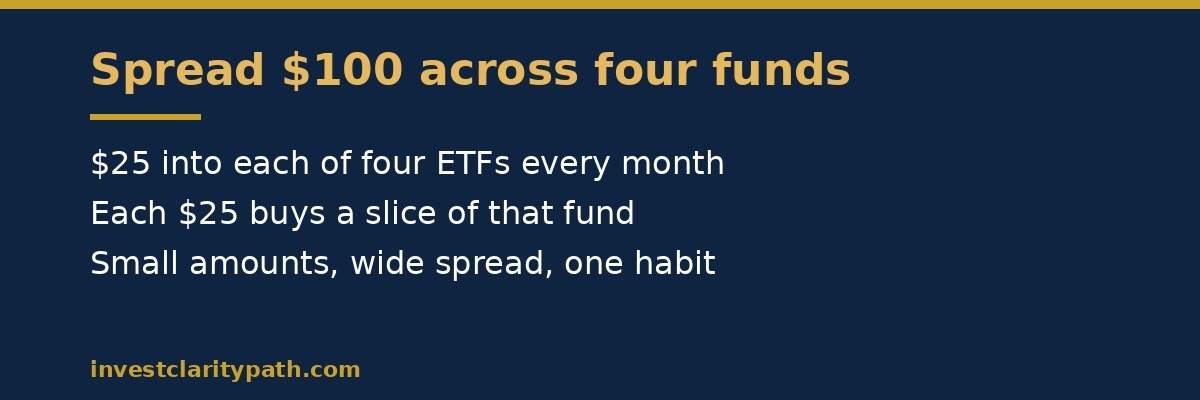
The second problem is spreading your money. With whole shares only, 100 dollars a month buys one or two cheap stocks, and your money sits in very few places. With fractional shares, the same 100 dollars can be split across four funds at 25 dollars each, or ten stocks at 10 dollars each. That spread is called diversification, and it means one bad company hurts you less, because it is a smaller part of your money. Our guide to diversification explains how that spread works.
Fractional shares also make automatic investing simple. You can set a monthly amount, such as 100 dollars, and have it split the same way every month, without worrying about share prices or leftover cash. And they make dividend reinvestment efficient, because every dollar of dividend buys more of the stock, instead of sitting as unused cash.
The limits and drawbacks to know first
Fractional shares are useful, but they have limits, and a beginner should know them before investing.
First, you usually do not get voting rights. Shareholders normally vote on company decisions, but fractional shareholders generally cannot vote, because the broker holds the whole share and the vote belongs to the whole. For a small investor this rarely matters, but it is a real difference.
Second, you cannot always move fractional shares to another broker. If you change brokers, you may have to sell your fractions and move the cash, which can mean paying tax on any gain. Whole shares usually transfer directly. Check the transfer rules before you build a large fractional position.
Third, not every stock is available. Some brokers offer fractions only for a set list of popular stocks and ETFs. A smaller company you want may not be on the list.
Fractional shares versus whole shares, side by side
The table below sums up the practical differences.
- Minimum cost: a whole share costs the full share price, which can be hundreds or thousands of dollars. A fractional share costs whatever dollar amount you choose, often from 1 dollar.
- Diversification: whole shares limit a small investor to one or two positions. Fractional shares let the same money spread across many stocks or funds.
- Dividends: a whole share pays the full dividend. A fractional share pays the same dividend in proportion to the fraction owned.
- Voting rights: a whole share usually carries a vote. A fractional share usually does not.
- Transfer to another broker: whole shares usually transfer directly. Fractional shares often must be sold first.
- Price movement: identical in percentage terms. A 10 percent rise is a 10 percent rise, whole or fractional.
The return in percentage terms is the same either way. The difference is access, not performance.
How to start with fractional shares, in five steps
Step one: learn the basics first. Understand what a stock is, what an ETF is, and what risk means. Our guides to the stock market and to risk are good places to start.
Step two: pick a broker that offers fractional shares. Check the minimum amount, which stocks and ETFs are covered, whether there are fees, and whether fractions can transfer out. Availability varies by broker and by country, so check the broker’s own page for your country.
Step three: decide how much to invest each month, using money you will not need soon. A common starting point is 25, 50, or 100 dollars a month. Our guide to starting with 100 dollars a month walks through that exact amount.
Step four: choose a simple, spread-out fund first. Many beginners start with a broad index fund or ETF, which holds hundreds of companies in one fund, rather than picking single stocks. Our guide to index funds explains what one is and why beginners use it.
Step five: automate it. Set a monthly transfer and a monthly investment for the same amount, on the same day, every month. Fractional shares make this easy, because the same dollar amount buys the same habit every month, whatever the share price does.
Worked example: Alex invests 100 dollars a month
Alex has 100 dollars a month to invest. She wants to buy shares in a company whose stock costs 400 dollars a share. With whole shares only, she would need four months of saving to buy a single share, and her money would sit idle in the meantime.
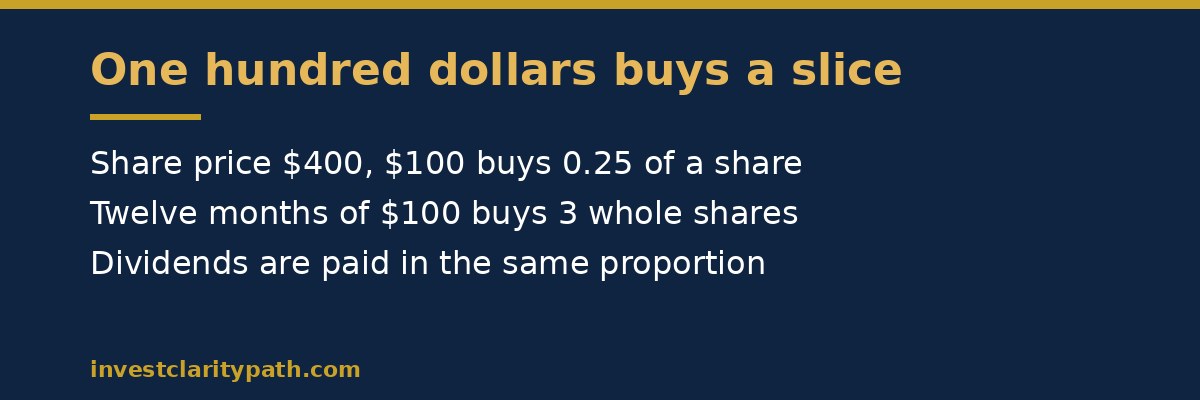
With fractional shares, she invests 100 dollars in month one. The math is 100 divided by 400, which is 0.25 of a share. In month two she invests another 100 dollars and owns 0.50 of a share. Each month adds 0.25 of a share. After 12 months she has invested 1,200 dollars and owns 3 whole shares, because 12 times 0.25 equals 3.
Now add dividends. Suppose the stock pays a dividend of 2 dollars per share each year. With 3 shares, Alex receives 6 dollars a year in dividends, because 3 times 2 equals 6. If she reinvests that dividend, it buys 6 divided by 400, which is 0.015 of a share. A small slice, but it is a slice that then earns its own dividends, and that is how compounding starts. Our guide to compound interest shows the same idea over longer periods.
Alex also wants to spread her money, so in a second example she splits her 100 dollars across four ETFs at 25 dollars each. If one ETF costs 250 dollars a share, her 25 dollars buys 25 divided by 250, which is 0.10 of a share. After 12 months she owns 1.20 shares of that ETF, because 12 times 0.10 equals 1.20, and she has invested 300 dollars in it. She repeats the same math for the other three funds. Her 100 dollars a month now sits in four places instead of one, and no single fund holds more than a quarter of her money.
The percentages tell the real story. Whether Alex owns 0.25 of a share or 25 whole shares, a 10 percent rise in the share price raises her holding by 10 percent. The fraction changes how much she can buy, not how well the investment performs.
Common mistakes to avoid
The first mistake is thinking a fractional share is safer than a whole share. It is not. The risk is identical in percentage terms. A bad company hurts a fractional owner just as much as a whole-share owner.
The second mistake is buying fractions of many single stocks with no plan. Ten slices of ten random companies is not a strategy. Start with a broad fund, learn how it behaves, and only then consider single stocks.
The third mistake is checking the price every day. A 0.25 share that moves a few dollars is not a signal to buy or sell. Fractional investing works best as a slow monthly habit, not as daily trading.
The fourth mistake is ignoring the broker’s rules. Some brokers charge fees on fractional trades, some limit which stocks are available, and some force you to sell fractions when you leave. Read the rules before you invest, not after.
The fifth mistake is investing money you need soon. Fractional shares are still shares. Their value can fall, and selling in a hurry can lock in a loss. Only invest money you can leave alone for years.
Frequently asked questions
What are fractional shares in simple terms?
A fractional share is a piece of one share of a stock or ETF, less than a whole share. You invest a dollar amount, and you own the fraction that amount buys. If a share costs 400 dollars and you invest 100 dollars, you own 0.25 of a share.
Can I buy fractional shares with $5?
Yes, at many brokers. Some brokers let you buy fractional shares for as little as 1 dollar. The exact minimum depends on the broker, so check the broker’s own page before you open an account.
Do fractional shares pay dividends?
Yes, in proportion to what you own. If a full share pays a 2 dollar dividend, a quarter share pays 50 cents. If you reinvest dividends, they buy more fractions of the same stock or fund.
Do fractional shares have voting rights?
Usually not. The broker holds the whole share, and the vote normally belongs to the whole share. Fractional shareholders generally do not vote. For most small investors this makes little practical difference.
Can I sell a fractional share?
Yes, you can sell a fractional share through the same broker, in the same way you sell a whole share. The sale is for the dollar value of your fraction at the current market price.
Are fractional shares good for beginners?
They can be, because they remove the share-price barrier and let a beginner start with a small monthly amount and spread it across several funds. They do not remove risk. The investment can still fall in value, so start small, learn the basics, and only invest money you can leave alone for years.
Conclusion, and your first step today
Fractional shares let you invest a dollar amount instead of buying whole shares, so a high share price no longer locks you out. You own a slice, your gains and dividends come in proportion, and a small monthly amount can spread across several funds. The limits are real, no voting rights, harder transfers, and not every stock is available, but for a beginner the biggest benefit is simple: you can start now, with the money you have.
Your first step is simple. Today, learn what a stock and an ETF are, and check whether your broker offers fractional shares and what its minimum is. If you are ready, set a small monthly amount, such as 25 or 50 dollars, and a broad fund to start with.
This post is educational only. It is not financial advice, and it is not a recommendation to buy any stock or fund.
Sources
- U.S. Securities and Exchange Commission, Investor Bulletin: Fractional Share Investing, Buying a Slice Instead of the Whole Share
- Charles Schwab, Fractional Shares, Invest in Stock Slices
- NerdWallet, Fractional Shares: What They Are and Where to Buy Them
- U.S. Bank, What Are Fractional Shares and How Do They Work?
- The Motley Fool, What Are Fractional Shares?
- Britannica Money, Fractional Shares, What They Are and How They Work
