
What Is the Stock Market in Simple Terms?
The stock market can look like a wall of flashing numbers and fast talk, but the idea behind it is simple. The stock market is a place where people buy and sell small pieces of ownership in public companies. When you buy a share, you own a tiny slice of a real business. When you sell it, someone else takes that slice from you.
In simple terms, the stock market is a network of exchanges where investors buy and sell shares of public companies. Prices move up and down during the day because buyers and sellers keep changing their minds about what each share is worth. This guide explains what a stock is, how trading works, how prices move, and how investors make money, with a worked example using real numbers.
What Is a Stock?
A stock is a small piece of ownership in a company. Each unit of ownership is called a share. If a company has one million shares and you own 10 of them, you own 10 out of one million, or one hundred-thousandth, of that company. That is a tiny slice, but it is real ownership. As a shareholder, you have a claim on a small part of the company’s future profits, and you usually get a vote on big company decisions.
FINRA, the Financial Industry Regulatory Authority, explains it plainly: when you invest in stock, you buy ownership shares in a company, and what you get back depends on the success or failure of that company. If the company does well, its stock price is likely to reflect that success. If it struggles, the price can fall.
There are two main types of stock. Common stock is what most people buy. It usually comes with voting rights, and it may pay a dividend, but the dividend is not guaranteed. Preferred stock usually pays a fixed dividend, similar to the interest on a bond, and it is paid before common stock dividends, but its price usually moves less, and it often has no vote.
What Is the Stock Market, Exactly?
The stock market is not one building, and it is not one website. It is a network of exchanges, brokers, and investors connected by computers. The best known exchanges in the United States are the New York Stock Exchange, called the NYSE, and Nasdaq.
The NYSE traces its roots to May 17, 1792, when 24 brokers signed an agreement under a buttonwood tree on Wall Street. Nasdaq opened on February 8, 1971, as the first electronic stock market. Today, trading is almost all electronic.
The US Securities and Exchange Commission, the SEC, regulates the stock market. Its mission is to protect investors, maintain fair, orderly, and efficient markets, and help companies raise money. Public companies must file regular reports with the SEC, and anyone can read those reports for free.
Why Do Companies Sell Shares?
Companies sell shares to raise money. A growing business may need cash to build a factory, launch a product, hire staff, or pay down debt. Instead of borrowing all of it and paying interest, the company can sell pieces of itself to investors.
The first time a company sells shares to the public, it is called an initial public offering, or IPO. After that first sale, most trading happens between investors. When you buy shares of a well known company today, your money usually goes to the person who sold you the shares, not to the company. The company already got its money at the IPO.
How Does Buying and Selling Actually Work?
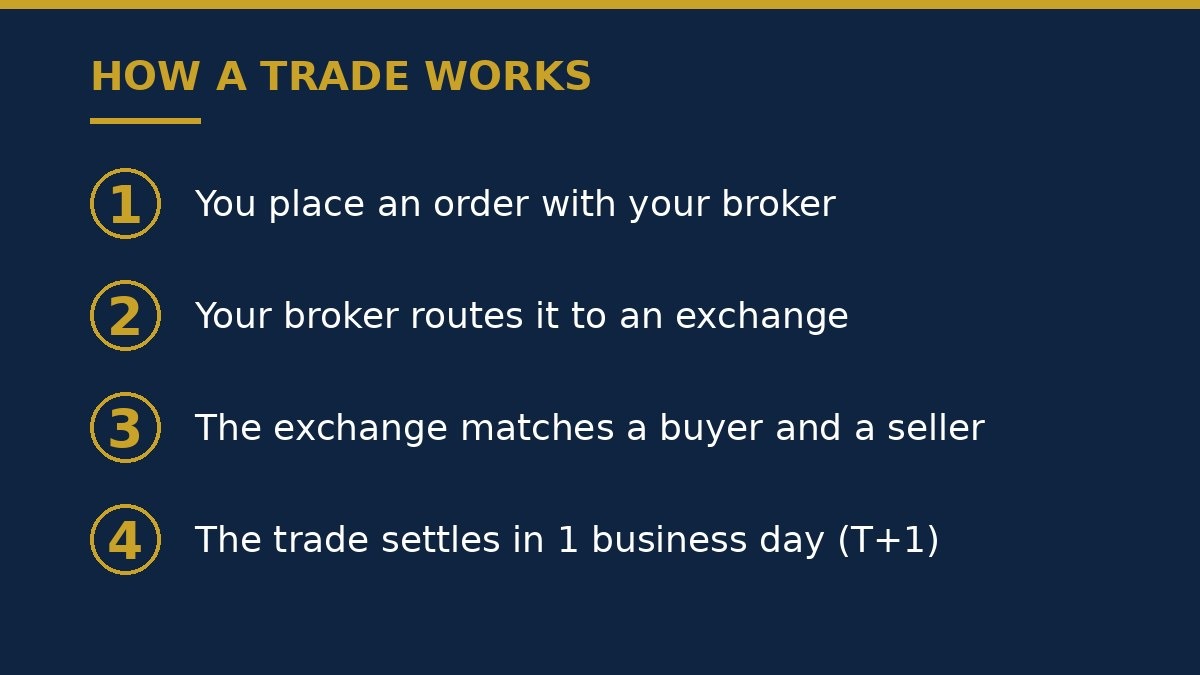
You cannot walk into an exchange and buy a share directly. You buy through a broker, and your order travels through a short chain before it is filled.
Stock exchanges
An exchange is a marketplace where securities are bought and sold. Companies apply to list their shares on an exchange, and they must meet its rules. The exchange keeps trading orderly and publishes prices so everyone can see the latest trade.
Brokers
A broker, also called a brokerage firm or broker-dealer, is the company that takes your order and sends it to the market. You open an account with a broker, add money, and place orders online or in an app.
Orders, bid and ask
Every stock has two prices at any moment. The bid is the highest price a buyer is willing to pay. The ask, also called the offer, is the lowest price a seller is willing to accept. A trade happens when the bid and the ask meet. The price you see on your screen is the price of the most recent trade, so it changes all day as new trades happen.
The two order types beginners meet most are market orders and limit orders. A market order buys or sells at the best price available right now. A limit order names the most you will pay, or the least you will accept, and it only fills if the price reaches your number.
When the market is open, and settlement
The main trading session on the NYSE runs from 9:30 a.m. to 4:00 p.m. Eastern Time, Monday to Friday, except on market holidays. After you buy shares, the trade settles one business day later. This is called T+1 settlement. Settlement is the step that actually moves the shares to your account and the money to the seller.
How Do Stock Prices Move?
No single person sets a stock price. Prices move because of supply and demand. When more investors want to buy a stock than sell it, buyers must offer more to get shares, and the price rises. When sellers outnumber buyers, the price falls.
Many things change what buyers and sellers are willing to pay:
- Company results, such as profits, sales, and growth.
- New products, or a product that fails.
- Interest rates, inflation, and the state of the economy.
- News about the industry, or about the world.
- What investors expect to happen next, not only what already happened.
A stock can also fall for reasons that have nothing to do with the company, such as a bad day for the whole market. A sharp fall of 10 percent to 20 percent from a recent high is called a correction.
How Do Investors Make Money From Stocks?
There are two main ways to make money from stocks, and FINRA describes both of them.
Dividends
When a company is profitable, it can choose to pay part of its earnings to shareholders as a dividend. You can take the dividend as cash, or reinvest it to buy more shares. Not every company pays a dividend. Many growing companies keep all their profits to fund growth instead. A dividend is never guaranteed, and a company can cut it or stop it.
Reinvested dividends can grow over time because each new share you buy can earn its own dividend later. That is the same idea behind compound interest, and our guide to how compound interest works explains the math in simple terms.
Capital gains
A capital gain happens when you sell a share for more than you paid for it. If you buy at $50 and sell at $60, the $10 difference is a capital gain, before fees and tax. If you sell for less than you paid, that is a capital loss. Keep in mind that if you sell a share you held for less than a year, any profit is usually taxed as regular income, not at the lower long term rate.
Worked Example: Buying 10 Shares
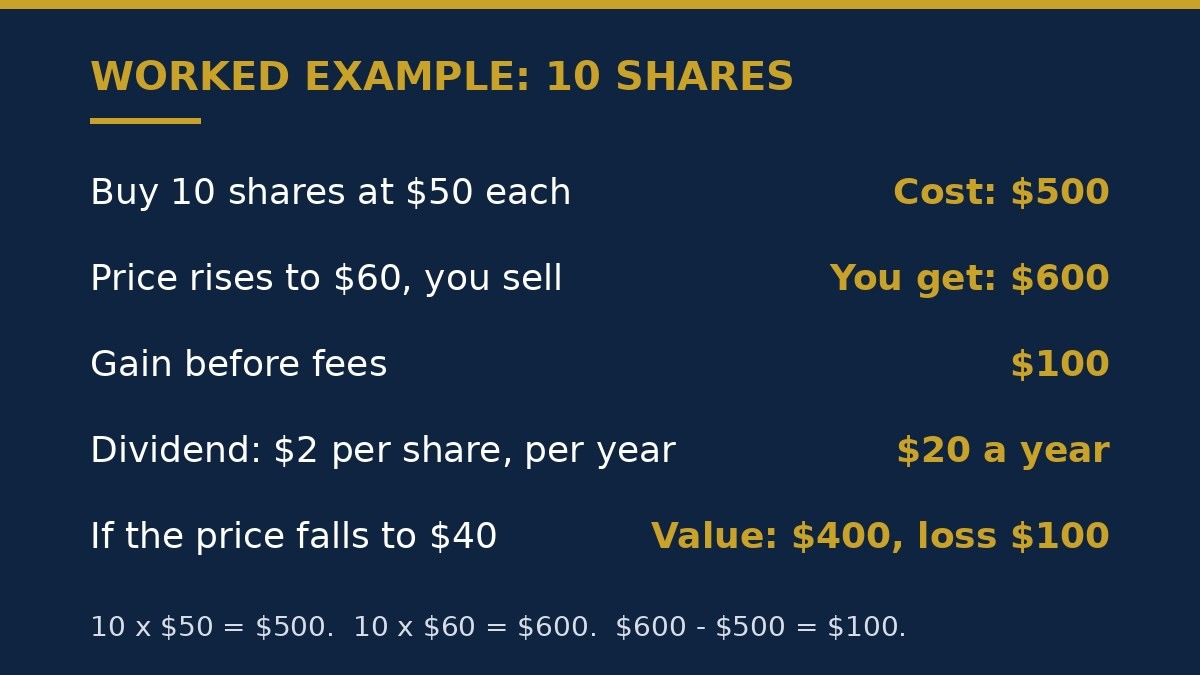
Here is a worked example with real numbers, so you can see how the two ways of making money fit together. Imagine you buy 10 shares of a company at $50 per share.
- Cost: 10 shares times $50 equals $500.
- The company pays a dividend of $2 per share each year. On 10 shares, that is 10 times $2, which equals $20 per year.
- After a year, the share price rises to $60. Your 10 shares are now worth 10 times $60, which equals $600.
- If you sell at $60, you get $600. Your gain is $600 minus $500, which equals $100, before fees and tax.
- Add the $20 dividend, and your total gain for the year is $100 plus $20, which equals $120. On a $500 investment, that is $120 divided by $500, which equals 24 percent.
Now look at the other side. If the price falls to $40 instead, your 10 shares are worth 10 times $40, which equals $400. Your loss is $500 minus $400, which equals $100. The $20 dividend would soften that loss, but it would not remove it.
What Are Stock Indexes?
An index is a group of stocks that is tracked as one number, so you can see how a whole part of the market is doing. The best known indexes are:
- The S&P 500, which tracks 500 of the largest companies listed in the United States. It is run by S&P Dow Jones Indices, a division of S&P Global.
- The Dow Jones Industrial Average, which tracks 30 large, well known companies.
- The Nasdaq Composite, which tracks the companies listed on the Nasdaq exchange, and includes many technology companies.
When the news says “the market was up today,” it usually means one of these indexes rose. An index is not something you can buy directly, but funds exist that track it. That is where index funds come in, and our guide to what an index fund is and why beginners use it explains how they work.
What Are the Main Risks?
Every investment carries risk, and stocks are no exception. Prices can fall, sometimes fast, and a company can even fail. The main risks to understand are:
- Market risk. The whole market can fall at once, and good companies can fall with it.
- Company risk. One company can run into trouble, even while the rest of the market is fine. If you own only one or two stocks, a problem at one company hits your whole investment.
- Short term risk. Money you need soon should not be in stocks, because prices move a lot in the short term. FINRA warns that investing in stocks to meet a short term goal can be risky because of stock price swings.
The usual answer to company risk is diversification, which means spreading your money across many companies, so no single one decides your result. Our guide to diversification explains how that works in practice, and our guide to what risk in investing means walks through each type of risk in simple terms.
How Do Beginners Usually Start?
Most beginners do not start by picking single stocks. They start with a broad fund, a simple plan, and a small regular amount. Here is a common path:
- Learn the basics first. You are doing that now, and that puts you ahead of many new investors.
- Choose a broad fund, such as an index fund or an ETF, that holds many companies at once. Our guide to what an ETF is and how it is different from a stock explains the difference.
- Set a small, regular amount you can afford, even $50 or $100 a month, and invest it on a schedule.
- Write a simple plan before you buy anything. Our guide to a simple first investment plan shows the steps.
- Leave the money alone for years, and check it only now and then.
This is education, not a recommendation to buy any fund or stock. The right choice depends on your goals, time frame, and comfort with risk.
Common Mistakes to Avoid
- Buying a stock because someone online promised it will double. The SEC warns that promises of high returns with little or no risk are classic warning signs of fraud, and its investor bulletin on ten things you should know about investing is a good check before you trust any tip.
- Putting all your money in one stock. One bad result can wipe out a large part of your savings.
- Checking prices every hour and selling in a panic. Short term swings are normal, and panic selling turns a paper loss into a real one.
- Investing money you need next month. Stocks are for long term goals, not for rent or bills.
- Ignoring fees. Check what your broker and your funds charge, because even small fees add up over years.
Frequently Asked Questions
What is the stock market in simple terms?
The stock market is a network of exchanges where investors buy and sell shares of public companies. A share is a small piece of ownership in a company, and its price moves up and down as buyers and sellers agree on new prices all day.
Do I need a lot of money to invest in the stock market?
No. Many brokers let you start with a small amount, and many funds accept regular investments of $50 or $100 a month. Some brokers also let you buy a fraction of a share, so a high share price does not lock you out.
What is the difference between the stock market and a stock exchange?
A stock exchange is one marketplace, such as the NYSE or Nasdaq, where shares are listed and traded. The stock market is the whole system: all the exchanges, brokers, and investors together.
How do stock prices go up and down?
Prices move with supply and demand. When more investors want to buy than sell, the price rises. When more want to sell than buy, it falls. Company results, interest rates, economic news, and investor expectations all feed into those decisions.
Can I lose all my money in the stock market?
You can lose money, and a single company can fail and leave its shares worth very little. That is why beginners are usually told to spread their money across many companies through a broad fund, instead of betting everything on one stock.
Is the stock market the same as gambling?
No, but it can feel like gambling if you trade without a plan. Buying a share means owning part of a real business that earns money and sells products, while gambling is a bet on a random outcome. Still, short term trading and chasing tips carry similar risks.
Conclusion
The stock market is simply a place where people buy and sell pieces of real businesses. Companies raise money by selling shares, investors buy them hoping the business grows, and prices move as buyers and sellers change their minds. You make money through dividends and capital gains, and you can lose money when prices fall. Start with the basics, spread your money across many companies, keep fees low, and give your investments years, not days, to grow.
This article is for general information and education only. It is not legal or financial advice.
