


How Do I Budget for a Family?
How do I budget for a family?
Start with the take home pay that actually lands in your account, list the bills you cannot skip, price the costs that grow with kids, and give every dollar a job before the month starts. For a family of four with 6,000 dollars a month in take home pay, a realistic shape is about 4,120 dollars for needs, 880 dollars for wants, and 1,000 dollars for savings and future goals. Then hold a short 20 minute family money meeting each week to compare the plan with reality and fix the lines that missed.
A family budget is different from a single person’s budget in one important way: several costs grow with each child. Groceries, childcare, school costs, clothes, and healthcare all rise when a child arrives, and they keep rising as children grow. A budget that worked for two people will not stretch to four without a rewrite. The good news is that the method is the same. You just need more lines, and a plan for the costs that do not arrive every month.
This guide builds a family budget in six steps, shows a worked example for a family of four, and explains how to keep it going when life gets busy. The national figures quoted are from the United States Bureau of Labor Statistics, and the worked example is an illustration, not a target. Your numbers will differ, and that is fine.
This post is educational only. It is not financial advice.
What a family of four actually spends
Before you build your own budget, it helps to know where the money usually goes. The best national source is the Bureau of Labor Statistics Consumer Expenditure Surveys. In the 2025 tables, four person households spent an average of 108,233 dollars for the year, about 9,019 dollars a month. Their average income before taxes was 164,387 dollars, with 2.1 earners and 1.4 children under 18.
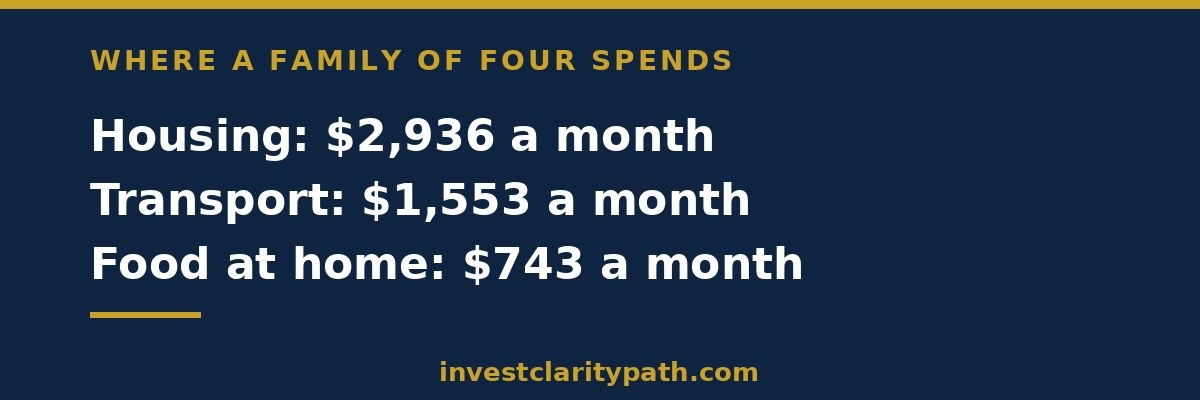
Here is how the biggest categories broke down for those households in 2025. Housing, including utilities and household operations, was 35,229 dollars a year, or 2,936 dollars a month. Transportation was 18,641 dollars a year, or 1,553 dollars a month. Food at home was 8,912 dollars a year, or 743 dollars a month. Food away from home was 6,139 dollars a year, or 512 dollars a month. Healthcare was 7,284 dollars a year, or 607 dollars a month. Housing, transportation, and food together came to about 64 percent of spending, and housing alone took about 32.5 percent.
These are averages, not targets. A family in a small town pays far less for housing than a family in a big city, and a household with two toddlers in daycare has a very different shape from one with two teenagers. Use the averages to spot a line that looks unusually large in your own budget, not as a score to hit. If your housing is 45 percent of your spending and the average is 33 percent, that line deserves a closer look. If your food spending is far above the average, your grocery line is the place to start.
Step 1: Add up your real take home pay
Budget the money you actually receive, not your salaries. Health insurance premiums for four people, retirement contributions, and taxes come out before the money reaches your account, and on a family plan the health premium alone can be a big bite.
Pull up the last two pay stubs for each earner and write down the net amount and the pay dates. Add any other regular income, such as a side income payment or a regular benefit, and use the monthly average. If pay varies, use your lowest normal month for planning, so a slow month does not break the budget.
If you have two earners, add both take home amounts together, but keep the pay dates visible. A budget that assumes all the money arrives on the 1st will fail if half of it arrives on the 15th. Bills with due dates early in the month need money that is already in the account.
Step 2: List the bills you cannot skip
These are the lines where something bad happens if you do not pay: rent or mortgage, utilities, phones, car payment and insurance, minimum debt payments, and childcare you need in order to work. Write the amount and the due date of each one.
If those lines already eat most of your take home pay, do not skip ahead to wants. The fix is to look at the biggest fixed lines first, because small cuts to groceries will not fix a housing cost that takes half your pay. Read our guide on creating a budget when money is tight for the order to follow, and read our monthly budget guide to rebuild the plan from scratch.
Childcare deserves its own line, and its own honesty. Full time childcare for a young child can cost as much as rent in many places. If childcare costs more than one parent earns after tax and commuting, some families choose to cut hours or change arrangements, but that is a family decision, not a budgeting trick. Write the real number down, and plan around it.
Step 3: Price the lines that grow with kids
This is where a family budget stops looking like a couple’s budget with two extra seats. Use your receipts or bank history from the last two or three months to price each of these lines.
Groceries, school lunches, and snacks. Food at home averaged 743 dollars a month for a four person household in the national figures, but your number depends on where you live and how much you cook. Plan meals for the week, shop with a list, and keep the grocery line separate from eating out, or the two will blur together.
Childcare, before and after school care, and summer camp. These costs change with the school year, so budget the yearly total divided by 12 rather than the monthly bill in a quiet month.
Health costs: copays, prescriptions, glasses, dental, and the deductible. A family of four hits the deductible most years, so plan for it. If your plan has a high deductible, a monthly set aside for health costs is not optional.
Clothes and shoes. Kids outgrow clothes, so this line rarely shrinks. Buy ahead in sales where you can, and set a monthly amount even in months when nobody needs shoes.
School fees, supplies, field trips, picture day, and fundraising. These are small on their own and large together. A 25 dollar monthly school line covers 300 dollars a year of these costs without a surprise.
Step 4: Pick a method that fits your family
The best budgeting method is the one your household will actually follow. Here are the four most common ones, and who each suits.
The 50/30/20 rule puts 50 percent to needs, 30 percent to wants, and 20 percent to savings and extra debt payments. It suits beginners who want a simple guideline. Most families of four find needs take more than 50 percent, often close to 70 percent, so treat 50/30/20 as a direction to grow toward, not a rule you have failed if you miss. Read our guide on the rule.
Zero based budgeting gives every dollar a job until income minus plan equals zero. It suits families who want full control or are paying off debt. It takes the most effort, but it catches leaks the other methods miss.
The envelope method sets amounts for spending categories, in cash or in digital envelopes. When an envelope is empty, spending stops. It suits families who overspend on groceries, dining out, or fun money.
Pay yourself first moves savings and goals out on payday, and you spend what is left. It suits families who are steady spenders but forget to save. Savings becomes a line item, not whatever happens to be left at the end of the month.
Step 5: Plan for the costs that are not monthly
A family budget fails most often on the costs that do not arrive every month. Christmas, birthdays, car repairs, school trips, annual insurance, and holidays all land in one month, and if there is no plan, they land on a credit card.
Turn every irregular cost into a small monthly line, called a sinking fund. Add up what each cost will be for the year, divide by 12, and transfer that amount every month into a separate savings account or a labelled envelope.
Here is a simple example. Christmas and birthdays, 900 dollars a year, is 75 dollars a month. Car repairs and servicing, 1,200 dollars a year, is 100 dollars a month. Holidays, 1,800 dollars a year, is 150 dollars a month. School costs, 300 dollars a year, is 25 dollars a month. Together, that is 350 dollars a month set aside for costs that would otherwise arrive as surprises. 75 plus 100 plus 150 plus 25 equals 350.
When the cost arrives, the money is already there, and the monthly budget does not break. If a sinking fund builds up unused, keep it. Car repairs are a matter of when, not if.
Worked example: the Ahmed family, 6,000 dollars a month
The Ahmeds are two parents and two school age children, with 6,000 dollars a month in take home pay. They use the pay yourself first method, with savings moved out on payday. Here is their monthly plan.
Housing, rent, is 1,650 dollars. Groceries are 850 dollars. Utilities, power, water, and gas, are 300 dollars. Transport, fuel and car costs, is 450 dollars. Insurance and healthcare are 350 dollars. Childcare and after school care are 400 dollars. Phone and internet are 120 dollars. Needs come to 4,120 dollars, which is about 69 percent of take home pay.
Eating out and treats are 300 dollars. Subscriptions and streaming are 80 dollars. Kids activities and hobbies are 250 dollars. Family fun and clothes beyond the basics are 250 dollars. Wants come to 880 dollars, which is about 15 percent of take home pay.
Emergency fund savings are 400 dollars. Savings goals, including sinking funds, are 300 dollars. Extra debt and investing are 300 dollars. Future savings come to 1,000 dollars, which is about 17 percent of take home pay.
The total is 4,120 plus 880 plus 1,000, which equals 6,000 dollars. Every dollar has a job, and the plan balances exactly.
Notice that needs land near 69 percent, not the textbook 50 percent. That is the reality for most families of four. Housing, food, and childcare are heavy, and the clean 50/30/20 split is an aspiration to grow toward, not a failure. Even here, savings stays a real line item, not whatever happens to be left.
The Ahmeds review the plan every Sunday evening for 20 minutes. They check the bank balance, compare spending with the plan, and move money between envelopes if one line ran over. If groceries ran 60 dollars over, they take 60 dollars from eating out, not from savings. The rule is simple: savings is the last line to touch.
To build your own emergency fund, read our guide. To see how much to keep in it, read our guide on the amount.

Common mistakes to avoid
The first mistake is budgeting from salaries instead of take home pay. Health premiums, tax, and retirement contributions come out first, and a plan built on gross pay will be short every month.
The second mistake is forgetting the irregular costs. A budget with no sinking funds works for eleven months and breaks in December. Give every yearly cost a monthly line.
The third mistake is setting the grocery line from hope instead of history. Look at the last three months of bank statements and use the real average. A line that is 200 dollars too low will be broken by the second week, every month.
The fourth mistake is cutting fun money to zero. A family budget with no fun in it lasts about three weeks. Keep a real fun line, even a small one, and protect it. A family that enjoys its budget keeps its budget.
The fifth mistake is treating savings as a leftover. Savings that waits until the end of the month gets whatever is left, which is usually nothing. Move savings out on payday, before spending starts. Learn how to plan your grocery spending in detail in our groceries guide.
Frequently asked questions
How much should a family of four budget for groceries?
The national average for food at home for a four person household was 743 dollars a month in 2025, plus 512 dollars a month for food away from home. Your number depends on where you live, how much you cook, and how old your children are. Check your last three months of spending and use that average, not the national figure.
What percentage of income should go to housing?
Housing averaged about 32.5 percent of spending for four person households in 2025. Many guides suggest keeping housing under 30 percent of take home pay, but that is hard in expensive cities. If housing takes more than 40 percent, look at the other lines first, because moving house is a bigger decision than cutting subscriptions.
How do I budget for a family on one income?
Use the same six steps, but be stricter about the order: needs first, savings second, wants last. A single income family often finds needs take 70 percent or more, so the savings line may start small, such as 5 percent, and grow as pay rises. Read our single income guide.
Conclusion, and your first step today
Budgeting for a family comes down to six steps: add up real take home pay, list the bills you cannot skip, price the costs that grow with kids, pick a method you will follow, give yearly costs a monthly sinking fund, and check the plan for 20 minutes each week. For a family of four on 6,000 dollars a month, a realistic shape is about 4,120 dollars for needs, 880 dollars for wants, and 1,000 dollars for savings and future goals.
Your first step today is simple. Pull up the last two pay stubs for each earner, write down the take home amounts, and list your fixed bills with their due dates. That one page is the start of your family budget, and everything else follows from it.
To build the full monthly plan, read our guide on creating a monthly budget. And if you want the simple percentage method, read our guide on the 50/30/20 rule.
This post is educational only. It is not financial advice.
Sources
- Bureau of Labor Statistics, Consumer Expenditure Surveys, 2025 tables, as reported in Savenests, How to Budget for a Family of Four
- Family Finance Warriors, How to Create a Family Budget: 7-Step Guide (2026)
