What Is a SIMPLE IRA?
What is a SIMPLE IRA?
A SIMPLE IRA is a retirement plan for small businesses with 100 or fewer employees. SIMPLE stands for Savings Incentive Match Plan for Employees. It lets employees save part of their salary for retirement before tax, and it requires the employer to contribute too, either by matching the employee’s savings or by paying a fixed percentage of pay to every eligible employee. It is simpler and cheaper to run than a 401(k), which is why small employers choose it.
This post is educational only. It is not financial advice. It does not recommend any retirement plan, and it does not promise any return. Tax rules change, so check the current IRS rules or speak to a qualified tax professional before you decide.
Who a SIMPLE IRA is for
A SIMPLE IRA is for a small employer and their employees, including self-employed people with no employees other than themselves. The employer must have 100 or fewer employees who earned at least 5,000 dollars in the previous year. A business that grows past 100 employees can keep the plan for a limited grace period, but it will eventually need to move to another plan.
It suits a small business owner who wants to offer retirement savings without the cost and paperwork of a 401(k). A 401(k) needs annual testing, a plan administrator, and often higher fees. A SIMPLE IRA needs a written plan document, a notice to employees each year, and deposits, but no annual filing with the IRS and no complex testing.
It also suits employees of small businesses who have no 401(k) at work. If your employer offers a SIMPLE IRA, it is usually the main workplace retirement plan available to you. Self-employed people can use one too, acting as both employer and employee, which means they can make both kinds of contribution.
A SIMPLE IRA is not for a large employer, and it is not for an employer who already offers another qualified retirement plan in the same year, with limited exceptions. An employer cannot run a SIMPLE IRA alongside a 401(k) for the same employees in the same year.
How a SIMPLE IRA works
The employee chooses a percentage of salary to save, or a fixed dollar amount, and that money comes out of each paycheck before income tax. This is called a salary reduction contribution. The money goes into an individual retirement account, or IRA, in the employee’s name at a bank, broker, or other financial institution chosen under the plan.
The employer must also contribute, and there are two choices. The employer can match the employee’s contributions dollar for dollar up to 3 percent of the employee’s pay. Or the employer can make a nonelective contribution of 2 percent of pay for every eligible employee, whether or not the employee saves anything. The employer picks one method for the year and tells employees in the annual notice.
All contributions are 100 percent vested at once. Vested means the money is fully yours, including the employer’s contributions, from the day it lands in your account. There is no waiting period and no forfeiture if you leave the job.
The money inside the account grows tax deferred, which means you do not pay tax on the growth each year. You pay income tax when you withdraw the money in retirement.
SIMPLE IRA contribution limits for 2026
All figures in this section are for tax year 2026, from the IRS page on SIMPLE IRA contribution limits. No 2027 figures are used in this post.
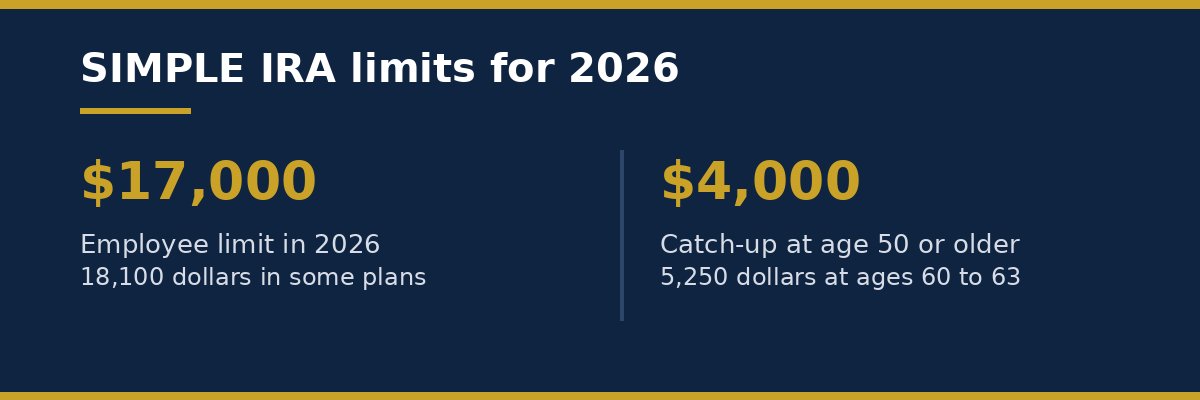
An employee can contribute up to 17,000 dollars of salary to a SIMPLE IRA in 2026. In some plans, under a change made by the SECURE 2.0 Act, the limit is higher: up to 18,100 dollars in 2026. That higher limit applies when the employer has 25 or fewer employees who received at least 5,000 dollars of compensation in a prior year, and it can also apply to employers with 26 to 100 employees that provide a higher employer contribution.
Employees aged 50 or older at the end of the year can make a catch-up contribution of 4,000 dollars in 2026, if the plan allows it. That takes the total to 21,000 dollars for most plans. Employees aged 60, 61, 62, or 63 can make a higher catch-up contribution of 5,250 dollars in 2026 under SECURE 2.0, taking the total to 22,250 dollars. In a plan with the higher base limit of 18,100 dollars, the catch-up for employees 50 and older is 3,850 dollars, taking the total to 21,950 dollars.
If you also participate in another employer plan during the year, the total of your salary reduction contributions to all plans cannot exceed 24,500 dollars in 2026.
The employer’s matching contribution is up to 3 percent of your pay, with no limit on the pay used for the match. The nonelective contribution is 2 percent of your pay, but only the first 360,000 dollars of pay in 2026 counts. So the largest nonelective contribution is 2 percent of 360,000 dollars, which equals 7,200 dollars. The employer may reduce the match to as low as 1 percent, but only for two years out of five, and employees must be told.
These limits rise with inflation over time, so always check the IRS page for the current year before you plan. NerdWallet and SmartAsset confirm the same 2026 figures: 17,000 dollars base, 4,000 dollars catch-up at 50 and older, and 5,250 dollars for ages 60 to 63.
Worked example: Ana saves 7,800 dollars in one year
Ana earns 60,000 dollars a year at a small design firm with 20 employees. Her employer offers a SIMPLE IRA with a 3 percent dollar-for-dollar match.
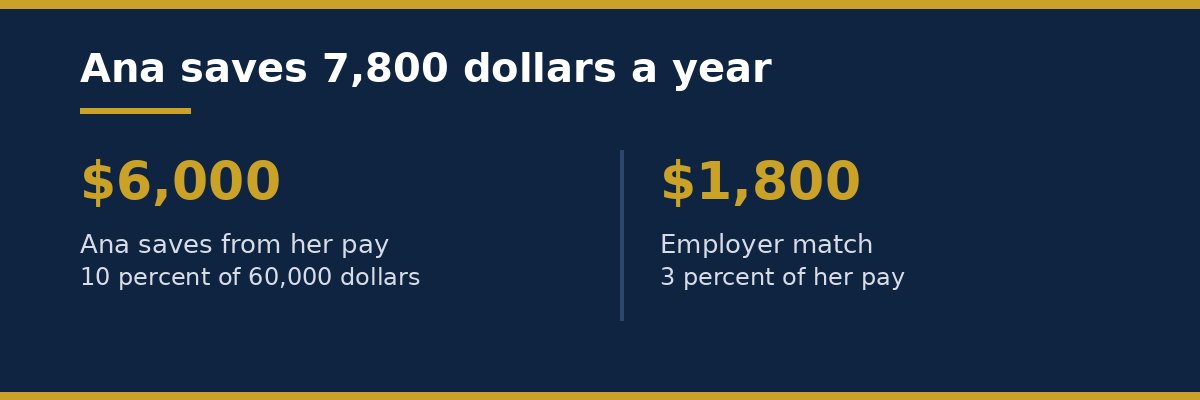
Ana decides to save 10 percent of her salary. That is 60,000 dollars times 10 percent, which equals 6,000 dollars a year, or 500 dollars a month from her paycheck before tax.
Her employer matches dollar for dollar up to 3 percent of her pay. Three percent of 60,000 dollars equals 1,800 dollars a year, or 150 dollars a month. Ana’s 6,000 dollars is more than the 1,800 dollar match limit, so she gets the full match.
Together they save 6,000 dollars plus 1,800 dollars, which equals 7,800 dollars a year, or 650 dollars a month. The employer paid 1,800 dollars of that, which is money Ana would not have if she saved only in her own IRA. If she kept this up for ten years with no investment growth at all, the contributions alone would total 78,000 dollars.
Now suppose Ana saved only 2 percent of her salary, which is 1,200 dollars a year. The match would be 1,200 dollars, because the match only covers what she puts in, up to 3 percent of pay. She would save 2,400 dollars a year instead of 7,800 dollars, and she would leave 600 dollars of match on the table. That is the first rule of a SIMPLE IRA: save at least enough to get the full 3 percent match, because the match is part of your pay.
SIMPLE IRA versus 401(k) versus traditional IRA
A SIMPLE IRA sits between a traditional IRA and a 401(k). A traditional IRA is an account you open yourself, with a 2026 contribution limit of 7,500 dollars, or 8,600 dollars if you are 50 or older. A SIMPLE IRA allows 17,000 dollars from the employee alone, more than double the IRA limit, plus the employer contribution on top.
A 401(k) allows higher employee contributions, 24,500 dollars in total elective deferrals across plans in 2026, and it can include features a SIMPLE IRA cannot, such as loans and Roth contributions. But a 401(k) costs more to run and needs annual testing. A small employer with 20 staff may find that cost hard to justify, and a SIMPLE IRA gives their employees a real workplace plan at a fraction of the cost.
A SIMPLE IRA has two limits a 401(k) does not. It does not allow loans, and it does not offer a Roth version. You cannot borrow from a SIMPLE IRA the way some 401(k) plans allow. And all employee contributions are pre-tax, so there is no Roth SIMPLE IRA.
A SIMPLE IRA also has a rollover rule worth knowing. In the first two years after you start participating, you can only roll the money into another SIMPLE IRA. After two years, you can roll it into a traditional IRA or another eligible plan.
To compare the 401(k) and the IRA directly, read our guide.
Taxes: what you pay, and when
Employee salary reduction contributions are pre-tax, which means they lower your taxable income in the year you make them. If Ana earns 60,000 dollars and saves 6,000 dollars in her SIMPLE IRA, her taxable income for the year is 54,000 dollars before other deductions. That is the main tax benefit.
Employer contributions are not taxed to the employee when they are made. The money grows tax deferred inside the account, so you do not pay tax each year on interest, dividends, or growth.
You pay ordinary income tax when you withdraw the money, usually in retirement. If you withdraw before age 59 and a half, you also face a 10 percent early withdrawal penalty, or 25 percent if the withdrawal is within the first two years of participation. After age 73, required minimum distributions generally apply, so you must start withdrawing a minimum amount each year. The exact age for required minimum distributions has changed in recent years, so confirm the current rule on the IRS site before you plan around it.
How to start a SIMPLE IRA as an employee
First, check whether your employer offers one, and ask for the plan summary and the annual notice. The notice tells you the employer contribution method for the year, the limits, and the election period dates.
Second, decide your contribution amount. Start with at least enough to get the full 3 percent match. If you can save more, raise the percentage in small steps, for example 1 percent at a time each year.
Third, choose your investments inside the account. The plan offers a menu of funds, usually including stock funds, bond funds, and target-date funds. A target-date fund picks the mix for you based on your planned retirement year. This post does not recommend any fund. If the menu confuses you, ask the plan provider for the education materials, or speak to a qualified adviser.
Fourth, check your first paycheck after enrolling. Confirm the contribution amount is right and the money reached the account. The IRS requires employee contributions to be deposited promptly, generally within 30 days after the end of the month.
Fifth, review once a year. Check your contribution percentage, your investment mix, and the employer notice for the next year. Small yearly checks keep the plan working for you.
Common mistakes to avoid
The first mistake is saving less than the full match. If your employer matches up to 3 percent and you save only 1 percent, you leave free pay behind. Save at least 3 percent before you save anywhere else.
The second mistake is taking money out early. A withdrawal before age 59 and a half costs income tax plus a penalty, and 25 percent in the first two years. A SIMPLE IRA is retirement money, not an emergency fund. Keep a separate emergency fund in savings. To learn how, read our guide.
The third mistake is rolling the money to the wrong account in the first two years. A rollover to a traditional IRA within two years of starting counts as a distribution, with tax and possibly the 25 percent penalty. Wait until the two years have passed, or roll only to another SIMPLE IRA.
The fourth mistake is ignoring the annual notice. The employer can change the contribution method from year to year, and the limits change with inflation. Read the notice each November and adjust your percentage.
Frequently asked questions
What does SIMPLE IRA stand for?
SIMPLE stands for Savings Incentive Match Plan for Employees. It is a retirement plan for small businesses with 100 or fewer employees, where both the employee and the employer contribute.
How much can I contribute to a SIMPLE IRA in 2026?
An employee can contribute up to 17,000 dollars in 2026, or 18,100 dollars in plans with the higher SECURE 2.0 limit. Employees 50 and older can add a 4,000 dollar catch-up, and employees aged 60 to 63 can add 5,250 dollars. The employer adds a match of up to 3 percent of pay, or a 2 percent nonelective contribution.
Is a SIMPLE IRA better than a 401(k)?
It depends on the employer. A SIMPLE IRA is cheaper and simpler to run, which suits a small business. A 401(k) allows higher contributions and offers loans and Roth options, but costs more. For an employee, the best plan is usually the one your employer offers, with the full match captured.
Can I withdraw money from a SIMPLE IRA early?
Yes, but it is costly. Withdrawals before age 59 and a half are taxed as income plus a 10 percent penalty, or 25 percent if the withdrawal is within the first two years of participating. Keep an emergency fund separate so you do not need to touch retirement money.
Does my employer have to contribute to my SIMPLE IRA?
Yes. The employer must either match employee contributions up to 3 percent of pay or make a 2 percent nonelective contribution to every eligible employee. The employer chooses the method each year and tells employees in the annual notice.
Conclusion, and your first step today
A SIMPLE IRA is a small business retirement plan where you save part of your salary before tax and your employer adds more on top. In 2026 you can save up to 17,000 dollars yourself, more with catch-up contributions, and your employer must match up to 3 percent of your pay or pay 2 percent to everyone. The money is fully yours from day one, it grows tax deferred, and it is taxed when you withdraw it in retirement.
Your first step is simple. If your employer offers a SIMPLE IRA, ask for the annual notice and check the employer contribution method. Then set your contribution to at least 3 percent of your pay, so you capture the full match.
This post is educational only. It is not financial advice.
Sources
- IRS, Retirement topics, SIMPLE IRA contribution limits (200, verified 2026-11-29). Source for the 2026 employee limit of 17,000 dollars, the 4,000 dollar catch-up, the 5,250 dollar catch-up for ages 60 to 63, the 24,500 dollar aggregate limit, the 3 percent match, the 2 percent nonelective contribution, and the 360,000 dollar compensation cap.
- NerdWallet, What Is a SIMPLE IRA? Retirement Plan Rules, FAQs (200, verified 2026-11-29). Source for the SIMPLE IRA definition, the 100 employee limit, the higher 18,100 dollar limit, and the mandatory employer contribution methods.
- SmartAsset, SIMPLE IRA Contribution Limits for 2026 (content read via search results 2026-11-29). Source for the 2026 limits, the 2 percent nonelective contribution, and the 7,200 dollar maximum nonelective contribution.
- The Motley Fool, SIMPLE IRA Contribution Limits in 2025 and 2026 (content read via search results 2026-11-29). Source for the 2026 limits, the 18,100 dollar higher limit, the catch-up figures, and the 24,500 dollar aggregate limit.