


When Should I Increase My Retirement Contributions?
When should I increase my retirement contributions?
Increase your retirement contributions whenever your finances get more room: after a raise or bonus, after paying off a debt, when you start a new job, at the start of a new year, when IRS limits rise, or after a major life change that lowers your costs. The easiest moment is the raise, because you can raise the contribution before the extra money reaches your bank account, so you never feel the loss. Even a 1 percent increase makes a real difference over decades.
This post is educational only. It is not financial advice. It does not recommend any contribution amount, and it does not promise any return.
Why timing matters more than the amount
Most people do not increase their retirement contributions because the amount feels too big. They wait for a perfect moment when they can jump from 5 percent to 15 percent at once, and that moment never comes. Small increases at the right moments work better, because they are easy to keep.
A 1 percent increase on a 60,000 dollar salary is 600 dollars a year, or 50 dollars a month. That is about the cost of a few takeaway meals. Done once a year for five years, it moves a saver from 6 percent to 11 percent without a single painful jump. The money has decades to grow, so the early increases matter most: money added at 30 has far more time to compound than money added at 55.
The other reason timing matters is the employer match. If your employer matches your contributions, every increase up to the full match is extra pay. Increasing to the full match is the first milestone, before any other increase. Principal notes that six key moments in life offer chances to adjust contributions, starting with a raise or bonus, and Gusto points out that even a 1 percent increase can make a meaningful difference by retirement.
The six best moments to increase
1. When you get a raise or a bonus
A raise is the best moment, because your take-home pay is already changing. If your salary rises by 3 percent, direct half of the raise to retirement and keep half as extra take-home pay. You still feel richer, and your savings rate rises without effort.
A bonus works the same way. A bonus is money you were not counting on for monthly bills, so sending part of it to retirement hurts less than cutting monthly spending.
2. When you pay off a debt
Paying off a credit card, a car loan, or a student loan frees up a monthly payment. That freed money is the easiest money to redirect, because your budget already survived without it. If your car payment was 300 dollars a month, sending 150 dollars of it to retirement and keeping 150 dollars as breathing room is a painless increase.
Do not redirect all of it at once if the payoff leaves you with no cushion. Keep the emergency fund topped up first, then raise the retirement contribution with what is left.
3. When you start a new job
A new job resets your pay and your benefits. Set the contribution rate on day one, before the first paycheck, so the higher rate is normal from the start. If the new job pays more, set the rate higher than at the old job. If the new employer offers a match, contribute at least enough to get the full match from the first month.
A new job is also the moment to check what happens to the old retirement account. You can usually leave it, roll it into the new plan, or roll it into an IRA, so ask the new plan provider about the options.
4. Every year during benefits enrollment
Benefits enrollment, usually once a year, is the built-in reminder to review your rate. Raise it by 1 percent each enrollment, even in years without a raise. If your plan offers automatic escalation, turn it on: it raises your rate by 1 percent each year on a date you choose, until it reaches a cap you set.
Enrollment is also the moment to check whether the IRS limits rose. Limits change with inflation, so a rate that hit the limit last year may leave room this year.
5. When IRS contribution limits increase
IRS limits rise most years with inflation. For 2026, the IRA contribution limit is 7,500 dollars, or 8,600 dollars for people age 50 or older, and the total salary reduction contributions across employer plans cannot exceed 24,500 dollars. Those figures come from the IRS and from FirstBank’s summary of the IRS limits. If you were already contributing the maximum, a higher limit is a direct invitation to add more.
If you are nowhere near the limit, the limit rise still matters: it is a reminder to check whether your rate still fits your income. A saver earning far more than five years ago but contributing the same dollar amount is saving a smaller share of pay each year.
6. After major life changes
A child leaving home, a mortgage payoff, a move to a cheaper home, or a partner returning to work can all lower your monthly costs. Each one is a moment to raise the contribution before the freed money becomes new spending. The same applies in reverse: a new child or a job loss may mean pausing an increase, and that is fine. Retirement saving is a long habit, not a straight line.
The 1 percent method: small steps that add up
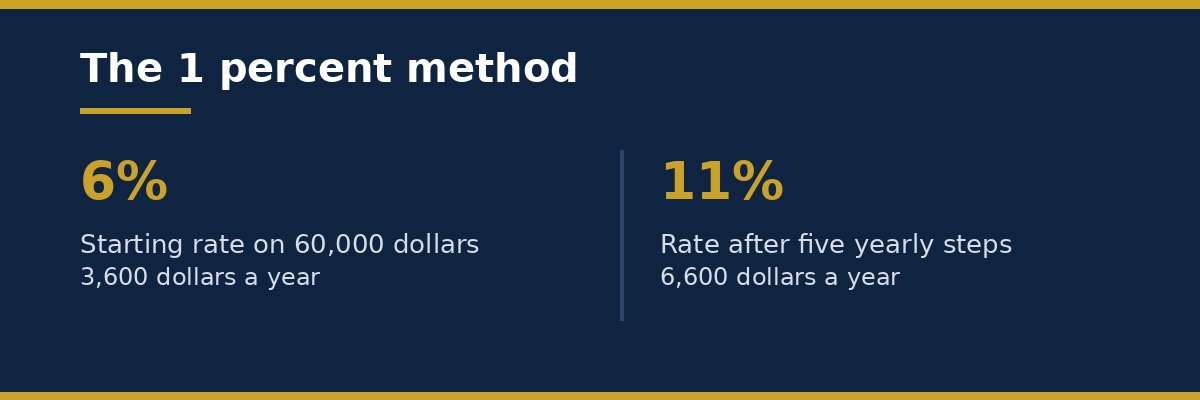
The 1 percent method is simple: raise your workplace contribution by 1 percentage point, then repeat on a schedule, usually once a year. Investors Leap describes it as one of the simplest approaches, because the goal is not to reach a target overnight but to build a higher savings rate gradually and sustainably.
Here is how it looks on a 60,000 dollar salary. At 6 percent you save 3,600 dollars a year. Raise it to 7 percent and you save 4,200 dollars a year, which is 50 dollars a month more. Raise it once a year, and after five years you are at 11 percent, saving 6,600 dollars a year. Your take-home pay barely changes each year, because each step is only 50 dollars a month.
The method works best when it is automatic. Set a calendar reminder for the same date each year, or turn on automatic escalation in your plan if it is offered. If a 1 percent step feels too large in a tight year, use a smaller step, such as 0.5 percent, or wait until the next raise. The best increase is the one you can keep without raiding savings or borrowing on a card for normal expenses.
How much should you save? A simple guide
There is no single right percentage, because income, age, debts, and retirement plans differ. A common guide is 15 percent of pay, including any employer match, as Principal notes. That is a guide, not a rule, and it is a destination to build toward, not a starting point for everyone.
If you are just starting, the order matters more than the number. First, contribute enough to get the full employer match. Second, build a starter emergency fund of one month of expenses, then three to six months, in a savings account. Third, pay off high-interest debt, such as credit cards. Fourth, raise the retirement rate toward 15 percent in 1 percent steps.
Your age changes the urgency. A 25-year-old saving 10 percent has decades of compounding ahead. A 50-year-old saving 10 percent has less time, and catch-up contributions exist for that reason: people 50 and older can contribute above the normal limits in most workplace plans and IRAs. If you are 50 or older, check your plan’s catch-up rules at enrollment.
Worked example: the raise that pays twice
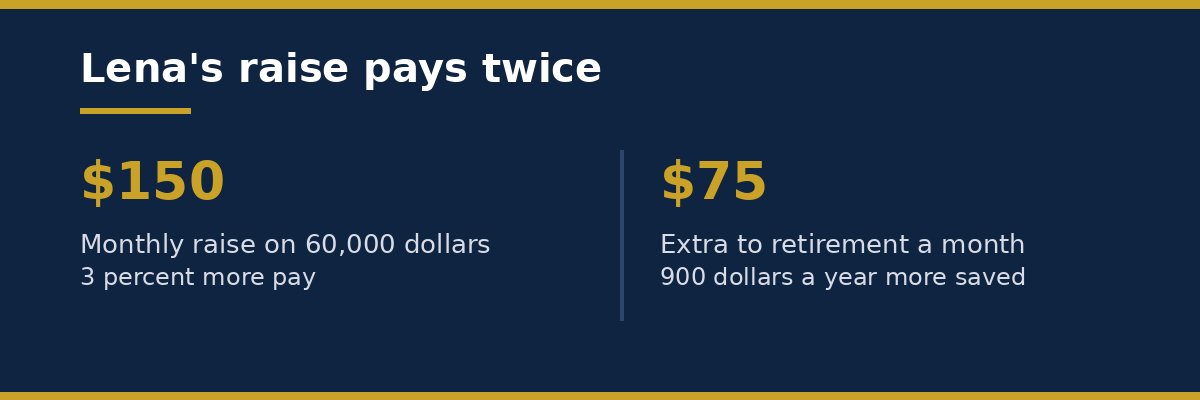
Lena earns 60,000 dollars a year and saves 6 percent of her pay for retirement. That is 3,600 dollars a year, or 300 dollars a month.
Her employer gives her a 3 percent raise. Three percent of 60,000 dollars equals 1,800 dollars a year, or 150 dollars a month. Her new salary is 61,800 dollars.
Lena directs half of the raise to retirement and keeps half. Half of 150 dollars a month is 75 dollars a month, or 900 dollars a year. Her retirement saving rises from 3,600 dollars to 4,500 dollars a year, and her take-home pay still rises by 75 dollars a month. She feels the raise, and her future gets 900 dollars more a year.
Now the long view. Suppose Lena adds an extra 100 dollars a month to her retirement saving and keeps it up for 30 years. Her extra contributions total 36,000 dollars. If that money grows at an average of 7 percent a year, which is an illustration, not a promise, it could reach about 122,000 dollars. The math is 100 dollars a month for 360 months at 7 percent a year, giving about 121,997 dollars. Real returns vary, and no return is guaranteed, but the shape of the result is the lesson: small monthly increases, kept up for decades, grow far beyond the money put in.
If Lena instead waited ten years before adding that 100 dollars a month, she would have only 20 years of growth. The same 100 dollars a month for 20 years at 7 percent reaches about 52,000 dollars in contributions of 24,000 dollars. Waiting ten years costs about 70,000 dollars in this illustration. Starting early matters more than starting big.
When not to increase
There are times when increasing is the wrong move. If you have no emergency fund and a car repair would go on a credit card, build the emergency fund first. If you carry credit card debt at a high rate, paying that down usually saves more than the investment growth you would earn, because the card rate is higher than a typical investment return.
If your income just fell, or you are between jobs, hold the rate steady or lower it for a while. You can raise it again when income recovers. Retirement accounts usually let you change the rate, and lowering it for a few months is not a failure.
How to make the increase: the practical steps
First, log in to your workplace plan and find your current contribution percentage. Write it down, along with the employer match formula and the amount you need to contribute to get the full match.
Second, pick the next moment from the list above: the next raise, the next debt payoff, or the next enrollment. Put a date on it.
Third, decide the size: 1 percent is the default, half a raise is the easy version, and the full freed debt payment is the fast version.
Fourth, make the change. In a workplace plan, change the percentage in the plan portal or with HR. In an IRA, raise the automatic monthly transfer. Do it on the day you decide, not next month, because next month is where increases go to die.
Fifth, check the next paycheck. Confirm the new amount left your pay and reached the account. Then leave it alone until the next review. To learn how much you need to start investing at all, read our guide.
A simple yearly review in ten minutes
Once a year, at enrollment or in January, spend ten minutes on five checks. What is my current percentage? Am I getting the full employer match? Did my pay, my debts, or my costs change this year? Did the IRS limits change? Can I add 1 percent now?
Common mistakes to avoid
The first mistake is waiting for a big jump. Saving 15 percent sounds hard, so people stay at 5 percent for years. Raise it by 1 percent at a time instead.
The second mistake is increasing before capturing the full match. The match is the highest return available, because it is extra pay. Get the full match first, then raise further.
The third mistake is raising the rate and then borrowing to cover daily spending. If the increase pushes you to a credit card, it is too big. Lower it and try a smaller step.
The fourth mistake is forgetting to check the paycheck. A change that was never saved, or was entered wrong, helps nobody. Confirm the first paycheck after every change.
The fifth mistake is never reviewing at all. A rate set at 25 can still be running at 45, while pay has doubled. The yearly review is the fix, and it takes ten minutes.
Frequently asked questions
When is the best time to increase my retirement contributions?
The best time is when your finances gain room: a raise, a bonus, a paid-off debt, a new job, enrollment season, or a rise in IRS limits. A raise is the easiest moment, because you can raise the contribution before the extra money reaches your bank account.
How much should I increase my contribution by?
A 1 percent increase is a good default. On a 60,000 dollar salary, 1 percent is 600 dollars a year, or 50 dollars a month. Raise it by 1 percent each year, or direct half of each raise to retirement, until you reach a rate you can keep.
Should I increase contributions before paying off debt?
Get the full employer match first, then pay off high-interest debt, such as credit cards, before raising retirement contributions further. Once the high-interest debt is gone, redirect that monthly payment into retirement.
How often should I review my retirement contribution rate?
At least once a year, at enrollment or in January, and after any major change: a raise, a new job, a paid-off loan, marriage, a new child, or a move.
What is the 2026 IRA contribution limit?
For 2026, the IRA contribution limit is 7,500 dollars, or 8,600 dollars for people age 50 or older, subject to taxable compensation and other eligibility rules. The total salary reduction contributions across employer plans cannot exceed 24,500 dollars in 2026.
Conclusion, and your first step today
Increase your retirement contributions when life gives you room: a raise, a payoff, a new job, enrollment season, a higher IRS limit, or a life change that lowers your costs. Raise the rate by 1 percent at a time, get the full employer match first, and check the next paycheck to confirm the change landed. Small increases, kept up for decades, build far more than a single big jump that never happens.
Your first step is simple. Log in to your plan today and write down your current percentage and the match formula. If you are below the full match, raise it to the match now.
This post is educational only. It is not financial advice.
Sources
- Principal, When to consider increasing my 401(k) and IRA contributions (200, verified 2026-11-29). Source for the six key moments, the 15 percent guide including the employer match, and increasing at raises, debt payoff, new jobs, enrollment, limit rises, and life changes.
- Gusto, When to consider increasing your retirement contribution rate (403 to curl on 2026-11-29, bot block; content read via search results). Source for the 1 percent yearly increase, redirecting freed debt payments, the three to six month emergency fund first, and catch-up contributions after age 50.
- FirstBank, Retirement Contributions: Small Changes Add Up (200, verified 2026-11-29). Source for the 2026 IRA limit of 7,500 dollars, or 8,600 dollars at age 50 or older, and reviewing contributions after raises, payoffs, and life changes.
- Investors Leap, The 1% 401(k) Increase Strategy (200, verified 2026-11-29). Source for the 1 percent method, raising after a raise or a debt payoff, the annual check-in, and capturing the employer match first.
- Western Southern, When to Increase 401(k) Contributions: 3 Things to Consider (200, verified 2026-11-29). Source for getting the full employer match first, the 1 percent annual increase, and the age, finances, and career factors. Only its general guidance is used here; no 2027 limit figure from this source is used in this draft.
