What Is Dividend Investing?
Dividend investing is a strategy where you buy shares in companies that pay cash dividends, and you build income from those payments. The return comes from the dividends and from share price growth. When you reinvest the dividends to buy more shares, the income buys more income, and that compounding can grow a small portfolio into a meaningful income stream.
This post is educational only. It is not financial advice. It does not recommend any stock or fund, and it does not promise any income.
Dividend investing is a strategy, not a stock pick
Beginners often think dividend investing means buying one stock with a high yield. It does not. A dividend is a payment a company makes to shareholders from its profits, usually in cash, four times a year. Dividend investing is the plan built around those payments: which companies to own, how much income to take versus reinvest, and how to check that the payments are safe.
Our site already explains the pieces: what a dividend is, how dividends work, how often they are paid, and what dividend yield means. This guide goes further: it explains dividend investing as a strategy, including dividend growth versus high yield, the payout ratio, reinvestment, taxes, and the risks that can cut your income. To learn how dividends work first, read our guide.
How the income reaches you
A company board votes on whether and when to pay. The company announces the payment, sets a record date, and pays shareholders who own the shares on that date. Most large companies in the United States pay four times a year. The money lands in your brokerage account as cash, or it buys more shares automatically if you turn on dividend reinvestment.
Two dates matter. The ex-dividend date is the first day a buyer will not get the next dividend, and the payment date is the day the money arrives. The share price usually falls by about the dividend amount on the ex-dividend date. To learn how often dividends are paid, read our guide.
The income is real money, but it is not guaranteed. A company can cut its dividend, pause it, or stop it completely, usually when profits fall or debts rise. That is the central risk of this strategy.
Dividend growth versus high yield: pick your style
There are two main styles inside dividend investing. Dividend growth investing focuses on companies with a track record of raising their payouts year after year. The yield today may be modest, say 2 percent, but the payment grows over time. High yield investing focuses on the biggest payment today, often 4 percent or more. The income starts higher, but the payment may not grow, and it may be less safe. A company paying a very high yield may be in trouble, or its share price may have fallen because the market expects a cut. The yield alone cannot tell you which.
Which style fits you? If you are young and building wealth, dividend growth usually fits better, because the rising payments compound for decades. If you are retired and need income now, a mix with higher yield can fit, but only if the payments are covered by real profits.
Yield, payout ratio, and the yield trap
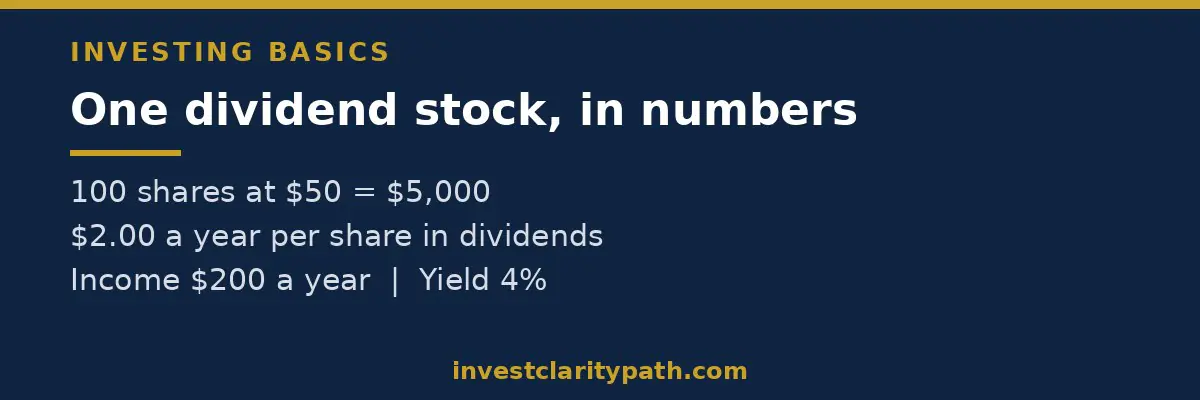
Dividend yield is the annual dividend per share divided by the share price, shown as a percentage. A stock at 50 dollars paying 2 dollars a year has a yield of 4 percent, because 2 divided by 50 equals 0.04. If the price falls to 25 dollars and the dividend stays at 2 dollars, the yield doubles to 8 percent. That may mean the market expects the dividend to be cut. To learn yield in detail, read our guide.
The payout ratio is the better safety check. It is the share of profits a company pays out as dividends. A company earning 4 dollars a share and paying 2 dollars has a payout ratio of 50 percent. That leaves half the profits inside the company to grow the business and to cover a bad year. A payout ratio above 80 or 90 percent leaves little room for trouble, and a ratio above 100 percent means the company is paying more than it earns, which cannot last. A safe dividend usually comes with a payout ratio below about 70 percent for most companies, though the right level varies by industry.
The yield trap is the classic beginner mistake: buying a stock only because its yield is the highest on the list. A 10 percent yield on a falling company is not income. It is a warning. Always check the payout ratio, the profit trend, and the debt before you trust a yield.
Reinvesting dividends: where the growth comes from
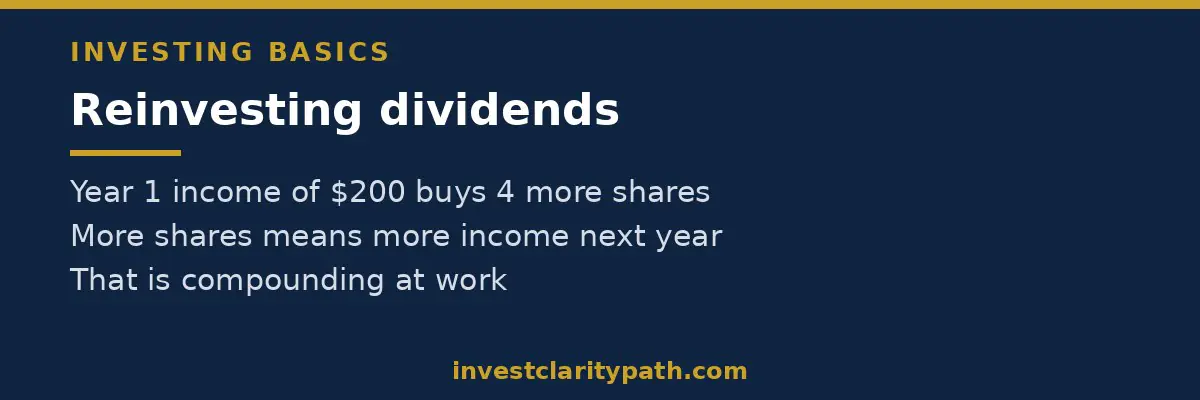
Reinvesting dividends is the engine of this strategy. Instead of taking the cash, you use it to buy more shares of the same company or fund. Those new shares pay dividends too, so your income grows even if the company never raises its payment. Most brokers offer this free as a dividend reinvestment plan, or DRIP. The effect is slow at first and powerful later: after twenty years, the reinvested dividends may have bought a large share of your total holding.
You do not have to reinvest forever. Many investors reinvest while building wealth, then switch to taking the cash when they need income, for example in retirement.
What to look for in a dividend payer
A good dividend payer has four traits: steady profits over many years, a payout ratio that leaves room for a bad year, a history of paying through hard times and ideally raising the payment most years, and manageable debt, so the company does not have to choose between lenders and shareholders.
Some investors look for Dividend Aristocrats, companies that have raised their dividends for at least 25 years in a row. That list is a useful starting point for research, not a recommendation. Use it to find candidates, then check the payout ratio, profits, and debt yourself.
Diversify across industries. Dividend payers cluster in sectors like utilities, banks, consumer goods, and energy. A dividend fund or ETF can spread the risk across many payers at once, for a small fee. To learn what an index fund is, a similar low-cost way to own many companies at once, read our guide.
Taxes: qualified dividends and the 60-day rule
Dividends are taxed, and the tax depends on the type of dividend and the account you hold it in. In the United States, dividends are classified as ordinary or qualified. Qualified dividends are taxed at lower long-term capital gains rates, while ordinary dividends are taxed at your regular income tax rate. The IRS explains in Topic 404 that qualified dividends are ordinary dividends that qualify for the lower rates, and the payer must identify them on Form 1099-DIV.
To get the lower rate, the dividend must come from a United States company or a qualifying foreign company, and you must have owned the investment for more than 60 days during a 121-day window around the ex-dividend date. Qualified dividends are taxed at 0, 15, or 20 percent, depending on your taxable income. For tax year 2026, the 0 percent rate covers single filers with taxable income up to 49,450 dollars, and married couples filing jointly up to 98,900 dollars. Ordinary dividends are taxed at income rates, which go up to 37 percent.
Dividends inside a tax-advantaged account, like a Roth IRA or a 401(k), are not taxed when they are paid. In a taxable brokerage account, you owe tax on dividends in the year they are paid, even if you reinvest them.
Who dividend investing suits, and who it does not
Dividend investing suits investors who want income they can see, who are patient, and who can hold shares for many years. It suits retirees who need cash without selling shares, and younger investors who like watching the income grow and reinvesting it.
It does not suit everyone. If you need the money in a year or two, stocks are too risky, dividends or not. If you want the highest possible growth, young companies that pay no dividend may grow faster, though with more risk. If you cannot stand seeing your income fall when a company cuts its dividend, this strategy will be stressful.
Dividend investing is also not a substitute for diversification. A portfolio of ten dividend stocks is still a stock portfolio, and it will fall when the market falls. Pair it with bonds, cash, and broad index funds. To compare dividend stocks with growth stocks, read our guide.
How to build a dividend plan in five steps
First, decide the goal: building income for retirement, or taking income now. Building means reinvesting everything. Taking income means choosing higher yield and checking each payment.
Second, pick the vehicle. A dividend fund or ETF gives you many payers at once, for a small fee, and it is the simplest start. Individual stocks give you control, but they need more research and monitoring. Most beginners should start with a fund. To learn how fees eat into returns, read our guide.
Third, set the amount. Start with what you can afford after bills, debt payments, and a starter emergency fund. Many beginners start with 50 or 100 dollars a month, reinvesting every dividend. Fourth, turn on dividend reinvestment and automate the monthly amount. Check the plan twice a year: is the payout ratio still safe, and are profits steady?
Fifth, decide in advance what you will do when a dividend is cut. A cut is a reason to review, not a reason to panic. Check whether profits fell and whether the payout ratio was too high. If the business is broken, sell and move the money to a safer payer. Decide the rule before the cut happens, when you are calm.
Worked example: Omar builds income of 200 dollars a year
Omar has 5,000 dollars to invest. He buys 100 shares of a steady dividend-paying company at 50 dollars a share. The company pays 0.50 dollars per share every quarter, which is 2.00 dollars a year per share. His yield is 2.00 divided by 50, or 4 percent. His income is 100 shares times 2.00 dollars, which equals 200 dollars a year.
Omar turns on dividend reinvestment. In the first year, his 200 dollars of dividends buys 4 more shares at 50 dollars a share. He now owns 104 shares. In the second year, those 104 shares pay 208 dollars, which buys about 4 more shares. The company never raises its dividend in this example, and the share price never moves, yet Omar income grows each year, because he owns more shares.
Now suppose the company raises its dividend by 5 percent a year. After ten years, the annual dividend per share would be about 3.26 dollars, and Omar 104 shares would pay about 339 dollars a year. The example is simplified: real share prices move, dividends can be cut, and a 5 percent raise every year is not guaranteed.
Risks to watch before you start
The first risk is a dividend cut. Companies cut dividends when profits fall, debts rise, or a crisis hits. A cut usually comes with a falling share price, so you can lose income and value at the same time. The second risk is the yield trap: a high yield that signals trouble, not value. The third risk is sector concentration. Dividend payers cluster in a few industries, so a bad year for banks or energy can hit many holdings at once.
The fourth risk is inflation. If your dividends grow slower than prices, your income buys less each year. Dividend growth is the best defence, because a rising payment can keep up with rising prices. The fifth risk is tax: dividends in a taxable account are taxed every year, even when reinvested.
Common mistakes to avoid
The first mistake is chasing the highest yield on the list. A 10 percent yield is usually a warning, not a gift. Check the payout ratio and the profit trend before you trust it. The second mistake is owning only a few dividend stocks: one cut can remove a large share of your income. Own many payers, or use a fund.
The third mistake is forgetting the tax: reinvested dividends are still taxed in the year they are paid, in a taxable account. The fourth mistake is selling every time a dividend is cut, or never selling when one is cut. A cut is a signal to review. Check the profits, the debt, and the payout ratio, then decide.
Frequently asked questions
What is dividend investing in simple terms?
Dividend investing means buying shares in companies that pay regular cash dividends, usually four times a year, and building income from those payments. The return comes from the dividends plus growth in the share price.
Is dividend investing good for beginners?
It can be, if you start with a dividend fund or ETF, reinvest the dividends, and hold for many years. It is not good for money you need soon. Beginners should learn the payout ratio and the yield trap before buying individual dividend stocks.
What is a good dividend yield?
A yield of 2 to 4 percent is common for healthy dividend payers. A yield above 6 percent needs a careful check of the payout ratio, the profit trend, and the debt. A very high yield often means the market expects a dividend cut.
Do I pay tax on dividends if I reinvest them?
Yes, in a taxable brokerage account, you owe tax on dividends in the year they are paid, even if you reinvest them. Qualified dividends are taxed at 0, 15, or 20 percent, while ordinary dividends are taxed at your regular income rate. Dividends inside a Roth IRA or 401(k) are not taxed when paid.
Can a company stop paying dividends?
Yes. A company can cut, pause, or stop its dividend at any time, usually when profits fall or debts rise. Diversifying lowers the risk, but no dividend is guaranteed.
Conclusion, and your first step today
Dividend investing means buying shares in companies that pay regular cash dividends, and building income from those payments over time. The return comes from the dividends and from share price growth, and reinvesting the dividends is what makes the income compound. The checks that matter are the yield, the payout ratio, the profit trend, and the debt.
Your first step is simple. Learn the payout ratio, then check three numbers for one dividend fund or company you know: the yield, the payout ratio, and whether the dividend has grown over the last five years. If you cannot find those numbers, do not buy yet.
This post is educational only. It is not financial advice.
Sources
- Experian, What Is Dividend Investing?: https://www.experian.com/blogs/ask-experian/what-is-dividend-investing/
- Equifax, What is Dividend Investing and Qualified Dividends: https://www.equifax.com/personal/education/credit/score/articles/-/learn/dividend-investing/
- Fidelity, Guide to dividend stocks: https://www.fidelity.com/learning-center/smart-money/dividend-stocks
- IRS, Topic 404, Dividends and other corporate distributions: https://www.irs.gov/taxtopics/tc404
- Fidelity, What are qualified dividends?: https://www.fidelity.com/learning-center/trading-investing/qualified-dividends
- IG, What is Dividend Investing?: https://www.ig.com/uk/trading-strategies/what-is-dividend-investing–230828