

How Do I Choose Between a CD and a Savings Account?
How do I choose between a CD and a savings account?
Choose a savings account when you need the money soon or at any time, and choose a certificate of deposit, or CD, when you can leave the money untouched until a fixed date and want a locked interest rate. The choice comes down to one trade: a savings account gives you access, and a CD usually gives you a higher fixed rate in exchange for locking the money away. If you are not sure when you will need the money, the savings account is the safer pick.
This post is educational only. It is not financial advice. It does not recommend any bank, account, or rate, and it does not promise any return.
What a savings account is
A savings account is a deposit account at a bank or credit union where you keep money you want to protect while earning a small amount of interest. You can add money at any time, and you can take money out at any time, usually by transfer, ATM, or in a branch. The interest rate is variable, which means the bank can raise it or lower it at any time as market conditions change.
Savings accounts are built for money with a job in the near future: an emergency fund, a holiday fund, a deposit for a car, or tax money you will pay in a few months. The money stays safe and ready. At a bank insured by the Federal Deposit Insurance Corporation, or FDIC, deposits are insured up to 250,000 dollars per depositor, per bank, for each ownership category. Credit unions have similar protection through the National Credit Union Administration, or NCUA. Bank of America explains that deposits up to 250,000 dollars are insured by the FDIC or the NCUA, and PNC notes the same federal insurance applies to CDs.
The weak point of a savings account is the rate. A regular savings account at a large bank often pays very little interest, sometimes far below inflation. A high-yield savings account pays more, but its rate still moves up and down, so the interest you earn this month may not be the interest you earn next year.
What a CD is
A CD is also a deposit account, but it works on a promise. You agree to leave a lump sum in the account for a fixed term, and the bank agrees to pay a fixed interest rate for that whole term. Terms usually run from three months to five years, and some run to ten years. When the term ends, the CD matures, and you can take the money plus interest, or roll it into a new CD.
The fixed rate is the main attraction. If rates fall after you open the CD, your rate stays the same until maturity. That certainty is valuable when you have a clear date in mind, for example money for a house deposit in two years, or a tax bill due in twelve months.
The cost of that certainty is access. You cannot add money to a standard CD after opening it, and taking money out before maturity usually means paying an early withdrawal penalty. The penalty can be a flat fee, or a number of months of interest, and in some cases it can wipe out all the interest you earned. PNC explains that early withdrawals often incur penalties, and Bank of America warns that the penalty can even cancel out the interest earned. Some banks sell no-penalty CDs, which let you withdraw early without a penalty, but they usually pay a lower rate than a standard CD.
CD vs savings account: the differences that matter
The two accounts differ in five ways, and each one points to a different kind of saver.
First, access. A savings account lets you withdraw at any time. A CD locks the money until maturity, and early withdrawal costs you a penalty.
Second, the rate. A CD usually pays a higher rate than a regular savings account, and the rate is fixed for the term. A savings account rate is variable, so it can rise or fall. A high-yield savings account can sometimes pay as much as a short-term CD, so always compare the actual numbers, not the labels.
Third, adding money. You can add money to a savings account whenever you like. A standard CD takes one deposit at the start, and that is it, until it matures.
Fourth, the minimum deposit. Savings accounts often open with little or no money. CDs often need a larger opening deposit, sometimes a few hundred dollars or more, though some online banks now offer CDs with no minimum.
Fifth, the term. A savings account has no end date. Your money can sit there for as long as you like. A CD has a maturity date, and you must decide what to do when it arrives: withdraw, or renew.
When a savings account is the better choice
Choose a savings account when you need the money soon, or when you cannot predict when you will need it. That covers the emergency fund, which is the most important job for a savings account. If your car breaks down or you lose income for a month, you need the money that day, not after a penalty and a waiting period.
Choose a savings account when you are still building the amount. If you can only save 50 dollars a month, a savings account lets you add it as you go. A CD would force you to wait until you have the full lump sum, and that delay earns you nothing.
Choose a savings account when rates are rising. If the central bank is raising rates, a variable savings rate can rise with them, while money locked in a CD stays at the old, lower rate until maturity.
Choose a savings account when the goal is less than a year away. For a holiday in six months or a car insurance bill in three months, the extra interest from a CD is small, and the risk of needing the money early is real.
To learn how to build an emergency fund first, read our guide.
When a CD is the better choice
Choose a CD when you know you will not need the money until a fixed date, and you want to lock in the rate. A house deposit in two years, a wedding next year, or a tax payment in eighteen months are classic CD jobs. The money has a date, and the CD matches it.
Choose a CD when rates are falling, or when you think they will fall. Locking a rate today protects you if savings rates drop tomorrow. Britannica Money notes that longer-term CDs often offer higher yields, and that the choice often comes down to liquidity versus yield.
Choose a CD when you already have a separate emergency fund. Never put your only safety money into a CD. The CD works only when the emergency fund is already sitting in a savings account, ready to use.
Worked example: 10,000 dollars for one year
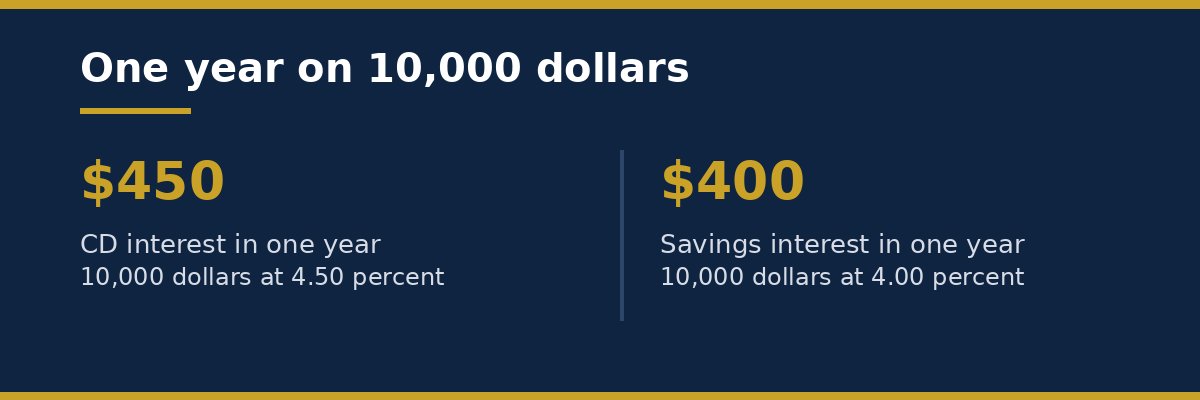
Sara has 10,000 dollars she will not need for one year. She compares two example rates: a savings account paying 4.00 percent and a one-year CD paying 4.50 percent. These are example rates for the math, not real rates from any bank. Real rates change, so always check the current rate before you open an account.
In the savings account, one year of simple interest is 10,000 dollars times 4.00 percent, which equals 400 dollars. In the CD, one year of interest is 10,000 dollars times 4.50 percent, which equals 450 dollars. The CD earns 50 dollars more over the year.
Now suppose Sara needs the money after six months. The savings account lets her withdraw the full 10,000 dollars plus about 200 dollars of interest, with no penalty. The CD charges an early withdrawal penalty equal to 90 days of interest. That penalty is 10,000 dollars times 4.50 percent times 90 divided by 365, which equals about 111 dollars. Her CD interest after six months would be about 225 dollars, so after the penalty she keeps only about 114 dollars. The CD still earns something, but the advantage is mostly gone, and she had to ask the bank and wait.
The lesson is simple: the CD wins by 50 dollars only if the money stays put for the full year. If there is a real chance you will need it early, the savings account wins on flexibility, and flexibility is worth more than 50 dollars.
What if you want both? Use a CD ladder
You do not have to pick one account for all your money. Many savers use both, and one popular way to combine them is a CD ladder.
A ladder splits the money into several CDs with different maturity dates. For example, take 6,000 dollars and open three CDs of 2,000 dollars each: one for six months, one for one year, and one for two years. When the six-month CD matures, you can use the money if you need it, or roll it into a new two-year CD. Every six months or so, one rung matures, so you always have money coming free soon, while most of the money still earns the higher CD rate.
A ladder also protects you against rate changes. If rates rise, the next rung to mature can be renewed at the higher rate. If rates fall, the longer rungs are still locked at the old rate. To learn more about ladders, read our guide on the difference between a savings account and a money market account, which covers similar trade-offs.
Keep the emergency fund out of the ladder. The ladder is for money with a date, not for money you may need tomorrow.
How to compare accounts before you open one
Start with the rate, but read the whole offer. Check whether the savings rate is an introductory rate that drops after a few months, and check whether the CD rate applies to your term and your deposit size.
Check the minimum deposit and the minimum balance. Some accounts charge a monthly fee if the balance falls below a limit, and that fee can eat the interest.
Check the early withdrawal penalty on the CD, in writing, before you deposit. Ask how many months of interest it costs, and whether the penalty can eat into your original deposit. Also check what happens at maturity. Some CDs renew automatically into a new CD of the same term, and you may have only a short grace period, often about ten days, to withdraw without a penalty.
Check the insurance. Confirm the bank is FDIC insured or the credit union is NCUA insured, and keep each ownership category within the 250,000 dollar limit. To compare banks and credit unions in general, read our guide.
The best account is the one that matches how you actually behave, not the one with the highest advertised rate.
Common mistakes to avoid
The first mistake is locking away the emergency fund. A CD is a poor home for money you may need in a crisis, because the penalty arrives at the worst moment. Keep three to six months of expenses in a savings account first.
The second mistake is choosing by the headline rate alone. A five-year CD rate looks high, but if you need the money in one year, the penalty wipes out the advantage. Match the term to the date you need the money.
The third mistake is forgetting the maturity date. A CD that renews automatically can lock your money away again just when you wanted it. Put the maturity date in your calendar, with a reminder a week before.
The fourth mistake is opening a CD with money you are still saving. If you add 100 dollars a month to a goal, keep it in savings until the full amount is ready, then move it to a CD. Otherwise the monthly savings sit earning nothing while they wait.
A simple decision in five questions
Ask yourself five questions, and the answer usually appears.
One, when will I need this money? If the answer is any time, or soon, choose savings. If the answer is a fixed date more than a year away, consider a CD.
Two, do I already have an emergency fund in savings? If not, build that first. A CD comes second.
Three, can I leave the full amount untouched until maturity? If not, choose savings.
Four, is the CD rate clearly higher than the best savings rate for the same period, after fees? If the difference is tiny, the flexibility of savings is worth more.
Five, what happens if rates move? If rates are falling, locking a CD rate helps. If rates are rising, a variable savings rate helps.
If three or more answers point to savings, open the savings account. If three or more point to a CD, open the CD.

Frequently asked questions
Is a CD safer than a savings account?
Both are equally safe at an insured bank or credit union. Both are FDIC or NCUA insured up to 250,000 dollars per depositor, per bank, for each ownership category. The difference is access and rate, not safety.
Can I lose money in a CD?
Your deposit is insured, so you do not lose it to a bank failure within the insurance limit. You can lose interest, and in rare cases a small part of your deposit, if you withdraw early and the penalty is larger than the interest earned. Read the penalty terms before you open the account.
What happens when a CD matures?
At maturity you can withdraw the money plus interest, or renew it into a new CD. Many CDs renew automatically, so check the grace period, often about ten days, during which you can withdraw without a penalty.
Conclusion, and your first step today
A savings account is for money you may need at any time, and a CD is for money you can leave alone until a fixed date. The savings account wins on access, the CD usually wins on rate, and both are equally safe at an insured bank or credit union. The wrong choice is not a disaster, but the right choice is easy: match the account to the date you need the money.
Your first step is simple. Write down when you will need the money and whether you already have an emergency fund in savings. If the date is soon or unknown, open or top up the savings account. If the date is fixed and more than a year away, compare a CD rate with your savings rate, check the penalty, and then decide.
This post is educational only. It is not financial advice.
Sources
- Britannica Money, Certificate of Deposit (CD) vs. Savings Account: Which Is Better? (403 to curl on 2026-11-29, bot block; content read via search results). Source for CD versus savings differences, FDIC protection, CD terms of three months to ten years, and when to choose each account.
- PNC, CDs vs. Savings Accounts: Where to Put Your Extra Money (200, verified 2026-11-29). Source for fixed versus variable rates, early withdrawal penalties, minimum deposits, and using both accounts.
- MoneyRates, CD vs. High-Yield Savings: Which Should You Choose? (200, verified 2026-11-29). Source for the quick answer on flexibility versus locked rates, no-penalty CDs, and adding money only at CD opening.
- Bank of America, Better Money Habits, Savings account vs CD: Which should I choose (content read via search results 2026-11-29). Source for FDIC and NCUA insurance up to 250,000 dollars and the risk of a penalty cancelling out CD interest.
