

What Is a Dividend Yield, and Why Does It Matter?
What is a dividend yield?
A dividend yield is the amount of cash income a stock pays you each year, shown as a percentage of the stock price. It tells you how much money you get back each year for every 100 dollars you put in, from dividends alone.
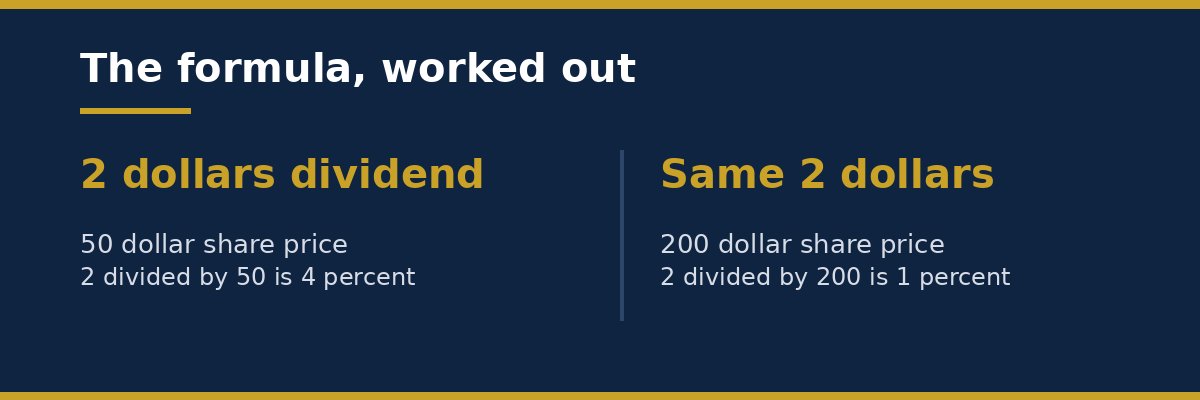
Here is the formula. Dividend yield equals the annual dividend per share, divided by the current share price, times 100. If a stock pays 2 dollars a year in dividends and costs 50 dollars a share, the yield is 4 percent, because 2 divided by 50 is 0.04, and 0.04 times 100 is 4. That means every 100 dollars you invest pays you about 4 dollars a year in dividends, if the dividend does not change.
Why does it matter? Because a dividend in dollars means very little on its own. A stock that pays 2 dollars a year sounds generous until you learn it costs 200 dollars a share. As a yield, that same payout is only 1 percent, which tells a very different story. Yield lets you compare stocks with very different prices, and compare a stock with a bond or a savings rate, on equal terms.
This guide explains the formula with worked examples, what counts as a good yield, and when a very high yield is a warning sign instead of a bargain. It is educational only. It is not financial advice, and it is not a recommendation to buy or sell any stock.
The formula, step by step
The dividend yield formula is short. Dividend yield, as a percent, equals annual dividends per share divided by the current share price, times 100.
To use it, you need two numbers. First, the annual dividend per share. This is the total dividend the company pays on one share over a full year. If a company pays 50 cents every three months, that is four payments a year, so the annual dividend is 2 dollars, because 0.50 times 4 is 2. Second, the current share price, which is what one share costs today.
Divide the first number by the second, then multiply by 100 to turn it into a percent. That is the whole formula. It is a snapshot, not a promise. Both numbers can change. The company can raise or cut its dividend, and the share price moves every trading day, so the yield moves with it.
Worked example 1: a 4 percent yield
Imagine a stock that costs 50 dollars a share and pays a dividend of 50 cents every three months. First, work out the annual dividend. Four payments of 50 cents is 2 dollars a year, because 0.50 times 4 is 2. Then divide by the price. 2 divided by 50 is 0.04. Multiply by 100, and the yield is 4 percent.
What does 4 percent mean in cash? If you invest 1,000 dollars in this stock, you buy 20 shares, because 1,000 divided by 50 is 20. Each share pays 2 dollars a year, so 20 shares pay 40 dollars a year, because 20 times 2 is 40. That is 4 percent of 1,000 dollars, which matches the yield.
Now imagine a second stock. It also pays 2 dollars a year, but it costs 200 dollars a share. The yield is 1 percent, because 2 divided by 200 is 0.01, and 0.01 times 100 is 1. Same dividend, very different yield. The first stock pays you four times as much income for each dollar you invest. That is why yield matters more than the dividend in dollars.
Worked example 2: when the price falls, the yield rises
Yield moves in the opposite direction from price. If the price falls and the dividend stays the same, the yield goes up. If the price rises and the dividend stays the same, the yield goes down.
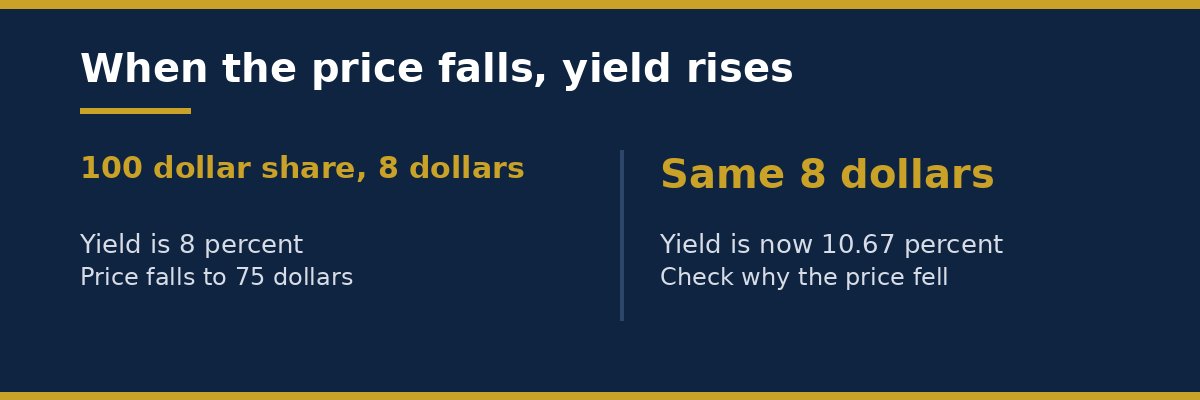
Imagine a stock that costs 100 dollars and pays 8 dollars a year in dividends. The yield is 8 percent, because 8 divided by 100 is 0.08, and 0.08 times 100 is 8. Now imagine the share price falls to 75 dollars, while the dividend stays at 8 dollars. The new yield is 10.67 percent, because 8 divided by 75 is 0.1067, and 0.1067 times 100 is 10.67.
The yield rose, but nothing about the company improved. The price fell, and the yield went up by arithmetic alone. This is the most important thing to understand about dividend yield. A rising yield can mean the company raised its payout, which is good, or that the share price fell, which may be bad. You have to check which one it is.
What is a good dividend yield?
There is no single good number, because it depends on the type of company, the sector, and what interest rates are doing. As a rough guide, many established dividend-paying companies sit somewhere between 2 percent and 5 percent. That is a starting point, not a target.
Growth companies often pay no dividend at all. They keep their profits and reinvest them in the business, to grow faster. That is not a flaw. It is a choice, and it means yield tells you nothing about those companies, because there is no dividend to measure.
Utility companies, banks, and large established companies often pay higher yields, because they grow slowly and return cash to shareholders instead. A yield of 4 or 5 percent from a steady company is normal in those sectors. The same yield from a fast-growing technology company would be unusual, and worth a closer look.
The S&P 500 as a whole usually yields around 1 to 2 percent, because it includes many growth companies that pay little or nothing. Comparing a single stock with that average is a useful check. A stock that yields far above the market average is either a generous payer or a company in trouble. The yield alone cannot tell you which.
When a high yield is a warning sign
A very high yield can be tempting. It can also be a trap. Remember the formula. Yield is the dividend divided by the price. If the share price falls sharply, the yield jumps, even though nothing about the dividend has changed yet.
Imagine a company that pays 4 dollars a year and its shares cost 100 dollars. The yield is 4 percent. Now the company runs into trouble, and the share price falls to 40 dollars. The yield is suddenly 10 percent, because 4 divided by 40 is 0.10. It looks like a bargain. But the price fell for a reason, and the next step is often a dividend cut. If the company cuts the dividend from 4 dollars to 1 dollar, the yield on the new price is only 2.5 percent, because 1 divided by 40 is 0.025.
Before you trust a high yield, check three things. First, is the dividend covered by earnings? If the company pays out more in dividends than it earns, the payout cannot last. Second, has the dividend been steady for years, or has it been cut before? A long record of steady or rising payments is a better sign than one good year. Third, why did the price fall? If the whole market fell, the yield rise may be harmless. If only this company fell, find out why before you buy.
A high yield is a starting point for research, not a verdict. The companies that pay steady dividends for decades are worth more attention than the ones with the highest number today.
Dividend yield vs other ways to earn income
Dividend yield is one way to earn income from investments, and it helps to compare it with the alternatives.
A savings account pays interest, and the rate can change at any time, but the money is safe and easy to reach. A bond pays interest too, and the payments are fixed until the bond matures, but the price of the bond can fall if interest rates rise. A dividend stock pays income that can grow over time, because companies often raise their dividends, but the payments are not guaranteed, and the share price can fall.
The trade is simple. Dividends can grow, but they are not promised. Interest from a savings account or a bond is more certain, but it usually grows more slowly, or not at all. Many investors hold a mix, some safe income and some dividend income, so they are not depending on one source alone.
One more point matters for beginners. Dividends are usually taxed in the year you receive them, and the tax rules depend on where you live and what kind of account holds the stock. In a retirement account, the tax treatment is often different from a regular taxable account. This article does not cover tax rules in detail, because they change, and they depend on your situation. Check the rules for your own country and account type before you decide anything.
How beginners actually use dividend yield
Most beginners use dividend yield in three simple ways. First, to compare two similar stocks. If two companies in the same sector pay different yields, the yield tells you which one pays more income per dollar invested, and then you check why they differ.
Second, to check whether a stock fits an income goal. If you want income from your investments, a yield of 3 or 4 percent from a steady payer may fit, while a stock that pays nothing does not, no matter how fast it grows.
Third, to spot a warning sign. If a yield is far above its sector average, or far above its own history, that is a reason to look closer, not a reason to buy at once.
What beginners should not do is chase the highest yield they can find. The highest yield on the market is usually the highest for a reason, and that reason is often trouble. A steady yield from a company with a long record of paying is worth more than a spectacular yield from a company that may cut its dividend next quarter.
Related reading: How Does Compound Interest Work?, What Is an Index Fund, and Why Do Beginners Use It?, What Is an ETF, and How Is It Different From a Stock?, What Is Risk in Investing, in Simple Terms?, What Is Diversification, and Why Does It Matter?.
Frequently asked questions
What is a good dividend yield for a beginner?
There is no single good number. Many established dividend payers sit between 2 and 5 percent. What matters more than the number is whether the dividend is steady, covered by earnings, and paid by a company with a long record. A steady 3 percent is usually better than a shaky 8 percent.
Is a high dividend yield good or bad?
It can be either. A high yield is good when the company is healthy and the dividend is well covered by earnings. It is bad when the yield is high only because the share price fell, and the dividend is about to be cut. Always check why the yield is high before you decide.
Do all stocks pay dividends?
No. Many companies, especially fast-growing ones, pay no dividend at all. They reinvest their profits in the business instead. A stock with no dividend can still be a good investment, if its price grows, but it will not pay you cash income while you hold it.
How often are dividends paid?
Most US companies that pay dividends do so every three months, so four times a year. Some pay once a month, and some pay once or twice a year. The annual dividend per share is the total of all the payments in a year, and that is the number you use in the yield formula.
Can a dividend yield change every day?
Yes. The yield changes whenever the share price changes, which is every trading day, and whenever the company changes its dividend. That is why yield is a snapshot, not a fixed rate. The yield you see today is not the yield you will get next year.
Conclusion, and your first step today
Dividend yield is the annual dividend a stock pays, divided by its price, shown as a percent. A 2 dollar dividend on a 50 dollar share is a 4 percent yield, and the same 2 dollars on a 200 dollar share is only 1 percent, so yield is what lets you compare income across stocks. A steady yield between 2 and 5 percent from a company with a long record is normal, and a very high yield is a reason to look closer, because it often means the price fell and a dividend cut may follow.
Your first step today is to look up one stock you already know, find its annual dividend and its current price, and work out the yield yourself. Divide the dividend by the price, multiply by 100, and write the answer down. Then check whether that yield is above or below the yields of similar companies. That one calculation is the skill this whole guide is about, and once you can do it, you can read any dividend stock with confidence.
Disclaimer: This article is for education only. It is not financial advice, and it does not guarantee any result. It is not a recommendation to buy or sell any stock or fund. Your income, costs, debts, and goals are personal, and you should consider your own situation, and speak to a qualified professional if you need personal advice, before making a financial decision.
Sources
- Fidelity, Dividend yield: What it is and how to calculate it: https://www.fidelity.com/learning-center/trading-investing/dividend-yield
