


What Happens If I Miss a Debt Payment?
If you miss a debt payment, three things happen in order. First, your lender charges a late fee, often the day after the due date, and interest keeps growing on the balance. Second, if you are still unpaid 30 days after the due date, the lender can report the late payment to the credit bureaus, and it can stay on your credit report for up to seven years. Third, if you stay unpaid for months, the account can be charged off, sold to a collector, and in some cases taken to court.
One missed payment is fixable, and the sooner you act, the smaller the damage.
This post is educational only. It is not financial advice.
What happens first
Missing a payment does not mean your debt disappears. It means the clock starts, and the first effects arrive fast.
A late fee comes first. Most agreements let the lender charge a fee as soon as the due date passes. The amount depends on your lender and your agreement, so check your statement for the exact number.
Interest keeps growing at the same time. On a credit card, interest is charged daily on the unpaid balance, so every day you wait adds a little more. On a loan with daily simple interest, a missed payment means more of your next payment goes to interest and less goes to reducing the balance.
Nothing reaches your credit report yet. Lenders usually report a payment as late only once it is 30 days past the due date.
The timeline, day by day
A missed payment follows a fairly fixed timeline. The exact dates depend on your lender and the type of debt, but the pattern below is how it usually works.
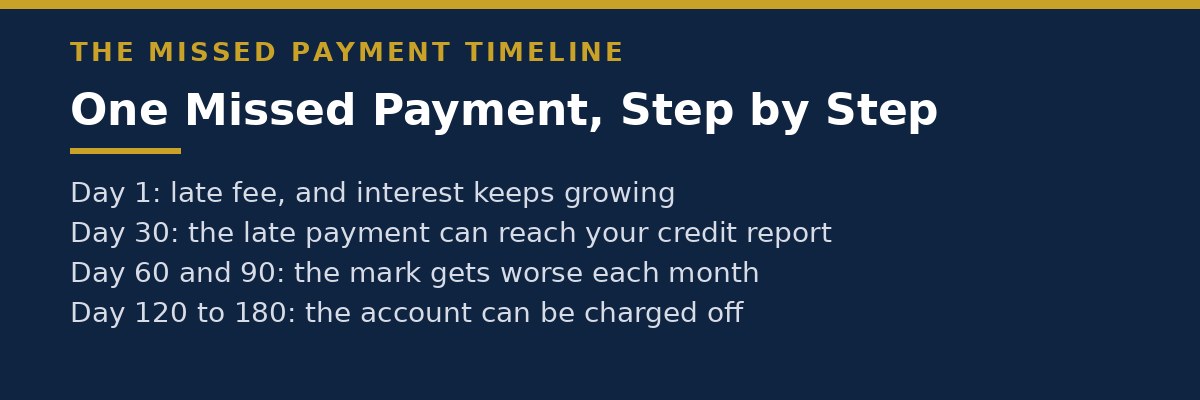
Day 1: the payment is late. A late fee may be charged and interest keeps adding up. At this stage the damage is small: pay what you owe as soon as you can.
Day 30: the late payment can reach your credit report. Once a payment is 30 days past due, your lender can report it to the three major credit bureaus, Equifax, Experian, and TransUnion. The Consumer Financial Protection Bureau explains that an account is usually still reported as current if paid within 30 days, and most negative information can be reported for seven years.
Day 60: the mark gets worse. The account is reported as 60 days late, and your lender may raise your rate.
Day 90: the account is seriously past due. Experian reports that a 90 day late payment could drop an excellent credit score by 110 to 130 points, and your lender may stop letting you use the card. For a car loan or a mortgage, this is the point where repossession or foreclosure steps can begin.
Day 120 to 180: charge-off and collections. If an account stays unpaid for a long time, typically 120 to 180 days, the creditor may charge it off, which means the lender has written the debt off its own books as a loss. It does not mean you no longer owe the money: the lender may sell the debt to a collector, and a collector can later sue, which can lead to wage garnishment or a bank levy depending on your state law.
For debts tied to something you own, the timeline is shorter. The National Foundation for Credit Counseling explains that for loans with collateral, such as car loans and mortgages, the lender will likely begin repossession or foreclosure after three missed payments. Rent works differently: a landlord can start eviction after only a few days in some states, even though missed rent may not reach your credit report unless it goes to collections.
How much can one missed payment hurt your credit score
Your credit score is built from your payment history more than anything else, so a late payment hits the part that matters most. How far your score falls depends on where it starts and how late the payment is.
Experian reports that a borrower with an excellent credit score could see a drop of around 60 to 80 points after a single 30 day late payment, and 110 to 130 points for a 90 day late payment.
The mark stays on your credit report for up to seven years, counting from the date of the missed payment. Its weight fades over time: as you add more on-time payments, the old late mark matters less, and lenders care most about your recent history.
An accurate late payment cannot be removed by disputing it. You can dispute a late payment only if it is wrong, for example if you did pay on time and the lender reported it wrongly. If the late payment is accurate, the only ways it comes off early are time passing, or the lender agreeing to stop reporting it as a favour, which is called a goodwill adjustment and is never guaranteed. The Consumer Financial Protection Bureau warns not to pay any company that promises to remove accurate negative information from your credit report.
What a penalty APR is
A penalty APR is a much higher interest rate your card issuer can charge after you miss payments, often 29.99 percent or higher after two missed payments, according to Experian. Under federal law, the issuer must review your account and lower the rate again after six months of on-time payments. A penalty APR is one more reason to act fast: a higher rate makes the balance grow faster, which makes the next payment harder.
What happens with different kinds of debt
A credit card is the most common case: a late fee, a lost grace period, a possible penalty APR after two missed payments, and charge-off after about four to six months. A personal loan works much the same way, except a missed payment can also push the end date further away, since more of the next payments go to interest first.
A car loan and a mortgage are secured debts, so the lender can take the car or start foreclosure after a few missed payments. If you think you will miss a mortgage payment, call your loan servicer before the due date, not after, because hardship options are much easier to get before you are already behind.
A federal student loan has its own default process, different from a card or a car loan, so contact your loan servicer and ask about income-driven repayment. Buy now, pay later plans are mixed: some are reported to the credit bureaus and some are not.
Worked example: Maya misses one card payment
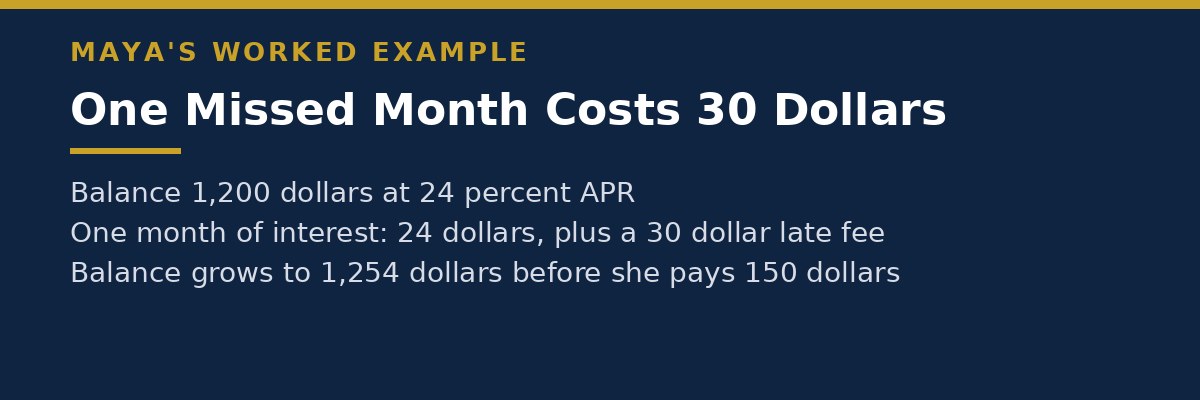
Maya has a credit card with a 1,200 dollar balance and a 24 percent APR. Her minimum payment is due on the 5th of the month. She forgets, and she does not pay until the 12th, seven days late. Here is what the miss costs her, using a 30 dollar late fee as the example fee in her agreement.
First, work out one month of interest. A 24 percent APR means 2 percent a month, because 24 divided by 12 is 2, and 2 percent of 1,200 dollars is 24 dollars.
Second, add the late fee. Her balance is 1,200 dollars, plus 24 dollars of interest, plus a 30 dollar late fee, which equals 1,254 dollars. The miss has added 54 dollars to what she owes, and she has not bought anything new.
Third, she pays 150 dollars on the 12th. Her balance falls to 1,104 dollars, because 1,254 minus 150 is 1,104. If she had paid the same 150 dollars on time, her balance would have been 1,074 dollars. The difference is 30 dollars, the late fee.
Now change one fact. Suppose Maya does not pay for 40 days instead of 7. She still owes the fee and the interest, but now the lender can also report a 30 day late payment, which can stay on her credit report for up to seven years.
The lesson is plain: pay before day 30 if you possibly can, even if you can only pay the minimum.
What to do right now if you missed a payment
Act in this order, today if you can.
Step one, pay the bill right away, online, by phone, or in person. Pay at least the minimum if you cannot pay the full balance. The most important thing is to pay within 30 days of the due date so the late payment is not reported to the credit bureaus.
Step two, call your lender. Confirm the payment has been made, then ask: can the late fee be waived, and can the account be marked current? If you have a clean payment history, many card issuers will waive a first late fee as a courtesy.
Step three, check what else changed. Ask whether your interest rate changed, whether your grace period still applies, and what your next due date and minimum payment are. Write down what they agreed to.
Step four, check your credit report. Get your free reports from AnnualCreditReport.com, the only federally authorized source. If the late payment is not there yet, you caught it in time. If it is there and it is accurate, do not pay a credit repair company to remove it. If it is there and it is wrong, dispute it with the credit bureau first, then with the lender.
Step five, ask about a goodwill letter if the mark is already reported: a short letter to your lender explaining that the miss was a one-off mistake, asking them to stop reporting the late payment.
Step six, set up a safeguard: put at least the minimum payment on autopay for every card and loan, and add a calendar reminder three days before each due date.
If you cannot pay at all, do not hide. Read our guide on talking to your lender when you cannot pay. It explains what to say on the call and what hardship options to ask about. Calling early gives you far more options than waiting until the account is 90 days late.
What to do if you cannot pay at all
Sometimes the problem is not a forgotten payment. It is that the money is not there. If that is your situation, list your debts and your due dates, and pay the secured ones first: rent, mortgage, car loan, and utilities.
Call every lender before the due date and explain the situation. Ask about a hardship plan, a lower payment for a few months, or a pause in payments. Lenders would rather get something than nothing.
Get free help from a nonprofit credit counselor. The National Foundation for Credit Counseling can connect you with a nonprofit agency that will review your budget and your debts with you.
Avoid credit repair companies that promise to remove accurate late payments, and avoid any company that asks for a large fee before it does any work. The Consumer Financial Protection Bureau is clear: do not pay fees to repair your credit history.
To rebuild after a missed payment, start with a plan you can keep. Read our guide on making a debt payoff plan. And if the choice is between paying debt and keeping savings, read our guide on whether to use savings to pay off debt.
Common mistakes to avoid
The first mistake is waiting to see what happens. Every day you wait adds interest, and day 30 turns a fee into a seven year mark. Pay something today, even if it is only the minimum.
The second mistake is paying a credit repair company to remove an accurate late payment. It cannot be done, and the fee is wasted money that could have gone to the debt itself.
The third mistake is using a new card to pay the old one. It adds a second bill and a second chance to miss.
The fourth mistake is closing the card after a missed payment. Closing a card can raise your credit utilization, which is the share of your available credit that you are using, and that can push your score down further.
If you are only paying the minimum on a card while you recover, read our guide on what happens if you only pay the minimum. And to clear the balance faster once you are back on track, read our guide on paying off debt faster with extra payments.
Frequently asked questions
What happens if I miss a debt payment by one day?
You may be charged a late fee, and interest keeps growing, but the late payment usually does not reach your credit report. Lenders typically report a payment as late only once it is 30 days past due. Pay it right away.
How long does a missed payment stay on my credit report?
A missed payment can stay on your credit report for up to seven years, according to the Consumer Financial Protection Bureau. Its effect on your score fades as you add on-time payments.
Will one missed payment ruin my credit score?
One missed payment hurts, but it does not ruin your credit forever. Experian reports that an excellent score could fall by around 60 to 80 points after a single 30 day late payment. The score recovers as you pay on time in the months that follow.
Can I get a late payment removed from my credit report?
Only if it is wrong. You can dispute an inaccurate late payment with the credit bureau and the lender. An accurate late payment generally cannot be removed by dispute, and no company can remove it for a fee.
Conclusion, and your first step today
A missed debt payment starts small and grows on a fixed timeline. Day one brings a late fee and more interest. Day 30 can put a mark on your credit report for up to seven years. Day 60 and day 90 make the mark worse and can trigger a penalty APR. Day 120 to 180 can end in a charge-off and a collection account.
But the same timeline gives you a clear window: pay within 30 days and the mark may never appear, and a first late fee is often waived if you call.
Your first step today is simple. Log in to the account, pay at least the minimum right now, and then call the lender to confirm it and ask for the fee to be waived.
This post is educational only. It is not financial advice.
Sources
- Experian, What to Do if You Miss a Payment: https://www.experian.com/blogs/ask-experian/what-to-do-if-you-miss-a-payment/
- Consumer Financial Protection Bureau, Understand Your Credit Report: https://files.consumerfinance.gov/f/documents/cfpb_understand_your_credit_report_handout.pdf
- National Foundation for Credit Counseling, Americans Not Paying Bills on Time, and Why That Is Bad: https://www.nfcc.org/blog/americans-not-paying-bills-on-time-and-why-thats-bad/
- Capital One, How to Remove Late Payments From Credit Report: https://www.capitalone.com/learn-grow/money-management/remove-late-payments-from-credit-report/
