
How Do Dividends Work in Simple Terms?
A dividend is cash a company pays you for owning its shares. When a company earns a profit, it can keep the money to grow the business, or it can share some of it with the people who own its stock. That shared money is the dividend, and it lands in your brokerage account as cash.
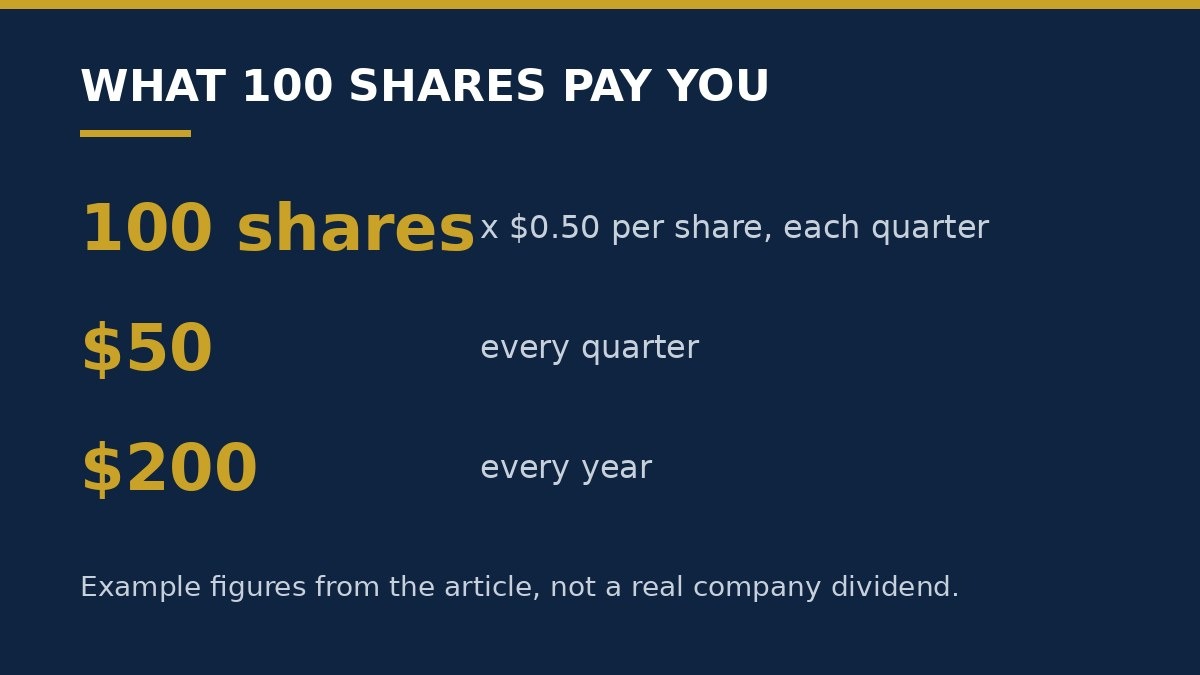
How do dividends work, in short? You buy shares in a company that pays dividends. The company announces a set amount per share. If you own the shares before the cut-off date, you get that amount for every share you own. At $0.50 per share each quarter, 100 shares pay $50 a quarter, or $200 a year.
Dividends are one of the two ways shares can earn you money. The other is a rising share price. With dividends, you do not have to sell anything. You keep your shares, and the cash still arrives.
What Is a Dividend?
A dividend is a payment a company makes to its shareholders from its profits. The US Securities and Exchange Commission explains it simply: investors buy stocks for reasons that include dividend payments, which come when the company distributes some of its earnings to stockholders. Not every company pays one. Young, fast growing companies often keep all their profit to fund growth, while older companies with steady profits are more likely to pay.
Think of it like owning a small slice of a shop. If the shop makes a profit, the owners can take some of it out as a reward. As a shareholder, you are a part owner, so your share of the reward is your dividend. The more shares you own, the bigger your payment, because dividends are paid per share.
How Dividends Work, Step by Step
Dividends follow the same five steps almost every time.
Step 1: The company earns a profit
Everything starts with profit. A company sells goods or services, pays its costs, and what is left is profit. No profit means no money to share.
Step 2: The board decides how much to share
The company’s board of directors decides whether to pay a dividend and how much it will be per share, weighing how much cash the business needs to keep growing.
Step 3: The company announces the payment
The company announces the dividend, the amount per share, and the dates that matter. This announcement is public, so you know exactly how much you will receive per share, and when.
Step 4: You must own the shares by the cut-off date
This is the step beginners most often miss. You only receive the dividend if you own the shares before the ex-dividend date. Buy on or after that date, and you miss this payment.
Step 5: The cash is paid into your account
On the payment date, the cash usually goes straight into your brokerage account. You can then take it out, leave it there, or reinvest it to buy more shares.
The Four Dates That Decide If You Get Paid
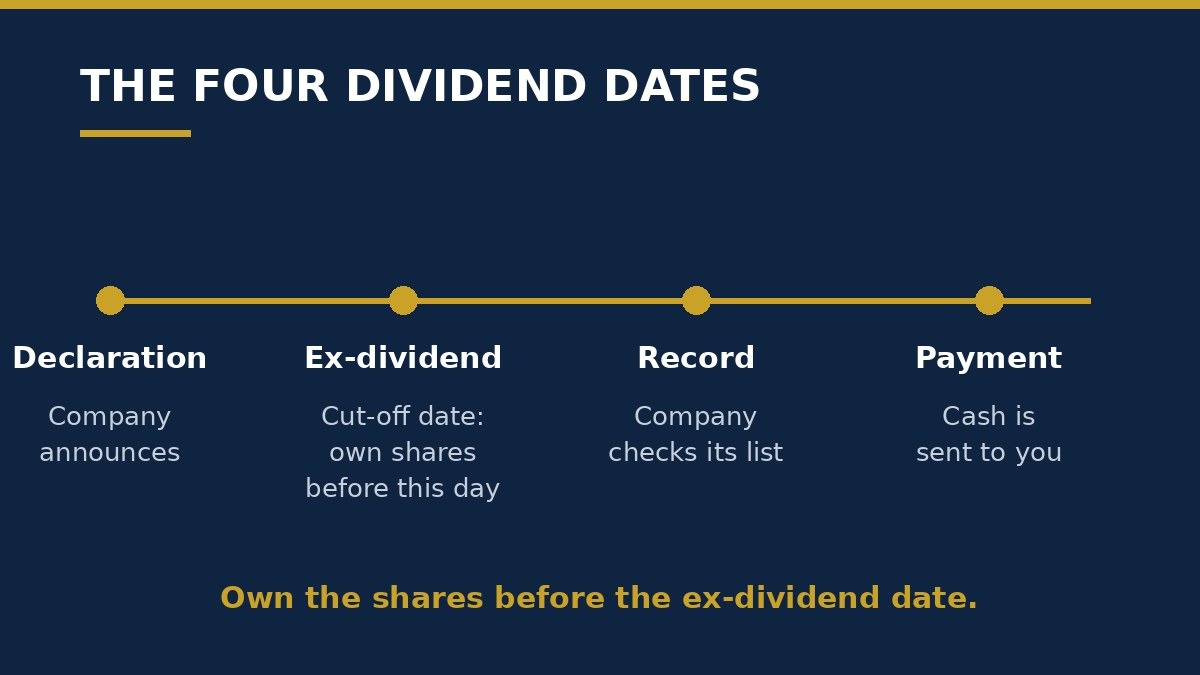
Every dividend has four dates.
- Declaration date. The day the company announces the dividend, the amount per share, and the other three dates. Think of it as the company saying, in public, that a payment is coming.
- Ex-dividend date. The cut-off date. You must own the shares before this date to receive the dividend. If you buy on or after it, you do not get this payment. If you sell after it, you still get it.
- Record date. The day the company checks its list of shareholders to see who gets paid. In the United States, the ex-dividend date is normally the same day as the record date, or one business day before it.
- Payment date. The day the money is sent to shareholders, often a few weeks after the record date.
Remember it this way: declaration is the announcement, ex-dividend is the cut-off, record is the list, and payment is the cash. If you only remember one date, remember the ex-dividend date.
Three Types of Dividends
Most dividends are cash dividends, but there are two other types worth knowing.
- Cash dividends. The company pays you money for each share you own. This is the most common type, and it is the type used in the worked example below. In the United States, companies usually pay every three months, which is called quarterly, though some pay monthly, twice a year, or once a year.
- Stock dividends. Instead of cash, the company gives you extra shares. If a company pays a 5 percent stock dividend and you own 100 shares, you receive 5 extra shares, giving you 105 shares in total.
- Special dividends. A one-off extra payment, on top of the regular dividend, for example after a very good year. Do not count on it repeating.
Owners of common stock can receive dividends and can vote at shareholder meetings. Owners of preferred stock usually cannot vote, but they are paid before common stockholders. For most beginners, common stock is the usual starting point.
Worked Example: What 100 Shares Pay You
Here is a worked example with simple numbers. The figures below are example figures for teaching the maths, not a real company’s actual dividend.
Imagine a company that pays a dividend of $0.50 per share, four times a year. You own 100 shares.
- Dividend each quarter: 100 shares times $0.50 per share equals $50.
- Dividend each year: $50 per quarter times 4 quarters equals $200.
- Annual dividend per share: $0.50 times 4 equals $2.00 per share per year.
So you receive $50 every three months, or $200 over the year, without selling a single share. Your shares are still yours, and they may also rise or fall in price. The dividend is separate from the share price.
Now work out the dividend yield, which investors use to compare dividends. The yield is the annual dividend per share divided by the share price, shown as a percentage. Suppose the share price is $40 and the annual dividend is $2.00. The yield is $2.00 divided by $40, which equals 0.05, or 5 percent. If the price rises to $50, the yield falls to 4 percent. If the price falls to $25, the yield rises to 8 percent, which is not always good news, because it can mean the price has fallen for a real reason.
What to Do With Your Dividends: Cash or Reinvest
When a dividend arrives, you have two choices. You can take the cash, or you can reinvest it to buy more shares. Taking the cash gives you income you can spend or save elsewhere. Reinvesting means using the dividend to buy more shares, often automatically through a dividend reinvestment plan, known as a DRIP.
Here is how the maths works with our example figures. You start with 100 shares and receive $200 in dividends over a year. You reinvest the $200 at a share price of $40, which buys 5 more shares, because $200 divided by $40 equals 5. You now own 105 shares. Next year, if the dividend stays at $2.00 per share, you receive 105 times $2.00, which equals $210. That extra $10 came from the 5 new shares. Over many years, this growth can add up. This is the same compounding effect explained in our guide to how compound interest works. If you do not need the income now, reinvesting is often the better choice. If you need it now, take the cash.
Which Companies Pay Dividends?
Dividends are most common among large, established companies with steady profits. These businesses have sold the same products for years and earn regular cash. The SEC calls them income stocks, which pay dividends consistently, and gives an established utility company as a typical example. Blue-chip stocks, shares in large, well-known companies with a solid history of growth, also generally pay dividends.
By contrast, young technology start-ups rarely pay dividends. They keep their profits to fund growth. No list of dividend payers stays correct for long, because companies start, raise, cut, or stop dividends as their business changes. Before you buy any company for its dividend, check its recent dividend history, and never buy on the size of the yield alone.
Dividends From Funds: Index Funds and ETFs
You do not need to pick single companies to receive dividends. Many funds pay them too. An index fund holds a basket of many companies, and when those companies pay dividends, the fund collects them and passes them on to you. Our guide on what is an index fund and why beginners use it explains how that basket works. An ETF works in a similar way: it holds a basket of shares you can buy and sell like a single stock, and it usually pays out the dividends it collects. Our guide on what is an ETF and how it is different from a stock explains the difference.
Funds usually pay dividends every three months or once a year. The amount changes each time, because it depends on what the companies in the fund actually paid. A fund gives you dividend income from many companies at once, without you having to research each one yourself.
Do You Pay Tax on Dividends?
Yes, in most cases dividends are taxable income. The IRS explains the rules in Topic 404, which covers dividends. In simple terms, there are two kinds: qualified dividends, usually taxed at lower capital gains rates, and ordinary dividends, usually taxed at your normal income tax rate. Your broker will send you a tax form each year showing how much you received and how much of it was qualified. Tax rules change, so check the current IRS guidance or speak to a qualified tax adviser about your own position.
The Risks: Dividends Are Never Guaranteed
Dividends look like steady income, but they are never guaranteed. A company can cut, pause, or stop its dividend at any time, usually when profits fall or the business runs into trouble. When a dividend is cut, the share price often falls at the same time.
- The dividend can be cut. Past payments are not a promise of future payments.
- A high yield can be a trap. If a share price falls sharply, the yield rises, because the same dividend is now divided by a smaller price.
- The share price can fall. Dividends do not protect you from price falls. You can receive $200 in dividends in a year and still lose far more if the share price drops.
- One company is one risk. If all your dividend income comes from a single company and it cuts its payment, your income drops at once. Our guide on what diversification is and why it matters explains how spreading your money lowers that risk.
None of this means dividends are bad. They are one part of a plan, not a guarantee.
Mistakes Beginners Make With Dividends
- Buying only for the highest yield. A very high yield often signals trouble, so check the company’s profits and dividend history before you buy.
- Buying just before the ex-dividend date to grab one payment. The share price usually falls by roughly the dividend amount on that date, so the quick gain is often an illusion.
- Ignoring the tax bill. Dividends are income in most cases, so set money aside for tax if your dividends are large enough to matter.
- Forgetting that dividends can be cut. Never build a budget that depends on a dividend staying exactly the same.
- Putting everything in one dividend stock. One company can cut its dividend at any time, so spread your money, and consider a fund if you want dividend income from many companies at once.
How to Start With Dividends, Step by Step
- Learn the basics first with our guide on what is a dividend, so you know what you are buying and why.
- Write a simple first investment plan. Our guide on what is a simple first investment plan walks through setting a goal, choosing an account, and deciding how much to invest each month.
- Start with a broad fund. For most beginners, a low cost index fund or ETF that pays dividends is simpler than picking single companies.
- Check the fund’s dividend history. Look at how much it has paid in recent years and how often it pays.
- Decide cash or reinvest. If you do not need the income now, set up automatic reinvestment. If you need the income, take the cash.
- Add money regularly, and review once or twice a year.
Frequently Asked Questions
How much money do I need to start earning dividends?
You can start with a small amount, because most brokers now let you buy a single share, or even part of a share. In the worked example, 100 shares earn $200 a year, while 10 shares earn $20 a year.
How often are dividends paid?
In the United States, most companies pay dividends every three months, which is called quarterly. Some pay every month, twice a year, or once a year. The company’s announcement tells you the exact dates.
Do I have to pay tax on dividends?
In most cases, yes. The rate depends on whether the dividend is qualified or ordinary. Your broker sends you a tax form each year showing what you received. Check the IRS guidance in Topic 404 or speak to a qualified tax adviser.
Can a company stop paying dividends?
Yes. A company can cut, pause, or stop its dividend at any time, usually when profits fall or the business needs cash. Past payments are not a promise of future payments. That is why many beginners prefer a fund that collects dividends from many companies.
What is dividend yield?
Dividend yield is the annual dividend per share divided by the share price, shown as a percentage. In the worked example, $2.00 on a $40 share price gives a yield of 5 percent. Yield lets you compare dividends, but a high yield alone is not a reason to buy.
Conclusion
Dividends work in a simple way: a company earns a profit, its board decides to share some of it, and you receive a set amount for every share you own, as long as you own the shares before the ex-dividend date. In the worked example, 100 shares paying $0.50 a quarter earn $200 a year, a 5 percent yield at a $40 share price. You can take the cash as income or reinvest it to buy more shares. Dividends are never guaranteed, and a very high yield can be a warning sign. For most beginners, the safest start is a broad fund, a simple plan, and regular investing.
This article is for general information and education only. It is not legal or financial advice.
