


How Do I Earn Side Income From Transcription?
How do I earn side income from transcription?
You earn side income from transcription by listening to audio or video recordings and typing out what you hear, word for word, and charging per audio minute or per audio hour. It is one of the most accessible remote side incomes: you need no degree, no portfolio, and no large startup cost, only a good ear, fast typing, and the discipline to work accurately. Beginner platforms pay around 0.45 to 0.75 dollars per audio minute, while direct clients can pay 1.00 to 2.50 dollars per audio minute.
This post is educational only. It is not financial advice, and it does not promise any income. Rates vary by platform, speed, audio quality, and country.
What transcription work actually looks like
Transcription means turning spoken words into written text. A client sends you an audio or video file, and you type everything that is said, following the client’s style guide. The work sounds simple, and the idea is simple, but the skill is in the details: background noise, accents, fast talkers, several people speaking at once, and filler words that may or may not belong in the final text.
There are several types of transcription, and they pay differently. General transcription is the easiest entry point. You type plain audio such as interviews, business meetings, podcasts, and YouTube videos. The pay is lower, but the barrier is also lower. Legal transcription covers court recordings, depositions, and legal proceedings. It pays more and needs familiarity with legal terms and strict formatting. Medical transcription covers clinical notes and doctor dictation. It pays the most but usually needs formal training and a certificate.
Two newer types are growing fast. Captions and subtitles add timed text to videos, in formats such as SRT or VTT, with readable line breaks and speaker labels. AI transcript cleanup means fixing rough transcripts made by speech recognition tools, correcting names, punctuation, invented phrases, and missing words.
Most clients have a style guide. Following it exactly, including how to mark speakers, timestamps, and inaudible words, is what separates people who get hired again from people who do not.
The skills you actually need
Three skills decide whether you can earn from transcription: typing speed, listening accuracy, and patience.
Typing speed is the first gate. Most transcription platforms require at least 60 words per minute with 98 percent accuracy to qualify. You can test yourself for free at TypingTest.com before you apply. If you type slower than 60 words a minute, practise daily until you reach it, because slow typing is the main reason beginners earn so little per hour.
Listening accuracy is the second gate. You need to understand different accents, fast speech, and unclear audio, and to tell speakers apart. Good headphones help a lot, and so does a quiet room. If you cannot hear a word, you mark it as inaudible rather than guessing, because a guessed word that is wrong is worse than a blank.
Patience is the third skill, and beginners underestimate it. One hour of audio takes a beginner four to eight hours of work, including listening, typing, and checking. Even experienced transcribers take three to five hours per audio hour.
The tools of the trade
Transcription needs only a small set of tools, and the total startup cost is low. Hustlers Library puts the realistic total at 60 to 230 dollars if you buy a foot pedal and headphones, and zero dollars if you already have both.
A transcription foot pedal costs about 30 to 80 dollars, and it lets you play, pause, rewind, and fast forward the audio without lifting your hands from the keyboard. The Infinity USB Foot Pedal is the standard beginner choice, at about 55 dollars. It is not required, but it saves a lot of time once you work regularly.
Transcription software is often free. Express Scribe by NCH Software is the most widely used free player, and it works with a foot pedal. Many platforms also have their own built-in players, so you may not need separate software at all.
Quality headphones cost about 30 to 150 dollars, and they are worth the money. Clear audio means fewer replays, faster work, and fewer errors. Noise-cancelling headphones help if your home is not quiet.
You do not need a special computer. Any reliable laptop with a stable internet connection is enough. Start with what you have, and buy the foot pedal and better headphones only after your first payments arrive.

How much transcription pays
Transcription is usually priced per audio minute or per audio hour, not per hour of your work. That difference is the single most important thing to understand about the pay, because one audio hour takes several hours of your time.
Beginner platforms pay the least. Rev, the most common starting point, pays 0.45 to 0.75 dollars per audio minute, which is 27 to 45 dollars per audio hour, according to Hustlers Library. Another recent guide lists Rev at 0.54 to 1.10 dollars per audio minute, with most beginners landing in the 0.40 to 0.60 dollar range. GoTranscript pays up to 0.60 dollars per audio minute. TranscribeMe and Scribie pay at the lower end, and beginners on those platforms often earn only a few dollars per hour of actual work until their speed improves.
Direct and specialist work pays more. SpeechText.AI reports broad benchmarks of 1.00 to 2.50 dollars per audio minute for direct general transcription, 1.25 to 3.00 dollars per audio minute for research interviews and focus groups, and higher rates for legal and medical work. Experienced general transcriptionists average 20 to 35 dollars per audio hour, and legal and medical specialists can earn 40 to 75 dollars per audio hour once they build credentials and speed, according to Hustlers Library. Rev states that the average transcriptionist on its service earns 245 dollars a month, and top earners make almost 1,500 dollars a month, according to The Budget Diet.
The pay trap: audio hour versus work hour
Here is the math that surprises every beginner. If a platform pays 0.60 dollars per audio minute, one audio hour earns 36 dollars. That sounds like 36 dollars an hour. But if that audio hour takes you five hours to transcribe, your real pay is 36 dollars divided by 5 hours, which is 7.20 dollars per hour of work.
As you get faster, the real hourly pay rises without any change in the per-minute rate. If the same audio hour takes four hours instead of five, your pay rises to 9 dollars an hour. If it takes three hours, it rises to 12 dollars an hour. Speed is the main lever on your income in this job.
Where to find transcription work
There are three main routes to your first job: beginner platforms, freelance marketplaces, and direct clients.
Beginner platforms are the fastest start. Rev is the most common, and it accepts new transcriptionists who pass its grammar and transcription tests. Work is available around the clock, and Rev pays weekly through PayPal. TranscribeMe, GoTranscript, and Scribie work the same way. The tests are not easy, and pass rates are low, often below 30 percent, so practise with sample audio before you apply.
Freelance marketplaces such as Upwork and Fiverr let you offer transcription as a service and set your own rate. Your first jobs will be small, because you have no reviews yet. Take them, deliver accurate work on time, and ask each client for a review. After a few good reviews, you can raise your rate. To learn how to find your first freelance client in detail, read our guide. To learn how to price that first service, read our guide.
Direct clients pay the best rates. Podcasters need transcripts for every episode, researchers need interviews typed up, and lawyers need depositions transcribed. You can find them by offering a free sample transcript of one short episode, or by joining podcast and research groups online. One podcaster who sends you two episodes a week is worth more than a dozen one-off platform jobs. To learn how to turn a skill into side income in general, read our guide. To compare transcription with writing or design work, read our guide.
Your first month, step by step
Week one is preparation. Test your typing speed and accuracy, and practise daily until you reach 60 words per minute with high accuracy. Set up your tools: a free player such as Express Scribe, good headphones, and a quiet place to work. Listen to a few hours of podcast audio and type along, to learn how long an audio hour really takes you.
Week two is practice and testing. Transcribe three short audio files, each five to ten minutes long, and check your work against the real transcript if one exists. Time yourself, so you know your real speed. Apply to one beginner platform, and take its grammar and transcription test when you feel ready.
Week three is your first paid work. Take small jobs from the platform, and choose clear audio with one speaker to start with. Difficult audio with several speakers and background noise takes far longer and pays the same per minute, so avoid it while you are learning. Deliver on time, and follow the style guide exactly.
Week four is review and planning. Work out your real hourly pay: divide what you earned by the hours you worked. If it is low, that is normal for month one. Keep a simple record of every job, your speed, and your pay, because that record shows you when you are ready to raise your rate.
Worked example: Dan earns 108 dollars a week, then 225 dollars a week
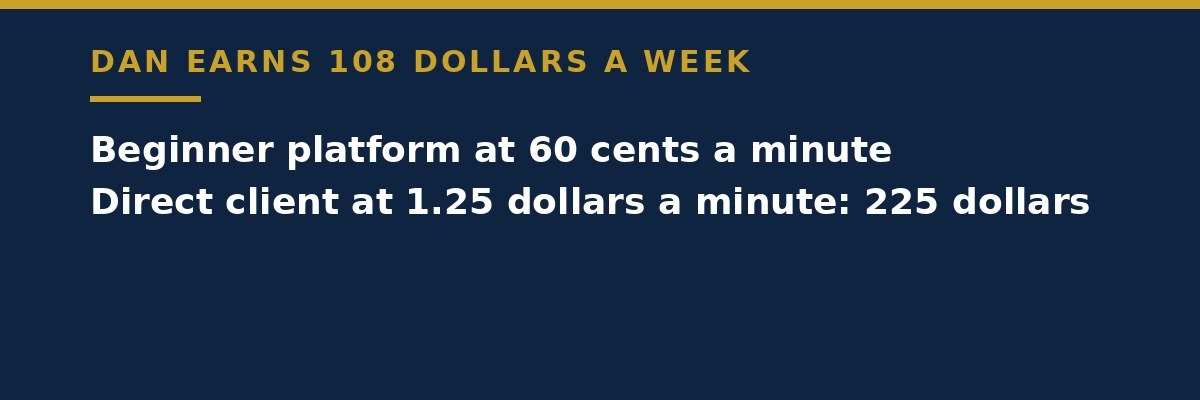
Dan works in the evenings and starts on a beginner platform that pays 0.60 dollars per audio minute. He takes on three audio hours a week.
Three audio hours is 180 audio minutes. At 0.60 dollars a minute, that earns 108 dollars a week. But Dan is a beginner, and each audio hour takes him five hours of work. Three audio hours take 15 hours, so his real pay is 108 dollars divided by 15 hours, which is 7.20 dollars per hour of work. That is low, and it is the honest beginner number. Dan treats the first month as training, and his speed improves.
After three months, Dan is faster, and he finds a direct client, a researcher who needs interviews transcribed. The client pays 1.25 dollars per audio minute, and Dan now finishes each audio hour in four hours of work. Three audio hours a week now earn 225 dollars, because 180 minutes at 1.25 dollars is 225 dollars. The work takes 12 hours, so his real pay is 225 dollars divided by 12 hours, which is 18.75 dollars per hour. Same three audio hours, more than double the money, because the rate rose and the speed improved.
Mistakes and scams to avoid
The first mistake is confusing the audio hour with the work hour. A platform that pays 36 dollars per audio hour sounds generous until you learn that the audio hour takes five hours to finish. Always work out your real hourly pay before you decide a job is worth it.
The second mistake is taking hard audio too early. Files with several speakers, heavy accents, or background noise take far longer than clean single-speaker files, and they pay the same per minute. Start with clear audio, and take the hard files only when you are fast.
Watch out for scams. A real client never asks you to pay a fee to join, to buy equipment from a specific seller before you can work, or to send money to receive a payment. A common scam is a fake employer who sends a large cheque for equipment and asks you to send part of it back. The cheque bounces, and your money is gone. Never accept a job that requires you to pay first. To learn the warning signs in detail, read our guide. Before you start, it also helps to know how much time a side income really takes. To learn that, read our guide.
Frequently asked questions
How much can a beginner earn from transcription?
Beginners on platforms typically earn 5 to 15 dollars per hour of actual working time in the first month or two, because one audio hour takes four to eight hours to finish. Rev states its average transcriptionist earns 245 dollars a month. The pay rises as you get faster and move to direct clients.
How long does it take to transcribe one hour of audio?
A beginner usually takes four to eight hours per audio hour. An experienced general transcriptionist takes three to five hours. The time depends on audio quality, the number of speakers, accents, and how strictly the style guide must be followed.
Is transcription still worth it with AI tools available?
Yes, but the work is changing. AI now produces a rough first transcript, and clients pay humans to clean it up, fixing names, punctuation, invented phrases, and missing words. Transcriptionists who learn AI cleanup, captioning, and a specialism such as legal or medical work still find steady jobs.
What equipment do I need to start transcription?
A computer, good headphones, and free player software such as Express Scribe are enough to start. A foot pedal, at about 55 dollars, saves time once you work regularly. Your total startup cost is 0 to 230 dollars if you buy a pedal and headphones.
Conclusion, and your first step today
You earn side income from transcription by typing what you hear, charging per audio minute, and getting faster and more specialised over time. The work needs a good ear, typing speed of at least 60 words a minute, and the patience to spend several hours on each audio hour. Beginner platforms pay around 0.45 to 0.75 dollars per audio minute, while direct clients pay 1.00 to 2.50 dollars per audio minute, and specialists earn more still.
Your first step is simple. Test your typing speed today, and transcribe a ten-minute podcast episode as practice. Time yourself, check your accuracy, and if you can type 60 words a minute with few errors, apply to one beginner platform this week.
This post is educational only. It is not financial advice, and it does not promise any income.
Sources
- Hustlers Library, How to Start a Transcription Side Hustle (200, verified 2026-11-29). Source for entry-level pay of 10 to 20 dollars per audio hour, Rev pay of 0.45 to 0.75 dollars per audio minute, the foot pedal at about 55 dollars, Express Scribe, and the 60 words per minute requirement.
- SpeechText.AI, How to Make Money Transcribing (200, verified 2026-11-29). Source for pricing benchmarks: entry marketplaces 0.30 to 1.10 dollars per audio minute, direct general transcription 1.00 to 2.50 dollars per audio minute, research interviews 1.25 to 3.00 dollars per audio minute, and AI transcript cleanup as a service.
- The Budget Diet, 10 Best Transcription Side Hustle Sites (2026 Guide!) (found in Google search results 2026-11-29; direct curl returned 403, the site blocks automated requests). Source for Rev average earnings of 245 dollars a month and top earners near 1,500 dollars, and GoTranscript average earnings of 150 dollars a month and top earners of 1,215 dollars. Cited from search results, with the access problem noted plainly.
- Eneba, Best Remote Transcription Jobs That Pay Well in 2026 (200, verified 2026-11-29). Source for Rev pay of 0.54 to 1.10 dollars per audio minute, beginner real hourly pay of 5 to 15 dollars, and the need for 60 or more words per minute.
