


How Much Should I Save for Retirement Each Month?
How much should I save for retirement each month?
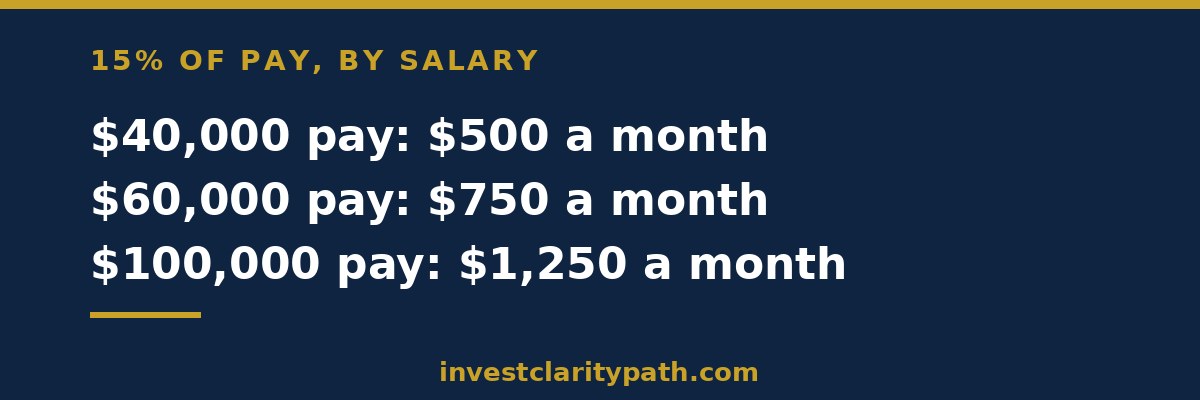
The most widely used answer is 15 percent of your pre tax income each month, including any employer match. On a 60,000 dollar salary, that is 750 dollars a month. On a 40,000 dollar salary, it is 500 dollars a month. On a 100,000 dollar salary, it is 1,250 dollars a month. If you cannot reach 15 percent yet, start with enough to get the full employer match, then raise your rate by 1 percent each year until you get there.
The 15 percent figure is a guideline, not a law. It assumes you start saving at 25, retire at 67, and save steadily every year. If you start later, you will need a higher monthly amount. If you start earlier, or you plan to retire later, you may need less. This guide shows the monthly amounts by salary and by starting age, so you can find your own number.
This post is educational only. It is not financial advice.
Where the 15 percent figure comes from
The 15 percent guideline comes from retirement research by Fidelity, the large investment firm, and it is repeated by Empower and most major financial institutions. Fidelity’s model assumes a person saves 15 percent of pre tax income each year, including any employer match, starting at age 25, investing more than half of their savings in stocks on average over their lifetime, retiring at 67, and aiming to keep their pre retirement lifestyle in retirement. Under those assumptions, the model estimates that saving 10 times your pre retirement income by age 67, together with Social Security, should maintain your lifestyle.
Empower states the same range in its retirement guide: aim to save between 10 percent and 15 percent of your annual pre tax income for retirement, assuming a working career of about 40 to 45 years, from around age 25 to 67. The key point is that 15 percent is a modelled result, not a number someone picked because it sounds good. It is built for a particular person: a steady earner who starts at 25, retires at 67, and collects Social Security. If your life looks different, your number will be different too.
Your monthly amount by salary
Here is what 15 percent looks like each month at different salaries. The figures are your total retirement saving, including any employer match. If your employer matches part of it, your own contribution is smaller.
On a 40,000 dollar salary, 15 percent is 6,000 dollars a year, or 500 dollars a month. On a 50,000 dollar salary, it is 7,500 dollars a year, or 625 dollars a month. On a 60,000 dollar salary, it is 9,000 dollars a year, or 750 dollars a month. On an 80,000 dollar salary, it is 12,000 dollars a year, or 1,000 dollars a month. On a 100,000 dollar salary, it is 15,000 dollars a year, or 1,250 dollars a month. On a 150,000 dollar salary, it is 22,500 dollars a year, or 1,875 dollars a month.
To work out your own number, take your gross monthly pay and multiply it by 0.15. If you earn 4,000 dollars a month before tax, 4,000 times 0.15 equals 600 dollars a month. If your employer matches 5 percent of your pay, your employer adds 200 dollars a month, so your own contribution needs to be 400 dollars a month to reach the 600 dollar total.
Check the limits too. For 2026, the IRS lets you put up to 24,500 dollars of your own pay into a 401(k) each year, which is about 2,042 dollars a month. The IRA limit is 7,500 dollars a year, or 625 dollars a month. On most salaries, 15 percent is well below these limits, so they will not hold you back. Learn how a 401(k) works in our beginner guide.
Your monthly amount by starting age
The 15 percent rule assumes you started at 25. The later you start, the higher your monthly amount needs to be to reach the same result. The table below shows the monthly saving needed to reach 1,000,000 dollars by age 67, using an assumed average annual return of 7 percent. This is an assumption for the illustration only, not a fact and not a forecast. Actual returns vary, and no investment grows at a steady rate.
If you start at 25, you need about 329 dollars a month. If you start at 30, you need about 477 dollars a month. If you start at 35, you need about 700 dollars a month. If you start at 40, you need about 1,045 dollars a month. If you start at 45, you need about 1,601 dollars a month. If you start at 50, you need about 2,563 dollars a month.
The pattern is clear. Waiting ten years, from 25 to 35, more than doubles the monthly amount needed. Waiting from 35 to 45 more than doubles it again. Time does the heavy work, and every year you wait makes the monthly bill bigger.
These figures are illustrations, not promises. They assume a steady 7 percent return, no fees, no taxes, and no missed months. Real life will differ. But the direction is right: start early, and the monthly amount stays small. Start late, and it grows fast.
Fidelity gives the same message in a different form. If you start at 30 instead of 25, the guideline rises from 15 percent to about 18 percent of pay. If you start at 35, it rises to about 23 percent. Those figures assume you have saved nothing yet, and they show why catching up late is hard.
Worked example: Sara earns 60,000 dollars
Sara is 32, earns 60,000 dollars a year, and has 5,000 dollars saved for retirement. Her employer matches 50 percent of the first 6 percent she contributes to her 401(k). She wants to know her monthly number.
First, the 15 percent guideline. 60,000 times 0.15 equals 9,000 dollars a year, or 750 dollars a month. That is her target total, including the match.
Second, the match. Sara contributes 6 percent of her pay to get the full match. 60,000 times 0.06 equals 3,600 dollars a year, or 300 dollars a month. Her employer adds 50 percent of that, which is 1,800 dollars a year, or 150 dollars a month. Together, 450 dollars a month goes into her 401(k).
Third, the gap. Her target is 750 dollars a month, and her 401(k) total is 450 dollars a month. The gap is 300 dollars a month. 750 minus 450 equals 300. She closes it with a Roth IRA contribution of 300 dollars a month, which is 3,600 dollars a year, well below the 2026 IRA limit of 7,500 dollars a year.
Fourth, the late start. Sara started at 32, not 25, so 15 percent may not be quite enough. The illustration above says a 30 year old needs about 477 dollars a month to reach 1,000,000 dollars by 67 at the assumed 7 percent return. Sara is saving 750 dollars a month, which is well above that figure, so she is on a strong path. She plans to raise her rate by 1 percent each year anyway, to build a cushion.
Sara sets her 401(k) to 6 percent and her Roth IRA to an automatic 300 dollar transfer on payday. She checks the plan once a year. If she gets a raise, she sends half of it to retirement before she gets used to the extra money.
To compare the two accounts Sara uses, read our guide on choosing between a 401(k) and an IRA. To learn how to open the Roth IRA, read our guide on setting up a Roth IRA.
What pushes your number above or below 15 percent
Your number is not fixed. Several things push it up or down. Starting late pushes it up. As the table shows, a 40 year old needs more than three times the monthly amount of a 25 year old to reach the same 1,000,000 dollar illustration. Retiring early pushes it up, because you have fewer years to save and more years to fund. A pension pushes it down, because the guideline assumes no pension. No Social Security pushes it up, because your savings must cover more. A high income pushes the dollar amount up but not the percentage. Low income pushes the percentage down in practice: if you earn 30,000 dollars a year, 15 percent is 375 dollars a month, which may not leave enough for rent and food. In that case, start with the match, save what you can, and raise the rate as your pay grows.
What to do if you cannot reach 15 percent yet
Most people cannot save 15 percent on their first try. That is normal, and it is not a reason to save nothing. Use this order.
First, contribute enough to get the full employer match. If the match needs 6 percent, contribute 6 percent. This is free money, and skipping it is the most expensive mistake in retirement saving.
Second, build a 1,000 dollar starter emergency fund, so a surprise bill does not force you to stop saving or borrow.
Third, pay down high interest debt, such as credit cards, because it grows faster than your investments can.
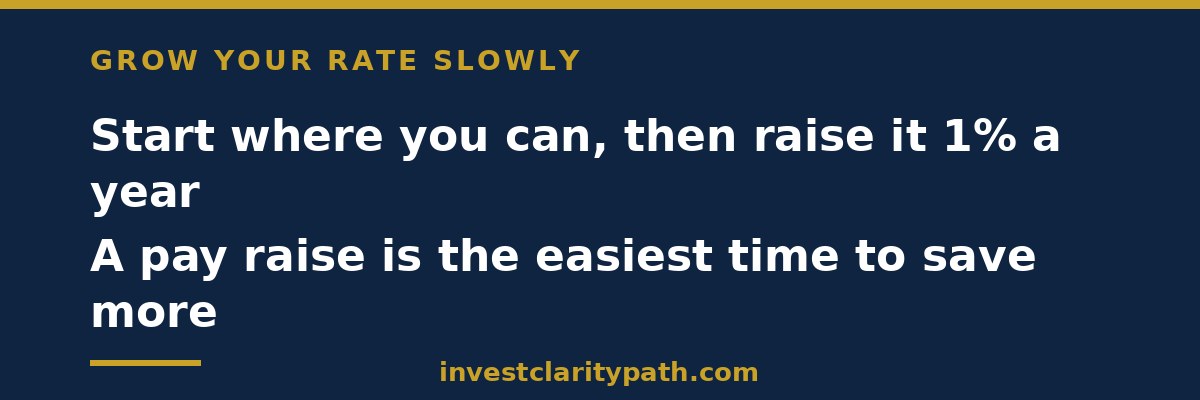
Fourth, raise your retirement rate by 1 percent each year, or with every raise. Send at least half of each raise to retirement before you get used to the extra money. Going from 6 percent to 15 percent takes nine yearly steps of 1 percent, and each step costs little in take home pay.
Fifth, check your milestones. Fidelity’s guideline is to have saved about 1 times your salary by 30, 3 times by 40, 6 times by 50, 8 times by 60, and 10 times by 67. If you are behind, the answer is to save a little more, not to panic. Read our guide on how much to have saved by age.
If you are starting from zero in your 40s or 50s, the monthly amount will feel large. Do not let that stop you. Save the match, then as much as you can, then raise it each year. Read our guide on planning for retirement with no savings.
Common mistakes to avoid
The first mistake is saving a flat dollar amount and never raising it. 200 dollars a month sounds fine at 25, but if your pay doubles over twenty years and your contribution stays at 200 dollars, your savings rate falls by half. Save a percentage of pay, not a fixed dollar amount, and raise it with every raise.
The second mistake is counting only your own contribution and forgetting the match. The 15 percent guideline includes the employer match. If your employer adds 5 percent, your own contribution only needs to be 10 percent to reach 15 percent in total.
The third mistake is stopping contributions when the market falls. A falling market means your monthly contribution buys more shares for the same money. Stopping means you miss the recovery. Keep the automatic transfer going, and review your investments once a year instead of reacting to headlines.
The fourth mistake is cashing out a 401(k) when you change jobs. Cashing out means tax plus a 10 percent penalty, and it throws away decades of growth. Roll the money into your new plan or an IRA instead.
The fifth mistake is keeping retirement money in a savings account. Savings accounts are for emergency funds and short term goals. Retirement money needs to be invested to grow over decades. Keep your emergency fund in a savings account and your retirement money in a 401(k) or IRA.
Frequently asked questions
How much should I save for retirement each month at 30?
Aim for 15 percent of your pre tax income, including any employer match. On a 60,000 dollar salary, that is 750 dollars a month. If you started at 30, Fidelity’s guideline rises to about 18 percent, which is 900 dollars a month on the same salary. Start with the match and raise your rate by 1 percent a year.
Is 500 dollars a month enough for retirement?
It depends on your salary and your starting age. On a 40,000 dollar salary, 500 dollars a month is exactly 15 percent, which is the guideline. On a 100,000 dollar salary, 500 dollars a month is only 6 percent, which is below the guideline. Check your own percentage, not someone else’s dollar amount.
What percentage of my salary should I save for retirement?
The most widely used guideline is 15 percent of pre tax income each year, including the employer match. If you started saving late, you may need 18 to 23 percent. If you started at 25 and retire at 67, 15 percent is the standard target.
Should I save a fixed amount or a percentage?
Save a percentage of your pay. A fixed amount shrinks as a share of your income as your pay grows. A percentage grows with you automatically. Set your 401(k) as a percentage of pay, and set your Roth IRA as a fixed transfer that you raise each year.
What if I can only save 100 dollars a month?
Save the 100 dollars. If your employer offers a match, make sure you contribute enough to get all of it first. Then raise the amount by 1 percent of pay each year, or with every raise. A small amount started early still grows, and the habit matters more than the starting number.
Conclusion, and your first step today
How much you should save for retirement each month comes down to one number: 15 percent of your pre tax income, including the employer match. On a 60,000 dollar salary, that is 750 dollars a month. On a 40,000 dollar salary, it is 500 dollars a month. On a 100,000 dollar salary, it is 1,250 dollars a month. If you started late, your number is higher, and the table by starting age shows how much higher. If you cannot reach 15 percent yet, start with the match and raise your rate by 1 percent each year.
Your first step today is simple. Take your gross monthly pay, multiply it by 0.15, and write the result down. Then check your 401(k) contribution and your employer match, and work out the gap. Set your contribution to close the gap, or set a Roth IRA transfer for the difference. Automate it on payday, and check it once a year.
To see how your monthly amount fits into the bigger picture, read our guide on how much to save for retirement overall. And if you are in your 30s, read our guide for that decade.
This post is educational only. It is not financial advice.
Sources
- IRS, Retirement Topics, 401(k) and Profit-Sharing Plan Contribution Limits: https://www.irs.gov/retirement-plans/plan-participant-employee/retirement-topics-401k-and-profit-sharing-plan-contribution-limits
- IRS, Retirement Topics, IRA Contribution Limits: https://www.irs.gov/retirement-plans/plan-participant-employee/retirement-topics-ira-contribution-limits
- Empower, How Much Should I Save for Retirement?: https://www.empower.com/the-currency/life/how-much-should-i-save-for-retirement
