

How Much Should I Save for Retirement at 30?
The short answer
At 30, a good target is to have saved about one times your annual salary for retirement, and to be saving about 15 percent of your pay for retirement each year, including any money your employer adds. So if you earn 60,000 dollars a year, aim to have about 60,000 dollars saved by 30, and aim to put away about 750 dollars a month from now on.
Those are targets, not pass marks. Many 30 year olds have saved less, and that is normal. Student loans, rent, and starting a family all compete for the same money. What matters at 30 is not hitting the target exactly. What matters is starting, saving regularly, and letting time work for you. A small amount saved at 30 is worth far more than a larger amount saved at 45, because the money at 30 has 35 years to grow.
This guide explains where the targets come from, shows the math with a worked example, and sets out what to do if you are behind.
The 1x salary by 30 guideline
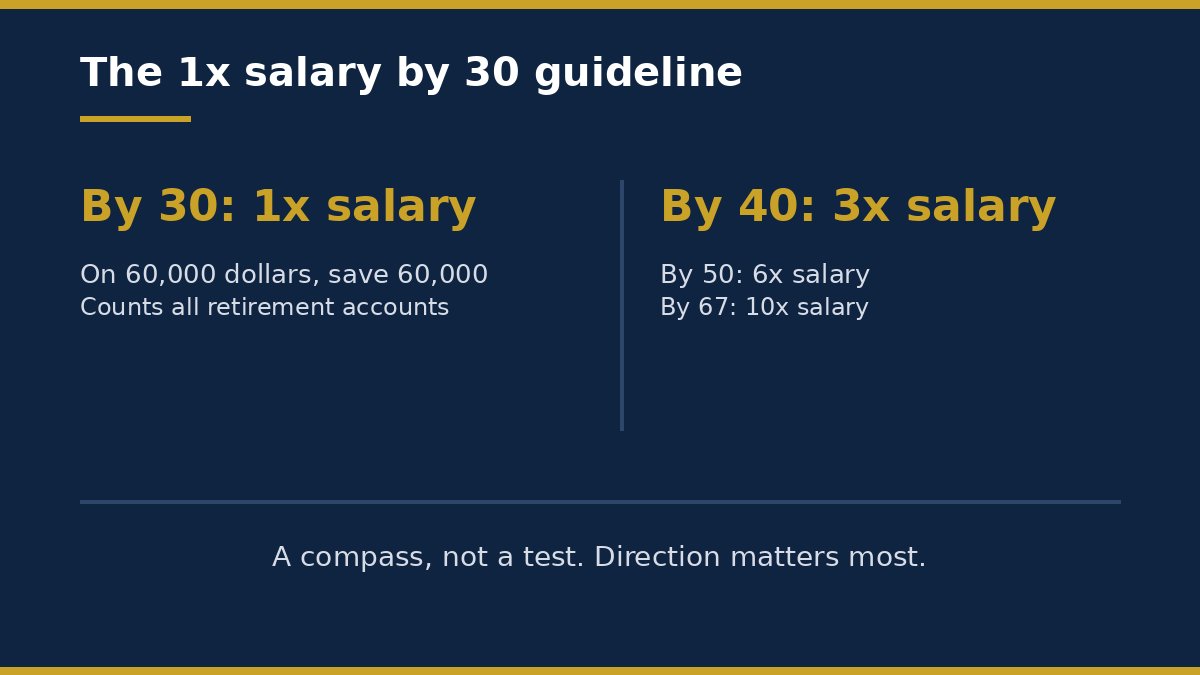
One widely used guideline, published by Fidelity, suggests how much to have saved at each age, as a multiple of your salary. The milestones are about 1 times your salary by 30, 3 times by 40, 6 times by 50, 8 times by 60, and 10 times by 67. You can read the full guideline on the Fidelity website (https://www.fidelity.com/viewpoints/retirement/how-much-do-i-need-to-retire).
Here is what that means in plain numbers. If you earn 50,000 dollars a year, the guideline suggests about 50,000 dollars saved by 30. If you earn 80,000 dollars, it suggests about 80,000 dollars. The target moves with your pay, so it stays fair whether you earn a little or a lot.
Two things to know about this guideline. First, it counts all retirement savings together: your workplace plan, your IRA, and any other account set aside for retirement. It does not count your emergency fund or the money you need for a house deposit. Second, it assumes you keep saving about 15 percent of your pay each year and retire at 67. If you save less, you will need to catch up later, or retire later, or live on less.
Treat the guideline as a compass, not a test. If you are at half the target at 30, you are not failing. You are halfway there, and you have 35 years to close the gap.
The 15 percent rule
The second guideline is simpler: save 15 percent of your pre-tax income for retirement. That includes any money your employer puts in. So if your employer matches part of your contribution, that match counts toward the 15 percent.
Here is the math on a 60,000 dollar salary. 15 percent of 60,000 dollars is 9,000 dollars a year. Divide that by 12 months, and it is 750 dollars a month. On a 40,000 dollar salary, 15 percent is 6,000 dollars a year, or 500 dollars a month. On an 80,000 dollar salary, it is 12,000 dollars a year, or 1,000 dollars a month.
If 15 percent is too much right now, start with what you can afford and raise it over time. A common trick is to raise your saving rate by 1 percent each year, or each time you get a pay rise. If you start at 6 percent and add 1 percent a year, you reach 15 percent in nine years, and you never feel a sudden cut to your take home pay.
The employer match deserves special attention. Many employers match part of what you put into a workplace retirement plan. A common match is 50 cents for each dollar you put in, up to 6 percent of your pay. On a 60,000 dollar salary, saving 6 percent means you put in 3,600 dollars a year, and your employer adds 1,800 dollars. That is 1,800 dollars of free money each year. If your employer offers a match and you do not take the full amount, you are leaving money on the table. Always contribute at least enough to get the full match, before you save anywhere else for retirement. If the 401(k) is new to you, read our guide for beginners on the 401(k). Link: https://investclaritypath.com/401k-for-beginners/
A worked example: 300 dollars a month from age 30
The reason starting at 30 matters so much is compound growth. Your money earns returns, and those returns earn returns of their own. The longer the money stays invested, the more the growth does the heavy lifting.
Here is a worked example. These figures use an average return of 7 percent a year, which is a common example figure for a broad stock market investment over long periods. It is not a promise. Real returns vary every year, and some years are negative.
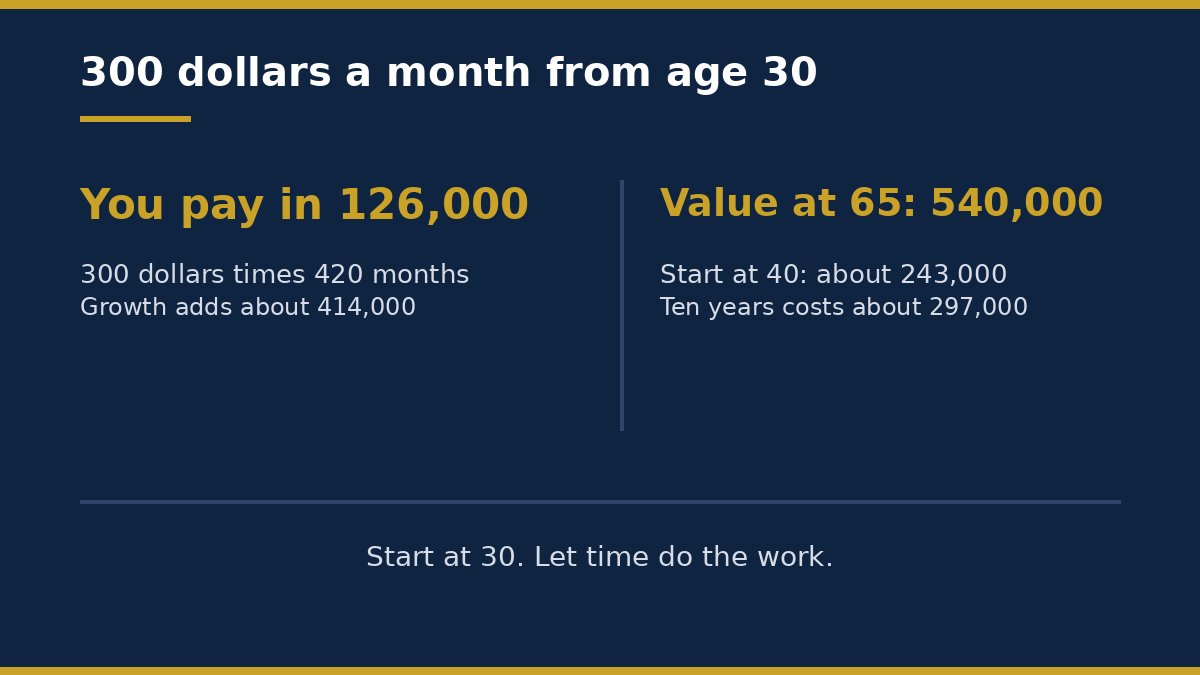
Say you save 300 dollars a month from age 30 to age 65. That is 35 years, or 420 monthly payments.
- Total you pay in: 300 dollars times 420 months is 126,000 dollars.
- Value at 65 at a 7 percent average annual return: about 540,000 dollars.
- Growth on top of what you paid in: about 414,000 dollars.
More than three quarters of the final amount comes from growth, not from your payments. That is the power of starting at 30.
Now compare starting ten years later. Say you save the same 300 dollars a month, but from age 40 to age 65. That is 25 years, or 300 monthly payments.
- Total you pay in: 300 dollars times 300 months is 90,000 dollars.
- Value at 65 at a 7 percent average annual return: about 243,000 dollars.
- Growth on top of what you paid in: about 153,000 dollars.
Waiting ten years costs about 297,000 dollars in the final amount, even though you only paid in 36,000 dollars less. The missing ten years are the most valuable ones, because they are the years when the growth compounds the longest.
Now look at the 15 percent rule on a 60,000 dollar salary, which is 750 dollars a month. Saving 750 dollars a month from 30 to 65, at the same example return of 7 percent a year, grows to about 1,350,000 dollars. You pay in 315,000 dollars, and growth adds about 1,035,000 dollars. That is why the 15 percent rule and the 1x by 30 target go together: the monthly habit is what builds the final number.
Where to put the money
Saving for retirement is not the same as saving in a bank account. Retirement money belongs in accounts built for the long term, where it can grow and where the tax rules help you.
The first place is usually your workplace plan, often a 401(k). Money goes in before tax, which lowers your taxable income, and many employers add a match. The money grows without tax until you withdraw it in retirement. If your employer offers one, start there, at least up to the full match. Our guide on the 401(k) for beginners explains the account in plain words. Link: https://investclaritypath.com/401k-for-beginners/
The second place is an IRA, an individual retirement account. You open it yourself, outside work, and you choose the investments inside it. A traditional IRA gives you a tax break now. A Roth IRA gives you tax free withdrawals later. Which one fits depends on your tax rate now and your tax rate in retirement. If the IRA is new to you, read our guide on what an IRA is in simple terms. Link: https://investclaritypath.com/what-is-an-ira-in-simple-terms/
The third point is what to invest in. For most 30 year olds, a broad, low cost index fund is a sensible default. It spreads your money across hundreds of companies, it charges a small annual fee, and it matches the long time horizon you have. You have 35 years until retirement, so you can accept the ups and downs of the stock market in exchange for higher long term growth. If you want the wider picture, read our guide on what a retirement account is in simple terms, and our guide on a simple first investment plan. Links: https://investclaritypath.com/what-is-a-retirement-account-in-simple-terms/ and https://investclaritypath.com/what-is-a-simple-first-investment-plan/
What if you have saved nothing by 30?
If you reach 30 with nothing saved for retirement, you are not too late. You still have 35 years, and the math above shows how much even a modest monthly amount can grow. Here is a simple catch up plan.
First, build a small emergency fund if you do not have one. One month of expenses in a savings account is enough to start. Without it, any surprise bill forces you to stop saving for retirement or to borrow. Our guide on how much money you need to start investing explains how to order these steps. Link: https://investclaritypath.com/how-much-money-do-i-need-to-start-investing/
Second, join your workplace plan and get the full employer match. That is free money, and it is the highest return you will ever get on a retirement contribution.
Third, automate the contribution. Set the money to move on payday, before you can spend it. Automation turns saving from a decision into a habit. Our guide on how to automate saving and investing shows how to set this up step by step. Link: https://investclaritypath.com/how-do-i-automate-saving-and-investing/
Fourth, raise the rate by 1 percent a year. If you start at 5 percent, you reach 15 percent in ten years. Pay rises make this painless, because you save part of the rise before it reaches your spending.
Fifth, use windfalls. A tax refund, a bonus, or a side income payment can go straight into retirement savings. A single extra 1,000 dollars at 30 can grow to about 10,000 dollars by 65 at the example return used above, so windfalls matter more than they look.
What the numbers depend on
The worked example used a 7 percent average return. Real returns are never smooth. Some years the market rises 20 percent. Some years it falls 20 percent. Over 35 years, the average matters more than any single year, but the final number will not match the example exactly. That is normal, and it is why the example is labelled as an example, not a forecast.
Fees matter too. A fund that charges 1 percent a year takes a large bite over 35 years. A fund that charges 0.1 percent a year leaves far more of the return with you. Over decades, the difference can be tens of thousands of dollars. Check the annual fee on any fund you buy, and prefer low cost funds.
Inflation matters as well. The example figures are in future dollars, not today’s dollars. 540,000 dollars at 65 will not buy what 540,000 dollars buys today. That does not make the saving pointless. It means the target should grow with your pay over time, which happens naturally if you save a percentage of your income rather than a fixed dollar amount.
Finally, your retirement age matters. Retiring at 67 instead of 65 gives your money two more years to grow and two fewer years to fund. Retiring at 60 does the opposite. The guideline milestones assume retirement at 67. If you plan to retire earlier, you need to save more. If you plan to work longer, you need to save less. For the full planning picture, read our guide on financial planning for retirement in simple steps. Link: https://investclaritypath.com/financial-planning-for-retirement/
Frequently asked questions
Is 1 times my salary by 30 realistic?
For many people, it is hard. Student loans, rent, and low starting pay make it tough. The guideline is a target to aim for, not a pass mark. If you have half the target saved and you are saving 10 percent of your pay, you are in a strong position. What matters most is the habit and the direction, not the exact number on your 30th birthday.
Should I pay off debt or save for retirement first?
Do both, in this order: pay the minimum on all debts, save enough in your workplace plan to get the full employer match, then attack high interest debt, then raise your retirement saving. The employer match is free money, so take it first. High interest debt, such as a credit card charging 20 percent or more, costs more than your investments are likely to earn, so clear it before you raise your saving rate further.
What if my employer does not offer a retirement plan?
Open an IRA yourself. You can open one online with a small amount, choose a low cost index fund inside it, and set up an automatic monthly contribution. The IRA gives you the same long term tax benefits, and you control it yourself.
How much will I actually need in retirement?
A common rule of thumb is 10 times your final salary, saved by 67. Another is to aim for a retirement income of about 70 to 80 percent of your pre-retirement pay, coming from savings, Social Security, and any pension. The exact number depends on your spending, your health, and where you live. The guidelines in this article are starting points, not a personal plan.
Does my emergency fund count toward the 1x target?
No. The 1x target counts retirement accounts only. Your emergency fund is separate money, for surprises such as a car repair or a job loss. Keep it in a savings account, where you can reach it at any time, and do not count it as retirement savings.
Should I invest more aggressively at 30?
At 30, you have 35 years until retirement, so you can accept more ups and downs than someone at 60. Most 30 year olds hold mainly stocks or stock funds, with a small share in bonds. As you get older, you shift gradually toward bonds for stability. That shift is a plan for decades from now, not a decision for this year.
Conclusion
At 30, the target is simple: about one times your salary saved, and about 15 percent of your pay going into retirement each year, including your employer match. On a 60,000 dollar salary, that means about 60,000 dollars saved and about 750 dollars a month going in.
If you are behind, do not panic. Start with the employer match, automate a monthly amount you can afford, and raise it by 1 percent each year. The worked example shows why: 300 dollars a month from 30 grows to about 540,000 dollars by 65, while the same amount started at 40 grows to only about 243,000 dollars. The ten years between 30 and 40 are worth nearly 300,000 dollars.
Time is the biggest advantage you have at 30. Use it. If you want the next step, read our guide on what a retirement account is in simple terms, and our guide on a simple first investment plan, then set up your first automatic contribution this week. Links: https://investclaritypath.com/what-is-a-retirement-account-in-simple-terms/ and https://investclaritypath.com/what-is-a-simple-first-investment-plan/ For savings targets at other ages, see our overview of how much to have saved for retirement by age.
This article is for general information and education only. It is not legal or financial advice.
