

How Much Should I Have Saved for Retirement by Age?
Most people ask the same quiet question about retirement: am I behind? The answer is hard to judge without a yardstick, and that is what this guide gives you. It shows simple retirement savings targets by age, explains what they mean in plain terms, and shows what to do if your savings are lower than the target today.
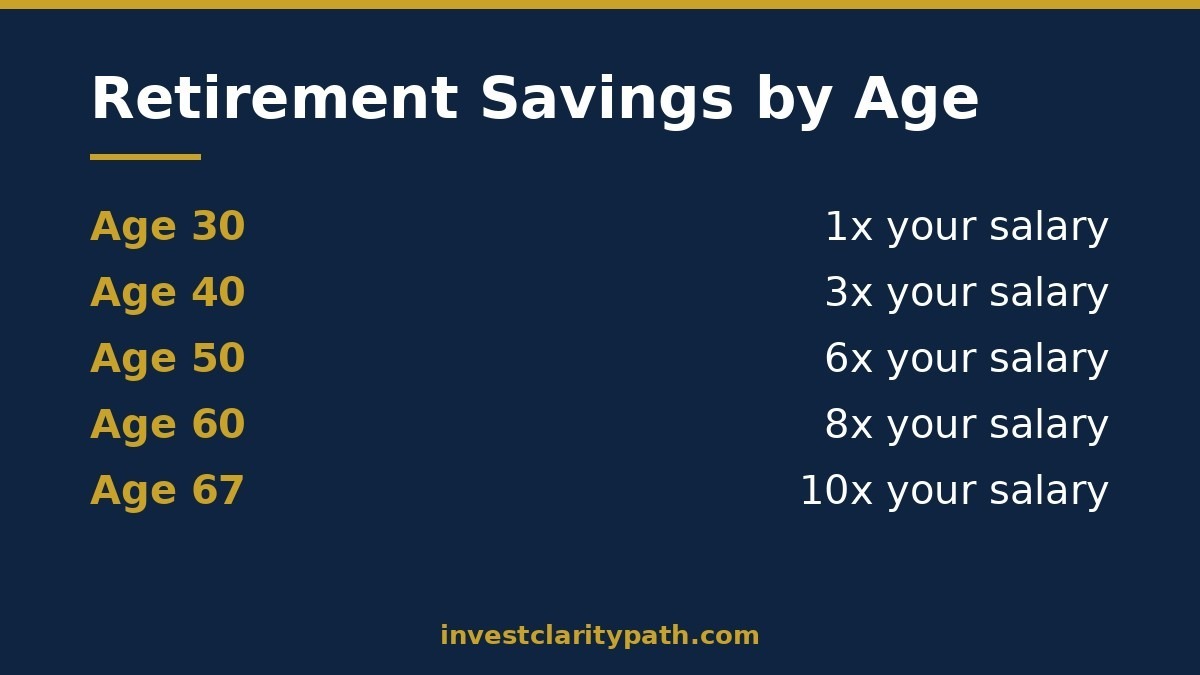
Here is the direct answer. A common rule of thumb, published by Fidelity, says you should aim to have saved about 1 times your salary by age 30, 3 times by age 40, 6 times by age 50, 8 times by age 60, and 10 times by age 67. These are rough guides, not promises and not personal advice. Your own target depends on your pay, your spending, when you plan to stop working, and what other income you expect, such as Social Security or a pension.
If you are below a target, that does not mean you have failed. It means you have a clear next step.
The quick answer: retirement savings by age
The table below gives the headline targets. They are stated as multiples of your annual salary, so they scale up or down with what you earn.
| Your age | Savings target |
|---|---|
| 30 | 1 times your salary |
| 40 | 3 times your salary |
| 50 | 6 times your salary |
| 60 | 8 times your salary |
| 67 | 10 times your salary |
To use the table, take your yearly pay before tax and multiply it by the number for your age. If you earn $50,000 a year and you are 40, the rough target is $150,000. That is 3 times $50,000. If you earn $80,000 a year and you are 50, the rough target is $480,000. That is 6 times $80,000.
These targets come from a well known set of guidelines that many financial educators use as a starting point. They assume you start saving in your 20s, save around 15 percent of your pay each year, and retire around age 67. If you started later, or you plan to retire earlier, your path will look different, and that is normal.
What the benchmarks actually mean
A multiple of salary is a shortcut, not a magic number. It is a way to turn a big, vague goal into a figure you can compare with your account balance today.
The idea behind it is simple. In retirement, most people need to replace a large share of their working income each year, often around 70 to 80 percent, from a mix of savings, Social Security, and any pension. The multiple grows as you get older because you have fewer working years left to save and invest, and your savings have less time to grow. You can compare your progress with the Fidelity retirement savings by age guide, which sets out the same multiples used in this article.
Three points matter when you read these targets.
First, salary means your gross pay, the amount before tax and other deductions. If you get a raise, your target rises too, because the multiple is tied to your pay.
Second, savings means the total across your retirement accounts. Add up your 401(k), IRA, and any other retirement savings. Everyday savings in a bank account for emergencies do not count toward this target, because that money has a different job.
Worked example: a $60,000 salary at every age
Let us work through one full example so the multiples turn into real numbers. Take a worker who earns $60,000 a year. Here is the target at each checkpoint.
- Age 30: 1 times $60,000 = $60,000
- Age 40: 3 times $60,000 = $180,000
- Age 50: 6 times $60,000 = $360,000
- Age 60: 8 times $60,000 = $480,000
- Age 67: 10 times $60,000 = $600,000
Notice how the jumps get bigger in the middle years. From age 40 to age 50, the target rises by $180,000, because the multiple doubles from 3 to 6 in that decade.
Now try the same maths with your own salary. Write down your pay, pick the multiple for your age, and multiply. The result is your rough target. Then add up your retirement accounts and compare. The gap, if there is one, is the number to work on. You do not need to close it in a month or a year. You need a steady plan that closes it over time.
If your pay has risen a lot in recent years, the target can feel high. That is a known weakness of this shortcut. A person who earned $40,000 at age 30 and $90,000 at age 50 will find the age 50 target much harder, because the target is based on the higher, later salary. In that case, use your average pay over the last few years as a sanity check, and focus on the saving rate as well as the balance. You can read more about the saving side of this question in our guide on how much to save for retirement, and about the total amount you may need in our guide on how much you need to retire.
Why your salary matters more than your age
Two people of the same age can need very different amounts saved, because their pay and their spending are different. The multiple method handles this by tying the target to salary, but salary alone does not tell the whole story.
Your spending in retirement matters most of all. Someone who plans to spend $40,000 a year needs a smaller nest egg than someone who plans to spend $90,000 a year, even if they are the same age and earn the same pay today.
Your retirement age matters too. Retiring at 60 instead of 67 means fewer years to save and more years to fund, so the target at each age would need to be higher. Retiring later, at 70 for example, means more years of saving and fewer years to fund, so the pressure eases.
Other income changes the picture as well. Social Security replaces a larger share of income for lower earners than for higher earners. A pension, rental income, or part time work in retirement can also reduce the amount your savings must cover. Treat the age targets as a starting point and adjust for your own life, not as a final verdict.
For the basics of the accounts you will use to build these savings, see our simple guides to what a 401(k) is and what an IRA is.
What to do if you are behind
Being behind at any age is common, and it is fixable in most cases. The right move depends on how much time you have left. Here is a simple plan for each decade.
In your 20s
Start now, even with a small amount. Time is your biggest advantage at this age, because money saved early has decades to grow. If your employer offers a 401(k) match, contribute at least enough to get the full match. Even $50 or $100 a month is a real start, and you can raise it each time your pay rises.
In your 30s
Aim for the 1 times salary mark by age 30, and work toward 3 times by age 40. This is often the decade when pay rises but costs rise too, with housing and children. Automate your saving so it leaves your pay before you can spend it. If you change jobs, roll your old 401(k) into your new plan or an IRA instead of cashing it out.
In your 40s
This is the decade when the target jumps the most, so check your balance once a year and adjust. If you are behind, raise your saving rate by 1 percent of pay each year. A 1 percent rise is small enough that most people barely notice it in their monthly budget, but repeated each year it adds up.
In your 50s
If you are behind at 50, you still have time, and the rules help you. Once you reach age 50, you can make extra catch-up contributions to a 401(k) and an IRA above the normal yearly limits. The IRS sets those limits each year, so check the current figures on the IRS IRA contribution limits page. Our guide on how to catch up on retirement savings at 50 walks through this decade in detail.
Here is a worked catch-up example. Take a worker aged 50 who earns $70,000 a year and has $150,000 saved. The rough target is 6 times $70,000, which is $420,000. The gap is $420,000 minus $150,000, which is $270,000. That is a large number, but it does not need to be saved in one year. Over 17 years to age 67, it works out to about $15,882 a year before any investment growth, which is $270,000 divided by 17. In practice, investment growth would help, so the real yearly amount needed would be lower than this simple division suggests. The point of the maths is to turn a scary gap into a yearly figure you can plan around.
In your 60s
In your 60s, the focus shifts from building savings to protecting them and planning the exit from work. Check when you plan to claim Social Security, because claiming later usually means a larger monthly payment. Review your planned retirement spending line by line, and test whether part time work for a year or two could close the remaining gap. If you are unsure when you can stop working, our guide on when you can retire explains the trade-offs in plain terms.
How much to save each month to catch up
The saving rate matters as much as the balance. A common guideline is to save around 15 percent of your pay for retirement each year, including any employer match. That is a useful starting point, not a law. If 15 percent is too much today, start lower and raise it over time.
Here is the worked example. Take a worker who earns $60,000 a year and saves 15 percent of pay. Fifteen percent of $60,000 is $9,000 a year. Divide that by 12 months and you get $750 a month. So the guideline means setting aside $750 each month on a $60,000 salary.
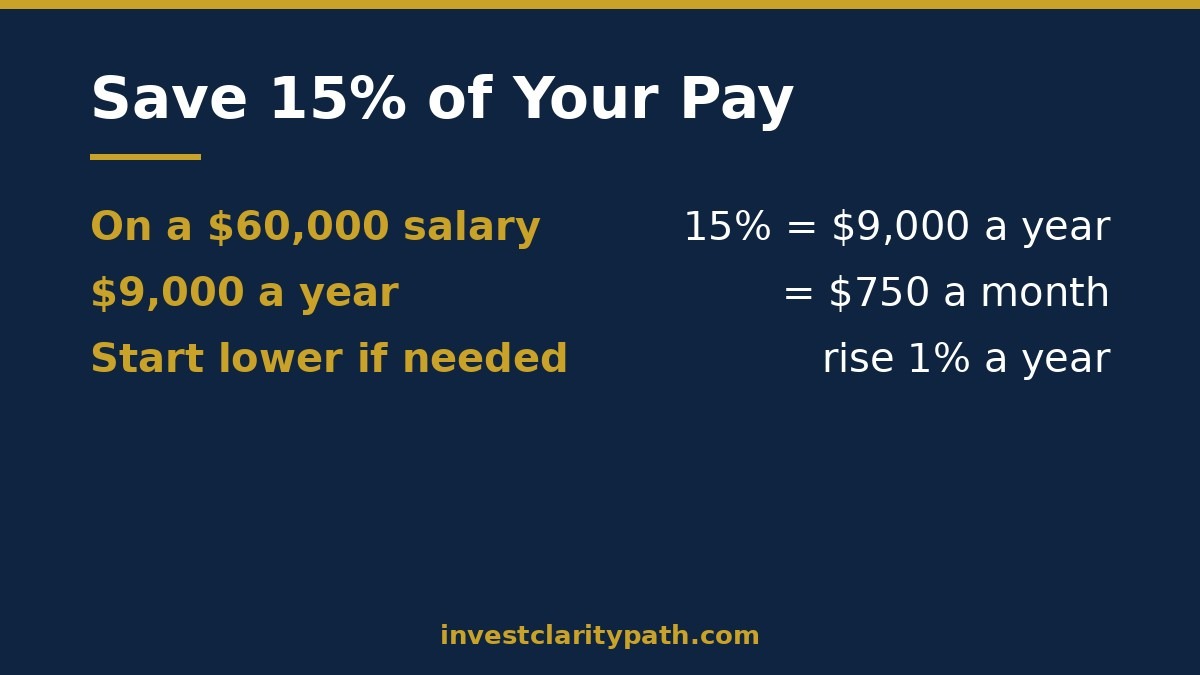
If $750 a month is too much right now, start with what you can manage. Saving 5 percent of $60,000 is $3,000 a year, or $250 a month. Saving 10 percent is $6,000 a year, or $500 a month. Then raise your rate by 1 percent each year, or each time you get a pay rise, until you reach 15 percent.
If your employer matches contributions, count the match in your rate. For example, if you put in 10 percent and your employer adds 5 percent, you are already at 15 percent in total. That is why the first step for most workers is to get the full match before doing anything else.
Common mistakes to avoid
Even a good plan can be undone by a few common mistakes. Watch for these four.
First, cashing out a 401(k) when you change jobs. It feels like free money, but you lose the growth that money would have earned, and you may owe tax and a penalty. Rolling it over keeps the money working.
Second, keeping all your retirement money in cash for decades. Cash feels safe, but over a long period it usually grows more slowly than prices rise, so your buying power shrinks.
Third, ignoring fees. A small yearly fee, repeated over 30 years, takes a large bite out of your final balance. Check what each fund charges and prefer low cost options where you can.
Fourth, saving for retirement last. If retirement saving is whatever is left at the end of the month, it will often be nothing. Pay yourself first by automating the contribution on payday.
FAQ
How much should I have saved for retirement by age 30?
A common rule of thumb is 1 times your annual salary by age 30. If you earn $50,000, that means about $50,000 saved. If you earn $70,000, it means about $70,000. This is a rough guide. Starting later is still fine, and the important step is to begin saving regularly and raise the amount over time.
How much should I have saved for retirement by age 40?
The common target is 3 times your salary by age 40. On a $60,000 salary, that is $180,000. On a $75,000 salary, it is $225,000. If you are below that figure, raising your saving rate by 1 percent a year is a simple way to start closing the gap.
How much should I have saved for retirement by age 50?
The common target is 6 times your salary by age 50. On a $70,000 salary, that is $420,000. From age 50 you can also make extra catch-up contributions to a 401(k) and an IRA, which helps if you are behind. Check the current IRS limits before you change your contributions.
How much should I have saved for retirement by age 60?
The common target is 8 times your salary by age 60. On a $60,000 salary, that is $480,000. In your 60s, also plan when to claim Social Security and what your yearly spending will be.
How much should I have saved for retirement by age 67?
The common target is 10 times your salary by age 67. On a $60,000 salary, that is $600,000. On an $80,000 salary, it is $800,000. This is the figure the age benchmarks build toward, and it assumes you retire around 67 and draw on savings along with Social Security.
What if I have saved nothing for retirement?
Start with any amount you can manage, even $25 or $50 a month, and automate it. If your employer offers a 401(k) match, get the full match first. Then open an IRA if you can, and raise your saving rate a little each year. A small start now is worth far more than a perfect plan that never begins.
Conclusion
Retirement savings by age is a simple idea: about 1 times your salary by 30, 3 times by 40, 6 times by 50, 8 times by 60, and 10 times by 67. Use those figures as a yardstick, not a judgement. Work out your own target with your salary, compare it with what you have saved, and close any gap with a steady saving rate, starting with the full employer match if one is available.
If you are ahead of the target, keep going and review it once a year. If you are behind, pick one step this week: raise your contribution by 1 percent, open an IRA, or set up an automatic transfer on payday. Progress comes from small, repeated actions over many years, and the best time to take the next step is now.
This article is for general information and education only. It is not legal or financial advice.
