


How Do I Budget After a Pay Rise?
How do I budget after a pay rise?
Split the extra take home pay before your first bigger paycheck arrives. A simple split is 50 percent to savings and investing, 30 percent to extra debt payments, and 20 percent to lifestyle. On a 350 dollar a month take home increase, that is 175 dollars to savings, 105 dollars to debt, and 70 dollars to enjoy. Set the transfers to run automatically on payday, so the money never sits in your spending account waiting to be spent.
The reason to decide fast is lifestyle creep. Lifestyle creep is the slow rise in spending that follows a rise in income. Your rent stays the same, but you eat out more, upgrade your phone plan, and buy nicer clothes, and within a few months the raise has vanished and your savings rate is exactly where it was. A raise only changes your future if part of it is captured before your spending adjusts to the new number.
This guide shows you how to work out what your raise is really worth after tax, how to split it, and how to update your budget in one sitting. It uses the United States tax and retirement system as its example, because that is where the cited sources sit, and the method works the same anywhere: decide the split first, automate it, then enjoy the rest without guilt.
This post is educational only. It is not financial advice.
What your raise is really worth after tax
A raise is quoted in gross pay, before tax. Your budget runs on take home pay, after tax. A 6,000 dollar annual raise does not add 500 dollars a month to your bank account. After federal tax, state tax, Social Security, and Medicare, the take home increase is usually 60 to 75 percent of the gross amount, or roughly 300 to 375 dollars a month on a 6,000 dollar raise. The exact share depends on your tax bracket, your state, and whether your retirement contributions rise with your pay.
The first step is to find the real number. Wait for your first new paycheck, or check your pay stub online, and compare the net pay with your last old paycheck. Write down the monthly difference. That difference is the only number your budget needs. Do not plan around the gross raise, or you will promise money that tax already took.
Also check whether your retirement contribution is a percentage of pay. If you contribute 10 percent to a 401(k), a raise automatically raises your contribution, which is good for your future but means your take home pay rises by less than you expect. That is not a problem. It just means part of your raise is already going to savings, and your split should count it.
If your employer match is a percentage too, check that as well. Some employers match a percentage of pay, so a raise can mean a slightly bigger match. Every dollar of match is money you did not have before, and it counts toward the savings part of your split.
The 50/30/20 split for a raise
The simplest way to budget a raise is to split only the new money, and leave the rest of your budget alone. Your old pay already has a plan. Your needs cost what they cost the day before the raise, so every new dollar is optional by definition. That makes the raise the easiest money you will ever budget, because none of it is spoken for yet.
Here is the split many budgeting guides recommend as a starting point: 50 percent to savings and investing, 30 percent to extra debt payments, and 20 percent to lifestyle. Adjust it to your situation.
If you have no emergency fund, move the debt share to savings until you have at least 1,000 dollars set aside, then build toward one month of expenses. If you have high interest debt, such as a credit card at 20 percent or more, consider 20 percent to savings, 60 percent to debt, and 20 percent to lifestyle until the card is gone. If you have no debt at all, split the raise 60 percent to savings and 40 percent to lifestyle, or 80 percent to savings and 20 percent to lifestyle if you are saving for a big goal such as a house deposit.
Here is what the standard split looks like at three raise sizes, using a take home increase of about 70 percent of the gross raise.
On a 3,000 dollar annual raise, the take home increase is about 175 dollars a month. Savings gets 88 dollars, debt gets 52 dollars, and lifestyle gets 35 dollars.
On a 6,000 dollar annual raise, the take home increase is about 350 dollars a month. Savings gets 175 dollars, debt gets 105 dollars, and lifestyle gets 70 dollars.
On a 12,000 dollar annual raise, the take home increase is about 700 dollars a month. Savings gets 350 dollars, debt gets 210 dollars, and lifestyle gets 140 dollars.
The 20 percent for lifestyle matters. A raise you never feel is a raise you will resent, and resentment is what breaks budgets. Pick one clear upgrade for the lifestyle share, such as a better gym, one extra dinner out a month, or a hobby budget, and spend it on purpose. Do not spread 70 dollars across every category, or you will not notice any of it.

Worked example: Maya gets a 5,500 dollar raise
Maya earns 55,000 dollars a year and gets a raise to 60,500 dollars, an increase of 5,500 dollars a year. She has a 1,200 dollar credit card balance at 22 percent interest, an emergency fund of 800 dollars, and a 401(k) contribution of 6 percent of pay, which gets her full employer match.
First, Maya works out the real monthly increase. Her gross raise is 5,500 dollars a year, or about 458 dollars a month. Her take home increase is about 70 percent of that, or about 320 dollars a month. She confirms this on her first new pay stub: her net pay rose by 318 dollars a month. She uses 318 dollars as her planning number.
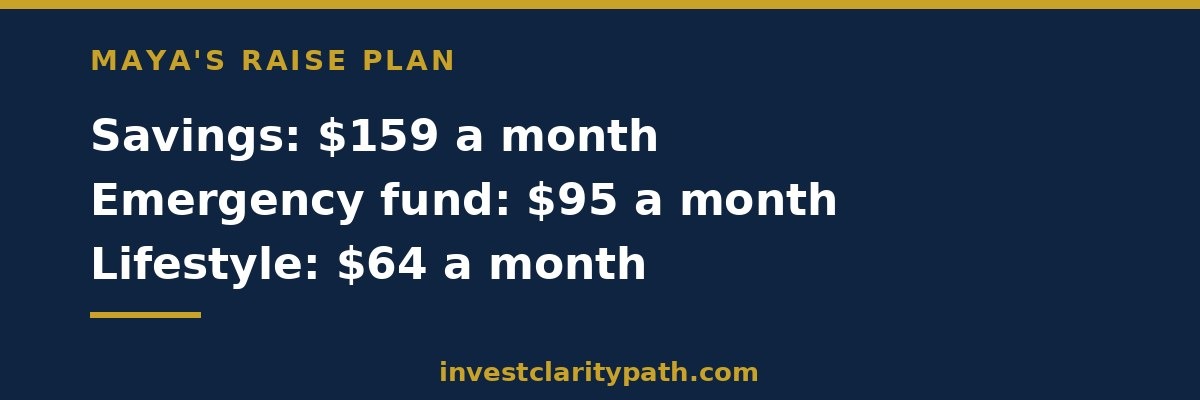
Second, Maya splits the 318 dollars. She uses the standard split, with a small change. Because her emergency fund is only 800 dollars, she sends the debt share to savings for now. Savings gets 50 percent, which is 159 dollars. Her emergency fund top up gets 30 percent, which is 95 dollars. Lifestyle gets 20 percent, which is 64 dollars. 159 plus 95 plus 64 equals 318 dollars. Every dollar of the raise has a job.
Third, Maya automates it before the first new paycheck. She raises her 401(k) contribution from 6 percent to 8 percent of pay. On her new salary of 60,500 dollars, 2 percent is 1,210 dollars a year, or about 101 dollars a month. That covers most of the 159 dollar savings share. She sets an automatic transfer of 58 dollars a month to a high yield savings account on payday, which brings her savings share to 159 dollars. She sets a second automatic transfer of 95 dollars a month to the same savings account, labelled emergency fund, until the fund reaches 2,000 dollars, and then she will redirect that 95 dollars to the credit card.
Fourth, Maya picks her lifestyle upgrade. She chooses 64 dollars a month for one dinner out with her partner and a streaming subscription she had been skipping. She adds both to her budget as fixed lines, so the money is spent on purpose and does not leak into random spending.
After three months, Maya checks the result. Her emergency fund is 800 plus 3 times 95, which is 1,085 dollars, plus the 58 dollar monthly transfers, which add 174 dollars, for a total of 1,259 dollars. Her 401(k) is growing faster. Her credit card balance is unchanged, because she is still paying the minimum, but her plan says the 95 dollars moves to the card once the emergency fund hits 2,000 dollars, which will take about eight more months. Her lifestyle spending rose by exactly 64 dollars a month, and no more.
How to update your budget in one sitting
Once you know your split, update your budget before the new paycheck lands. Money you never see in your spending account is money you do not spend, so do the admin first.
First, raise your automatic savings transfer by the savings amount. If you use pay yourself first, adjust the transfer on your next payday. If your 401(k) is a percentage of pay, change the percentage through your employer portal. For 2026, the IRS lets you put up to 24,500 dollars of your own pay into a 401(k) each year, so a raise rarely pushes you near the limit, but check if your salary is high.
Second, raise your extra debt payment by the debt amount. If you were paying 100 dollars extra a month on a credit card, raise it to the new total. Apply the extra payment to one debt only, either the highest interest rate or the smallest balance, depending on your plan.
Third, add one lifestyle line, not five. Pick the upgrade that matters most to you, give it a fixed monthly amount, and add it to the budget. If the lifestyle share is small, such as 35 dollars, pick one small pleasure and enjoy it properly.
Fourth, check your sinking funds. A raise is a good moment to start or raise a sinking fund for a cost that is coming, such as car repairs, a holiday, or Christmas. If your car is getting older, a 50 dollar a month sinking fund now is cheaper than a surprise 600 dollar repair later.
Fifth, write the new numbers down and set a review date three months away. Your budget should match your new pay, and the review is where you catch any drift. If your spending crept up anyway, the review is the moment to pull it back, while the raise is still fresh.
To rebuild your monthly budget around the new income, read our guide on creating a monthly budget. To see how the 50/30/20 rule works across a whole budget, read our guide on the rule.
Common mistakes to avoid
The first mistake is spending the raise before it arrives. A new car, a new flat, or a new subscription signed the week you hear about the raise will eat the whole increase and add a monthly bill you cannot undo. Wait until the money has landed for two months, then decide.
The second mistake is upgrading everything a little. Ten small upgrades add up to the whole raise and none of them feels like a reward. Pick one upgrade, fund it properly, and leave the rest alone.
The third mistake is forgetting tax. Planning around the gross raise means your budget will be short every month, and the shortfall will come out of savings. Always plan from the take home figure on your pay stub.
The fourth mistake is leaving the raise in your spending account. Money that sits in checking gets spent. Automatic transfers on payday are the whole trick. If the money moves before you see it, you cannot spend it by accident.
The fifth mistake is ignoring the employer match. If your raise lifts you into a higher match, or if you never raised your contribution to get the full match, a raise is the cheapest moment to fix it. The match is free money, and it is the first place any raise should go. Learn how a 401(k) works in our beginner guide.
Frequently asked questions
How much of a raise should I save?
Save at least half of the take home increase. A 50 percent savings rate on new money is the standard starting point, and it rises naturally if you apply it to every raise. If you have high interest debt or no emergency fund, send the debt share to savings or debt first, and keep the lifestyle share at 20 percent.
What is lifestyle creep?
Lifestyle creep is the slow rise in spending that follows a rise in income. Your spending grows to match your new pay, so your savings rate never improves. The fix is to capture part of every raise with automatic transfers before your spending adjusts to the new number.
Should I pay off debt or save my raise first?
If you have credit card debt above 20 percent interest, send most of the raise to the debt until it is gone, but keep a small emergency cushion of at least 1,000 dollars first. If your debt is low interest, such as a mortgage or a student loan under 6 percent, split the raise between savings and extra payments. Read our guide on the debt or savings choice.
How do I budget a small raise, such as 3 percent?
A 3 percent raise on a 50,000 dollar salary is 1,500 dollars a year, or about 88 dollars a month in take home pay. Split it the same way: 44 dollars to savings, 26 dollars to debt, and 18 dollars to lifestyle. Small raises still compound. Saving 44 dollars a month extra, every month, is 528 dollars a year, and the habit matters more than the amount.
Conclusion, and your first step today
Budgeting after a pay rise comes down to one move: split the extra take home pay before you get used to it. Save 50 percent, send 30 percent to debt, and enjoy 20 percent on purpose. On a 350 dollar a month increase, that is 175 dollars to savings, 105 dollars to debt, and 70 dollars to enjoy. Check your first new pay stub for the real monthly increase, automate the transfers on payday, and review the result after three months.
Your first step today is simple. Find your take home increase from your new pay stub, or estimate it at 70 percent of the gross monthly raise. Multiply it by 0.5 for savings, 0.3 for debt, and 0.2 for lifestyle. Set the transfers now, before the next payday.
To put the raise into a full monthly plan, read our guide on creating a monthly budget. If you budget on one income, the same split works, and our single income guide shows how.
This post is educational only. It is not financial advice.
