
How Do I Plan for Retirement If I Start Late?
How do I plan for retirement if I start late?
You can still build a solid retirement plan if you start late, but the plan looks different from an early starter’s plan. There is no shortcut that turns a late start into a fully funded retirement in a couple of years. Instead, you pull the five levers you can control: save more each month, spend less, use every tax-advantaged account and catch-up limit, invest for growth, and consider working a few extra years. Start with 1 percent of your pay, then raise it by 1 percent each year until you reach 20 percent or more.
Starting late is common. Many people reach their 50s with little saved because of low pay, children, illness, divorce, or simply never getting started. The past is fixed. What matters now is the monthly amount you save from today forward, and the years you give it to grow.
This post is educational only. It is not financial advice.
Step 1: Face the numbers honestly
Start by writing down three numbers: what you have saved for retirement, what you earn, and what you spend each month. Do not guess. Open the accounts, add up the balances, and look at three months of bank statements.
Then work out your gap. A simple target is 10 times your final salary saved by retirement, Fidelity’s guideline for age 67. If you earn 75,000 dollars a year, that target is 750,000 dollars. If you have 50,000 dollars saved at 55, your gap is 700,000 dollars. That number will look big. It is the full target, not the amount you must save from pay alone.
Also work out your monthly need. The illustration below shows the monthly saving needed to reach 500,000 dollars by age 67, using an assumed average annual return of 7 percent. This is an assumption for the illustration only, not a fact and not a forecast.
If you start at 50, you need about 1,282 dollars a month. At 55, about 2,225 dollars a month. At 60, about 4,630 dollars a month. Every year you wait makes the monthly amount much bigger, which is why starting today matters more than starting perfectly.
If you have saved nothing yet, start with our guide for that situation:
Step 2: Start saving now, even if it is small
The worst response to a late start is to save nothing because the target looks too big. A small amount started now still grows, and the habit matters more than the starting number.
Start with 1 percent of your pay if that is all you can manage, then raise it by 1 percent each year, or with every pay rise. On a 75,000 dollar salary, 1 percent is 750 dollars a year, or about 63 dollars a month. That sounds tiny, but each yearly step adds about 63 dollars a month, and after ten steps you are saving 11 percent, or about 688 dollars a month, without ever feeling a big cut in one go.
If your employer offers a 401(k) match, contribute at least enough to get all of it before anything else. A common match is 50 percent of the first 6 percent you contribute. On a 75,000 dollar salary, contributing 6 percent means 4,500 dollars a year from you, or 375 dollars a month, and 2,250 dollars a year from your employer, or about 188 dollars a month. That is 563 dollars a month in total.
Step 3: Use the catch-up limits after 50
The tax rules give late starters extra room, and you should use all of it.
For 2026, the IRS lets you put up to 24,500 dollars of your own pay into a 401(k) each year. If you are 50 or older, you can add a catch-up of 8,000 dollars, for a total of 32,500 dollars a year, or about 2,708 dollars a month. If you are 60, 61, 62, or 63, the catch-up is 11,250 dollars, for a total of 35,750 dollars a year, or about 2,979 dollars a month.
For IRAs, the 2026 limit is 7,500 dollars a year across all your IRAs, or 8,600 dollars a year if you are 50 or older, about 717 dollars a month. The IRA catch-up is 1,100 dollars a year.
Learn how a 401(k) works in our beginner guide: To open a Roth IRA, read our guide:

Step 4: Cut spending to free up saving money
When you are behind, cutting spending does double work: it frees up money to save today, and it lowers the income you will need in retirement. Every 100 dollars a month you cut is 100 dollars a month more for saving.
Start with the big costs, because they move the number fastest. Housing is usually the biggest: downsizing, moving to a cheaper area, or taking in a lodger can free up hundreds of dollars a month. Transport is next: keeping a paid-off car instead of buying a new one can free up a car payment of 300 to 500 dollars a month.
Step 5: Invest for growth, not for safety alone
A late starter who keeps everything in cash or low-interest savings will not catch up, because the money does not grow fast enough. You need growth: keep a meaningful share of your retirement money in stocks, through broad index funds.
That does not mean taking wild risks. It means not hiding in the safest option out of fear. If you are 55 and plan to retire at 67, you still have 12 years for the money to grow, and then 20 or more years of retirement after that. A mix weighted toward stocks, with some bonds for stability, is a common choice, and a low-cost target-date fund can set it for you automatically.
Keep fees low and keep contributing every month, even when markets fall. A falling market means your contribution buys more shares for the same money. Stopping contributions when the market falls turns a late start into a much worse one.
Step 6: Consider working a few extra years
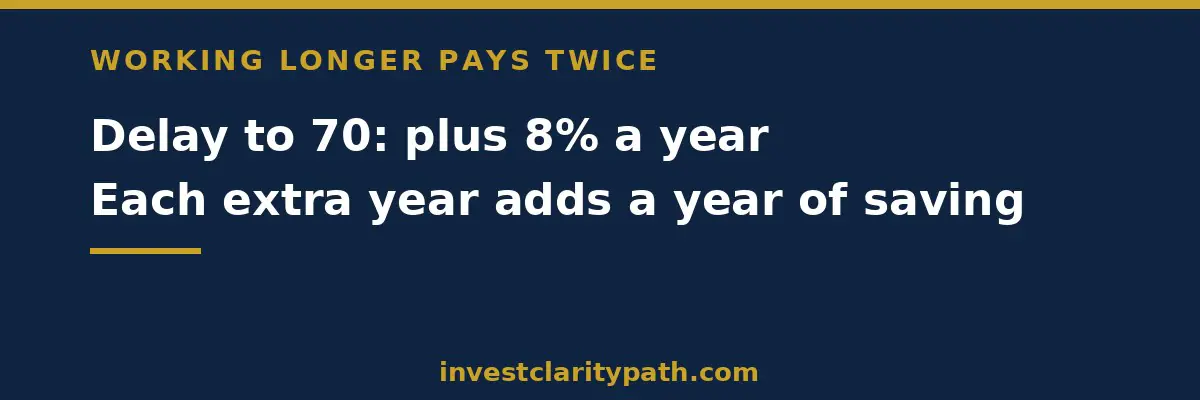
Working longer is the single most powerful lever a late starter has, because it works three ways at once: each extra year adds a year of saving, a year of investment growth, and one less year to fund in retirement.
Retiring at 70 instead of 67 adds three years of contributions and growth, and shortens your retirement by three years. It also raises your Social Security benefit. For people born in 1960 or later, the full retirement age is 67, and claiming at 62 cuts the monthly benefit by 30 percent. Delaying past 67 adds 8 percent a year, up to age 70, so waiting to 70 raises the monthly benefit by 24 percent. That is a large, guaranteed increase for life.
Step 7: Plan your income, not just your savings
A late starter’s retirement will usually have several income sources, not one big pot.
Social Security is the base. Check your statement at ssa.gov for your estimated benefit at 62, 67, and 70. The difference between claiming at 62 and at 70 is large, often 70 percent or more in monthly income, so the claiming age is a big decision.
Your 401(k) and IRA savings are the second source. A common planning rule is to aim for 25 times your expected yearly spending in retirement, the same idea as the 4 percent rule: withdraw about 4 percent of your savings in the first year, then adjust for inflation each year after. On 500,000 dollars of savings, 4 percent is 20,000 dollars a year. On 750,000 dollars, it is 30,000 dollars a year. These are planning guides, not guarantees.
Other sources can fill the gap: a pension, part-time work, rental income, or a side income. A skill you can sell for a few hours a week can cover a real share of your retirement spending.
Add the sources up and compare them with your expected yearly spending in retirement. If the income covers the spending, your plan works. If not, go back to the levers: save more, spend less, or work longer, until the numbers meet.
Worked example: Daniel, 52, earns 75,000 dollars
Daniel is 52, earns 75,000 dollars a year, and has no retirement savings at all. He plans to retire at 67, which gives him 15 years.
First, the target. Daniel aims for 500,000 dollars saved by 67, plus Social Security. At an assumed 7 percent average annual return, he needs about 1,577 dollars a month to reach 500,000 dollars in 15 years. That is a big monthly amount, but it is made of his own saving, his employer match, and investment growth.
Second, the saving rate. Daniel starts at 20 percent of his pay, 15,000 dollars a year, or 1,250 dollars a month. His employer matches 50 percent of the first 6 percent, so his 6 percent, 4,500 dollars a year, earns a match of 2,250 dollars a year. His total going in is 17,250 dollars a year, or about 1,438 dollars a month. That is close to the 1,577 dollars a month he needs.
Third, the catch-up room. Daniel is over 50, so his 401(k) limit is 32,500 dollars a year, or about 2,708 dollars a month. His 15,000 dollars a year is well below that, so the limit does not hold him back. He also opens a Roth IRA and adds 200 dollars a month, 2,400 dollars a year, well below the 2026 IRA limit of 8,600 dollars for someone 50 or older. His total saving is now 19,650 dollars a year, or about 1,638 dollars a month, above the 1,577 dollars he needs.
Fourth, the payoff. At the same assumed 7 percent average annual return, saving 1,250 dollars a month for 15 years grows to about 396,000 dollars. Saving 2,000 dollars a month grows to about 634,000 dollars. Saving the full 401(k) maximum for someone over 50, about 2,708 dollars a month, grows to about 858,000 dollars. These are illustrations, not promises. But they show that Daniel’s plan works if he sticks to it.
Fifth, the spending cut. To afford 20 percent saving, Daniel cuts his spending. He keeps his paid-off car instead of buying a new one, saving a 400 dollar a month car payment. He cancels subscriptions and cooks at home more, saving about 250 dollars a month. He downsizes his phone plan and shops for cheaper insurance, saving about 100 dollars a month. That is 750 dollars a month freed up, which covers most of his new saving.
Sixth, the extra years. Daniel also plans to work until 70 if his health allows. Those three extra years add about 59,000 dollars of his own saving at his current rate, plus growth, plus a 24 percent higher Social Security benefit.
Daniel is starting from zero at 52, and his plan still works, because he saves a high percentage, uses the match and the catch-up limits, cuts spending, and plans to work a few extra years.
Common mistakes to avoid
The first mistake is waiting for a windfall. An inheritance, a bonus, or a lottery win is not a plan. The plan is a monthly amount, saved every month, starting now.
The second mistake is saving too little because the target feels impossible. Saving 1,250 dollars a month feels hard, but saving 63 dollars a month feels easy, and 63 dollars a month is infinitely better than zero. Start small, raise it every year, and let the habit grow.
The third mistake is taking on more risk than you can handle. A late start can tempt you into risky investments or a business idea that promises fast returns. If it fails, you lose the little time you have left. Keep your money in broad, low-cost investments and let time do the work.
The fourth mistake is raiding retirement money early. Cashing out a 401(k) means tax plus a 10 percent early withdrawal penalty if you are under 59 and a half, and it throws away years of growth. If you change jobs, roll the money over instead.
The fifth mistake is ignoring Social Security timing. Claiming at 62 without checking the numbers can cost you hundreds of dollars a month for the rest of your life. Check your statement, compare 62, 67, and 70, and choose with the numbers in front of you.
Frequently asked questions
Is it too late to start saving for retirement at 50?
No. At 50, you still have about 17 years until 67, and the catch-up limits let you save more than younger workers: up to 32,500 dollars a year in a 401(k) and 8,600 dollars a year in an IRA for 2026. You will need a higher monthly amount than an early starter, but the plan works if you save aggressively.
How much should I save for retirement if I start at 50?
Aim for 20 percent or more of your pay, including any employer match. On a 75,000 dollar salary, 20 percent is 15,000 dollars a year, or 1,250 dollars a month. At an assumed 7 percent average return, 1,577 dollars a month from age 52 reaches about 500,000 dollars by 67.
Should I pay off debt or save for retirement if I start late?
Do both, in order. First, get the full match. Second, build a 1,000 dollar starter emergency fund. Third, pay off high-interest debt like credit cards, because it grows faster than investments. Fourth, raise retirement saving to 20 percent or more. A low-rate mortgage can wait.
Does working longer really help that much?
Yes, it is the most powerful lever for a late starter. Each extra year adds a year of saving, a year of growth, and one less year to fund. Delaying Social Security from 67 to 70 also raises your monthly benefit by 24 percent.
Conclusion, and your first step today
Planning for retirement when you start late comes down to five levers: save more, spend less, use every catch-up limit, invest for growth, and consider working a few extra years. No single lever closes the gap on its own. Together, they do. Daniel shows it: starting from zero at 52, saving 20 percent of pay, using the match and the catch-up limits, cutting 750 dollars a month of spending, and working to 70 if he can, builds a plan that works.
Your first step today is simple. Check your retirement balance and your employer match, and set your 401(k) contribution to at least the full match. Then set a date, one week from today, to raise it by 1 percent, and keep raising it every year until you reach 20 percent. Starting late is not the same as never starting.
To check your progress by age, read our guide: To see why now matters, read our guide:
This post is educational only. It is not financial advice.
Sources
- IRS, Retirement Topics, 401(k) and Profit-Sharing Plan Contribution Limits: https://www.irs.gov/retirement-plans/plan-participant-employee/retirement-topics-401k-and-profit-sharing-plan-contribution-limits
- IRS, Retirement Topics, IRA Contribution Limits: https://www.irs.gov/retirement-plans/plan-participant-employee/retirement-topics-ira-contribution-limits
- Social Security Administration, Retirement Age and Benefit Reduction: https://www.ssa.gov/benefits/retirement/planner/agereduction.html
- Social Security Administration, Delayed Retirement Credits: https://www.ssa.gov/benefits/retirement/planner/delayret.html
- Kiplinger, Late to Retirement Planning? Four Ways to Help Catch Up: https://www.kiplinger.com/retirement/late-to-retirement-planning-how-to-catch-up