


How Do I Earn Side Income From YouTube?
You earn side income from YouTube by publishing helpful videos in one niche, growing to 1,000 subscribers and 4,000 watch hours so you can join the YouTube Partner Program and earn from ads, and adding income that pays before ads do, such as affiliate links, a simple service, or a digital product. Ads alone pay slowly, so the channels that earn as a side income treat YouTube as a library of useful videos that keeps working for years, not as a quick payout.
You do not need a film crew, an expensive camera, or millions of subscribers. You need a phone, decent light, one clear topic, and a steady upload habit.
This post is educational only. It is not financial advice.
How YouTube income actually works
YouTube is the second largest search engine in the world, and its biggest advantage is permanence: a well made video can rank in YouTube and Google search results for years, and keep attracting new viewers and earning long after you uploaded it. Creators who build a steady side income treat each video as an asset that pays a little, over and over, instead of chasing one viral hit.
Income comes in three buckets, and they arrive in order. Before you qualify for the Partner Program, you can earn from affiliate links, services, and digital products. After you qualify, you add ads, channel memberships, and fan funding. Once you have an audience and trust, you add sponsorships, your own products, and courses. Most beginners should start with the first bucket, because it pays before you have 1,000 subscribers, and it keeps paying after.
The mistake most beginners make is starting with ads. Ads pay only after you qualify, and only once you have real watch time. A channel with ten videos and one affiliate link in each description can earn its first money in the first month.
Step 1: pick one niche and one format
Pick a topic you can make 50 videos about without getting bored, and that other people are already searching for. Good beginner niches are skills you already have: cooking on a budget, fixing things at home, basic phone photography, study tips, simple fitness at home, or explaining a hobby. The test is simple: can you name 20 video titles in that niche right now? If you cannot, the niche is too narrow or too new to you.
Then pick one format and stick to it for at least 60 days. The three formats that work best for beginners are face to camera explainers, screen capture tutorials, and faceless videos with voiceover and stock footage. A phone and a quiet room are enough for the first two. Switching formats every week stops YouTube from learning who to recommend your videos to, so pick one and stay with it.
Check the competition before you commit. Search your niche on YouTube and look at the channels ranking on the first page. If small channels with a few thousand subscribers appear, there is room for you. Look for questions the big channels answer badly or skip, and make those your first videos.
Step 2: set up the channel properly
Set up the channel once, properly, before you publish anything. Use a clear channel name that says what the channel is about. Write a short channel description that names the viewer and the problem you solve, for example: simple budget cooking for students, one new recipe every week. Add a simple profile picture and a banner with the same promise.
Turn on the basics in YouTube Studio: a default description with a link to your other videos, and upload defaults that save you time on every video. Connect an AdSense account later, when you apply for the Partner Program, not on day one.
Plan your first 10 videos before you record the first one. Each video should answer one question a real person types into search, such as how to cook rice without a rice cooker, or how to fix a leaking tap without a plumber. Search style titles bring steady viewers for years, while clever titles bring nobody. Write the title first, then the video.
Step 3: qualify for the YouTube Partner Program
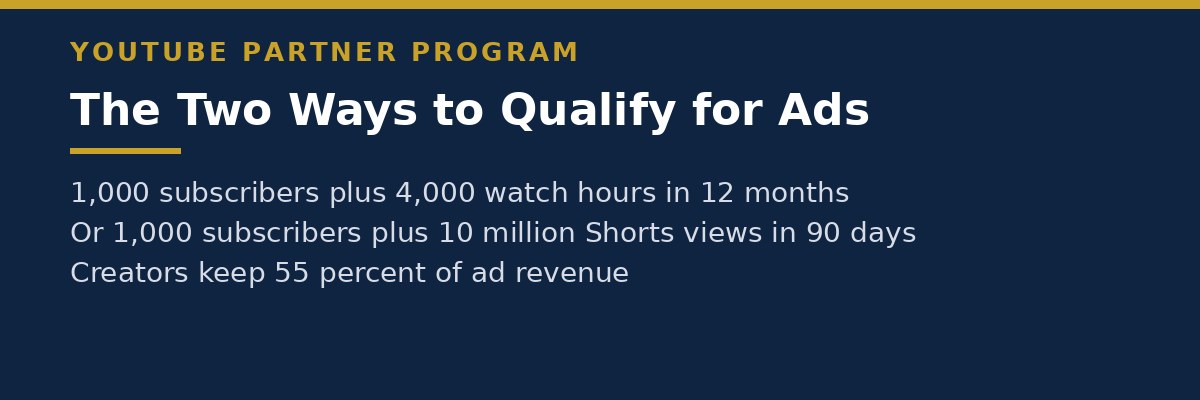
The YouTube Partner Program is the scheme that lets you earn from ads on your videos. YouTube Help states the two ways a channel can become eligible: get 1,000 subscribers with 4,000 qualified watch hours in the last 12 months, or get 1,000 subscribers with 10 million qualified Shorts views in the last 90 days. Watch time from Shorts views in the Shorts Feed does not count towards the 4,000 watch hour threshold.
Most small channels reach this in 6 to 18 months of steady weekly uploads. The maths shows why watch time matters more than views. Four thousand watch hours is 240,000 minutes of viewing. If your average viewer watches 10 minutes, you need 24,000 views that each last 10 minutes, not 24,000 clicks. Short videos that nobody finishes will not get you there. Longer videos that people actually watch will.
Once you are eligible, you apply in YouTube Studio, agree to the Partner Program terms, and connect your AdSense account. YouTube reviews the channel, and if it follows the monetization policies, ads can start running on your videos. Creators keep 55 percent of ad revenue, and YouTube keeps 45 percent. That split is fixed, so your income depends on how many views you get and how much advertisers pay in your niche, not on negotiation.
Step 4: earn before ads pay
Do not wait for the Partner Program to earn your first money. These four streams pay before you qualify, and they usually pay more than ads for a small channel.
Affiliate marketing is the fastest first stream for most beginners. You recommend a product you actually use, and put a link in the video description. When a viewer buys through your link, you earn a commission, usually a small percentage of the sale. It works in almost any niche, it needs no product of your own, and it pays before you have 1,000 subscribers. Always say in the video and the description that the link is an affiliate link. Honesty builds trust, and trust is what makes people click.
A simple service is the fastest way to real cash. If your videos teach a skill, sell that skill directly: video editing, basic design, CV help, language practice, or a one hour advice call. One client paying 50 dollars is worth more than months of ad revenue on a small channel. If writing or design is your skill, read our guide on earning side income from writing or design.
A digital product scales the service. Turn the thing you teach into a template, a checklist, or a short guide, and sell it for 19 to 49 dollars. You build it once, and it can sell again and again while you sleep. Read our guide on selling digital products as a side income.
YouTube Shopping affiliate links, where available, let you tag products in your videos and earn a commission on sales. Super Thanks, where enabled, lets viewers pay a small amount to highlight a comment. Both are small at first, but they cost nothing to turn on.
Step 5: add income after you qualify
Once you are in the Partner Program, turn on ads for your videos in YouTube Studio, and set upload defaults so new videos are monetized automatically. Ads run before, during, and after your videos, and you earn a share of what advertisers pay. Your earnings depend on your niche, your viewers’ countries, and how long people watch. Finance, business, and technology videos usually pay more per view than entertainment videos, because advertisers pay more to reach those viewers.
Channel memberships let your most loyal viewers pay a monthly amount for perks like badges or members only videos. Super Chat and Super Stickers let viewers pay to highlight their messages during live streams. Both work best once you have a core of regular viewers, not on day one.
Sponsorships and brand deals usually pay more than ads once you have an audience. A brand pays you to feature its product in a video, and the payment is often two to five times what the same video would earn from ads. Only accept sponsors whose products you would genuinely use, and always disclose a paid promotion clearly. One dishonest sponsorship can cost you the trust that took a year to build.
Your own merch line, a paid course, or a small community can come later, once you know exactly what your audience wants. Do not build a course before you have an audience asking for one.
Worked example: Ana’s first year as a side income channel
Ana works full time and starts a YouTube channel about simple home cooking on a budget. She uploads one video a week, each 8 to 12 minutes long, and she uses her phone, natural light, and a quiet kitchen. She spends about 90 minutes per video: 20 minutes planning, 25 minutes recording, 25 minutes editing, and 20 minutes on the title, thumbnail, and upload.
After 6 months she has 26 videos, about 800 subscribers, and about 2,800 watch hours. She is not in the Partner Program yet, but she earns from affiliate links. Her videos link to the pan, the knife, and the rice cooker she actually uses. In month 6 she earns 60 dollars from affiliate sales: 20 sales at an average commission of 3 dollars each.
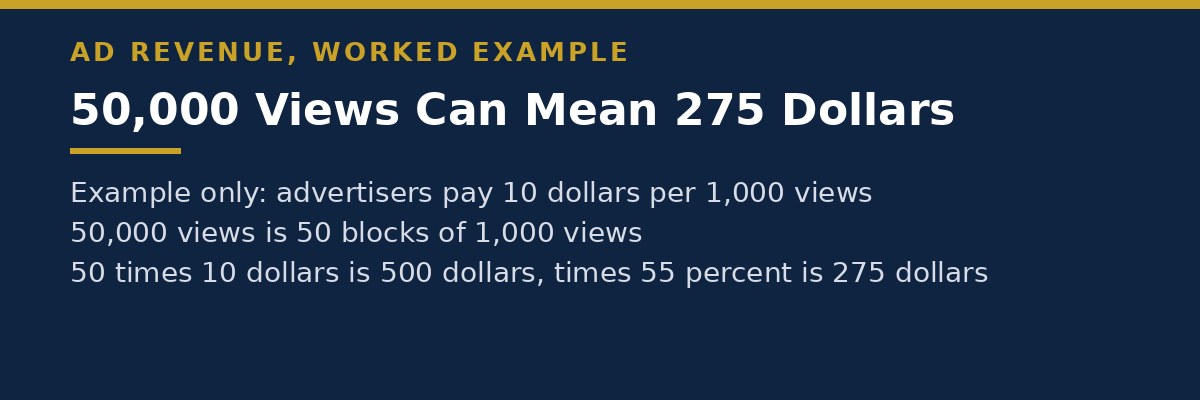
After 12 months she has 52 videos, 1,600 subscribers, and 5,400 watch hours. She qualifies for the Partner Program and turns on ads. Her channel now gets about 50,000 views a month. Here is the ad maths, using an example rate only: suppose advertisers pay 10 dollars per 1,000 views in her niche. Fifty thousand views is 50 blocks of 1,000 views, so 50 times 10 dollars is 500 dollars of ad revenue. The creator keeps 55 percent, so Ana earns 275 dollars from ads that month. That is an example, not a promise. Her real rate could be higher or lower, and it changes every month.
In the same month, her affiliate income grows to 120 dollars, because she now has 52 videos with links instead of 26. She also sells a 19 dollar meal planning template, and 8 viewers buy it, which is 152 dollars. Her month 12 total is 275 dollars from ads, plus 120 dollars from affiliates, plus 152 dollars from the template, which equals 547 dollars. She spent about 6 hours a month making videos, so the channel earns her about 90 dollars an hour in that month, on top of her day job. The first 6 months paid almost nothing. The library she built is what pays now.
Ana’s result is not typical and not guaranteed. It shows the pattern that works: one niche, one video a week, affiliate income first, ads second, and a small product third.
A weekly routine that fits around a day job
YouTube as a side income only works if it fits your real week. Batch the work into one 90 minute session and one upload. Read our guide on how much time a side income really takes before you set your schedule.
Pick a fixed upload day and keep it for at least 60 days. Viewers and the algorithm both like a pattern. Tuesday or Thursday evenings work well for most people with day jobs.
Use a simple production system. Write one short plan for each video: the problem in the first 15 seconds, three steps in the middle, and one clear ending. Record in a single take if the audio is clean. Edit with jump cuts, captions, and chapter markers. Make the thumbnail after the video, with short text and one clear image, and never promise in the thumbnail what the video does not deliver.
Turn each long video into a Short. Cut a 35 to 55 second clip with the hook and one useful tip, and post it to bring new viewers to the full video. One script can feed three things: the long video, the Short, and a short post for your community tab.
Track two numbers each week and ignore the rest: click through rate, which is how many people click your video when they see it, and average view duration, which is how long they stay. If people do not click, fix the title and thumbnail. If people click but leave early, fix the first 30 seconds.
Common mistakes to avoid
The first mistake is copying another channel’s niche instead of picking your own. A niche you do not care about runs out of ideas in a month. Pick the topic you can talk about for a year.
The second mistake is buying expensive gear before your first video. A phone, decent light, and clear audio beat a costly camera with bad sound. Spend money on a basic microphone first, not on a camera.
The third mistake is chasing viral videos instead of search videos. A viral video brings a spike and then nothing. A search video about a question people ask every week brings viewers for years. Build the library first.
The fourth mistake is quitting at month 3. Most channels that earn a side income take 6 to 18 months to reach the Partner Program. The creators who earn are usually the ones who kept uploading weekly while nobody was watching.
The fifth mistake is making income claims you cannot prove. Never promise viewers they will earn a set amount, and never use a thumbnail that promises money the video does not explain. That breaks trust and can break YouTube’s policies too.
The sixth mistake is forgetting the rules. Do not use music, clips, or images you do not have the right to use. Do not click your own ads or ask viewers to click them. Both can get your channel removed from the Partner Program. Read our guide on avoiding side income scams before you accept any offer.
If you want to turn a different skill into side income first, read our guide on turning a skill into side income. And if you want to start with no money at all, read our guide on starting a side income with no money.
Frequently asked questions
How do I earn side income from YouTube?
Pick one niche, publish one helpful video a week, and earn first from affiliate links, a service, or a digital product. When you reach 1,000 subscribers and 4,000 watch hours in 12 months, or 10 million Shorts views in 90 days, you can join the YouTube Partner Program and earn from ads too.
How many subscribers do I need to make money on YouTube?
You need 1,000 subscribers to join the YouTube Partner Program, plus 4,000 watch hours or 10 million Shorts views. But you can earn before that, from affiliate links, services, and digital products, with no subscriber minimum at all.
How much can a small YouTube channel earn?
It varies widely by niche and country. As an example only, a channel with 50,000 views a month at an example rate of 10 dollars per 1,000 views would earn about 275 dollars from ads, because creators keep 55 percent. Most small channels earn more from affiliates and services than from ads at first.
Do I need expensive equipment to start a YouTube channel?
No. A smartphone, decent light, and clear audio are enough for your first videos. Spend on a basic microphone before a camera, because viewers forgive average video quality but leave quickly when the audio is bad.
How long does it take to earn from YouTube?
Most steady channels take 6 to 18 months to reach the Partner Program. Affiliate income and services can pay in the first few months, but ads only start after you qualify, and real income usually comes after you have a library of 40 or more videos in one niche.
Conclusion, and your first step today
Earning side income from YouTube is slow at first and steady later. Pick one niche and one format, publish one helpful video a week, and earn first from affiliate links, a service, or a digital product. Qualify for the Partner Program at 1,000 subscribers and 4,000 watch hours, or 10 million Shorts views, then add ads, memberships, and sponsorships on top. A library of 50 videos in one niche can keep earning for years after you made them.
Your first step today is simple. Write down 20 video titles in one niche, each one answering a question a real person searches for. If you can write 20, you have a channel. Record the first one on your phone this week, and publish it even if it is not perfect. The second video will be better, and the fiftieth will be the one that pays.
This post is educational only. It is not financial advice.
Sources
- YouTube Help, YouTube Partner Program Overview and Eligibility: https://support.google.com/youtube/answer/72851
- The Skill Journey, How to Make Money on YouTube: Every Revenue Stream: https://www.theskilljourney.com/how-to-make-money-on-youtube-every-revenue-stream/
- Side Hustlers, YouTube: https://www.sidehustlers.co/side-hustle/youtube/
