


How Do I Earn Side Income as a Student?
You earn side income as a student by picking one flexible job that fits around your classes, such as tutoring, freelance writing, a campus job, or babysitting, and working a few hours a week for real pay. The best student side incomes need little or no money to start, let you choose your hours, and build a skill you can use after graduation.
Five to eight flexible hours a week can realistically add 200 to 600 dollars a month, and skill based work like tutoring or editing usually pays more per hour than general gig work.
This post is educational only. It is not financial advice.
The rules first: protect your studies, your time, and your money
Before you pick an idea, set three rules for yourself.
First, studies come first. A side income that costs you grades is a bad deal, because your degree is worth far more than a few hundred dollars a month. Pick work you can pause during exam weeks, and cap your hours at a number you can keep when classes get hard. Five to eight hours a week is a good limit for most students.
Second, check the age and account rules. Most online platforms require you to be at least 18 to get paid on your own, including tutoring sites, freelance sites, and pet sitting apps. If you are under 18, your list is shorter: campus work through your own school, babysitting for families you know, and freelance work through an account you can legally hold. Always read the platform’s age rule before you sign up.
Third, keep the money honest. Any money you earn outside a regular job counts as self-employment income, and the tax rules apply to students the same as to anyone else. If your net earnings from self-employment are 400 dollars or more in a year, you must file a federal tax return and pay self-employment tax, even if your total income is low. Keep a simple record of every payment you receive and every expense, in a notebook or a spreadsheet, from the first dollar.
Eight side income ideas that fit around classes
These eight ideas are the strongest picks for students, because they are flexible, they need little or no money to start, and they pay fairly for the hours.
1. Tutoring, online or in person
Tutoring is one of the strongest choices for students who did well in a subject or can explain material patiently. Online tutors typically charge 15 to 35 dollars an hour on tutoring platforms, and busier tutors average closer to 27 dollars an hour once experience is counted. Platforms usually take a cut: one major tutoring platform takes 25 percent of the rate, so a 20 dollar lesson leaves you 15 dollars. You can also tutor privately, through your school or local families, and keep the full rate. Start with the subject you know best, offer one free trial lesson, and ask happy students to recommend you.
2. Freelance writing, editing, or design
If you can write clearly, edit carefully, or design simple graphics, businesses will pay for it. Beginner freelancers commonly list starter gigs between 15 and 50 dollars on freelance marketplaces, and experienced student writers charge 20 dollars or more per hour. You need no money to list a gig, but the marketplace takes a cut: one major freelance site takes 20 percent of every payment. Build a small portfolio first with three short samples, even if they are unpaid practice pieces, and let each finished job bring the next one.
3. Campus jobs
Libraries, recreation centres, admissions offices, dining halls, computer labs, and academic departments often hire students, and the hours are built around class times. Campus jobs pay a steady hourly wage, they are close to your classes, and the managers understand exam weeks. Check your university jobs board first, because these roles go fast at the start of term, and ask your department office directly if nothing is listed.
4. Babysitting
Babysitting is a classic student job because it needs no money to start, the hours are evenings and weekends, and families pay well for someone they trust. Our own guide on babysitting as a beginner side income explains how to start, what to charge, and how to find your first families. Get a basic first aid certificate if you can, it makes parents far more likely to choose you, and always agree the rate and the hours in writing before the first sitting.
5. Pet sitting and dog walking
Pet sitting pays about 15 to 50 dollars an hour on pet care platforms, before the platform’s cut of about 20 percent. It suits students who like animals and can fit walks between classes. Start with friends and neighbours, build a few regular clients, and let word of mouth do the rest. You need to be reliable above all: a missed walk is a lost client.
6. Social media help for local businesses
Small businesses near your campus often need help posting on social media, answering messages, or making simple graphics, and they cannot afford a full time hire. A student who manages one small business account can earn 300 to 1,500 dollars a month per client. Offer one business a free trial week, show them the results, then agree a simple monthly price. Keep the work to a few hours a week per client, and do not take on more clients than your timetable allows.
7. Selling study guides and digital products
If you take good notes, turn them into a study guide, a revision checklist, or a set of flashcards, and sell them online. A single guide can sell again and again after you make it once, which is the closest thing to passive income a student can build. Digital products take time to make and sell slowly at first, so treat this as a second income stream, not your first. Price low at first, ask buyers what would help them more, and improve the guide from their answers.
8. Reselling items responsibly
Buy used textbooks, clothes, or gadgets cheaply, clean them up, and resell them for a little more. Textbook resale is a natural fit for students: buy last year’s books cheaply, sell them to next year’s students. Keep it small and honest, and check your university rules on selling on campus. For the costs around the school year, read our guide on budgeting for back-to-school costs.
How to pick the right one for you
Do not pick the idea that pays the most on paper. Pick the one that fits your week, your skills, and your personality.
Ask four questions. First, how many hours can you honestly give each week, including in exam weeks? Second, what skill do you already have that someone will pay for? Third, do you want fast cash or slow growth? Tutoring, babysitting, and campus jobs pay in the first week, while digital products pay slowly but can keep paying later. Fourth, do you like people or screens?
If you are still unsure, start with tutoring in your best subject. It pays well, it fits around classes, and it looks strong on a CV.
How to start this week
You can start most of these ideas in seven days with no money. If you want a plan for starting with nothing at all, read our guide on starting a side income with no money.
Day 1 and 2: pick one idea and name your offer in one sentence. For tutoring: I help first year students pass introductory maths, 20 dollars an hour, online or in person. For writing: I write clear short articles for small businesses, 25 dollars per article. A one sentence offer is what people remember and recommend.
Day 3 and 4: make proof. Write three short samples, record a short introduction video, or offer one free trial lesson. Proof matters more than a fancy profile, because buyers pay for results they can see.
Day 5: tell people. Post in your university groups, tell your classmates, ask your department office, and list yourself on one platform only. One platform, done well, beats five half finished profiles. Ask your first three customers for a short review, and put those reviews on your profile.
Day 6 and 7: do the first paid job, however small. A 20 dollar first job is worth more than a perfect plan, because it proves someone will pay you, and it gives you a real review to show the next buyer.
Set your price with a simple rule: charge what the work is worth, not what you think a student should charge. If local tutors charge 20 dollars an hour, charge 20 dollars, not 8. Undercharging wins a few jobs and burns you out fast. Read our guide on pricing a first freelance service before you set your first price.
Worked example: Sara tutors six hours a week
Sara is a second year student who is good at maths. She tutors first year students for 6 hours a week at 20 dollars an hour, online, in the evenings. She finds her students through her university tutoring board and through recommendations, so she keeps the full rate and pays no platform cut.
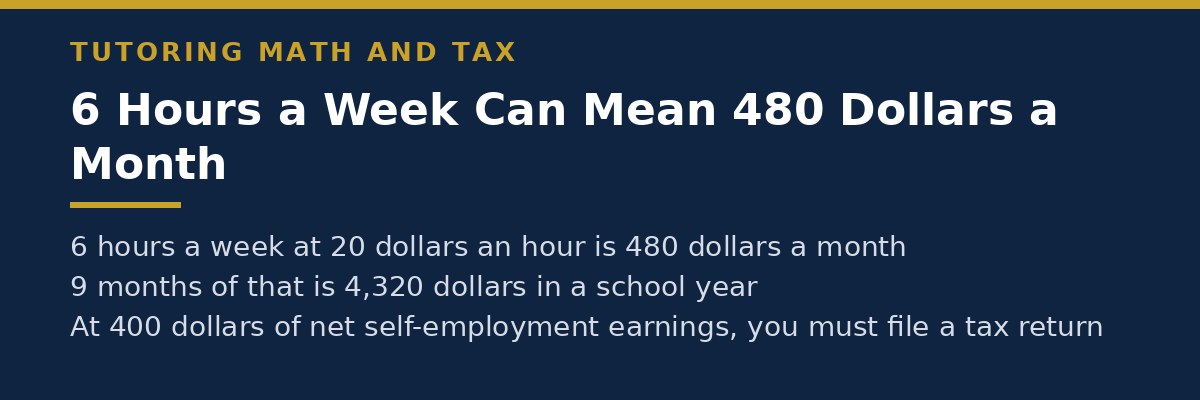
Her weekly income is 6 hours times 20 dollars, which is 120 dollars a week. Over a four week month, that is 480 dollars a month. Over a nine month school year, that is 4,320 dollars, if she keeps the same hours every week, which she does not during exam weeks, so her real total is a little lower.
Now the tax part. Sara’s 4,320 dollars is self-employment income, because she is not an employee of the university or of a tutoring company. The rule is that if your net earnings from self-employment are 400 dollars or more in a year, you must file a federal tax return and pay self-employment tax. Sara is well over 400 dollars, so she must file.
Self-employment tax is 15.3 percent of net earnings, where net earnings are 92.35 percent of net profit. If Sara has no business expenses, her net profit is 4,320 dollars, her net earnings are 4,320 times 0.9235, which is 3,989 dollars, and her self-employment tax is 15.3 percent of 3,989 dollars, which is about 610 dollars. That is about 14 percent of her income, and she should set it aside as she earns it, not discover it in April.
If Sara had used a platform that takes 25 percent, her income would be lower: 480 dollars a month times 75 percent is 360 dollars a month, and 3,240 dollars over nine months. Her tax would be lower too, but so would her income, which is why finding her own students is worth the effort.
Sara puts 15 percent of every payment into a separate savings account the day it arrives. She also keeps a simple record: date, student, hours, amount paid, and any expense, in one spreadsheet. At the end of the year, that record makes filing simple. To learn how to find those first students, read our guide on finding a first freelance client.
Tax, records, and money rules for students
Three money rules keep a student side income simple and safe.
First, remember the 400 dollar rule. If your net earnings from self-employment are 400 dollars or more in a year, you must file a federal tax return and pay self-employment tax, even if your total income is low and you owe no income tax. Net earnings are 92.35 percent of your net profit, after subtracting ordinary business expenses. If you file for any other reason, such as a part time job with tax withheld, you must include all your income, including the small self-employment amount.
Second, set aside tax money as you earn it. Put 15 percent of every self-employment payment into a separate savings account on the day it arrives. That covers the self-employment tax in most cases, and any income tax on top is usually small for a student. If you are not sure, a campus tax clinic or a free tax help service can check your numbers before you file.
Third, keep records from day one. One spreadsheet with five columns, date, who paid you, what for, how much, and any expense, is enough. Keep receipts for anything the work needed, such as a textbook, a bus fare to a tutoring job, or a software subscription. Good records make filing easy, and they protect you if anyone asks questions later.
Fourth, think about financial aid. Income you earn can affect future financial aid applications, depending on your country and your aid rules. Do not let that stop you from earning, but do check your aid office if your income grows large, so there are no surprises.
Common mistakes and scams to avoid
The first mistake is taking on too much. Ten hours a week sounds fine until exam season arrives. Cap your hours, keep exam weeks free, and tell clients in advance when you will be unavailable. A client who knows you are away for two weeks is fine. A client who is ignored for two weeks is lost.
The second mistake is working for free for too long. One free trial lesson is sensible. A month of free work is not. If a client will not pay after a trial, they were never going to pay.
The third mistake is undercharging. Charge the local rate, not a student discount. Clients who pay a fair rate respect your time. Clients who pay almost nothing do not.
The fourth mistake is ignoring the tax rule. The 400 dollar threshold is low, and almost any profitable student side income crosses it. Set the money aside as you earn it, and file the return.
The fifth mistake is falling for scams. Watch for these signs: a job that asks you to pay a fee before you can start, a client who overpays you and asks you to send the difference back, a job that asks for your bank login or a photo of your ID before any work, and a promise of hundreds of dollars a day for no skill. Real work pays fairly for real skill, and real clients never ask for your passwords. Read our guide on avoiding side income scams before you accept any new client.
Frequently asked questions
How do I earn side income as a student?
Pick one flexible idea that fits around your classes, such as tutoring, freelance writing, a campus job, or babysitting. Name your offer in one sentence, make a little proof of your skill, tell people at your university, and do your first paid job this week.
What is the best side income for students?
Tutoring is usually the best first pick, because it pays 15 to 35 dollars an hour, it fits around classes, and it builds your own understanding. Freelance writing and campus jobs are close behind. The best idea for you is the one that matches a skill you already have and hours you can honestly give.
How much can a student earn as a side income?
Five to eight flexible hours a week can realistically add 200 to 600 dollars a month. Tutoring at 20 dollars an hour for 6 hours a week is 480 dollars a month. Skill based work pays more per hour than general gig work, and digital products take longer to pay but can keep earning later.
Do students have to pay tax on side income?
Yes, if the income is self-employment income. If your net earnings from self-employment are 400 dollars or more in a year, you must file a federal tax return and pay self-employment tax, even if your total income is low. Set aside 15 percent of every payment as you earn it, and keep a simple record of income and expenses.
Can students under 18 earn side income?
Yes, but the options are narrower. Most online platforms require you to be 18 to get paid on your own. If you are under 18, campus work through your school, babysitting for families you know, and freelance work through an account you can legally hold are the usual routes.
How do I balance a side income with my studies?
Cap your hours at five to eight a week, keep exam weeks free, and pick work you can pause. Tell clients your exam dates in advance, and use a simple weekly plan so study time is protected first. If grades slip, cut the hours before you cut the study time.
Conclusion, and your first step today
Side income as a student works best when it is small, flexible, and honest. Tutoring, freelance writing, campus jobs, babysitting, pet sitting, social media help, study guides, and reselling all fit around classes, need little or no money to start, and pay fairly for the hours.
Your first step today is simple. Pick one idea, write your one sentence offer, and tell three people at your university about it today.
This post is educational only. It is not financial advice.
Sources
- Morgan Franklin Foundation, 12 Best Side Hustles for Students That Build Skills: https://morganfranklinfoundation.org/best-side-hustles-for-students/
- The Interview Guys, 15 Best Side Hustles for College Students in 2026: https://blog.theinterviewguys.com/side-hustles-for-college-students/
- Eneba, Best Side Hustle for Students: 8 Top Picks in 2026: https://www.eneba.com/hub/play-to-earn/best-side-hustle-for-students/
- The 1099 Desk, Self-Employed Under 400 Dollars: Do You Have to File Taxes?: https://the1099desk.com/self-employment-taxes/self-employed-under-400/
