
How Do I Plan for Retirement in My 40s?
How do I plan for retirement in my 40s?
Your 40s are the decade when retirement planning gets serious, and the good news is that it is not too late. Start with three numbers: what you have saved, what you earn, and what you can save each month. Then aim to save at least 15 percent of your pre-tax pay, including any employer match, clear high-interest debt, and use the tax-advantaged accounts open to you. Fidelity’s guideline is about 3 times your salary saved by 40 and about 6 times by 50, on the way to 10 times by 67. If you are behind, the fix is to save more each month and give your money more years to grow, not to panic.
Your 40s are often your peak earning years, but also the busiest: career, children, a mortgage, and maybe aging parents. This guide gives you a clear order of steps, so you can make progress without trying to do everything at once.
This post is educational only. It is not financial advice.
Step 1: Find out where you stand
You cannot plan without numbers. Gather three figures this week.
First, add up everything saved for retirement: your 401(k), any IRA, and any other retirement account. Do not count your house or your emergency fund. Those matter, but they are not retirement savings.
Second, write down your gross annual pay, before tax. Your benchmarks are measured against this number.
Third, work out your current savings rate. Add up what you and your employer put into retirement accounts each month, multiply by 12, and divide by your gross annual pay. If you earn 80,000 dollars a year and save 800 dollars a month in total, that is 9,600 dollars a year, or 12 percent of your pay. Now you know your starting point.
Then compare your savings to the benchmarks. Fidelity’s guideline is about 1 times your salary saved by 30, 3 times by 40, 6 times by 50, 8 times by 60, and 10 times by 67. If you earn 80,000 dollars and you are 42, the benchmark is about 240,000 dollars. If you have 120,000 dollars, you are at 1.5 times your salary: behind, but far from hopeless. Either way, the benchmark tells you how big the gap is.
If you have saved nothing yet, a zero is still a number, and knowing it is the start of the plan. Read our guide for that situation.

Step 2: Build your budget around saving
Fidelity suggests keeping essential expenses, housing, food, transport, and loan payments, to no more than 60 percent of your income, so the rest can go to saving, debt payoff, and the things you enjoy. You do not need to hit 60 percent on day one. Just find the gap between what you earn and what you spend.
List your monthly take-home pay and your spending for the last three months. Sort it into essentials, debt payments, and everything else. The everything else category is where extra saving usually comes from: eating out, subscriptions, and impulse buys. Cutting 200 dollars a month there is a 2,400 dollar a year raise to your future self.
Step 3: Save at least 15 percent, and raise it each year
The most widely used guideline is to save 15 percent of your pre-tax pay for retirement, including any employer match. On an 80,000 dollar salary, that is 12,000 dollars a year, or 1,000 dollars a month. On a 60,000 dollar salary, it is 9,000 dollars a year, or 750 dollars a month.
If you started saving at 25, 15 percent is roughly the right target. If you started later, or you are behind, aim higher: 18 to 20 percent is a common catch-up range for people in their 40s. On an 80,000 dollar salary, 20 percent is 16,000 dollars a year, or about 1,333 dollars a month.
If you cannot reach 15 percent today, start where you can and raise it by 1 percent each year, or with every pay rise. Going from 10 percent to 15 percent takes five yearly steps.
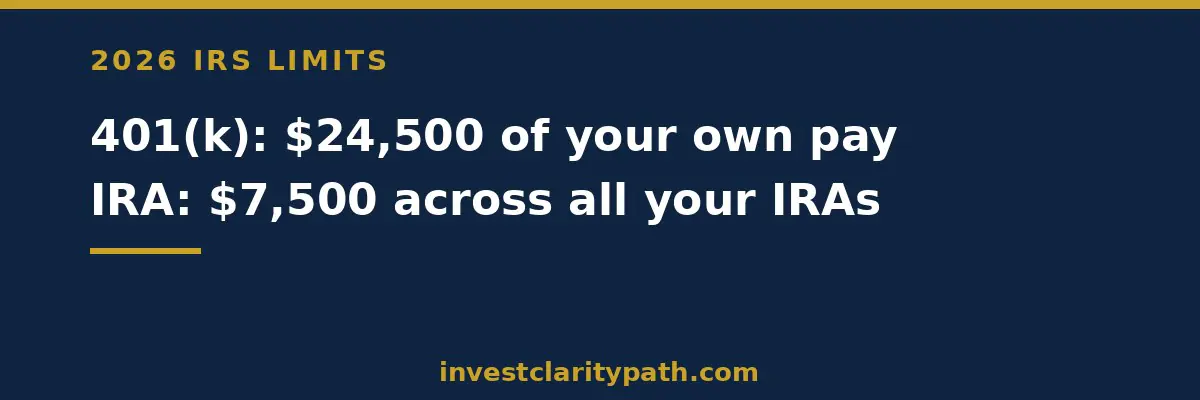
Check the limits too. For 2026, the IRS lets you put up to 24,500 dollars of your own pay into a 401(k) each year, about 2,042 dollars a month. The IRA limit is 7,500 dollars a year across all your IRAs, or 625 dollars a month. Learn how a 401(k) works in our beginner guide.
To see the monthly amounts by salary and starting age, read our guide.
Step 4: Get the full employer match, then fill the right accounts
If your employer offers a 401(k) match, contribute at least enough to get all of it. A common match is 50 percent of the first 6 percent you contribute. On an 80,000 dollar salary, 6 percent means 4,800 dollars a year from you, or 400 dollars a month, and 2,400 dollars a year from your employer, or 200 dollars a month. That is 600 dollars a month going in, and 200 dollars of it is free money.
After the match, fill your accounts in this order. First, the 401(k) up to the match. Second, an IRA, Roth or traditional, up to the 7,500 dollar yearly limit. Third, back to the 401(k) up to the 24,500 dollar yearly limit. To compare the two accounts, read our guide. To open a Roth IRA, read our guide.
If you are self-employed, look into a solo 401(k) or a SEP IRA, which let you contribute as both employee and employer, with higher limits than a regular IRA.
Step 5: Clear high-interest debt
Debt and saving pull in opposite directions. Credit card debt at 20 percent interest grows faster than any investment you can reasonably expect, so paying it off returns about 20 percent a year, guaranteed.
Use one of two proven methods. The avalanche method pays the highest-interest debt first, which saves the most money. The snowball method pays the smallest balance first, which builds momentum. Pick the one you will stick with. Once a debt is gone, send that same monthly payment into retirement saving instead of spending it.
A mortgage is different: its interest is usually much lower than credit card interest. Do not rush to pay off a low-rate mortgage while your retirement accounts are empty. Clear the expensive debt first.
Step 6: Protect your income and your family
First, keep an emergency fund of 3 to 6 months of essential expenses in a savings account, separate from retirement accounts. If you lose your job or face a big bill, it keeps you from stopping contributions or borrowing.
Second, check your insurance: health, disability through work, and term life if people depend on your income. A single serious illness without cover can undo a decade of saving.
Third, plan for health costs. Fidelity estimates that a 65-year-old retiring in 2026 will need about 185,500 dollars to cover medical expenses through retirement. If your employer offers a health savings account, an HSA, use it: money goes in, grows, and comes out tax-free for medical costs.
Fourth, sort out the paperwork: update the beneficiaries on your 401(k) and IRA, and write a will.
Step 7: Invest for growth, and check your mix
Money you need in 25 years should be invested for growth, not sitting in cash. A common beginner mix in your 40s is broad stock index funds with some bond funds, weighted toward stocks because you still have decades to grow. The exact mix depends on your comfort with risk, but the key point is to stay invested and keep contributing every month, even when markets fall. A falling market means your contribution buys more shares for the same money.
Check your mix once a year, rebalance if one part has grown far beyond its target, and keep fees low: a fund charging 0.1 percent a year keeps far more than one charging 1 percent, and the difference compounds over 25 years.
Step 8: Picture the retirement you want, and price it
Planning is easier when you know what you are planning for. Ask three questions: when do you want to retire, how much will you spend each year, and where will the money come from? 67 is the full retirement age for Social Security for people born in 1960 or later. Retiring earlier means saving more now. Retiring later means saving less now.
How much will you spend each year in retirement? A common planning figure is 75 to 85 percent of your pre-retirement income, because some costs fall away: no commuting, no work clothes, and often no mortgage. On an 80,000 dollar salary, that is about 60,000 to 68,000 dollars a year.
Where will the money come from? Social Security, your 401(k) and IRA savings, and any pension. Social Security alone will not cover most people. You can start it as early as 62, but for people born in 1960 or later, claiming at 62 cuts the monthly benefit by 30 percent compared with waiting until 67. Delaying past 67 adds 8 percent a year, up to age 70. Learn how Social Security works in our guide.
Work out your own target with the benchmarks: about 3 times your salary by 40, 6 times by 50, and 10 times by 67. To check your progress, read our guide.
Worked example: Omar, 42, earns 80,000 dollars
Omar is 42, earns 80,000 dollars a year, and has 110,000 dollars saved. His employer matches 50 percent of the first 6 percent he contributes. He wants to know if he is on track and what to do next.
First, the benchmark. At 42, he should have about 3 times his salary saved, which is 240,000 dollars. He has 110,000 dollars, so he is 130,000 dollars behind. That is a real gap, but he has 25 years until 67, and his peak earning years are still ahead.
Second, the savings rate. Omar contributes 8 percent of his pay, 6,400 dollars a year, or about 533 dollars a month. His employer adds 3 percent, 2,400 dollars a year, or 200 dollars a month. His total is 8,800 dollars a year, about 733 dollars a month, which is 11 percent of his pay. He needs at least 15 percent, and 20 percent would close the gap faster.
Third, the new plan. Omar raises his contribution to 14 percent of pay, 11,200 dollars a year, or about 933 dollars a month. His employer still adds 2,400 dollars a year. His total becomes 13,600 dollars a year, about 1,133 dollars a month, which is 17 percent of his pay. He also opens a Roth IRA and adds 200 dollars a month, 2,400 dollars a year, well below the 2026 IRA limit of 7,500 dollars. His total saving is now 16,000 dollars a year, or 20 percent of his pay.
Fourth, the payoff. At an assumed 7 percent average annual return, saving 1,333 dollars a month from age 42 to 67 would grow to about 1,080,000 dollars on its own, before counting the 110,000 dollars he already has. This is an illustration, not a promise. At 20 percent, Omar closes the gap.
Fifth, the debt. Omar has a 6,000 dollar credit card balance at 22 percent interest. He pays it off over six months, then sends that 1,000 dollars a month to his Roth IRA instead.
To see when to start, read our guide.
Common mistakes to avoid
The first mistake is waiting for the perfect time to start. Every year you wait makes the monthly amount bigger. Starting this month at 12 percent beats starting next year at 15 percent.
The second mistake is saving a flat dollar amount and never raising it. 500 dollars a month sounds fine at 35, but if your pay grows and your contribution stays at 500 dollars, your savings rate falls every year. Save a percentage of pay and raise it with every raise.
The third mistake is cashing out a 401(k) when you change jobs. That means tax plus a 10 percent early withdrawal penalty, and it throws away decades of growth. Roll the money into your new plan or an IRA instead.
The fourth mistake is ignoring the match. If your employer offers one and you do not contribute enough to get all of it, you leave free money on the table every month.
The fifth mistake is keeping retirement money in a savings account. Savings accounts are for emergency funds and short-term goals. Retirement money needs to be invested to grow.
Frequently asked questions
How much should I have saved for retirement by 40?
Fidelity’s guideline is about 3 times your salary saved by 40, on the way to 6 times by 50 and 10 times by 67. On an 80,000 dollar salary, that is about 240,000 dollars by 40. If you are behind, raise your savings rate: the fix is a higher monthly amount.
How much should I save for retirement in my 40s?
Aim for at least 15 percent of your pre-tax pay, including any employer match. If you are behind, aim for 18 to 20 percent. On an 80,000 dollar salary, 15 percent is 1,000 dollars a month and 20 percent is about 1,333 dollars a month.
Is it too late to start saving for retirement at 40?
No. At 40, you still have about 27 years until 67, enough time for regular saving and growth to build a large fund. The monthly amount is bigger than at 25, but the plan works: save a high percentage, get the full match, clear expensive debt, and stay invested.
Should I pay off debt or save for retirement in my 40s?
Do both, in order. First, get the full match. Second, build a 1,000 dollar starter emergency fund. Third, pay off high-interest debt like credit cards. Fourth, raise retirement saving to 15 percent or more. A low-rate mortgage can wait.
Conclusion, and your first step today
Planning for retirement in your 40s comes down to eight steps: find out where you stand, build your budget around saving, save at least 15 percent and raise it each year, get the full match, clear high-interest debt, protect your income and family, invest for growth, and picture the retirement you want. If you are behind, the answer is a higher monthly amount and more years of steady saving, not a risky shortcut.
Your first step today is simple. Add up your retirement savings, work out your savings rate, and compare your total to the benchmark of 3 times your salary by 40. Then raise your 401(k) contribution by 1 percent, or set up the IRA transfer that closes the gap. Do it today, and check it again in a year.
To explore retiring earlier than 67, read our guide on FIRE.
This post is educational only. It is not financial advice.
Sources
- IRS, Retirement Topics, 401(k) and Profit-Sharing Plan Contribution Limits
- IRS, Retirement Topics, IRA Contribution Limits
- Fidelity, Retirement planning: What to consider in your 40s
- Social Security Administration, Retirement Age and Benefit Reduction
- Social Security Administration, Delayed Retirement Credits