


Should I Keep Cash at Home?
Should I keep cash at home?
Yes, keep a small amount of cash at home, but keep most of your money in a bank account. A small cash stash covers short emergencies when cards and ATMs do not work, such as a power outage or a lost wallet. A large stash does the opposite of helping you. It earns no interest, it is not insured if it is stolen or destroyed, and it slowly loses buying power to inflation.
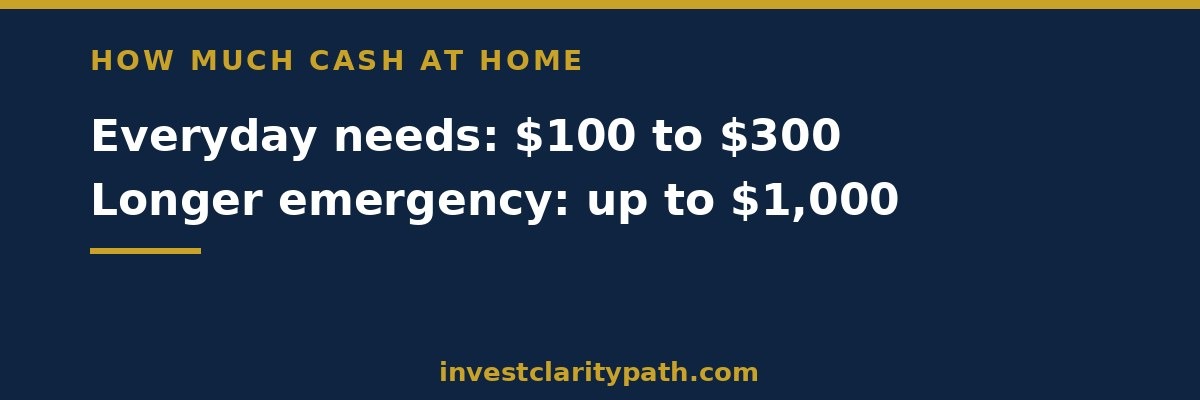
A sensible range for most people is 100 to 300 dollars for everyday needs, and up to 1,000 dollars if you live somewhere with frequent storms or power cuts, or if you have a larger family. Your full emergency fund belongs in a savings account, not in a drawer.
This post is educational only. It is not financial advice.
Why keep any cash at home at all?
Most spending today is digital. You tap a card, you pay with a phone, or you transfer money in an app. Cash feels old fashioned, and for daily spending it mostly is. But there are still moments when cash is the only thing that works, and those moments are the reason to keep a little on hand.
The first reason is a power outage or a network failure. When the power goes out, card machines stop working and ATMs go dark. A few hundred dollars buys food, fuel, water, and medicine while the systems are down.
The second reason is a lost or stolen wallet. If your cards are gone, you cannot pay for a taxi home, a meal, or a phone charger until replacement cards arrive. A small cash reserve at home bridges that gap.
The third reason is cash only payments. Some small sellers, market stalls, repair workers, and tips still run on cash. A small stash means you are not caught short.
The fourth reason is simple peace of mind. Many people feel calmer knowing they could cover a day or two of basics without a bank. That feeling is real, and it costs very little, as long as the amount stays small.
How much cash should you keep at home?
There is no single number that fits everyone. The right amount depends on your household size, your daily spending, and how often your area loses power or banking access. Use these ranges as a starting point, then adjust them to your own life.
For everyday needs, 100 to 300 dollars covers most people. Chase, the large United States bank, suggests that many people feel comfortable with enough cash to cover a few days of essential spending, typically between 100 and 300 dollars.
For a longer emergency, such as a storm that cuts power for a week or more, experts suggest more. The Motley Fool suggests planning for one to two weeks of essential spending in cash if you live somewhere that regularly loses power or gets cut off from ATMs and card readers. Experian suggests keeping enough to cover about a month of absolute necessities, and gives examples of 200 dollars for a single person in a city, 500 dollars for a couple in a remote area, and 1,000 dollars or more for a family of five with medical needs.
Put together, a practical rule is this. Keep 100 to 300 dollars for everyday use. If you live in an area with hurricanes, wildfires, floods, or frequent outages, add a separate disaster stash that brings your total to somewhere between 500 and 1,000 dollars, depending on household size. Do not go above 1,000 dollars without a specific reason, and never keep your life savings at home.
The risks of keeping cash at home
Cash at home has four real risks, and each one grows with the amount you keep.
The first risk is theft. Cash is the easiest thing in a home to steal, and the hardest to recover. A card can be cancelled in minutes. A bank transfer can be traced. Stolen cash is almost impossible to get back.
The second risk is damage. Cash can burn in a fire, soak in a flood, or get torn or washed. A home safe helps, but no safe is perfect. Money in a bank does not have this problem.
The third risk is the missing interest. Cash in a drawer earns nothing. The same money in a high yield savings account earns interest every month. The gap is small on 200 dollars, but it grows fast on 5,000 or 10,000 dollars.
The fourth risk is the missing paper trail. Money in a bank leaves a record. That record proves where the money came from, which matters when you apply for a mortgage or rent a home. Cash has no record.
There is also a quieter risk, which is temptation. Cash that sits within reach gets spent. Money in a savings account is one step further away, and that distance protects it.
Where to store cash safely at home
If you decide to keep cash at home, where you put it matters as much as how much you keep.
Use a small fireproof and waterproof safe. A basic safe costs as little as 40 dollars, and larger ones cost 150 dollars or more, according to Experian. Bolt the safe down so it cannot be carried away, and put it somewhere a burglar would not look first. A basement can protect it in a fire, but it is a bad place if your home floods, so raise it off the floor if flooding is a risk.
Keep small bills, not large ones. Fives, tens, and twenties are the most useful in an emergency, because shops can make change from them. A 100 dollar bill is hard to spend when a shop has no change.
Split the money if you keep a larger amount. Do not put all of it in one obvious spot like a nightstand drawer or a cookie jar. Keep your everyday cash in one spot and your disaster cash in the safe.
Tell one trusted person where the safe is and how to open it. If something happens to you, your family needs to find the money.
What not to do with cash at home
Do not keep your emergency fund in cash at home. Your emergency fund is three to six months of expenses, and it protects you from a job loss, a medical bill, or a major repair. That money belongs in a high yield savings account, where it is insured and earns interest.
Do not hide cash in a mattress, a freezer, or a book. These are the first places a burglar looks, and they are also the places you forget.
Do not keep cash at home to avoid tax or to hide income. Cash leaves no record, and that is exactly the problem. If you earn money, report it properly and keep it in a bank.
Do not lend your home stash to family or friends and expect it back on time. Cash lent from a drawer is hard to track. If you want to help someone, do it from your bank account, where the transfer is recorded.
Do not count cash at home as part of your savings total. It is a spending reserve, not savings.
Worked example: a family of four plans three days of cash
Suppose a family of four wants enough cash at home to cover three days if the power goes out and no card works. First, they list what they would need to buy each day. Food for four people, about 60 dollars a day. Fuel for the car, about 20 dollars a day. Medicine and basics like batteries and water, about 10 dollars a day. That is 90 dollars a day in total.
Three days at 90 dollars a day is 270 dollars. 90 times 3 equals 270. They round that up to 300 dollars, so they have a small buffer.
They keep the 300 dollars in small bills: ten 20 dollar bills, eight 10 dollar bills, and four 5 dollar bills. Ten times 20 is 200, eight times 10 is 80, four times 5 is 20, and 200 plus 80 plus 20 equals 300. They store it in a small fireproof safe, bolted to a shelf in a closet. They also keep 50 dollars in a wallet at home for everyday cash needs. Their total cash at home is 350 dollars. Their emergency fund of 9,000 dollars, which is three months of their 3,000 dollar monthly spending, stays in a high yield savings account.
Now compare that with a neighbour who keeps 5,000 dollars in cash at home. If that cash is stolen, 5,000 dollars is gone, with no insurance and no way to recover it. If the same 5,000 dollars sat in a savings account earning 4 percent a year, it would earn about 200 dollars a year. 5,000 times 0.04 equals 200.
Cash at home vs money in the bank
It helps to see the two side by side, because they do different jobs.
Cash at home is fast when systems fail. It works without power, without a phone signal, and without a card machine. But it earns nothing, it is not insured, it can be stolen or destroyed, and it leaves no record.
Money in a bank is insured. In the United States, the Federal Deposit Insurance Corporation, known as the FDIC, insures deposits up to 250,000 dollars per depositor, per insured bank, per ownership category. Credit unions have the same protection through the National Credit Union Administration, known as the NCUA, also up to 250,000 dollars. Money in a bank earns interest and leaves a record.
To learn how the insurance works in practice, read our guide on whether your money is safe in a bank.

How to build your cash stash step by step
Building a cash stash is a small job, and it should take one afternoon, not one month.
Step one is to work out your number. Multiply your daily essential spending by the number of days you want to cover, three days for most people, seven to fourteen days if you live in a storm prone area. Cap the total at 1,000 dollars unless you have a clear reason to go higher.
Step two is to get the cash from your bank in small bills. Ask the teller for twenties, tens, and fives, and count it at the counter before you leave.
Step three is to use a small fireproof and waterproof safe if your stash is more than a couple of hundred dollars. Bolt it down, put it somewhere sensible, and store the cash inside.
Step four is to write down the amount and the date on a card you keep with your other household records.
Step five is to set a rule for using it. The stash is only for emergencies and cash only needs, not for everyday spending. If you spend from it, replace the money within a week. Step six is to check it twice a year, count it, replace damaged notes, and adjust the amount if your household has grown.
Common mistakes to avoid
The first mistake is keeping too much. People start with 200 dollars, then add a little more each month, and a year later there are 3,000 dollars in a drawer earning nothing and at risk. Set your target in writing and stop when you reach it.
The second mistake is keeping it in an obvious place. A drawer, a jar, or under a mattress is the first place a burglar checks. Use a safe, and do not tell people outside your household where it is.
The third mistake is using large bills. A 100 dollar bill is hard to spend in an emergency, when shops have little change. Small bills are far more useful.
The fourth mistake is forgetting about it. Cash left for years can get damp, torn, or forgotten. Check it twice a year and keep the notes in good condition.
The fifth mistake is treating the stash as savings. Cash at home does not grow, and it is not insured. Your savings belong in a bank.
The sixth mistake is keeping cash at home because you do not trust banks. Banks in the United States are insured up to 250,000 dollars per depositor. If you are worried about a specific bank, check that it is FDIC insured.
Frequently asked questions
Should I keep cash at home?
Yes, keep a small amount, usually 100 to 300 dollars, for short emergencies when cards and ATMs do not work. Keep your larger savings and your emergency fund in an insured bank account, where the money earns interest and is protected.
How much cash should I keep at home?
For most people, 100 to 300 dollars covers a few days of essentials. If you live in an area with frequent storms or power cuts, or you have a larger family, up to 1,000 dollars can make sense.
Is cash at home insured?
No. Cash kept at home is not covered by FDIC or NCUA insurance. That insurance only covers money held in an insured bank or credit union, up to 250,000 dollars per depositor, per institution, per ownership category. If cash at home is stolen, burned, or flooded, it is gone.
Where is the safest place to keep cash at home?
In a small fireproof and waterproof safe, bolted down and kept out of obvious spots. Keep the cash in small bills, fives, tens, and twenties, so it is easy to spend in an emergency.
Should I keep my emergency fund in cash at home?
No. Your emergency fund should be three to six months of expenses kept in a savings account, ideally a high yield savings account. It is insured, it earns interest, and you can reach it quickly. Cash at home is only a short term reserve for a few days.
Conclusion, and your first step today
Keeping cash at home is a small decision with a clear answer. Keep a little, not a lot. For most people, 100 to 300 dollars in small bills, stored in a fireproof safe, covers the emergencies that cash is actually for. Everything beyond that belongs in a bank, where it is insured up to 250,000 dollars, earns interest, and leaves a record.
Your first step today is simple. Work out your daily essential spending, multiply it by three, and write that number down as your cash target. Take that amount out of the bank in small bills this week, store it safely, and stop there. Then check your emergency fund. If it is not yet in a savings account, read our step by step guide to building an emergency fund from zero. To work out how big it should be, read our guide on how much to keep in an emergency fund.
Sources
- Experian, How Much Cash Should You Keep at Home?: https://www.experian.com/blogs/ask-experian/how-much-cash-should-you-keep-at-home/
- Chase, How Much Cash Should You Keep at Home?: https://www.chase.com/personal/banking/education/basics/how-much-cash-should-you-keep-at-home
- Motley Fool, How Much Cash Should You Keep at Home?: https://www.fool.com/money/banks/articles/how-much-cash-should-you-keep-at-home/
- FDIC, Deposit Insurance: https://www.fdic.gov/resources/deposit-insurance/
