


How Do I Earn Side Income From Dog Walking?
How do I earn side income from dog walking?
You earn side income from dog walking by walking other people’s dogs for pay, either through an app like Rover or Wag, or by finding your own clients directly. It is one of the simplest side incomes to start, because it needs no special training, no shop, and almost no money to begin. You need to like dogs, be reliable, and be willing to walk in all weather.
The money is real but modest. This post gives you honest numbers, a worked example, the two ways to find work, the costs, and how to get your first five clients. It is educational only. It is not financial advice.
How much can you earn? A worked example
Pay per walk depends on where you live, how long the walk is, and whether you work through an app or on your own. A common range for a 30 minute walk is 15 to 25 dollars. We will use 15 dollars for the worked example, so the numbers are cautious, not optimistic.
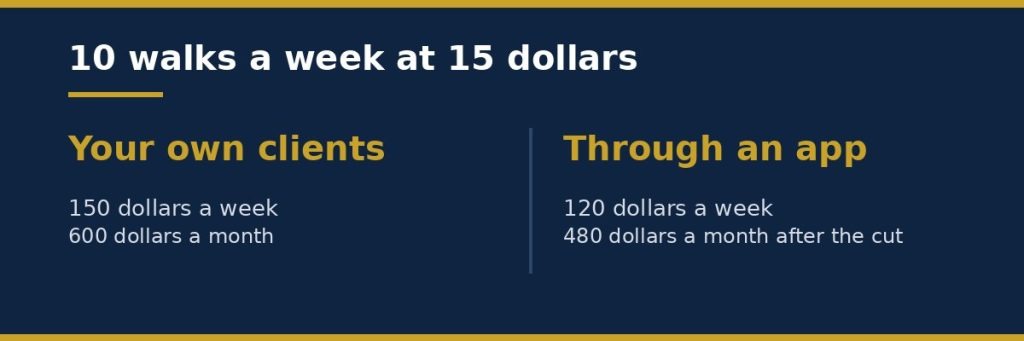
If you do 10 walks a week at 15 dollars each, you earn 150 dollars a week, because 10 times 15 is 150. In a month of four weeks, that is 600 dollars, because 150 times 4 is 600.
If you work through an app, the app takes a cut. Rover, for example, keeps 20 percent of what you earn through the app. On a 15 dollar walk, the app keeps 3 dollars, because 20 percent of 15 is 3, and you keep 12 dollars. Ten walks a week then pays 120 dollars a week, because 10 times 12 is 120, and 480 dollars a month, because 120 times 4 is 480.
If you find your own clients, you keep the full 15 dollars, so 10 walks a week is the full 600 dollars a month. But you pay your own costs, and you find your own clients, which takes time. The app’s cut buys you clients and bookings. Your own clients buy you the full rate. Most walkers start on an app, then move some clients to direct bookings as they build trust.
Those numbers assume you can fill 10 walks a week. At the start, you will have fewer. Two walks a day, five days a week, is 10 walks. One walk a day is 5 walks a week, which is 75 dollars a week on your own, or 60 dollars a week through an app, at 15 dollars a walk.
Rover and Wag vs finding your own clients
The apps are the fastest way to start. You make a profile, pass a background check, set your prices and your area, and owners can book you. Rover and Wag are the two best known apps in the United States. The app handles payments, and it gives you insurance cover while you walk, which matters if a dog is injured or causes damage. The cost is the cut, around 20 percent, and the fact that the app, not you, owns the client relationship.
Finding your own clients pays the full rate, and the clients are yours. You find them through neighbours, local notice boards, community groups, and word of mouth. You set your own prices, your own hours, and your own rules. The cost is that you find every client yourself, you handle payments, and you need your own insurance if you want cover. Some walkers buy a simple pet sitter insurance policy, which is a real cost to factor in.
A practical path is to do both. Start on an app to learn the work and get reviews. Then, as owners ask to book you again, offer them direct booking at the same price, and keep the difference. Be honest with the app about its rules, and do not take a client off the app in a way that breaks the terms you agreed to.
What it costs to start
The startup costs are small, which is why this side income suits beginners. You need comfortable walking shoes, a spare leash or two, poop bags, a water bottle and a portable bowl, and a phone with data so you can message owners and use the app. If you already walk, you may own most of this.
The ongoing costs are the app’s cut, transport to the dogs, and insurance if you buy it. There is no stock to buy, no rent to pay, and no big equipment. Your main cost is your time, and walking is the job, so that is the point.
One cost people forget is tax. Money from dog walking counts as income, and you should keep a record of every payment and every cost. Our guide to tracking side income for tax explains the simple version. Set aside a share of each payment for tax, so you are not caught out at the end of the year.
How to get your first five clients
Your first five clients are the hardest, and they matter most, because their reviews bring the next fifty. Work through these steps in order.
First, finish your profile properly. Use a clear photo of you with a dog, write two or three honest sentences about your experience, even if it is just your own dog or a neighbour’s, and set a fair starting price. A new walker with no reviews should not charge the top rate. Start at the low end, get reviews, then raise the price.
Second, tell people nearby. Post in a local community group, put a simple note on a notice board, and tell neighbours, friends, and coworkers. Most early clients come from people who already know you, not from strangers online.
Third, offer a short trial. A free 15 minute meet and greet, where the owner watches you with their dog, removes the worry. Many owners will book after a good meet and greet.
Fourth, be reliable in a way owners can see. Arrive on time, send a photo and a short message after each walk, and tell the owner at once if anything unusual happens. Reliability is the whole business. One missed walk can lose a client. One good month can win you five more through word of mouth.
Fifth, ask for a review after the first few walks. A short, honest review on your app profile is worth more than any advert. Ask politely, once, and thank the owner either way.

Safety, for you and the dogs
Safety is part of the job, not an extra. Always meet the dog and the owner first, before the first paid walk. Ask about the dog’s behaviour, whether it is friendly with other dogs, and whether it pulls on the lead. Do not take a dog you cannot control.
Walk in daylight when you can, carry your phone, tell someone where you are going, and carry water for the dog in hot weather. If a dog is aggressive, or the owner asks you to do something unsafe, say no. Losing one booking is better than an injury.
Keep a simple record of each walk: the dog, the owner, the time, and anything unusual. If a dog is ill, or something happens on a walk, tell the owner straight away, in writing, so there is no confusion later.
Related reading in the Side Income cluster: how to find your first freelance client, what the simplest side income for beginners is, how to track side income for tax in simple terms, how to earn side income from cleaning houses, and how to earn side income from babysitting as a beginner.
Frequently asked questions
How much does Rover pay per walk?
Rover does not set one fixed rate. Walkers set their own prices, and a common range for a 30 minute walk is 15 to 25 dollars, depending on the area. Rover keeps 20 percent of what you earn through the app, so on a 15 dollar walk you keep 12 dollars. Your area, your reviews, and your availability all affect how many bookings you get.
Do I need experience to start dog walking?
No formal experience is needed, but you do need to be comfortable with dogs of different sizes and temperaments. Experience with your own dog, a family dog, or a neighbour’s dog counts. A short pet first aid course is a useful extra, and it looks good on a profile, but it is not required to start.
Do I need insurance to walk dogs?
If you work through an app, the app usually provides cover while you are on a booked walk. If you find your own clients, you are not covered, so consider a pet sitter insurance policy. It is a real cost, but it protects you if a dog is injured or causes damage while in your care.
What are the risks of starting a dog walking business?
The main risks are injury, to you or a dog, a dog running off, bad weather, and quiet weeks with few bookings. There is also the risk of a client cancelling at short notice. You reduce these risks by meeting every dog first, walking in daylight, keeping records, and not relying on dog walking as your only income at the start.
Can I do dog walking with no money to start?
Yes, almost. If you already have walking shoes, a phone, and a leash, your cash cost is near zero. The apps do not charge you to join, though they take a cut of each booking. Your first costs will be poop bags, a water bottle, and transport to the dogs.
Conclusion, and your first step today
Dog walking is a simple side income: 10 walks a week at 15 dollars is 600 dollars a month on your own, or 480 dollars a month through an app that keeps 20 percent. It needs almost no money to start, and the work is the walking itself. The hard part is the first five clients, and the thing that keeps them is reliability.
Your first step today is to make your profile, or your one-page offer, with a photo, two honest sentences about your experience with dogs, and a fair starting price. Then tell five people nearby that you are available. That is how the first booking happens.
Disclaimer: This article is for education only. It is not financial advice, and it does not guarantee any result. Your income, costs, debts, and goals are personal, and you should consider your own situation, and speak to a qualified professional if you need personal advice, before making a financial decision.
Sources
- US Internal Revenue Service, gig economy tax center: https://www.irs.gov/businesses/gig-economy-tax-center
- Google keyword research, 2026-11-28, keyword “how do I earn side income from dog walking”. Top results included Rover, Business Insider, Medium, Reddit, Side Hustle School, Budgets Are Sexy, Sniffspot, and UMass Media. No People also ask box appeared on this results page. No volume, difficulty, or CPC figure was shown on any Google results page.
