

What Is Debt Settlement in Simple Terms?
What is debt settlement in simple terms?
Debt settlement is an agreement where you pay less than the full amount you owe, and the creditor agrees to treat the rest as settled. You offer a lump sum, the creditor accepts it, and the account is closed. It is not the same as paying off a debt in full, and it is not the same as a payment plan. It is a deal to end a debt for less than you owe.
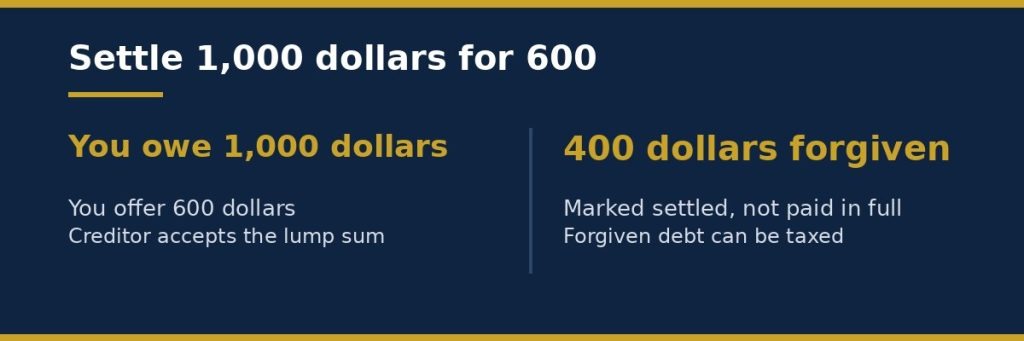
Here is a worked example. Imagine you owe 1,000 dollars on a credit card, and you cannot pay it in full. You offer 600 dollars as a single payment. The creditor accepts. You pay 600 dollars, and the remaining 400 dollars is forgiven. You saved 400 dollars, but the account is marked as settled, not paid in full, and the 400 dollars of forgiven debt can count as taxable income. Those two consequences matter, and they are the reason settlement is a last resort, not a first choice.
This post explains how settlement works, the pros and cons, the risks to your credit score and your taxes, and how it compares with paying in full, consolidation, and a debt management plan. It is educational only. It is not financial advice.
How does debt settlement work?
Settlement usually follows the same steps. First, you stop paying the debt, or you are already behind on it. Creditors rarely settle a debt that is current, because they have no reason to accept less when you are still paying. Second, you save up a lump sum, often over months, while the account falls further behind. Third, you or a settlement company offer the lump sum, and the creditor accepts it, rejects it, or asks for more. Fourth, you pay the agreed amount, get the agreement in writing, and the account closes.
There are two ways to do it. You can negotiate yourself, by calling the creditor and offering a lump sum. Or you can hire a debt settlement company, which takes your monthly payments into a special account, then offers lump sums to your creditors when enough has built up. The company charges a fee for this, and the fee is usually a percentage of the debt. Ask any company for its fee in writing before you sign anything, and check what the CFPB says about settlement companies before you pay them.
A warning that matters: while you save up the lump sum, your credit score falls, because you are missing payments. Late fees and interest keep adding up, so the debt can grow while you wait. And the creditor can still sue you for the debt during this time. Settlement is not protection from legal action.
The pros of debt settlement
The main pro is clear: you pay less than you owe. In the example above, you paid 600 dollars instead of 1,000 dollars, and the debt is gone. For a debt you truly cannot pay in full, that can be the difference between endless minimum payments and a clean end.
The second pro is speed, once the deal is done. A settled account is closed. You no longer get calls about it, and you can move on to rebuilding, instead of carrying the same balance for years.
The third pro is that it can stop the debt from growing, once the deal is signed. Interest and fees stop when the account closes, which is not true while you are only making minimum payments.
The cons and risks beginners miss
The first con is your credit score. A settled account stays on your credit report, marked as settled, and it hurts your score for years. It is better than an unpaid debt, but worse than a debt paid in full. If you plan to rent a home, get a car loan, or apply for a mortgage in the next few years, a settled account can cost you more than it saved you.
The second con is tax. In the United States, forgiven debt can count as taxable income. In the example, the 400 dollars that was forgiven could be added to your taxable income for that year. There are exceptions, for example if you are insolvent, which means you owe more than you own, but you cannot assume you qualify. Check the IRS rules or speak to a tax professional before you settle, so the tax bill does not surprise you.
The third con is the fee. If you use a settlement company, you pay its fee on top of the settlement amount. The fee, the months of missed payments, and the extra interest can eat much of the saving. Work out the total cost, not just the settlement amount, before you agree.
The fourth con is that settlement is not guaranteed. A creditor can refuse your offer, or ask for more than you have saved. Meanwhile, the debt has grown, and your credit score has fallen. You can end up worse off than when you started, with nothing settled.
Settlement vs paying in full vs consolidation vs a debt management plan
These four options are often confused, so here is the difference in plain words.
Paying in full means you pay everything you owe, with interest, until the balance is zero. It costs the most, but it is best for your credit score, and there is no tax on forgiven debt, because nothing is forgiven.
Settlement means you pay less than you owe, in one lump sum, and the rest is forgiven. It costs less in cash, but it hurts your credit score, and the forgiven part can be taxed.
Consolidation means you take one new loan, or a balance transfer card, and use it to pay off several debts, so you have one payment instead of many, usually at a lower interest rate. You still owe the full amount. It helps when your credit is still good enough to get the lower rate.
A debt management plan means a nonprofit credit counsellor negotiates lower interest rates and one monthly payment with your creditors, and you pay the full amount over three to five years. You still owe everything, but the interest is lower, and the plan is structured. It does not hurt your credit score the way settlement does.
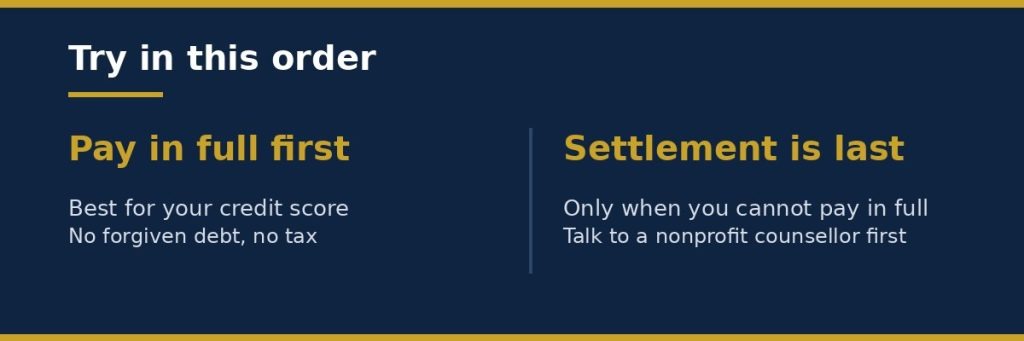
For most people, the order to try is: paying in full first, then a debt management plan, then consolidation if the rate is genuinely lower, and settlement last, only when the debt truly cannot be paid.
When to talk to a nonprofit credit counsellor first
Before you settle anything, talk to a nonprofit credit counsellor. The National Foundation for Credit Counseling, the NFCC, can connect you with one. A counsellor will look at your full picture, your income, your debts, and your bills, and tell you honestly whether settlement makes sense, or whether a debt management plan would cost you less in the long run.
A counsellor is also the right person to ask about the tax question, and about whether you qualify for any exception. A settlement company earns money when you settle, so its advice is not neutral. A nonprofit counsellor’s advice is.
Be careful with any company that promises to cut your debt in half, charges a large fee upfront, or tells you to stop paying your debts without explaining the risks. Those are warning signs. The CFPB has guidance on how to spot a bad settlement company, and it is worth reading before you sign anything.
Related reading in the Debt Payoff cluster: should you consolidate your debt, what a debt management plan is in simple terms, how to talk to a lender if you cannot pay, what a credit score is in simple terms, and how long it will take to pay off your debt.
Frequently asked questions
Is debt settlement ever a good idea?
Sometimes, yes, but only in a narrow case: when you truly cannot pay the debt in full, you have a lump sum to offer, and you understand the credit and tax costs. It is a last resort, not a smart shortcut. If you can pay the debt in full over time, or through a debt management plan, that usually costs you less in the long run.
What are the downsides of debt settlement?
The main downsides are a damaged credit score, because the account is marked settled rather than paid in full; tax on the forgiven amount, because forgiven debt can count as income; fees if you use a settlement company; and the risk that the creditor refuses your offer after months of missed payments, leaving you with a bigger debt and a lower score.
Is it better to settle a debt or pay it off?
Paying it off in full is better for your credit score, and there is no tax on forgiven debt, because nothing is forgiven. Settling is better only when paying in full is not possible, and the lump sum deal genuinely ends a debt that would otherwise drag on for years.
Why shouldn’t you settle debt?
You should not settle debt when you can pay it in full, when you will need a good credit score soon, when the tax on the forgiven amount wipes out the saving, or when a debt management plan would cost you less overall. Settlement also does not fix the spending or income problem that created the debt, so without a plan, the debt can come back.
How much can debt settlement save me?
It varies, and no company can promise a number before it negotiates. In the example in this post, settling a 1,000 dollar debt for 600 dollars saved 400 dollars before fees and tax. Your result depends on the creditor, how far behind you are, and whether you negotiate yourself or pay a company. Always work out the total cost, including fees and possible tax, before you agree.
Conclusion, and your first step today
Debt settlement means paying less than you owe, in one lump sum, and having the rest forgiven. It can end a debt you truly cannot pay, but it damages your credit score, it can create a tax bill, and it is not guaranteed to work. Paying in full, or a nonprofit debt management plan, is usually the better first step.
Your first step today is not to call a settlement company. It is to call a nonprofit credit counsellor, through the NFCC, and ask for an honest look at your debts. That one call can tell you whether settlement is really your best option, or whether a cheaper path exists.
Disclaimer: This article is for education only. It is not financial advice, and it does not guarantee any result. Your income, costs, debts, and goals are personal, and you should consider your own situation, and speak to a qualified professional if you need personal advice, before making a financial decision.
Sources
- US Consumer Financial Protection Bureau, consumer tools: https://www.consumerfinance.gov/consumer-tools/
- National Foundation for Credit Counseling: https://www.nfcc.org/
- Google keyword research, 2026-11-28, keyword “what is debt settlement in simple terms”. Top results included Experian, NerdWallet, GreenPath, the CFPB, InCharge Debt Solutions, Wikipedia, CNBC, and the FDIC. People also ask included “Is debt settlement ever a good idea?” and “Is it better to settle a debt or pay it off?” No volume, difficulty, or CPC figure was shown on any Google results page.
