

How Do I Stop Using Credit Cards While Paying Off Debt?
To stop using credit cards while you pay them off, make the card harder to reach than your own money, switch your everyday spending to a debit card or cash, and build a small buffer so a surprise bill does not force you back to the card. Take the cards out of your wallet, remove them from your phone and saved checkouts, and give yourself a planned spending amount from your own money. The goal is to stop adding new charges while you clear the old balance, not to ban cards forever.
The math is simple, and it is brutal. If you pay 200 dollars off your card this month but charge 180 dollars of new spending to it, your balance only fell by 20 dollars, even though you paid 200 dollars. New charges cancel your hard work. That is why stopping the new spending matters as much as the payment itself.
This guide shows you how to set up a no-new-charges system, how to replace the card’s function so you can still live your life, and what to do when the card has been paying for essentials because income does not cover basics. It is educational only. It is not financial advice.
Why paying and using at the same time keeps you stuck
Most cards give you a grace period on purchases, which is a stretch of time after the statement closes when you can pay the full balance without interest. But once you carry a balance, that grace period usually disappears, and the Consumer Financial Protection Bureau notes that new purchases can be charged interest from the day you make them. So every new charge starts costing you interest at once, while your payment is fighting the old balance plus the interest on it.
There is also a timing problem. If you throw every spare dollar at the debt but keep no cushion for a higher than usual electric bill, a prescription refill, or a child’s field trip, the card becomes your emergency fund. The payoff plan is too aggressive for the life you are actually living, so the card fills the gap, and the balance barely moves.
The fix is not to try harder on payments. It is to stop feeding the balance from the other end, and to build a small buffer first, so the plan can survive a normal month.
Step 1: build a small buffer before you push harder
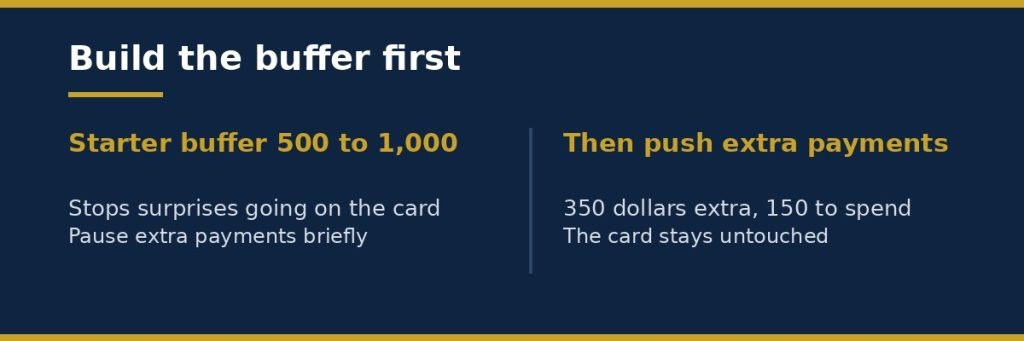
You do not need a fully funded emergency fund to stop relying on credit cards. You need a small, boring cash buffer that keeps you from reaching for plastic when life wiggles. A common target is 300 to 500 dollars if your expenses are fairly stable, or 500 to 1,000 dollars if your income fluctuates or you have children, a car, or medical expenses.
To build it fast, pause extra debt payments for one or two paychecks and redirect that amount to the buffer. Sell a few unused items and send that money to the buffer first, not the card. Cut one category temporarily, such as dining out or a subscription, and send the saving to the buffer. Keep the buffer in a separate savings account, so it is not mixed with spending money.
It is fine to temporarily lower extra payments while you build the buffer. A 500 dollar buffer that stops three months of new charges is worth more than 500 dollars of extra payments that get undone by new spending.
Step 2: make the card hard to reach
Friction is the whole method. Remove the cards from your wallet and store them out of reach, in a drawer, a lockbox, or a sealed envelope at home. Delete saved cards from Amazon, Target, food delivery apps, and browser autofill. Turn off one-click checkout, and remove the cards from Apple Pay or Google Pay, keeping debit if you need it. If your issuer’s app lets you freeze a card, use it: freezing is reversible and practical, and it stops the card without closing the account.
You do not need to cut the cards up, and in many cases you should not close the accounts, because closing a card can hurt your credit score by raising your credit utilization and shortening your credit history. Stopping use is not the same as closing the account.
If you are worried about emergencies, keep one card accessible but not convenient, and define “emergency” in writing before you need it. A car repair that gets you to work, a medical expense, or urgent travel counts. A sale, a dinner out, or a gadget does not.
Step 3: switch everyday spending to debit or cash
If you stop using the card, you need something to use instead for normal life. Switch your day-to-day spending to a debit card or cash, which is money you actually have, rather than borrowed money.
Pick one setup and try it for two weeks. Option A is a debit-only week for variable spending: use your debit card for groceries, gas, and household needs, and before the week starts, transfer a set amount into checking that covers those categories. When it is gone, you pause spending. Option B is cash envelopes for your trouble categories, such as food, errands, or small treats. Cash forces a pause and makes tradeoffs visible. Option C is a one-card quarantine: if you have several cards, lock all but one down, and use the remaining one only for a defined purpose.
Give your checking account enough structure so you are not constantly surprised by bills. A simple split helps: bills in one place, daily spending in another, and a small buffer kept separate. When money is divided before the week starts, each dollar has one job, and the card is not needed to fill a gap.
Step 4: give yourself a planned spending amount
If you cut up your cards but leave yourself no room to spend on anything you enjoy, the pressure builds until you crack, often by reaching straight back for the card. So plan a spending amount for normal wants, funded by your own money, that is yours to use without guilt.
A worked example shows how this fits together. Suppose you take home 2,400 dollars a month. Your essentials are 1,700 dollars, your minimum debt payments are 200 dollars, and your buffer is already built. That leaves 500 dollars, because 2,400 minus 1,700 minus 200 is 500. You decide to send 350 dollars as an extra debt payment, and keep 150 dollars as your planned spending amount for the month. That is 37 dollars and 50 cents a week, because 150 divided by 4 is 37.50.
If you spend the 150 dollars on a dinner out and a small treat, that is the plan working, not a failure. The card stays untouched, the extra payment of 350 dollars goes through, and the balance falls by the full 350 dollars plus the minimum, instead of being cancelled by new charges.
A worked example: the same payment, two different results
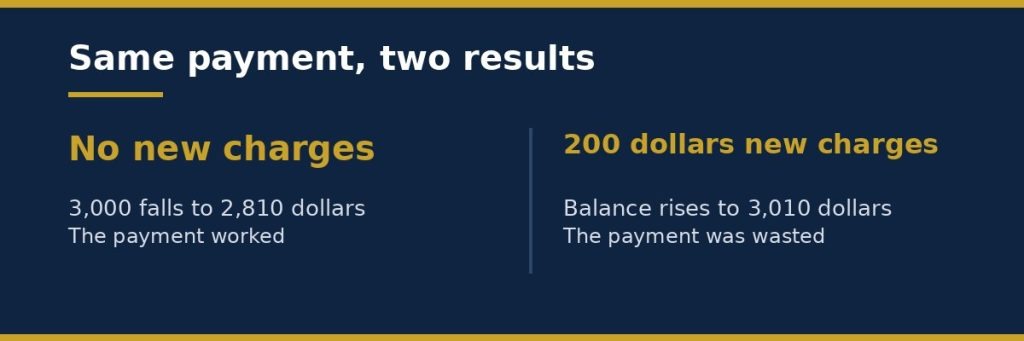
Imagine your card balance is 3,000 dollars at 24 percent APR, and your monthly payment is 250 dollars. In the first month, the interest is about 60 dollars, because 3,000 times 0.24 is 720 dollars a year, and 720 divided by 12 is 60. If you pay 250 dollars and charge nothing new, your balance falls to 2,810 dollars, because 3,000 plus 60 minus 250 is 2,810.
Now imagine the same month with 200 dollars of new charges. Your balance after the payment is 3,010 dollars, because 3,000 plus 60 minus 250 plus 200 is 3,010. You paid 250 dollars and your balance went up by 10 dollars. That is the trap: the payment was real, but the new charges ate it and the interest on top.
Over six months, the difference is stark. Paying 250 dollars a month with no new charges cuts the balance steadily. Paying the same amount while charging 200 dollars a month barely moves it, and you have paid 1,500 dollars for almost nothing. The lesson is not that you need a bigger payment. It is that the new charges have to stop first.
What if the card pays for normal living expenses
Everything above assumes the card covers extras. If it is covering rent, groceries, or bills because your income does not stretch far enough, taking it out of your wallet will not fix that. The card is filling a gap, and the gap has to close first.
Find the gap. Add up your monthly take-home pay and your essential costs. The difference is roughly what the card has been covering each month. If the gap is 300 dollars, you need 300 dollars of change: lower costs, more income, or help. Quick moves include negotiating bills, applying for assistance programs, and asking creditors about hardship options. A nonprofit credit counselor can look at the whole picture and talk to your lenders for you.
Do not feel ashamed about this. It is not a discipline problem, it is an arithmetic problem, and it needs an arithmetic fix. The card was a bridge, and the job now is to build a road underneath it.
When to get help, and what comes after
If you have tried the steps above and the balance still does not move, or if collectors are calling, or if you are choosing between food and minimum payments, talk to a nonprofit credit counselor. They can set up a debt management plan, which is a structured way to pay debts down over time, and they can often negotiate lower interest rates with your creditors. Avoid any company that promises to make your debts disappear for a fee.
Once the balance is gone, you can reintroduce credit intentionally, or not at all. If you do use a card again, use one card, not many, pay it in full every month, automate the payoff, and treat rewards as a bonus, not a reason to spend. The card goes back to being a tool, not a lifeline.
Related reading in the Debt Payoff cluster: what the debt snowball method is, what the debt avalanche method is and when it is better, how to make a debt payoff plan you can stick to, what happens if you only pay the minimum on a credit card, and should you pay off debt or invest first.
Frequently asked questions
Should I close my credit cards to stop using them?
Usually not. Closing a card can hurt your credit score by raising your credit utilization and shortening your credit history. It is better to stop using the card and keep the account open. Remove it from your wallet and from saved checkouts, and freeze it in your issuer’s app if you can.
How much buffer do I need before I pay extra on my debt?
A common target is 500 to 1,000 dollars. If your expenses are stable, 300 to 500 dollars can be enough to start. The buffer’s job is to stop a surprise bill from going back on the card, so even a small buffer helps.
What counts as a real emergency for the one card I keep?
A car repair that gets you to work, a medical expense, or urgent travel. A sale, a dinner out, a holiday, or a gadget does not count. Write the definition down before you need it, so the decision is already made.
Will stopping card use hurt my credit score?
Stopping use does not hurt your score. In fact, paying down the balance usually helps it, because your credit utilization falls. Closing accounts, on the other hand, can hurt your score, so keep the accounts open and just stop charging.
What if I slip and use the card once?
Log it, learn from it, and keep going. One charge does not cancel the plan. Look at what triggered it, fix that trigger, and make the next week card-free. The goal is a trend, not perfection.
Conclusion, and your first step today
Stopping card use while you pay off debt is a system, not a test of willpower. Build a small buffer first, make the card hard to reach, switch everyday spending to debit or cash, and give yourself a planned amount to spend without guilt. In our example, the same 250 dollar payment cut a 3,000 dollar balance to 2,810 dollars when no new charges were added, but left it at 3,010 dollars when 200 dollars of new charges were added. The payment was the same. The new charges were the difference.
Your first step today is to take the cards out of your wallet and delete them from one saved checkout, such as your food delivery app. That one minute of friction is the start of the system, and it works even before the buffer is built.
Disclaimer: This article is for education only. It is not financial advice, and it does not guarantee any result. Credit card terms, interest rates, grace periods, and credit scoring rules differ by lender and by where you live. Your income, costs, debts, and goals are personal, and you should consider your own situation, and speak to a qualified professional, such as a nonprofit credit counselor, if you need personal advice, before making a financial decision.
Sources
- Consumer Financial Protection Bureau, What is a grace period for a credit card?
