


How Do I Teach My Kids to Save Money?
How do I teach my kids to save money?
You teach kids to save money by starting early, keeping it simple, and letting them see their savings grow. Children learn about money by watching you, by handling real coins and notes, and by making small choices with their own money, not by lectures. The best age to start is as soon as a child can count, usually around age 3 or 4, with coins in a jar.
The method in this post works for any age: three jars, one for spending, one for saving, and one for giving, plus a simple rule about how much goes into each jar, and a parent bank that pays a little interest, so saving feels rewarding. It is educational only. It is not financial advice.
Start with the three jars: Spend, Save, Give
Get three clear jars, or three envelopes, and label them Spend, Save, and Give. Every time your child gets money, from allowance, from a birthday, or from a small job, split it between the three jars.
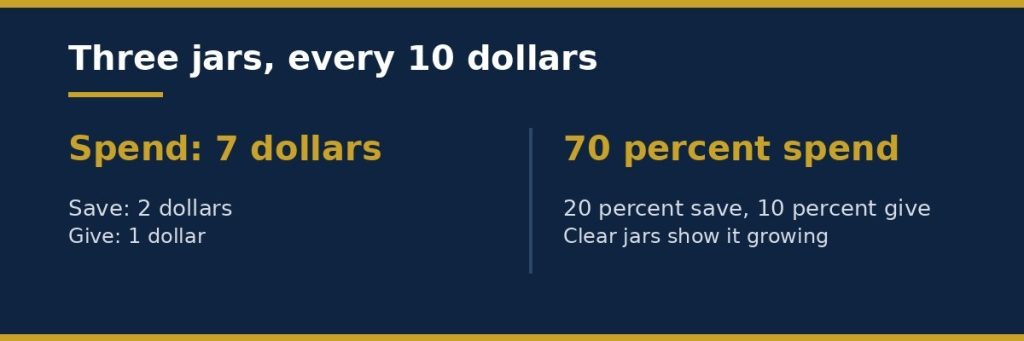
A simple split that works for most ages is 70 percent for Spend, 20 percent for Save, and 10 percent for Give. If your child gets 10 dollars, that is 7 dollars for Spend, 2 dollars for Save, and 1 dollar for Give, because 70 percent of 10 is 7, 20 percent of 10 is 2, and 10 percent of 10 is 1.
The Spend jar is for small things they want now, like a snack or a toy. The Save jar is for a bigger goal, like a bike or a game, and it stays untouched until the goal is reached. The Give jar is for helping someone else, like a charity or a class collection, and it teaches that money is not only for ourselves.
Use clear jars, so your child can see the money grow. A jar that fills up is more convincing than any talk about saving. When the Save jar reaches its goal, celebrate it, then set the next goal together.
The worked example: a parent bank that pays interest
Saving feels slow to a child, because a bank pays very little interest, and a jar pays none at all. You can fix that by acting as the parent bank: you pay a little interest on what your child saves, so the reward is visible in weeks, not years.
Here is a worked example. Your child gets 5 dollars a week in allowance, and saves 1 dollar of it, which is 20 percent. In a year of 52 weeks, that is 52 dollars saved, because 1 times 52 is 52.
Now add the parent bank. You pay 50 cents for every dollar your child saves, at the end of each month. In a month of four weeks, your child saves 4 dollars, because 1 times 4 is 4. You add 2 dollars, because 50 cents times 4 is 2 dollars. So the Save jar grows by 6 dollars a month, not 4.
Over a year, the child saves 52 dollars, and you add 26 dollars, because 50 cents times 52 is 26 dollars. The total is 78 dollars, because 52 plus 26 is 78. Your child put in 52 dollars and ended with 78 dollars, and that is a lesson about interest no lecture can match.
Keep the match small enough that you can afford it, and explain it in plain words: “For every dollar you save, I add fifty cents, because saving is worth rewarding.” As your child grows older, lower the match, and move the money to a real savings account, where the bank pays the interest instead.

What to teach at each age
Ages 3 to 7: keep it physical. Use real coins and notes, not cards or apps. Let your child count the coins, put them in the jars, and choose between two small things in a shop. The lesson is that money is real, it runs out, and choices have to be made. Take them shopping with you, and let them hand the money to the cashier.
Ages 8 to 12: add goals and numbers. Help your child set a savings goal with a price and a date, and work out the weekly amount together. If a game costs 40 dollars, and your child saves 5 dollars a week, it takes 8 weeks, because 40 divided by 5 is 8. Write the goal on the jar, and mark the progress each week. This is also the age to open a first savings account, and to let your child watch the balance grow.
Ages 13 to 18: add real life. A first job, even a few hours a week, teaches more about money than years of allowance. Help your teen split their pay the same way, Spend, Save, Give, and talk about the bigger choices: a car, college costs, and the habit of saving before spending. A teen who saves 20 percent of a part-time job is building a habit that will last into adult life.
Allowance: how much, and should you pay for chores?
There is no single right amount. A common guide is 1 dollar a week for each year of age: a 6 year old gets 6 dollars a week, a 10 year old gets 10 dollars a week. But the amount matters less than the habit. A small allowance, split between the three jars every week, teaches more than a large one handed over without a system.
Should you pay for chores? Keep it simple. Do not pay for the chores that are part of being in a family, like tidying their room or clearing the table. Those are shared work. You can pay for extra jobs, like washing the car or helping with a bigger task, and that teaches the link between work and money.
Never take saved money away as a punishment. If saving is punished, your child will stop saving. Talk about a mistake instead, and let the jars keep growing.
The mistakes parents make
The first mistake is lecturing instead of showing. Children copy what you do, not what you say. If you save regularly, and you talk openly about saving for a goal, they will copy that. If you spend without thinking, they will copy that too.
The second mistake is rescuing them every time. If your child spends the Spend jar on Monday and wants more on Wednesday, do not top it up. Let them wait until the next allowance day. Waiting is the lesson, and it is a gentle one when the amounts are small.
The third mistake is making money a secret, or a worry. Children do not need to know every bill, but they do need to hear that money is a tool you plan with, not a fear you hide. A calm, open conversation about a family saving goal does more good than silence.
Related reading in the Saving and Banking cluster: how much to keep in an emergency fund, the best savings account for a baby, what a money market account is, how to save for a goal and an emergency fund at the same time, and what APY is and why it is different from the interest rate.
Frequently asked questions
What is a good age to start teaching kids about money?
Start as soon as your child can count, usually around age 3 or 4, with coins in a jar. At that age, the lesson is simply that money is real, it comes in amounts, and it runs out. Add numbers, goals, and bank accounts as your child grows, around ages 8 to 12, and real earning and spending choices in the teens.
How much should kids save?
A good starting rule is to save 20 percent of everything they get, with 70 percent for spending and 10 percent for giving. On 10 dollars, that is 2 dollars saved, 7 dollars to spend, and 1 dollar to give. The exact split matters less than keeping it up every time money arrives.
Should I pay my kids for chores?
Pay for extra jobs, not for being part of the family. Tidying their room and clearing the table are shared family work, and paying for them teaches the wrong lesson. Washing the car, or helping with a bigger job, is extra work, and paying for it teaches the link between work and money.
When should my child open a bank account?
A savings account makes sense around ages 8 to 12, when your child has a savings goal and can watch the balance grow. Start with a simple savings account in your child’s name, and let them come with you to open it, so they see where the money lives. Check that the account has no fees that eat the balance.
What is the best way to save money for a child?
For a young child, the best way is the three jars and a small parent match, so saving feels rewarding right away. As your child grows, move the money to a real savings account, keep the same split, and let the interest, even if it is small, do its work. The habit matters more than the account.
Conclusion, and your first step today
Teaching kids to save money is not about lectures. It is about three jars, a simple split, a visible goal, and a parent who saves too. Start at age 3 or 4 with coins, add goals and numbers at ages 8 to 12, and add real earning and a bank account in the teens. A child who saves 20 percent of a small allowance, with a parent match, learns the habit that carries into adult life.
Your first step today is to get three jars, label them Spend, Save, and Give, and split the next money your child gets between them. That one small act starts the habit.
Disclaimer: This article is for education only. It is not financial advice, and it does not guarantee any result. Your income, costs, debts, and goals are personal, and you should consider your own situation, and speak to a qualified professional if you need personal advice, before making a financial decision.
Sources
- US Consumer Financial Protection Bureau, consumer tools: https://www.consumerfinance.gov/consumer-tools/
- Federal Deposit Insurance Corporation, deposit insurance: https://www.fdic.gov/resources/deposit-insurance/
- Google keyword research, 2026-11-28, keyword “how do I teach my kids to save money”. Top results included the FDIC, Leading Edge Credit Union, FamilyMeans, Reddit, Mariner Wealth Advisors, Leaders Credit Union, and the American Bankers Association. People also ask included “What is the 7 7 7 rule for kids?” and “What is the 3-3-3 rule for kids?” No volume, difficulty, or CPC figure was shown on any Google results page.
