


What Is FIRE, and Can Beginners Retire Early?
What is FIRE, and can beginners retire early?
FIRE stands for Financial Independence, Retire Early. It is a movement, and a plan, for people who save a large share of their income, invest it, and retire far earlier than the usual age of 65. The idea is simple: if you save enough, your investments can pay your living costs, so work becomes a choice, not a need.
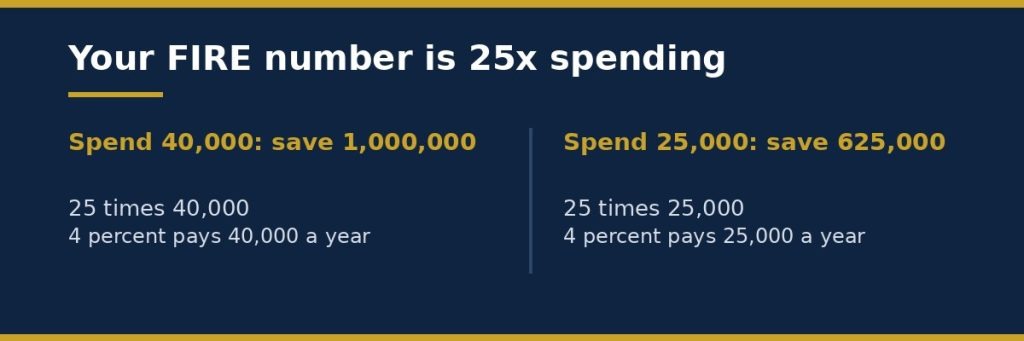
The core math is the 25x rule. Work out what you spend in a year, multiply it by 25, and that is your FIRE number, the amount you need saved to retire. If you spend 40,000 dollars a year, your FIRE number is 1,000,000 dollars, because 25 times 40,000 is 1,000,000. Then you can take out about 4 percent a year, which is 40,000 dollars, and the fund should last.
Can beginners retire early? Yes, in theory, if they can save a large share of their income for many years. In practice, it is hard, because it needs a savings rate of 50 percent or more, which most people cannot reach. But even if full FIRE is out of reach, the ideas behind it, save more, spend less, invest the difference, help any beginner.
This post explains FIRE in simple terms, the math, the three types, and the risks. It is educational only. It is not financial advice.
The 25x rule and the 4 percent rule
FIRE runs on two simple rules.
The 25x rule: your FIRE number is 25 times your yearly spending. If you spend 40,000 dollars a year, you need 1,000,000 dollars. If you spend 25,000 dollars a year, you need 625,000 dollars, because 25 times 25,000 is 625,000. If you spend 80,000 dollars a year, you need 2,000,000 dollars, because 25 times 80,000 is 2,000,000.
The 4 percent rule: once you retire, you take out 4 percent of your fund in the first year, then adjust that amount for inflation each year after. On a 1,000,000 dollar fund, 4 percent is 40,000 dollars a year. On a 625,000 dollar fund, 4 percent is 25,000 dollars a year. On a 2,000,000 dollar fund, 4 percent is 80,000 dollars a year.
The 4 percent rule comes from a well-known study, the Trinity study, which looked at how long a mix of stocks and bonds would last if you took out 4 percent a year. It found that 4 percent usually lasted 30 years. But FIRE retirements can last 50 years or more, because you retire at 40, not 65. So many FIRE planners use a lower rate, like 3.5 percent, or even 3 percent, to be safer. At 3.5 percent, a 1,000,000 dollar fund pays 35,000 dollars a year. At 3 percent, it pays 30,000 dollars a year.
Both rules are guides, not guarantees. They depend on investment returns, inflation, and how long you live. Use them to work out your target, not as a promise.
The three types of FIRE
Not all FIRE is the same. There are three common types, and they fit different lives.
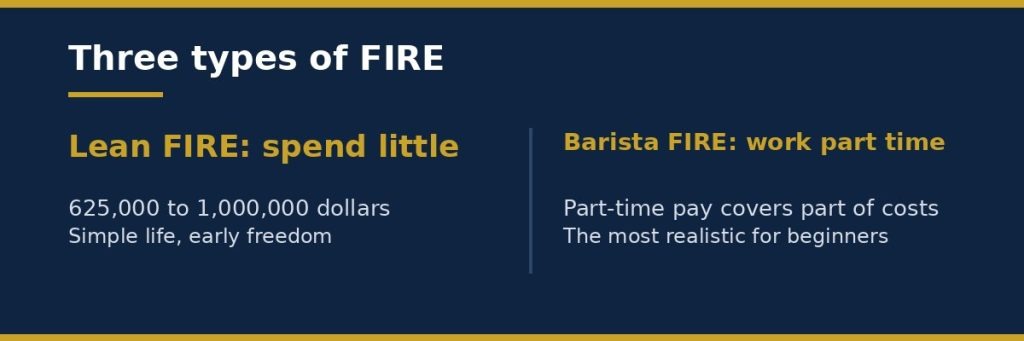
Lean FIRE means retiring on a small budget. You spend little, often 25,000 to 40,000 dollars a year, and your FIRE number is 625,000 to 1,000,000 dollars. It needs the highest savings rate, and the most discipline, because you live simply for many years, and you retire on a tight budget. It fits people who are happy with a simple life, and who do not mind a small home, no car, or a low-cost area.
Fat FIRE means retiring on a comfortable budget. You spend 80,000 to 100,000 dollars a year or more, and your FIRE number is 2,000,000 to 2,500,000 dollars or more. It needs a high income, because you must save a large amount each year while still living well. It fits high earners who want to keep their lifestyle in retirement.
Barista FIRE means retiring from full-time work, but working part time for fun, for benefits, or for a little income. The name comes from the idea of working part time in a coffee shop, but it can be any part-time work. You need a smaller fund, because the part-time work covers part of your costs. For example, if you spend 40,000 dollars a year and part-time work brings in 15,000 dollars, your fund only needs to cover 25,000 dollars a year. At 25 times, that is 625,000 dollars, not 1,000,000 dollars. Barista FIRE is the most realistic type for many beginners, because it does not ask you to stop working completely.
The savings rate: the number that decides everything
The savings rate is the share of your income you save and invest. It is the most important number in FIRE, because it decides how fast you get there.
If you earn 60,000 dollars a year after tax, and you spend 30,000 dollars, you save 30,000 dollars. Your savings rate is 30,000 divided by 60,000, which is 50 percent. If you spend 48,000 dollars, you save 12,000 dollars, and your savings rate is 20 percent.
FIRE usually needs a savings rate of 50 percent or more. At 50 percent, with average investment growth, many planners estimate it takes about 17 years to reach financial independence. At 20 percent, it takes far longer, often 35 years or more. At 10 percent, which is the usual advice for a normal retirement at 65, it takes a working lifetime.
Those year counts are rough estimates, not promises. They depend on investment returns, which go up and down. But they show the trade: the higher your savings rate, the sooner you can retire. The two ways to raise it are to earn more, or to spend less, and most FIRE followers do both.
A beginner does not need to jump to 50 percent on day one. Start at 20 percent, then raise it by a small amount each time your income rises. The habit matters more than the starting number.
The risks beginners miss
FIRE looks simple on paper, but there are real risks.
First, healthcare. If you retire at 40 in the United States, you need health insurance for 25 years before Medicare starts at 65. That can cost hundreds of dollars a month, or more, and it must be in your yearly spending number. Many FIRE plans fail because healthcare was left out.
Second, the fund must last a very long time. Retiring at 40 means the money must last 50 years or more. The 4 percent rule was tested for 30 years, not 50. That is why many FIRE planners use 3.5 percent or 3 percent instead, which means a bigger fund, or lower spending.
Third, life changes. Children, illness, a parent who needs care, or a market crash in the first years of retirement can all break the plan. A plan that only works if nothing goes wrong is not a plan. Build in a buffer: a lower withdrawal rate, some part-time income, or a willingness to spend less in bad years.
Fourth, Social Security starts late. In the United States, you cannot claim Social Security before age 62, and claiming early reduces the amount. If you retire at 40, Social Security does not help you for 22 years. Your fund must cover all of it alone until then.
Can beginners really do FIRE?
For most beginners, full FIRE, retiring at 40 and never working again, is very hard. It needs a high income, a high savings rate, and many years of discipline. But the ideas behind FIRE help everyone, even if full FIRE is out of reach.
If you save 20 percent instead of 10 percent, you retire years earlier, even if it is not at 40. If you cut one big cost, like housing, your FIRE number falls by 25 times that saving, because the rule is 25 times spending. If you earn a little side income in retirement, your fund needs to be smaller.
The honest answer is: beginners can use FIRE ideas to retire earlier than 65, and to gain freedom, even if they do not hit full FIRE. Barista FIRE, where you work part time by choice, is the most realistic goal for many people, and it still gives you the freedom that FIRE promises.
Related reading in the Retirement Planning cluster: how much to save for retirement by age, what a 401(k) is in simple terms, what a Roth IRA is in simple terms, when you can retire, and how long your retirement savings will last.
Frequently asked questions
How much money do I need to retire early FIRE?
Multiply your yearly spending by 25. If you spend 40,000 dollars a year, you need 1,000,000 dollars. If you spend 25,000 dollars a year, you need 625,000 dollars. If you spend 80,000 dollars a year, you need 2,000,000 dollars. That is the 25x rule, and it is a guide, not a guarantee.
What is the 4 percent rule in the FIRE movement?
The 4 percent rule says you can take out 4 percent of your fund in the first year of retirement, then adjust for inflation each year, and the fund should last about 30 years. On a 1,000,000 dollar fund, that is 40,000 dollars a year. Many FIRE planners use 3.5 percent or 3 percent instead, because FIRE retirements can last 50 years or more.
Is 2 million dollars enough to retire at 45?
It depends on your spending. At the 4 percent rule, 2,000,000 dollars pays 80,000 dollars a year. If you spend 80,000 dollars or less a year, it can work. If you spend more, it will not last. Remember that healthcare, taxes, and a 50-year time frame all make the math harder than the simple rule suggests.
Can I retire at 45 and get Social Security?
No, not straight away. In the United States, the earliest you can claim Social Security is age 62, and claiming early reduces the amount. If you retire at 45, your fund must cover all your costs for 17 years before Social Security starts. Plan for that gap.
What is Lean FIRE?
Lean FIRE means retiring on a small budget, often 25,000 to 40,000 dollars a year, with a fund of 625,000 to 1,000,000 dollars. It needs a high savings rate and a simple life, and it fits people who are happy living simply.
What is Barista FIRE?
Barista FIRE means retiring from full-time work, but working part time for fun, for benefits, or for a little income. The part-time work covers part of your costs, so your fund can be smaller. It is the most realistic type of FIRE for many beginners.
Conclusion, and your first step today
FIRE means Financial Independence, Retire Early. The math is the 25x rule: save 25 times your yearly spending, then take out about 4 percent a year. Lean FIRE is a small budget, Fat FIRE is a comfortable budget, and Barista FIRE mixes part-time work with a smaller fund. Full FIRE is hard, because it needs a savings rate of 50 percent or more, but the ideas help any beginner retire earlier and gain freedom.
Your first step today is to work out your FIRE number. Write down what you spend in a year, multiply it by 25, and that is your target. Then work out your savings rate, and see how far you are. That one calculation turns FIRE from a dream into a plan.
Disclaimer: This article is for education only. It is not financial advice, and it does not guarantee any result. Your income, costs, debts, and goals are personal, and you should consider your own situation, and speak to a qualified professional if you need personal advice, before making a financial decision.
Sources
- US Social Security Administration, plan for retirement: https://www.ssa.gov/prepare/plan-retirement
- Investor.gov, US Securities and Exchange Commission, free financial planning tools: https://www.investor.gov/free-financial-planning-tools
- Google keyword research, 2026-11-28, keyword “what is FIRE retire early”. Top results included Charles Schwab, Wikipedia, 1st Source Bank, Protective Life, Fidelity, and Experian. Only one smaller bank ranked on page 1. People also ask included “How much money do I need to retire early FIRE?” and “What is the 4% rule in the FIRE movement?” No volume, difficulty, or CPC figure was shown on any Google results page.
