
What Is a Roth IRA in Simple Terms?
A Roth IRA is a retirement account you open yourself. You pay tax on the money before it goes in, and the money can grow and come out tax free in retirement if you follow the rules. In short: pay tax now, so you do not pay tax later.
A Roth IRA is not an investment by itself. It is an account, and you choose the investments inside it, such as index funds.
You do not need a job that offers a retirement plan. You open it yourself with a bank, a brokerage, or another provider, if you have earned income and meet the income rules. Limits change over time, so this article describes them only in general terms and points you to irs.gov for current figures.
For the wider picture of retirement accounts, see What Is a Retirement Account in Simple Terms?
The simple idea behind a Roth IRA
A Roth IRA works the same way your pay does. Tax comes out first, and what is left is yours. You contribute money you have already paid tax on, and the account grows over the years. If you meet the rules for qualified withdrawals in retirement, you take the money out without paying tax on it again.
Think of it like a seed you have already paid for. The tree grows for years, and when you pick the fruit in retirement, you do not pay again.
So the trade is simple: you give up a tax break today in exchange for tax free money later. That suits many beginners, who are often in a lower tax bracket early in life than they expect to be later.
How a Roth IRA works, step by step
A Roth IRA works in four steps: put money in, invest it, leave it to grow, and take it out in retirement.
First, you put money in. You contribute from income you have already paid tax on. You can usually still contribute for a tax year up to the tax filing deadline for that year. Check the current limits on irs.gov, because they change.
Second, you invest the money. Cash sitting in the account does not grow on its own, so you choose investments, such as a broad index fund. If you do nothing, your contributions may sit as cash and earn very little. For a simple explanation of index funds, see What Is an Index Fund and Why Do Beginners Use It?
Third, the money grows. The investments earn returns, and those returns can earn returns of their own. This is compound growth, the same force that makes regular saving powerful over decades. For a plain explanation, see How Does Compound Interest Work?
Fourth, you take the money out in retirement. If you meet the rules for a qualified withdrawal, the money, including all the growth, comes out tax free. The rules include an age condition and a holding period condition, described later in this article. If you take earnings out early, tax and a penalty may apply.
Roth IRA vs traditional IRA vs 401(k)
A Roth IRA is an individual account you open yourself. You pay tax before the money goes in, and qualified withdrawals in retirement are tax free. There is no tax break when you contribute.
A traditional IRA is also an individual account you open yourself. The tax treatment is usually the opposite. You may get a tax deduction when you contribute, depending on your income and whether you have a workplace plan, and then you pay tax when you take the money out. In short, a traditional IRA can mean a tax break now and tax later, while a Roth IRA means tax now and no tax later.
A 401(k) is a workplace account your employer offers. You contribute from your pay, and many employers add matching contributions, extra money from the employer. That match is one reason a 401(k) is often the first account people use when it is offered. A 401(k) can be traditional or Roth, depending on what your employer offers. None of these accounts is right for everyone.
Who can open a Roth IRA
In general, you can open a Roth IRA if you have earned income in the year, meaning money from work, such as wages, salary, or self employment income. Investment income alone, such as interest or dividends, does not count.
There is also an income limit. If your income is above a certain level, the amount you can contribute is reduced, and above a higher level you cannot contribute directly at all. Those limits change over time and depend on your tax filing status. This article states no current income limit figure, because none was verified from irs.gov in this run. Check the current limits on the IRS Roth IRA page before you contribute: https://www.irs.gov/retirement-plans/roth-iras
There is no age limit as long as you have earned income. A teenager with a part time job can have one, usually opened with a parent or guardian as custodian. You do not need a large amount to start: many providers let you open an account with a small deposit, and some with no minimum at all.
How to open a Roth IRA, step by step
Opening a Roth IRA is simple, and most people do it online in under an hour.
Step 1: Choose a provider, such as a brokerage, a bank, or an investment firm. Compare providers on three things: low fees, a good range of low cost index funds, and an easy website or app.
Step 2: Open the account. You will need your name, address, date of birth, Social Security number, employment details, and bank account details. Choose “Roth IRA” as the account type, not a traditional IRA or a regular brokerage account.
Step 3: Link your bank account and add money. Start with an amount you can afford every month, even if it is small.
Step 4: Choose your investments. This is the step beginners most often skip. Your money needs to be invested, not left as cash. A common beginner choice is a broad, low cost index fund, such as one that follows the S&P 500, an index run by S&P Global, or a total stock market index. Another common choice is a target date fund, which picks a mix based on the year you expect to retire.
Step 5: Set up automatic contributions. Set a monthly transfer from your bank to your Roth IRA, on or just after payday. Automation removes the monthly decision and the temptation to skip. For more on automation, see How Do I Automate Saving and Investing?
What can you hold inside a Roth IRA
A Roth IRA can hold many kinds of investments, depending on your provider. Index funds are the most common beginner choice. An index fund holds a large basket of investments that follows a market index, so one fund gives you broad diversification.
Exchange traded funds, often called ETFs, are similar to index funds and trade during the day like a stock. Individual stocks are shares in single companies. They can grow a lot, but they can also fall a lot, and one company can fail. Most beginners keep them as a small part of the account.
Bonds are loans you make to a government or a company, which pay interest. They are usually steadier than stocks but grow more slowly. Target date funds hold a mix of stocks and bonds, chosen for a retirement year. Whatever you choose, keep the fees low and the mix simple.
Rules to know before you touch the money
First, the five year rule. Your account must have been open for at least five tax years before your earnings can come out tax free as a qualified withdrawal. The clock usually starts on January 1 of the tax year of your first contribution.
Second, the age rule. You must be at least 59 and a half years old for your earnings to come out tax free as a qualified withdrawal, alongside the five year rule.
Third, your own contributions are treated differently from the earnings. Because you already paid tax on your contributions, you can generally withdraw the amount you contributed without tax or penalty at any time. Withdrawing contributions early still hurts your retirement, because that money stops growing.
Fourth, early withdrawals of earnings can cost you. If you take out earnings before you meet the rules, you may owe income tax plus an extra 10 percent penalty, unless an exception applies, such as for a first home purchase or higher education costs. Check the IRS Roth IRA page for the current list: https://www.irs.gov/retirement-plans/roth-iras
Fifth, there are no required minimum distributions for the original owner during their lifetime. The tax rules do not force you to start taking money out at a certain age, as they do for some other retirement accounts. Before you take money out early, check the IRS page or ask a tax professional.
A worked example, with real math
Here is a worked example. Every number here is an example. The 7 percent growth rate is assumed for illustration only, it is not a prediction, and real returns go up and down.
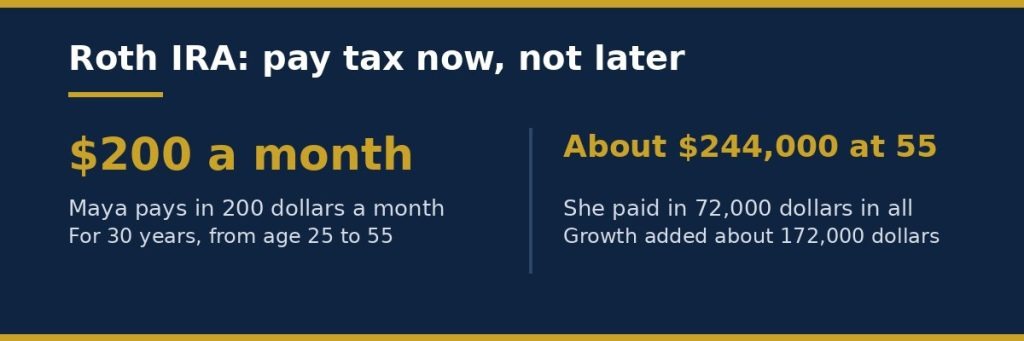
Maya is 25. She opens a Roth IRA and contributes 200 dollars a month until she is 55, which is 30 years. Her investments grow at an assumed 7 percent a year, compounded monthly. The example ignores fees, and it assumes she never withdraws money early.
First, add up what Maya pays in. She contributes 200 dollars a month for 30 years. There are 12 months in a year, so she contributes 200 times 12, which is 2,400 dollars a year. Over 30 years, that is 2,400 times 30, which is 72,000 dollars in total. Check it the other way: 200 dollars a month times 360 months equals 72,000 dollars. Both ways agree.
Next, work out the value at age 55. With monthly contributions of 200 dollars growing at an assumed 7 percent a year, compounded monthly, for 360 months, the account value comes to about 243,994 dollars. It is rounded to about 244,000 dollars here.
Now split the total into what Maya paid in and what growth added. Her contributions were 72,000 dollars, so growth added 243,994 minus 72,000, which equals 171,994 dollars, or about 172,000 dollars. Growth added more than twice what she paid in. Check it the other way: 72,000 plus 171,994 equals 243,994, which matches the total.
Now compare starting ten years later. Suppose Maya waits until age 35 and contributes the same 200 dollars a month until age 55, which is 20 years. Her contributions are 200 dollars a month times 240 months, which is 48,000 dollars. At the same assumed 7 percent growth rate, the account value at age 55 comes to about 104,185 dollars. Growth added is 104,185 minus 48,000, which is 56,185 dollars, or about 56,000 dollars. The difference between the two start dates is 243,994 minus 104,185, which is 139,809 dollars, or about 140,000 dollars. The extra ten years cost only 24,000 dollars more in contributions, because 72,000 minus 48,000 equals 24,000. That extra 24,000 dollars turned into about 140,000 dollars of extra value, because the earlier money had ten more years to grow.
That is the lesson. The amount you contribute matters, but the number of years matters more. Starting ten years earlier more than doubles the final value in this illustration. The example is not a promise: real returns are not a smooth 7 percent every year. But the pattern is real: time is the biggest advantage a young saver has.
Common beginner mistakes to avoid
Do not leave the money as cash. The most common beginner mistake is opening the account, contributing, and never choosing an investment.
Do not contribute more than the limit. The yearly limit changes, and contributing too much creates a tax problem you have to fix. Check the current limit on the IRS page before you contribute: https://www.irs.gov/retirement-plans/plan-participant-employee/retirement-topics-ira-contribution-limits
Do not treat the account as an emergency fund. Every dollar you take out stops growing for retirement, and you cannot put it back beyond the yearly limit. Keep a separate emergency fund in a savings account.
Do not try to time the market. Some beginners wait years for the perfect moment while their money sits as cash. Regular monthly contributions, left alone through ups and downs, are a simpler plan.
Do not ignore the fees. A fund that charges 1 percent a year takes a large slice of your growth over thirty years. Check the fee, called the expense ratio, before you choose a fund.
Frequently asked questions
What is a Roth IRA in simple terms?
A Roth IRA is a retirement account you open yourself. You pay tax on the money before it goes in, and qualified withdrawals in retirement come out tax free if you meet the age and holding period rules.
How is a Roth IRA different from a traditional IRA?
With a Roth IRA, you pay tax now and qualified withdrawals in retirement are tax free. With a traditional IRA, you may get a tax deduction when you contribute, and then you pay tax when you take the money out.
Who can open a Roth IRA?
In general, anyone with earned income can open one, if their income is below the IRS limit. Check the current limits on irs.gov, because they change over time.
Can I take my money out of a Roth IRA before retirement?
You can generally withdraw the money you contributed without tax or penalty, because you already paid tax on it. Taking out earnings early can mean income tax plus a 10 percent penalty, unless an exception applies.
How much should I put in a Roth IRA each month?
There is no single right amount. Start with an amount you can afford every month without missing bills, even if it is small, and raise it when your income rises. Check the yearly contribution limit on irs.gov.
Conclusion, and your first step today
A Roth IRA is a simple deal: pay tax on the money now, invest it, leave it alone for decades, and take it out tax free in retirement if you follow the rules. The worked example shows why starting early matters: ten extra years turned about 104,000 dollars into about 244,000 dollars.
Start today: check the current limits on irs.gov, choose a low fee provider, open the account, and set up a small automatic monthly contribution. Then choose a broad, low cost investment, and let it grow. If you are not sure when to begin, see When Is the Right Time to Start Investing?
This article is for general information and education only. It is not legal or financial advice.
