

How Long Will My Retirement Savings Last? How to Estimate It
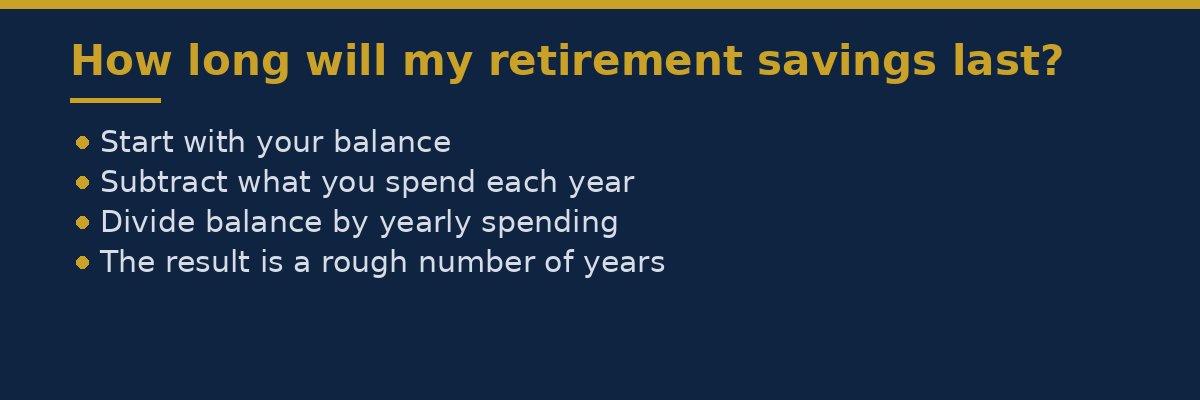
How long will my retirement savings last? The short answer is that it depends on three numbers: how much you have saved, how much you spend each year in retirement, and how long you live in retirement. If you know the first two numbers, you can make a simple estimate in a few minutes. Take your total retirement savings, divide it by the amount you plan to spend from savings each year, and the result is a rough number of years your savings could last if nothing else changed.
That simple division is only a starting point. It does not include investment growth, inflation, taxes, fees, or other income such as a pension or Social Security. It also does not know how long you will live. Still, it is useful, because it turns a vague worry into a clear number you can work with. If the number is much shorter than the years you hope to spend in retirement, you can see the gap early and make small changes while you still have time.
This post explains the key numbers to check, shows a worked example with clear math, and gives simple steps to take if your savings look like they may run short. It is educational only. It is not financial advice, and it does not tell you what to buy, sell, or hold.
The three numbers that decide the answer
Every estimate of how long retirement savings last starts with the same three numbers. You do not need exact figures to start. A close, honest estimate is enough for a first check, and you can refine it later.
First, your total retirement savings. Add up all the accounts you plan to use in retirement. This may include a workplace plan, an individual retirement account, and other savings set aside for retirement. Do not include your emergency fund in this total unless you truly plan to spend it in retirement, because that fund has a different job. Our guide on what a retirement account is in simple terms explains the common account types in plain language.
Second, your yearly spending in retirement. This is the total amount you expect to spend in a year, not just the amount you take from savings. Your spending may be lower than your working years, because you may no longer pay for commuting, work clothes, or saving for retirement itself. It may also be higher in some areas, such as health care, travel, or helping family. Start with your current yearly spending, then adjust it for the changes you expect.
Third, your other yearly income in retirement. This is money that does not come from your savings. It may include Social Security, a pension, or part time work. This income matters a lot, because every dollar of other income is a dollar you do not need to take from savings. If your other income covers half of your spending, your savings only need to cover the other half, so they last much longer.
Once you have these three numbers, you can find the gap your savings must fill. Take your yearly spending, subtract your other yearly income, and the result is the amount you need to withdraw from savings each year. That yearly withdrawal is the key number in the simple estimate.
A simple estimate you can do in five minutes
Here is the simple method, step by step. It uses division only, and it gives a rough answer you can improve later.
Step 1: Write down your total retirement savings. Use the current balance of all your retirement accounts added together.
Step 2: Write down your expected yearly spending in retirement. Use a full year, not one month, and include irregular costs such as home repairs, car costs, and gifts.
Step 3: Write down your expected other yearly income in retirement, such as Social Security or a pension. If you are not sure of the amount, use a low, careful estimate for now, and check the official figures later.
Step 4: Subtract other yearly income from yearly spending. The result is the amount you need from savings each year.
Step 5: Divide your total savings by that yearly amount from savings. The result is a rough number of years your savings could last.
For example, if you have savings of 300,000 and you need 15,000 from savings each year, the math is 300,000 divided by 15,000, which equals 20 years. That means your savings could last about 20 years at that yearly withdrawal, if nothing else changed. It is a rough guide, not a promise, because real life includes growth, inflation, taxes, and changes in spending.
Worked example: a 400,000 balance and a 20,000 yearly withdrawal
This worked example uses round numbers that are stated clearly and labelled as an example only. It is not a prediction for any real person.
Meet Sam, an example retiree. Sam has total retirement savings of 400,000. Sam expects to spend 50,000 per year in retirement. Sam expects other income of 30,000 per year from Social Security and a small pension. That leaves a gap to fill from savings.
Yearly spending: 50,000.
Other yearly income: 30,000.
Amount needed from savings each year: 50,000 minus 30,000 equals 20,000.
Now divide the savings by the yearly amount from savings. Total savings of 400,000 divided by 20,000 per year equals 20 years. So in this simple example, Sam’s savings could last about 20 years if spending, income, and the balance never changed.
Now see what happens when one number changes. If Sam spends 5,000 less per year, yearly spending falls to 45,000. The amount needed from savings becomes 45,000 minus 30,000, which equals 15,000. Then 400,000 divided by 15,000 equals about 26.7 years. That is about 6.7 years longer, from one change in spending.
If Sam spends 5,000 more per year instead, yearly spending rises to 55,000. The amount needed from savings becomes 55,000 minus 30,000, which equals 25,000. Then 400,000 divided by 25,000 equals 16 years. That is 4 years shorter than the first example.
This shows why the yearly withdrawal matters so much. A small change in yearly spending changes the answer by several years. That is good news, because it means small, steady changes can make a real difference.
Remember, this simple division leaves out investment growth, which could help savings last longer, and inflation, which could make each year cost more. It also leaves out taxes and fees. Use it as a first check, not as a final plan. For a fuller picture, many people speak to a qualified professional who can run a more detailed estimate for their own situation.
Key numbers to check every year
An estimate is not a one time task. Your balance, spending, and income change over time, so check the key numbers once a year, at the same time you review your budget.
Check your total savings balance. Has it grown, stayed flat, or fallen? A falling balance while you are still working may mean you need to save more, while a falling balance in retirement may mean your withdrawals are higher than planned.
Check your actual yearly spending. Compare what you really spent with what you planned to spend. Look for the categories that rose the most, and ask whether the rise was a one off cost or a new normal level of spending.
Check your other income. Has a pension or Social Security payment changed? Has part time income started or stopped? Any change here changes the amount you need from savings.
Check your withdrawal rate. This is your yearly withdrawal from savings, divided by your total savings, shown as a percentage. In the worked example above, 20,000 divided by 400,000 equals 0.05, or 5 percent. A lower percentage usually means savings last longer, while a higher percentage means they are used up faster. There is no single safe percentage for everyone, because age, health, other income, and market returns all matter.
Check your plan for a long retirement. If you retired at 65 and your savings last 20 years in the simple estimate, they would run out at about age 85. If you live longer, what would cover the extra years? This is not a pleasant question, but it is better to ask it early, when you still have choices, than late, when choices are few.
If you want a broader plan around these numbers, our guide on financial planning for retirement walks through the main pieces in plain language, and our guide on how to set up a Roth IRA explains one common account type for retirement saving.
What to do if your savings may run short
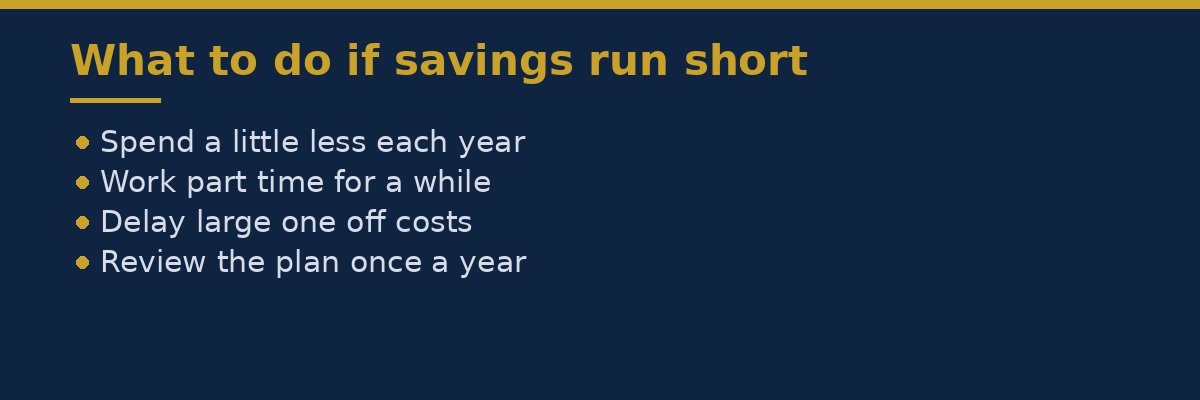
If your simple estimate is shorter than the retirement you hope for, do not panic. A gap found early is a problem you can work on. Here are practical steps, starting with the ones that usually help most.
Spend a little less each year. This is often the most powerful step, because it helps twice. First, you withdraw less from savings, so the balance falls more slowly. Second, if you are still working, the money you do not spend can be added to savings. Look for large, repeatable costs first, such as housing, transport, and food, rather than cutting every small pleasure at once.
Consider working longer, or part time. Even one or two extra years of work can help in three ways: you add more savings, you delay withdrawals, and you may increase other income such as Social Security. Part time work in early retirement can have a similar effect on a smaller scale, by covering part of your yearly spending so savings cover less.
Delay large one off costs where you can. A major home project, a new car, or a large gift can take a big slice out of savings in a single year. If the cost can wait a year or two, or be done in smaller stages, the yearly withdrawal stays lower and the estimate improves.
Review your investment mix with care. This does not mean chasing high returns or taking risks you do not understand. It means checking that your mix fits your age, your time horizon, and your need for income, and that fees are reasonable. If you are unsure, speak to a qualified professional before making changes.
Protect your emergency fund. Keep a separate buffer for unexpected costs, so a car repair or a medical bill does not force a large extra withdrawal from retirement savings in a bad year. Our guide on how much to keep in an emergency fund explains how to size that buffer in simple terms.
Check benefits and official information. The Consumer Financial Protection Bureau offers general retirement planning information, including its retirement tools and guides, which can help you think through the key choices. Use official sources for benefit amounts and rules, rather than guessing from memory or from a single article.
Frequently asked questions
How long will my retirement savings last if I withdraw 20,000 a year?
It depends on your total balance. In the worked example in this post, savings of 400,000 divided by a yearly withdrawal of 20,000 equals 20 years, as a rough estimate. Your own answer comes from dividing your own balance by your own yearly withdrawal from savings. Remember that growth, inflation, taxes, and fees are not included in that simple division.
What is a safe amount to withdraw each year?
There is no single safe amount for everyone. It depends on your age, your total savings, your other income, your health, and how long retirement may last. A useful first step is to find your withdrawal rate by dividing your yearly withdrawal by your total savings. A lower rate usually means savings last longer. For personal guidance, speak to a qualified professional who can look at your full situation.
Does Social Security count when I estimate how long savings will last?
Yes, it matters a lot. Social Security and any pension are other income, so they reduce the amount you need to take from savings each year. Subtract other yearly income from yearly spending first, then divide savings by the amount that is left. That gives a more realistic estimate than dividing savings by total spending.
What if I have no pension and only Social Security?
Then Social Security is your main other income, and the same method still works. Write down your yearly spending, subtract your expected Social Security for the year, and divide your savings by the amount left. If that amount is high, savings will be used faster, so spending less or working part time may help more.
Should I include my home in my retirement savings?
In most cases, no, not for this simple estimate. Your home is where you live, so you cannot spend its value without selling it or moving. Keep your home value separate from the savings you plan to withdraw from each year. If you later decide to downsize, you can redo the estimate with the new figures.
How often should I redo this estimate?
Once a year is enough for most people, plus after any big change, such as retiring, stopping work, moving, or a large medical cost. A yearly check keeps the estimate honest without turning it into a daily worry.
Conclusion
How long will my retirement savings last? Start with the simple estimate: total savings divided by the yearly amount you need from savings. In the worked example, 400,000 divided by 20,000 a year gave about 20 years. That number is rough, because it leaves out growth, inflation, taxes, fees, and health costs, but it is still a useful first check.
The next step is yours, and it is simple. Write down your three numbers today: your total retirement savings, your yearly spending, and your other yearly income. Do the subtraction, then the division, and write down the result. Then test it with a lower spending year and a higher spending year, so you can see the range. If the answer is shorter than you hoped, start with the smallest helpful change, such as spending a little less each year or reviewing your plan once a year. Small, steady steps, started early, give your savings the best chance to last.
This article is for general information and education only. It is not legal or financial advice.
