

When Can I Retire?
Short answer: you can retire when your savings, plus any pension and Social Security, can cover your yearly spending for the rest of your life. There is no single age that works for everyone, because spending, saving, and health differ so much. Three numbers decide your date: how much you spend in a year, how much you have saved, and how much you can count on from other income. This guide shows you how to work out each number, with a worked example using the 25 times rule. It is educational only, not financial advice.
The three numbers that decide your date
Number 1: your yearly spending in retirement. Not your salary, but what you actually spend in a year: housing, food, transport, bills, health costs, and fun. Most people spend less in retirement than while working, because the mortgage may be paid off and work costs disappear, but health costs often rise. Track your spending for a few months now, and use that as the base. If you spend 40,000 dollars a year now, plan on needing something close to that in retirement, adjusted for the costs that will change.
Number 2: your savings. Add up your retirement accounts, your savings, and any investments you hold for the long term. Do not count the house you live in, because you need somewhere to live. The question is how much income that pile of money can safely produce each year.
Number 3: your other income. In the United States, that usually means Social Security, and for some people a pension from an employer. Social Security pays a monthly amount based on your earnings history and the age you claim it. A pension pays a set amount, often for life. These two can cover a large part of yearly spending, which lowers the savings you need.
When the yearly income from savings plus other income covers yearly spending, with room to spare, you can retire. When it does not, you need more time, more saving, or lower spending. That is the whole calculation.
A worked example: the 25 times rule
A common planning rule says you need savings of about 25 times your yearly spending, if you plan to take out 4 percent of your savings in the first year and adjust for inflation after that. It is a rough guide, not a promise, but it turns a vague question into a clear target.
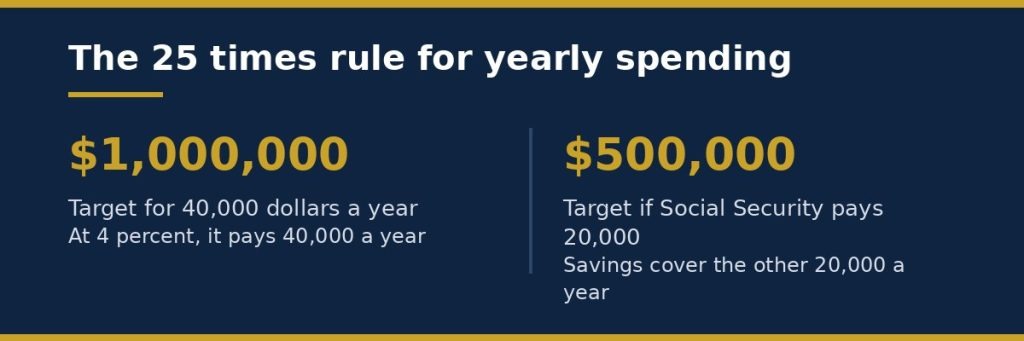
Here is the math. If you spend 30,000 dollars a year, 25 times that is 750,000 dollars. At a 4 percent withdrawal, 750,000 dollars supports 30,000 dollars a year. If you spend 40,000 dollars a year, 25 times that is 1,000,000 dollars, which supports 40,000 dollars a year at 4 percent. If you spend 60,000 dollars a year, 25 times that is 1,500,000 dollars, which supports 60,000 dollars a year.
Now add Social Security and any pension, because they lower the savings target. Suppose you spend 40,000 dollars a year, and Social Security will pay you 20,000 dollars a year. Your savings only need to cover the other 20,000 dollars. Twenty-five times 20,000 dollars is 500,000 dollars, not 1,000,000 dollars. That is why the claiming age for Social Security matters so much: a bigger monthly benefit means a smaller savings target.
The 25 times rule assumes your money keeps growing while you take money out, and that you take out a steady amount. Real life is messier: markets fall, costs spike, and health changes plans. Treat the rule as a planning target, and build in a margin. If the rule says 500,000 dollars, aiming for 600,000 dollars gives you room for the years that do not go as planned.
To learn how much to save by age, read: How Much Should I Save for Retirement? A Simple Guide by Age
How much do you need to save each month?
The monthly amount depends on your age, your target, and the return you assume. Here is a simple example, using an average yearly growth of 7 percent, money added every month, and all growth left in the account. These figures are an example, not a promise. Real returns move up and down, and no one can promise 7 percent.
Start at 30 and save until 65, which is 35 years. Saving 200 dollars a month grows to about 360,000 dollars, from 84,000 dollars paid in. Saving 300 dollars a month grows to about 540,000 dollars, from 126,000 dollars paid in. Saving 500 dollars a month grows to about 901,000 dollars, from 210,000 dollars paid in.
Start ten years later, at 40, and save the same 300 dollars a month until 65, which is 25 years. It grows to about 243,000 dollars, from 90,000 dollars paid in. The ten missing years cost about 297,000 dollars in the final total, even though the extra payments were only 36,000 dollars. Starting early matters more than the monthly amount, because the money has more time to grow.
The practical lesson is to start with what you can afford now, even 100 or 200 dollars a month, and raise it by one percent of pay whenever you get a raise. A small amount started at 30 beats a large amount started at 45, because time does the heavy lifting.
To plan your first investment steps, read: What Is a Simple First Investment Plan?
Social Security: the claiming age changes the answer
In the United States, Social Security pays a monthly benefit based on your earnings and the age you start claiming. The full retirement age is 67 for people born in 1960 or later, and lower for people born earlier. Claiming before the full age cuts the monthly amount. Claiming after it, up to age 70, raises it.
Claiming at 62, the earliest age, with a full retirement age of 67, cuts the benefit by about 30 percent. That is a large cut, and it lasts for life. Claiming at 70 raises the benefit by about 24 percent over the full amount. The difference between claiming at 62 and at 70 is very large, and it changes the savings target by a lot.
There is no single right claiming age. Claiming early gives you money sooner, which helps if you need the income or your health is poor. Claiming late gives you more each month for life, which helps if you live long and your savings are thin. The useful question is not which age is best in theory, but which age fits your savings, your health, and your spending.
The US Social Security Administration explains the reduction for early claiming here: https://www.ssa.gov/benefits/retirement/planner/agereduction.html
How to work out your own date, step by step
Step 1: Work out yearly spending. Add up a year of real spending, or track three months and multiply by four. Split it into needs, like housing and food, and wants, like travel. The needs number is the one your retirement income must cover without fail.
Step 2: Work out other income. Check your Social Security statement for the estimated benefit at different claiming ages, and check any pension you have. Write down the yearly amount for the claiming age you are most likely to use.
Step 3: Find the gap. Subtract other income from yearly spending. The gap is what your savings must cover each year. Multiply the gap by 25, and that is your rough savings target.
Step 4: Compare the target with what you have now. If you have 200,000 dollars saved and the target is 500,000 dollars, the gap is 300,000 dollars. Now work out how many years of saving at your monthly amount will close it, using the same kind of growth example as above.
Step 5: Pick a date, then check it once a year. If the numbers say you can retire at 65, plan for 65, but check each year. A good year moves the date earlier. A bad year moves it later. A plan you check is a plan you can trust.
To plan savings, income, and withdrawals in full, read: Financial Planning for Retirement in Simple Steps: Savings, Income, and Withdrawals for Beginners
What can move your date earlier
Four things move the date earlier. Spending less in retirement is the fastest: cutting yearly spending by 5,000 dollars cuts the savings target by 125,000 dollars, because 25 times 5,000 is 125,000. Saving more each month is the steadiest: an extra 100 dollars a month for 30 years adds about 122,000 dollars at the 7 percent example rate. Earning more and investing the raise helps the same way. Claiming Social Security later raises the monthly benefit, which cuts the savings target.
What moves the date later is the mirror image: higher spending, lower saving, a market fall early in retirement, or a health cost that was not planned for. None of these is a disaster if the plan has margin. A target with 10 or 20 percent of slack absorbs most of them.
A 401(k) at work is the most common way to build the savings. If your employer matches contributions, take the full match first, because it is free money added to your saving.
To learn how one works, read: What Is a 401(k) in Simple Terms?
An IRA is the most common account outside work. It lets you save for retirement with tax benefits, and it suits people whose employer offers no plan, or who want to save more than the work plan allows.
To learn how one works, read: What Is an IRA in Simple Terms?
Five mistakes that push retirement later
Mistake 1: Guessing your spending instead of measuring it. A guess is usually too low, because it forgets the irregular costs: car repairs, home fixes, gifts, and travel. Track three months of real spending before you set the target.
Mistake 2: Counting the house as retirement savings. The house you live in is not income. You can only spend it by selling and moving somewhere cheaper, or by borrowing against it, and both have costs. Count only money that can pay a monthly bill.
Mistake 3: Forgetting health costs. Health spending usually rises with age, and it is the cost most likely to surprise a plan. Budget for it separately, and look into what your health cover will pay after you stop working.
Mistake 4: Claiming Social Security early without doing the math. Claiming at 62 cuts the benefit by about 30 percent for life. If your savings are thin, that cut can force a lower standard of living for decades. Run the numbers for 62, 67, and 70 before you decide.
Mistake 5: Stopping saving when the target looks far away. A target of 500,000 dollars looks impossible from zero, so some people save nothing. But 300 dollars a month from age 30 grows to about 540,000 dollars by 65 in the example above. The target is reached one month at a time, not in one leap.
To check what you need overall, read: How Much Do I Need to Retire
FAQ
What is the best age to retire?
There is no best age for everyone. It depends on your spending, your savings, your other income, and your health. The right age is the one where your yearly income from savings, Social Security, and any pension covers your yearly spending, with room to spare.
Can I retire at 55?
It is possible, but it needs a large savings pile, because you must cover more years without Social Security, which cannot start before 62, and you may need to buy your own health cover until Medicare starts. Work out the 25 times target for your spending, and check whether your savings can reach it by 55.
How much do I need to retire at 65?
Use the 25 times rule as a starting point. If you spend 40,000 dollars a year and Social Security pays 20,000 dollars, your savings must cover 20,000 dollars a year, so the rough target is 500,000 dollars. Your own target depends on your spending and your other income.
Does Social Security pay enough to retire on?
For most people, no, not on its own. Social Security replaces only part of your working income, and the amount depends on your earnings history and claiming age. It is designed as one leg of retirement income, next to savings and any pension.
What if I have saved nothing by 50?
Start now. Saving 500 dollars a month from 50 to 65 grows to about 158,000 dollars at the 7 percent example rate, from 90,000 dollars paid in. That is not enough on its own, but it is far better than nothing, and it can sit next to Social Security and a lower spending plan. Also consider working a few years longer, which both adds saving years and raises the Social Security benefit.
Should I pay off my mortgage before I retire?
It usually helps, because it cuts yearly spending, which cuts the savings target. A paid-off home means no monthly mortgage payment in retirement. But it is not a rule for everyone: if your mortgage rate is low and your savings are thin, keeping cash for retirement may matter more. Weigh it against your own numbers.
Conclusion
When you can retire is a math question, not a birthday. Work out your yearly spending, subtract Social Security and any pension, and multiply the gap by 25 to find your rough savings target. The worked example shows the scale: spending 40,000 dollars a year with 20,000 dollars from Social Security leaves a 20,000 dollar gap, and a 500,000 dollar target. Saving 300 dollars a month from age 30 grows to about 540,000 dollars by 65 in the example, which covers that target. Claiming Social Security at 62 cuts the benefit by about 30 percent, while waiting until 70 raises it, so the claiming age is part of the decision, not an afterthought. Start with what you can save this month, check the numbers once a year, and let the date move earlier as the savings grow. The sooner the plan starts, the sooner the date arrives.
This article is for general information and education only. It is not legal or financial advice.
