

Should I Pay Off My Mortgage Early or Invest the Extra Money?
Should I pay off my mortgage early or invest the extra money?
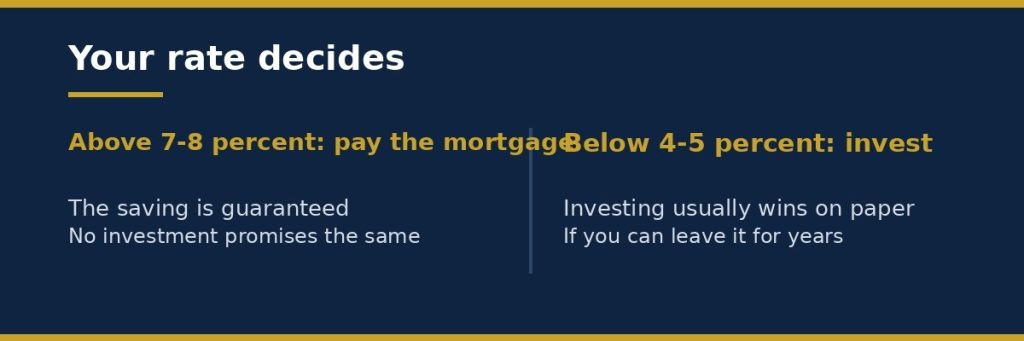
It depends on your mortgage rate. If your mortgage rate is high, above about 7 or 8 percent, paying it off early usually wins, because every extra payment saves you that high rate, guaranteed. If your mortgage rate is low, below about 4 or 5 percent, investing usually wins on paper, because investments have often earned more than that over long periods. If your rate is in the middle, between about 4 and 7 percent, either choice is reasonable, and the best answer depends on how much you value being debt free versus growing wealth.
Before either choice, do two things first. Build a starter emergency fund, and take the full 401(k) match from your employer if one is offered. After those two, the extra money goes to the mortgage or to investing, using the rate rule above.
This post gives you a worked example with real numbers, the decision rule, and the exceptions. It is educational only. It is not financial advice.
The worked example: 300,000 dollars at 6.5 percent
Take a homeowner with a 300,000 dollar mortgage at 6.5 percent interest, over 30 years. The monthly payment is about 1,896 dollars. Over 30 years, the total interest paid is about 382,633 dollars. That is more interest than the loan itself.
Now suppose the homeowner has an extra 200 dollars a month. Two choices.
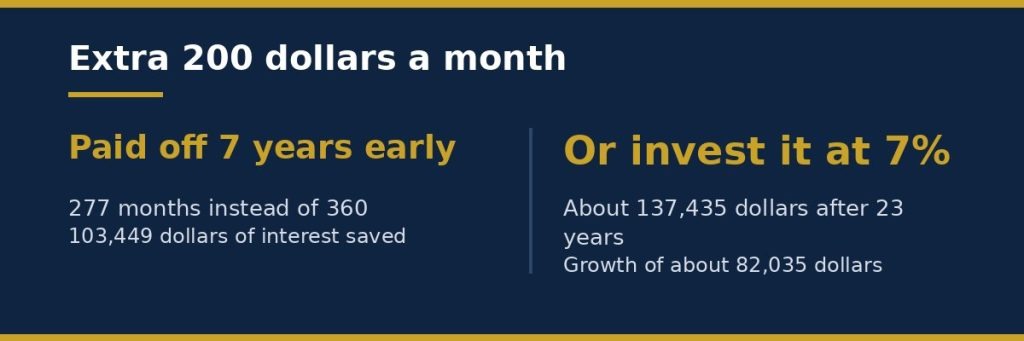
Choice 1: Pay the extra 200 dollars a month to the mortgage. The loan is paid off in about 277 months, which is about 23.1 years, instead of 30 years. The total interest falls to about 279,185 dollars. The interest saved is about 103,449 dollars, because 382,633 minus 279,185 is 103,449. The loan is gone almost 7 years early, and the saving is guaranteed, because it comes from the mortgage rate itself.
Choice 2: Invest the extra 200 dollars a month instead, at an average return of 7 percent a year. The 7 percent is an example to show the math, not a promise. After 23.1 years, the same 200 dollars a month has grown to about 137,435 dollars. The homeowner put in 55,400 dollars of their own money, so the growth is about 82,035 dollars.
Compare the two. Paying the mortgage saves about 103,449 dollars, guaranteed. Investing grows about 82,035 dollars, not guaranteed, and the mortgage still runs for the full 30 years. On these numbers, at a 6.5 percent mortgage rate, paying the mortgage wins, and it also removes the monthly payment almost 7 years early.
Change the rate, and the answer changes. At a 3.5 percent mortgage rate, the interest saved by paying early is far smaller, and investing at 7 percent would win by a large margin on paper. At an 8 percent mortgage rate, paying the mortgage wins by a large margin. That is why the rate is the decision.
The decision rule, in three bands
High rate, above about 7 or 8 percent: pay the mortgage early. Every extra dollar saves you that rate, guaranteed, and no investment can promise the same. This is the clearest case.
Middle rate, about 4 to 7 percent: either choice is reasonable. If you value being debt free and sleeping well, pay the mortgage. If you value growing wealth and you can accept market ups and downs, invest. Or split the extra money: half to the mortgage, half to investing. Splitting is a good answer when you cannot decide, because it gives you both benefits.
Low rate, below about 4 or 5 percent: investing usually wins on paper, because a diversified investment has often earned more than that over long periods. But only invest if you can leave the money alone for many years. If you will need the money soon, paying the mortgage, or keeping it in savings, is safer.
One more check: if you can deduct mortgage interest on your taxes, the real cost of the mortgage is lower than the rate, which pushes the answer toward investing. If you cannot deduct it, the rate is the real cost. Tax rules change, so check the current rules for your situation, or ask a qualified tax professional.
Do these first, before either choice
No matter what your rate is, do these first.
First, build a starter emergency fund of 1,000 dollars, then build it to three to six months of essential costs. Without it, a surprise goes on a card, or forces you to stop the extra mortgage payments.
Second, take the full 401(k) match if your employer offers one. A match is free money, and it beats both paying the mortgage and investing on your own.
Third, pay off any high-interest debt, like credit cards, before you pay extra on the mortgage or invest. Credit card interest is far higher than any mortgage rate, so it always comes first.
Only after those three, send the extra money to the mortgage or to investing, using the rate rule.
The case for paying it off: freedom and certainty
Paying off a mortgage early has benefits that do not show in the math. When the mortgage is gone, your monthly costs fall by the whole payment, which is often 1,500 to 2,500 dollars a month. That money is yours, every month, for the rest of your life.
It also removes risk. If you lose your job, a paid-off home cannot be taken by the bank for missed payments, though you still owe property taxes and insurance. That peace of mind is worth a lot, and it is why many people pay the mortgage even when investing would win slightly on paper.
Dave Ramsey teaches paying off the mortgage as part of becoming fully debt free, and many people follow that path for the freedom it brings. Suze Orman has taken a different view, advising some homeowners to keep a low-rate mortgage and keep cash for emergencies and investing, rather than locking all their money into the house. Both views have merit. The rate, and your comfort with risk, decide which fits you.
The case for investing: growth and flexibility
Investing the extra money has its own benefits. Your money stays reachable, in an account you can sell if you need it, while money paid into a mortgage is locked in the house until you sell or refinance. Investing also grows over time, and over long periods, a diversified mix has often earned more than a low mortgage rate costs.
The risk is real. Investments fall as well as rise, and the 7 percent in the example is an average, not a promise. Some years will be far below it, and some years will be negative. If you invest the extra money, you must be able to leave it alone for ten years or more, through the falls.
Frequently asked questions
What does Dave Ramsey say about paying off a mortgage?
Dave Ramsey teaches paying off the mortgage as part of becoming debt free, after building an emergency fund and paying off other debts. He values the freedom of a paid-off home, and he advises against keeping a mortgage just to invest the difference.
What does Suze Orman say about paying off your mortgage early?
Suze Orman has advised that it is not always right to rush to pay off a mortgage, especially when the rate is low. She has pointed out that money paid into a house is not easily reachable in an emergency, and that keeping cash and investing can be safer for some people. Her view fits low-rate mortgages best.
How can I cut 10 years off a 30 year mortgage?
Pay extra every month, and ask your lender to apply it to the principal, not to future payments. Even 100 dollars extra a month shortens the loan by years. On the example above, 200 dollars extra a month cut about 7 years off the loan. A yearly lump sum, like a tax refund, works the same way.
What is the 2 percent rule for mortgage payoff?
The 2 percent idea is a rough guide some people use: if your mortgage rate is about 2 percent higher than the return you expect from safe savings, paying the mortgage is the better choice. It is a rule of thumb, not a law. The cleaner rule is the one in this post: compare your mortgage rate with the return you expect, and remember that the mortgage saving is guaranteed while the investment return is not.
Is it better to pay off mortgage or invest in retirement?
Do both in order. Take the full 401(k) match first, because it is free money. Then build your emergency fund. Then, if your mortgage rate is high, pay the mortgage. If it is low, invest in retirement. If it is in the middle, split the extra money between the two.
Should I pay off my house or keep the money in savings?
If the money is your emergency fund, keep it in savings. Never empty your emergency fund to pay off a mortgage. Only use money above your emergency fund for extra mortgage payments, so a surprise does not force you back into debt.
Related reading in the Debt Payoff cluster: should you pay off debt or invest first, a debt-free plan for the next 12 months, how to build an emergency fund from zero, and how long it will take to pay off your debt.
Conclusion, and your first step today
Pay off the mortgage early or invest the extra money? Check your rate. Above about 7 or 8 percent, pay the mortgage. Below about 4 or 5 percent, invest. In between, split it, or follow your comfort with risk. And always do the first steps first: emergency fund, employer match, and high-interest debt.
Your first step today is to find your mortgage rate on your latest statement, and compare it with the bands above. Then check whether you are getting the full 401(k) match. Those two numbers tell you what to do with the next extra dollar.
Sources
Consumer Financial Protection Bureau, mortgages: https://www.consumerfinance.gov/consumer-tools/mortgages/
Disclaimer: This article is for education only. It is not financial advice, and it does not guarantee any result. Your income, costs, debts, and goals are personal, and you should consider your own situation, and speak to a qualified professional if you need personal advice, before making a financial decision.
