


What Is Market Timing, and Why Does It Rarely Work for Beginners?
What is market timing, and why does it rarely work for beginners?
Market timing means trying to buy stocks when prices are low and sell when prices are high, by predicting what the market will do next. It sounds simple, and it is the dream of every beginner. In practice, it rarely works, because it asks you to be right twice: right about when to sell, and right about when to buy back in. Most people get one of those wrong, and many get both wrong.
The evidence is consistent. Even professional investors, with teams and data, usually fail to time the market well over long periods. For a beginner, the odds are worse, because the market moves on news no one can predict, and the best days often arrive right after the worst days, when fear is highest.
This post explains what market timing is, why it fails, a worked example that shows the cost of sitting out, and what to do instead. It is educational only. It is not financial advice.
What market timing looks like in real life
Market timing usually starts with fear or excitement. Prices fall, the news is bad, and you sell to avoid more losses. Then you wait for prices to fall further, so you can buy back cheaper. Or prices rise, the news is good, and you buy more, hoping they keep rising.
The problem is the second step. After you sell, you must decide when to buy back in. If prices rise while you wait, you have to buy back higher than you sold, which loses money. If prices fall further, you feel clever, but you still have to pick the bottom, and the bottom is only clear after it has passed.
Here is a common story. An investor sells after a 10 percent fall, to avoid a bigger fall. The market falls 5 percent more, and the investor feels smart. Then the market rises 20 percent in a few months, while the investor is still waiting for a better entry. By the time the investor buys back in, prices are higher than when they sold. The timing attempt lost money, even though the first call was right.
Why it rarely works: three reasons
First, the market moves fast, and the best days cluster near the worst days. Big rises often come right after big falls, when the news is worst and most people are afraid to buy. If you sell during a fall, you are likely to miss the rise that follows. Missing just a few of the best days can cut your long-term return by a large amount.
Second, timing asks you to be right twice. You must sell near the top and buy near the bottom. Being right once is hard. Being right twice in a row, again and again, is almost impossible. A single wrong call wipes out the gain from a right call.
Third, fees and taxes eat the gain. Every time you sell and buy, you may pay trading costs, and in a taxable account, selling at a profit can create a tax bill. A timing strategy that looks good before costs often looks poor after them. A buy-and-hold investor pays those costs far less often.
Warren Buffett, one of the most famous investors, has said many times that he does not try to time the market, and that time in the market beats timing the market. That is a useful rule for a beginner: the market rewards patience more than prediction.
The worked example: staying invested vs sitting out
Take two beginners, Ana and Ben. Both have 10,000 dollars to invest. The example uses an average return of 7 percent a year, which is an example to show the math, not a promise. Real returns go up and down.
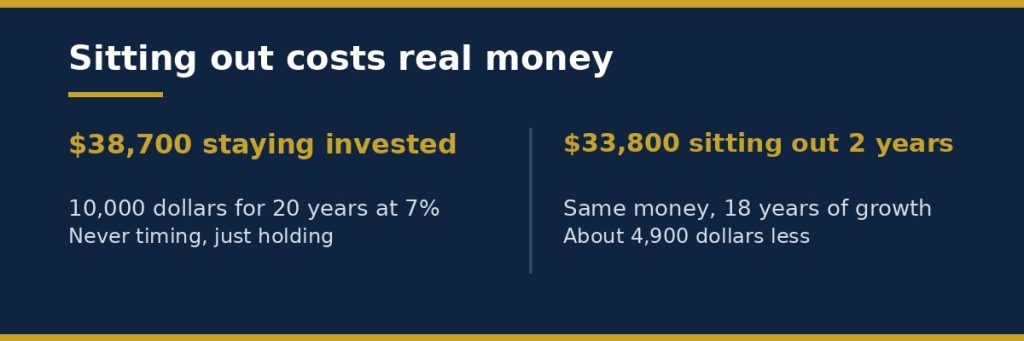
Ana invests the 10,000 dollars and leaves it alone for 20 years. Her money grows at 7 percent a year. After 20 years, 10,000 dollars times 1.07 to the power of 20 is about 38,700 dollars. The growth factor is about 3.87, because 1.07 multiplied by itself 20 times is about 3.87.
Ben invests the same 10,000 dollars, but he tries to time the market. He sits in cash for 2 of those 20 years, waiting for a better entry, earning nothing in those years, and his money grows at 7 percent for the other 18 years. After 18 years of growth, 10,000 dollars times 1.07 to the power of 18 is about 33,800 dollars. The growth factor for 18 years is about 3.38.
Ben ends with about 4,900 dollars less than Ana, because 38,700 minus 33,800 is 4,900. He missed only 2 years out of 20, and he lost about 4,900 dollars. That is the cost of sitting out, even when the timing feels careful.
The real cost is often larger, because the years you sit out are often the years with the biggest rises, which arrive right after the falls that scared you out. This example uses average growth in both cases, so it understates the real cost. The point is simple: time in the market beats timing the market, because the market spends most of its time rising, and the rises are hard to predict.
What to do instead: time in the market
The alternative to market timing is simple, and it has a boring name: buy and hold, with regular investing.
Step 1: Decide on a simple, diversified mix, like a broad index fund. You do not need to pick the perfect investment. A broad fund that owns hundreds of companies is enough to start.
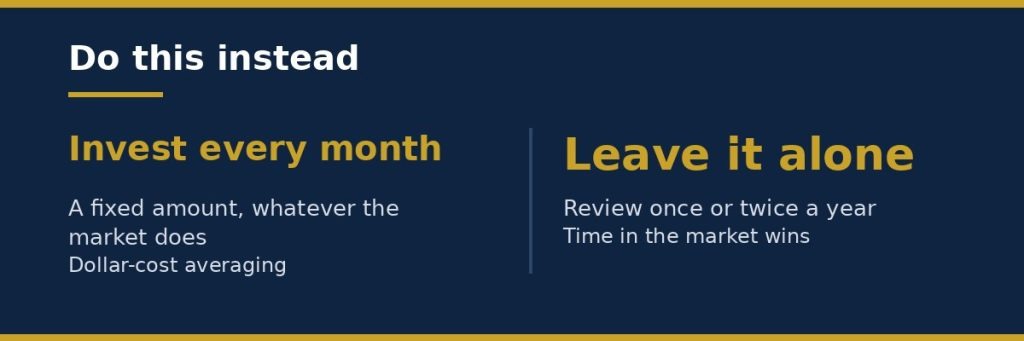
Step 2: Invest a fixed amount every month, whatever the market is doing. This is called dollar-cost averaging. When prices are low, your fixed amount buys more shares. When prices are high, it buys fewer shares. You never have to decide whether today is a good day to buy, because you buy every month.
Step 3: Leave it alone. Do not check the price every day. Do not sell when the news is bad. Do not buy extra when the news is good. Review once or twice a year, and rebalance if your mix has drifted far from your plan.
This approach does not feel clever, and it does not make a good story at dinner. But it removes the two decisions that market timing gets wrong, and it keeps your money growing through the rises and the falls.
If you already tried to time the market and it went wrong, do not try to fix it with more timing. The fix is to pick a simple plan, invest regularly, and stop predicting.
Related reading in the Investing Basics cluster: when is the right time to start investing, what long-term investing is and why time matters, what risk in investing means in simple terms, and what a bear market is in simple terms.
Frequently asked questions
What does Warren Buffett say about market timing?
Warren Buffett has said many times that he does not try to predict short-term market moves, and that the best approach for most people is to own good businesses, or a broad index fund, and hold them for a long time. His message is that time in the market beats timing the market.
Is market timing illegal?
No. Market timing is legal for ordinary investors buying and selling stocks. It is not the same as insider trading, which is illegal, and which means trading on secret information that the public does not have. Market timing is legal, but it is still hard to do well.
What is the 3-5-7 rule in trading?
The 3-5-7 rule is a trading idea that suggests risking a small fixed amount per trade, and it is often quoted as risking no more than 3 percent, or similar limits. It is a rule for short-term traders, not for long-term investors, and it does not make market timing work. For a beginner saving for the long term, regular investing matters far more than any trading rule.
Can I make 1,000 dollars a day from trading?
A few traders do, on some days, but most beginners who try lose money, and the income is not steady. Day trading is a job, not a savings plan, and it needs skill, capital, and time. If your goal is long-term wealth, regular investing in a diversified fund is the calmer and more reliable path.
What is the 10:00 AM rule in stocks?
The 10:00 AM rule is a trading saying that the first hour of trading is often volatile, and some traders wait until after 10:00 AM before trading. It is a short-term trading habit, not an investing strategy, and it has nothing to do with building long-term wealth.
What is the difference between timing the market and time in the market?
Timing the market means trying to buy low and sell high by predicting moves. Time in the market means staying invested for many years, so your money grows through the rises and falls. The evidence favours time in the market for most people, because the best days are hard to predict and often arrive when fear is highest.
Conclusion, and your first step today
Market timing means trying to be right twice, about selling and about buying back in, in a market that moves on news no one can predict. It rarely works for beginners, and it rarely works for professionals either. The worked example shows the cost: sitting out just 2 years out of 20 can cost about 4,900 dollars on 10,000 dollars invested. Time in the market beats timing the market, because the market rewards patience more than prediction.
Your first step today is to stop checking prices daily, and to set up a fixed monthly investment into a diversified fund, if you have not already. Buy every month, whatever the market does, and let time do the work.
Sources
FINRA, investor education: https://www.finra.org/investors
Investor.gov, US Securities and Exchange Commission, stocks: https://www.investor.gov/introduction-investing/investing-basics/investment-products/stocks
Disclaimer: This article is for education only. It is not financial advice, and it does not guarantee any result. It does not recommend buying or selling any investment. Your income, costs, debts, and goals are personal, and you should consider your own situation, and speak to a qualified professional if you need personal advice, before making a financial decision.
