


What Happens If I Miss a Loan Payment?
What happens if I miss a loan payment?
A missed loan payment sets off a chain of events, and the damage grows with time. At first, you get a late fee and some reminder messages. If the payment reaches 30 days past due, the lender can report it to the credit bureaus, and that mark can stay on your credit report for up to seven years. If you keep missing payments, the loan can go into default, be charged off, and be sent to a collection agency, which can sue you.
The good news is that the worst damage is not instant. Lenders do not report a missed payment to the credit bureaus until it is about 30 days late. That gives you a window to catch up before your credit score takes the hit. The key is to act fast, pay what you can, and talk to the lender before the 30 day mark passes.
This guide walks through the timeline day by day, explains the costs with a worked example, and shows exactly what to do if you have already missed a payment, or you know you are about to. It is educational only. It is not financial advice.
The first few days: late fees and reminders
A payment is late as soon as the due date passes. Some loan agreements include a grace period, often 10 to 15 days, before a late fee is charged, but the grace period does not change the due date, and not every loan has one. Check your loan agreement to see whether yours does.
If a late fee applies, it can be a flat amount, often around 25 dollars, or a percentage of the payment, often up to 5 percent. On a 300 dollar monthly payment, a 5 percent fee is 15 dollars, because 300 times 0.05 is 15. The fee is added to what you owe, so the next payment has to cover the missed payment, the fee, and the interest that kept building.
Interest does not stop while you are late. If your loan balance is 8,000 dollars at 12 percent APR, the interest for one month is 80 dollars, because 8,000 times 0.12 is 960 dollars a year, and 960 divided by 12 is 80. So after one missed month, you owe the 300 dollar payment, plus 80 dollars of interest, plus the late fee. That is why catching up early matters. Every week you wait adds more interest.
The lender will also start contacting you, by text, email, or phone, to remind you. Those reminders are normal, and they are not yet collections. Answer them, or call the lender yourself. Lenders are far more willing to help a borrower who calls early than one who hides.
At 30 days late: the credit report mark
Once a payment is at least 30 days past due, the lender can report it to one or more credit bureaus. This is usually the point when a missed payment starts to hurt your credit score. A single 30 day late mark can lower your score, and the effect is bigger if your credit file is short or your score was high.
The mark can remain on your credit report for up to seven years. That does not mean your score stays low for seven years. The damage fades with time, especially if you pay on time from then on, but the mark itself stays visible for years, and future lenders can see it when they check your report.
This is the most important deadline in the whole timeline. If you can pay before the payment is 30 days late, you can usually avoid the credit report mark entirely. Even a partial payment, or an agreement with the lender, can help, so do not wait until day 29 to act.
At 60 to 90 days late: delinquency deepens
If the payment stays unpaid, the lender will report it as 60 days past due, then 90 days past due, in 30 day steps. Each step is a fresh negative mark, and each one hurts more. Your credit score falls further, and the lender’s calls become more frequent and more serious.
At this stage, some lenders may also raise your interest rate, if the loan agreement allows it. A higher rate means more interest every month, which makes catching up harder. For a credit card, this is often called a penalty APR, and it can stay in place for months even after you catch up.
The lender may also start talking about the loan going into default. Default is the point where the lender decides you have broken the loan agreement. The exact time varies by lender and loan type, but for many personal loans it is around 90 to 120 days of missed payments.
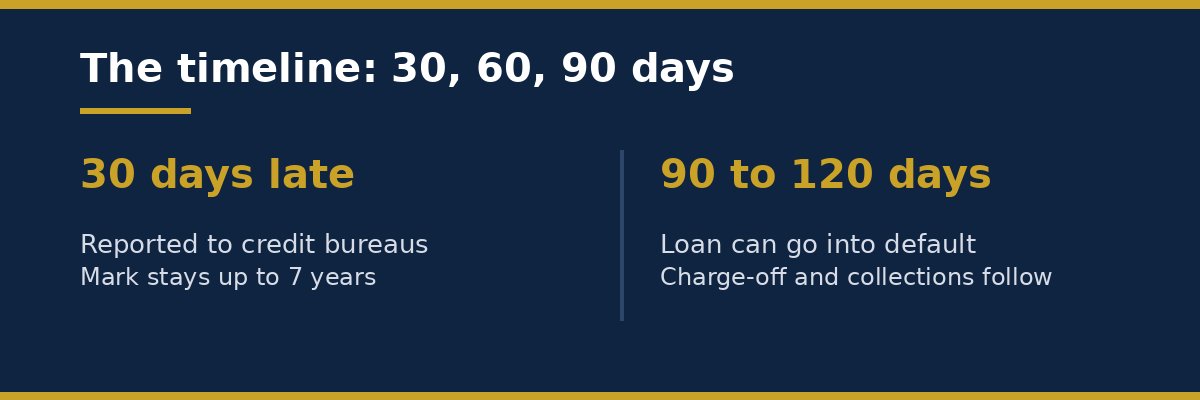
At 90 to 120 days and beyond: default, charge-off, and collections
Once the loan is in default, the lender can take stronger steps. For a secured loan, such as a car loan or a mortgage, the lender can take the property that secures the debt. That means repossession for a car, or foreclosure for a home. For an unsecured loan, such as a personal loan or a credit card, the lender cannot take property directly, but it can sue you.
After several months of non-payment, often around 120 to 180 days, the lender may charge off the account. A charge-off means the lender has given up trying to collect the money itself, and has written the debt off its books. You still owe the money. The lender usually sells the debt to a third-party collection agency, which then tries to collect it, and the collection account appears separately on your credit report.
The collection agency can sue you to get payment. If it wins, the court can order wage garnishment, which means part of your pay goes straight to the debt, or a lien on your property. A lawsuit is the last step, not the first, and it usually comes after many months of missed payments, but it is a real risk, and it is why you should never ignore a debt.
A worked example: one missed payment on an 8,000 dollar loan
Imagine you have a personal loan with a balance of 8,000 dollars, at 12 percent APR, with a monthly payment of 300 dollars. You miss one payment.
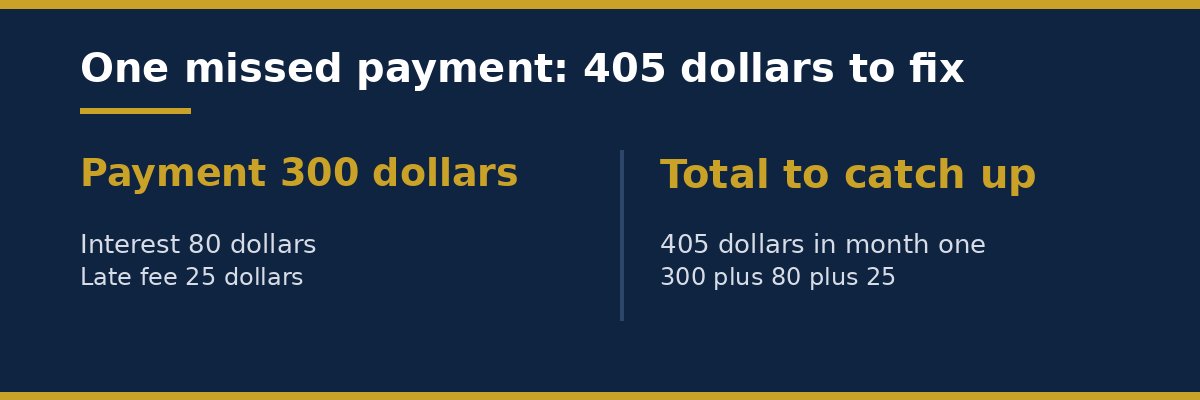
First, the interest for the month is 80 dollars, because 8,000 times 0.12 is 960 dollars a year, and 960 divided by 12 is 80. Second, the lender charges a late fee of 25 dollars. So after one month, you owe the missed 300 dollar payment, plus 80 dollars of interest, plus the 25 dollar fee. That is 405 dollars, because 300 plus 80 plus 25 is 405, just to get back to where you were.
If you pay within 30 days, that is the whole cost: 405 dollars, and no credit report mark. If you wait until the payment is 30 days late, you pay the same 405 dollars, plus you get a late mark that can stay on your report for up to seven years. If you wait 90 days, you owe three payments of 300 dollars, which is 900 dollars, plus about 240 dollars of interest over three months, because 80 times 3 is 240, plus more fees. That is over 1,140 dollars to catch up, and the loan may be near default.
The lesson is simple. A missed payment is cheapest on day one, and it gets more expensive every day after. Paying fast is not just good advice, it is the cheapest option by far.
What to do if you are about to miss a payment
If you know you cannot pay, call the lender before the due date, not after. Lenders have options they can offer, but only if you ask early.
Ask about a payment plan, which spreads the missed amount over future payments. Ask about forbearance, which pauses payments for a set time, though interest usually keeps building. Ask about a loan modification, which changes the terms, such as a lower payment for a while. Ask about a hardship program, if your income has dropped or you are facing a temporary problem. Get any agreement in writing, with the new amounts and dates, before you rely on it.
If the payment is already missed, pay it as soon as you can, even if you cannot pay the fee as well. Paying the missed amount stops the clock on the 30 day report, and it shows the lender you are trying. Then call and ask whether the late fee can be waived. Many lenders waive a first late fee for a customer with a good record, but only if you ask.
If you have missed several payments and cannot catch up, talk to a nonprofit credit counselor. They can look at your whole situation, talk to your lenders for you, and set up a debt management plan, which is a structured way to pay debts down over time. Do not pay a company that promises to make your debts disappear for a fee. A nonprofit counselor is the safe route.
Related reading: How Do I Talk to a Lender If I Cannot Pay?, What Is the Debt Snowball Method?, How Do I Make a Debt Payoff Plan I Can Stick To?, Should I Consolidate My Debt?, What Happens If I Only Pay the Minimum on a Credit Card?.
Frequently asked questions
How late can a payment be before it hurts my credit score?
Usually 30 days. Lenders do not report a missed payment to the credit bureaus until it is about 30 days past due. Before that, you may owe a late fee, but your credit report is usually not affected. Pay before the 30 day mark if you possibly can.
How long does a late payment stay on my credit report?
Up to seven years. The mark stays visible for that long, but its effect on your score fades over time, especially if you pay on time after that. One late payment, followed by years of on-time payments, hurts far less than a pattern of late payments.
Can I get a late payment removed from my credit report?
You can ask, but the lender is not required to remove an accurate mark. If the mark is wrong, for example the payment was made on time, you can dispute it with the credit bureau, and it must be corrected. If the mark is accurate, the best fix is time and a clean payment record afterwards.
What is the difference between delinquency and default?
Delinquency means you are late on payments. Default means you have broken the loan agreement by being very late, usually around 90 to 120 days for many personal loans, though the exact time depends on the lender and the loan type. Default is more serious, and it opens the door to charge-off, collections, and legal action.
Will missing one payment ruin my chances of getting a loan later?
It makes it harder, but it does not ruin them forever. A single late payment, followed by a long run of on-time payments, is something many lenders will look past, especially after a year or two. Several late payments, or a default, are much harder to overcome, so the goal is to stop at one.
Conclusion, and your first step today
Missing a loan payment starts with a late fee, and it gets worse with time. Before 30 days, the cost is a fee and some interest, and your credit report is usually untouched. At 30 days late, the lender can report it, and the mark can stay for up to seven years. After 90 to 120 days, the loan can default, be charged off, and be sent to collections, which can lead to a lawsuit. In our example, one missed 300 dollar payment on an 8,000 dollar loan costs 405 dollars to fix in the first month, and over 1,140 dollars after three months.
Your first step today depends on where you are. If a payment is due soon and you cannot make it, call the lender today, before the due date, and ask about a payment plan or forbearance. If you have already missed one, pay it now, before it reaches 30 days late, and ask for the fee to be waived. The cheapest day to fix a missed payment is today.
Disclaimer: This article is for education only. It is not financial advice, and it does not guarantee any result. Loan terms, grace periods, fees, and reporting rules differ by lender and by loan type, and by where you live. Your income, costs, debts, and goals are personal, and you should consider your own situation, and speak to a qualified professional, such as a nonprofit credit counselor, if you need personal advice, before making a financial decision.
Sources
- Experian, What Happens if You Do Not Pay Back a Personal Loan?: https://www.experian.com/blogs/ask-experian/what-happens-if-you-dont-pay-back-personal-loan/
