


How Do I Earn Side Income From Selling Crafts Online?
Can I really earn side income from selling crafts online?
Yes, and it is one of the easiest side incomes to start, because the product is something you already love making. If you make jewelry, candles, soap, greeting cards, or anything else by hand, you already have the skill. The work is learning to price it so the hours pay, take photos buyers trust, and put it where buyers already shop.
Selling crafts online is not a get rich plan. Most beginners earn a small amount at first, a few sales a week, and grow from there. What makes it work as a side income is the low startup cost. You need materials, a phone camera, and a shop on a marketplace, and you can start with a handful of items. There are no employees, no shop rent, and no big upfront cost.
This guide explains how to pick a craft to sell, where to sell it, how to price it, how to photograph it, and how to get your first sales. It is educational only. It is not financial advice, and it does not promise any level of income.
Pick one craft, not ten
The first mistake beginners make is trying to sell everything they can make. Jewelry, candles, soap, cards, and resin art, all at once. That spreads your time thin, and buyers cannot tell what your shop is about. Pick one craft, the one you enjoy most and can make well, and build the shop around it.
A good craft to sell has three qualities. First, you can make it again and again, the same way, so every buyer gets the same quality. Second, the materials are easy to buy, and not so expensive that the price has to be very high. Third, people already buy it online, so you are not trying to create a market from nothing.
Jewelry, candles, soaps, greeting cards, stickers, macrame, embroidered goods, and printables are all popular because they are small, easy to ship, and easy to photograph. Large or fragile items, like upcycled furniture, are harder to sell online, because shipping is expensive and breakage is common. If you love a large craft, sell it locally at markets first, and keep the online shop for the small items.
Before you commit, check what similar items sell for. Search for your craft on a marketplace, look at ten listings, and write down their prices. If the prices are far below your costs, that craft may not pay. If the prices leave room for your costs and your time, it is worth trying.
Where to sell: marketplace, your own shop, or both
Most beginners start on a marketplace, because the buyers are already there. Etsy is the largest marketplace for handmade goods. It has high discovery, which means buyers find your listings without you bringing them. The cost is competition, and fees on every sale, and the platform’s rules can change.
Your own website, on a platform like Shopify or Squarespace, gives you more control, lower fees per sale, and no algorithm standing between you and your customers. The catch is that you have to bring the traffic yourself, through social media, search, or word of mouth. Most makers who scale use two or three channels at once, not all of them. Start with the channel closest to where your customers already are.
Local markets and craft fairs are a third option. They give you direct feedback, no platform fees, and real conversations with buyers, but only on the days you are there. Many makers start online, then add a local market once a month to learn what buyers actually want.
A simple plan is to start on one marketplace, learn what sells, and add your own website later, once you have repeat buyers. Do not build a full website before you have made your first sale. The first sale teaches you more than a month of planning.
How to price your crafts so the hours pay
Pricing is where most craft sellers go wrong. The common mistake is to price for the materials only, and forget the hours. By month three, the seller is exhausted, because the work pays almost nothing per hour.
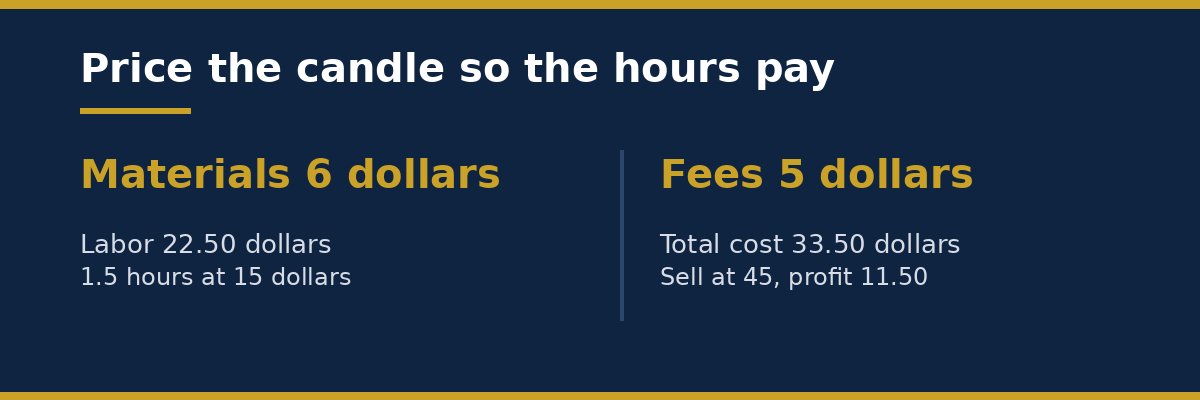
Use a simple formula. Price equals materials plus labor plus fees, plus a margin. Labor is your hours times an hourly rate you choose. If a candle costs 6 dollars in materials, takes 1.5 hours to make, and you value your time at 15 dollars an hour, the labor is 22.50 dollars, because 1.5 times 15 is 22.50. Add 5 dollars for fees and packaging, and the total cost is 33.50 dollars, because 6 plus 22.50 plus 5 is 33.50.
If you sell that candle for 45 dollars, your profit is 11.50 dollars per candle, because 45 minus 33.50 is 11.50. Sell 10 candles in a month, and the profit is 115 dollars, because 11.50 times 10 is 115. That is real side income, from a craft you enjoy, and it grows as you get faster and your shop gets more reviews.
Do not undersell yourself to get the first sale. A price that is too low attracts buyers who want the cheapest option, not buyers who value handmade work. And it trains you to work for almost nothing. Price for the hours, not just the materials, and let the buyers who value the work find you.
Photos matter more than marketing
A buyer online can only judge what they see. Great photos are the single biggest driver of sales for most makers, more than any advertising. You do not need a professional camera. A phone camera, natural light, and a clean background are enough.
Take several photos of each item. Show it from more than one angle, show it in use or in scale, such as a bracelet on a wrist, so buyers can tell the size, and show the details up close. A styled lifestyle photo, such as a candle lit on a table, helps buyers picture it in their own home. Avoid dark, blurry, or cluttered photos, because buyers skip them in seconds.
Write the listing like you are telling a story, not like a label. Say what the item is, what it is made of, how big it is, who it is for, and why you made it. Specific stories sell. Bland descriptions do not. Include the words buyers search for, such as handmade, the material, and the use, so the listing can be found.
Getting your first sales
Your first sales usually come from people you already know, or from buyers who find your listing by search. Both need the same thing: a shop that looks real, with clear photos, honest descriptions, and fair prices.
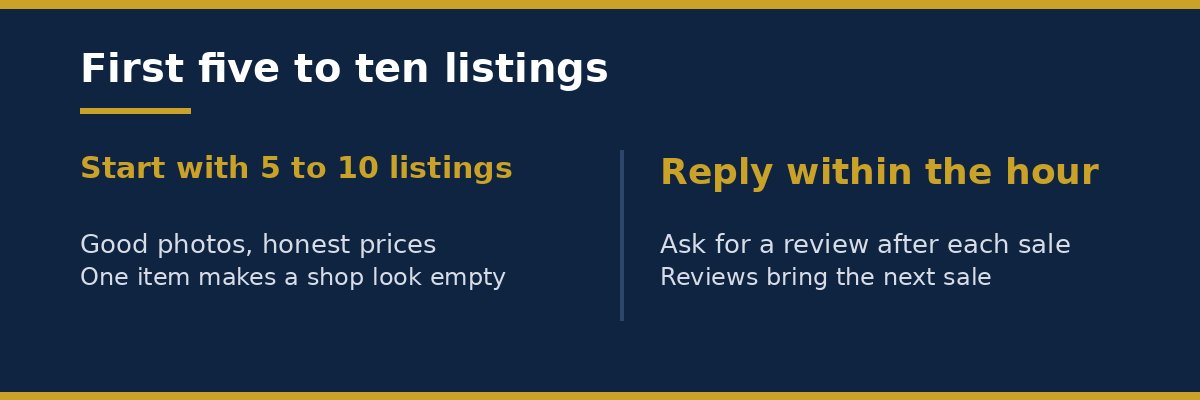
Start with 5 to 10 listings, not one. A shop with one item looks empty, and buyers leave. A shop with ten items looks like a real shop, and buyers stay to look around. Make the items before you list them, so you can ship quickly when an order comes in. Fast shipping earns good reviews, and good reviews earn the next sale.
Respond to messages quickly, ideally within an hour during the day. The buyer who messages you is in the rare moment when they want to buy, and a slow reply loses them. Ask for a review after every sale, politely, in the package or in a message. Social proof drives the next sale, and a shop with reviews looks far more trustworthy than a shop with none.
Share your work where your buyers already spend time. For crafts, that is usually image-led places, and your own circle of friends and family. You do not need a big following. A few honest posts, showing the work in progress and the finished piece, can bring your first buyers. Keep it simple, and keep making.
The practical side: taxes, time, and growth
Selling crafts is a business, even as a side income, so keep it tidy from the start. Track every sale, every materials cost, and every fee, in a simple spreadsheet. That record is what you need at tax time, and it tells you whether the craft actually pays. In the United States, income from a side business is generally taxable, and self-employment tax rules can apply, so check the tax rules for your country and your situation, and keep your records from day one.
Set a weekly time limit, and stick to it. Two or three evenings a week is enough to make, list, and ship a small number of items. If the craft starts taking over your weekends, raise the price a little, or pause new listings until you catch up. A side income should add to your life, not take it over.
Growth usually comes in small steps. More listings, better photos, a few good reviews, and a repeat buyer or two. Some makers add digital products later, such as patterns or tutorials, which can be sold again and again without making a new item each time. Others add teaching, such as a simple online class. Both are ways to earn more without making more physical items, but they come after the shop is working, not before.
Related reading: How Can I Start a Side Income With No Money?, What Is the Simplest Side Income for Beginners?, How Do I Price My First Freelance Service?, How Do I Track Side Income for Tax in Simple Terms?, Side Income Ideas for Beginners: Filter by Time, Cost, and Skill.
Frequently asked questions
How much money do I need to start selling crafts online?
Very little. Materials for your first batch, a phone camera you already have, and the small listing fee on a marketplace. Many beginners start with less than 100 dollars in materials, make a handful of items, and use the first sales to buy more materials. Do not buy a large stock before you know what sells.
Which craft sells best online?
There is no single best craft. Jewelry, candles, soap, greeting cards, stickers, and printables all sell well, because they are small, easy to ship, and easy to photograph. The best craft for you is the one you can make well, make again and again, and enjoy making, because you will be making a lot of it.
Do I need a business license to sell crafts?
It depends on where you live. Some places need no license for a small hobby-level shop, and some need a business registration once sales pass a certain level. Check the rules for your city and country before you scale up, and keep your sales records from the start, so you can answer that question with real numbers.
How long does it take to make the first sale?
It varies. Some shops make a sale in the first week, and some take a month or more. A shop with 5 to 10 listings, good photos, and fair prices sells faster than a shop with one listing and one blurry photo. Sharing your listings with people you know can bring the first sale sooner, and the first review helps the second sale come faster.
Should I sell on Etsy or my own website?
Start on a marketplace like Etsy, because the buyers are already there, and you can learn what sells without building a website. Add your own website later, once you have repeat buyers and know which items sell best. Most makers who scale use both, not one or the other.
Conclusion, and your first step today
Selling crafts online is a side income you can start with a skill you already have. Pick one craft, list it where buyers already shop, price it so the hours pay, and take photos buyers can trust. In our example, a candle that costs 33.50 dollars to make and sells for 45 dollars earns 11.50 dollars of profit, and 10 sales a month is 115 dollars of side income, before any growth at all.
Your first step today is to pick the craft, then list five items you already know how to make, with their materials cost and their making time written down. Then work out the price for each one with the formula in this guide. That list is the start of your shop, and the first sale is closer than it looks.
Disclaimer: This article is for education only. It is not financial advice, and it does not guarantee any income or result. Your income, costs, taxes, and goals are personal, and you should consider your own situation, and speak to a qualified professional if you need personal advice, before making a financial decision.
Sources
- Internal Revenue Service, Self-Employment Tax (Social Security and Medicare Taxes): https://www.irs.gov/businesses/small-businesses-self-employed/self-employment-tax-social-security-and-medicare-taxes
