


How Do I Budget for Pet Costs as a Beginner?
A pet is a monthly bill that lasts 10 to 20 years, and the first year is the expensive one. The ASPCA’s cost estimates, the latest it publishes, put a dog at about 1,391 dollars a year in recurring costs, and a cat at about 1,149 dollars a year, before any emergency. The first year costs more: about 3,221 dollars for a dog and 1,904 dollars for a cat, once one-time costs such as spaying or neutering, first vaccines, and basic gear are added.
Budgeting for a pet means three things. First, work out the monthly cost and put it in your budget before you bring the pet home. Second, set aside money every month for the costs that come once a year, such as the annual vet visit. Third, build a small emergency fund, because the one cost no chart can price is the emergency. This guide shows the numbers, the monthly math, and the steps to build a pet budget that holds. It is educational only. It is not financial or veterinary advice.
What Does a Pet Actually Cost?
The ASPCA splits pet costs into three groups: yearly costs, one-time setup costs, and extra first-year costs. Here are its 2021 figures, the latest it publishes. Prices have risen since 2021, so treat these as a floor, not a forecast. The government’s price index for veterinary services was 3.6 percent higher in September 2026 than a year earlier, and about 32 percent higher than in September 2021.
For a dog, the yearly costs add up to 1,391 dollars: food 300 dollars, routine vet care 225 dollars, preventive medication for heartworm, fleas, and ticks 185 dollars, toys and treats 97 dollars, and pet health insurance 516 dollars, plus boarding and other small lines. For a cat, the yearly costs add up to 1,149 dollars: food 225 dollars, routine vet care 160 dollars, preventive medication 140 dollars, litter 150 dollars, toys and treats 58 dollars, and pet health insurance 348 dollars.
The one-time costs come to 1,030 dollars for a dog and 455 dollars for a cat. For a dog, that includes spaying or neutering at about 300 dollars and first vaccines and other initial vet costs at about 300 dollars, plus a crate, a collar, a leash, and training classes. For a cat, it includes spaying or neutering at about 150 dollars and initial medical care at about 175 dollars, plus a litter box, a carrier, and scratching posts.
The extra first-year costs are grooming and dental care: about 800 dollars for a dog, 300 dollars for grooming and 500 dollars for dental care, and about 300 dollars for a cat, for dental care. Add the three groups together, and the first year comes to 3,221 dollars for a dog and 1,904 dollars for a cat.
The American Veterinary Medical Association’s survey of pet owners found that average household spending on pets, not counting adoption or purchase costs, was 1,516 dollars in 2024. Dog owners spent more than 1,700 dollars on average, and cat owners less than 1,350 dollars. Its 2026 figures show households spending an average of 595 dollars a year on veterinary care for dogs and 426 dollars a year for cats.
The Monthly Math: A Worked Example
Yearly totals are hard to budget from, so turn them into a monthly number. Here is the full math for a dog, using the ASPCA lines above, with one update: pet insurance prices have risen since 2021, so this example uses the newer industry figure from the North American Pet Health Insurance Association, which puts the average accident-and-illness premium at 836 dollars a year for a dog in 2025, about 70 dollars a month.

Monthly dog budget, recurring costs only:
- Food: 300 dollars a year, divided by 12, equals 25 dollars a month
- Routine vet care: 225 dollars a year, divided by 12, equals about 19 dollars a month
- Preventive medication: 185 dollars a year, divided by 12, equals about 15 dollars a month
- Toys and treats: 97 dollars a year, divided by 12, equals about 8 dollars a month
- Pet insurance: 836 dollars a year, divided by 12, equals about 70 dollars a month
- Total: 25 plus 19 plus 15 plus 8 plus 70 equals 137 dollars a month
Add 50 dollars a month to an emergency fund, and the dog costs 187 dollars a month to budget for. That is the number to put in your monthly budget, not the 116 dollars the ASPCA yearly total alone suggests, because the ASPCA total leaves out emergencies and uses older insurance prices.
For a cat, the same math, using the industry insurance figure of 435 dollars a year, about 36 dollars a month:
- Food: 225 dollars a year, divided by 12, equals about 19 dollars a month
- Routine vet care: 160 dollars a year, divided by 12, equals about 13 dollars a month
- Preventive medication: 140 dollars a year, divided by 12, equals about 12 dollars a month
- Litter: 150 dollars a year, divided by 12, equals about 13 dollars a month
- Toys and treats: 58 dollars a year, divided by 12, equals about 5 dollars a month
- Pet insurance: 435 dollars a year, divided by 12, equals about 36 dollars a month
- Total: 19 plus 13 plus 12 plus 13 plus 5 plus 36 equals 98 dollars a month
Add 40 dollars a month to an emergency fund, and the cat costs 138 dollars a month to budget for. These are example numbers, not a quote for your pet. Your real costs will differ, so replace each line with a local price once you have it.
How to Build a Pet Budget in 6 Steps
Step 1: Work out the cost before you adopt
Do the monthly math above before you bring a pet home, not after. Add the monthly number to your budget for a month and see if it fits. If 187 dollars a month for a dog does not fit, a cat at 138 dollars a month may fit better, or the timing may be wrong. A pet is a 10 to 20 year promise, and the kindest decision is the one your budget can keep. How to Create a Monthly Budget shows how to build a budget that has room for a new line like this, and What Is the 50-30-20 Budget Rule? explains how to fit wants, needs, and savings together.
Step 2: Split the money into three buckets
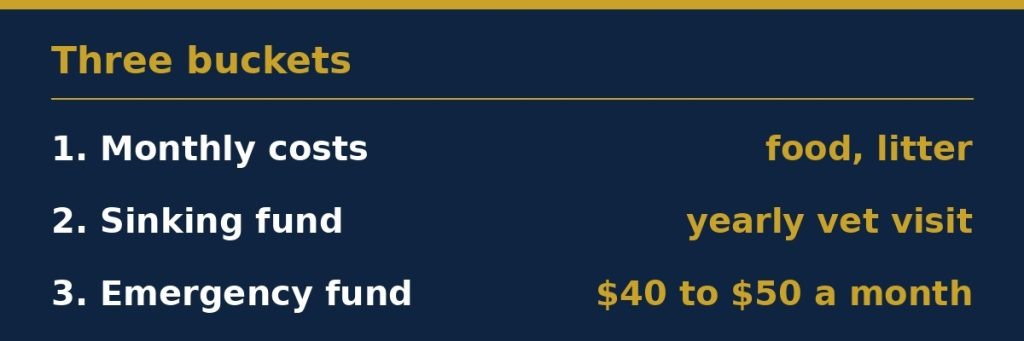
A pet budget has three buckets, and they need different treatment. Monthly costs, such as food, litter, and preventive medication, come out of your monthly budget like groceries. Yearly costs, such as the annual vet visit and vaccines, need a sinking fund: a small amount set aside every month, so the bill does not surprise you. Emergency costs need a separate fund that you do not touch for anything else. What Is a Sinking Fund? explains how a sinking fund works and why it beats saving in a lump sum.
Step 3: Set up the sinking fund first
The sinking fund is the part most new owners skip. The annual vet visit costs about 225 dollars for a dog, so set aside 19 dollars a month. The yearly preventive medication costs about 185 dollars, so set aside 15 dollars a month. When the vet visit comes, the money is already there, and you do not have to choose between the visit and another bill. Put the sinking fund in a separate savings account, and move the money on payday, before you spend it.
Step 4: Build the emergency fund before the emergency
No chart can price an emergency, and that is exactly why it needs its own fund. Start with 500 dollars, then build toward 1,000 dollars, saving 40 to 50 dollars a month. An emergency vet visit can cost several hundred dollars, and a surgery can cost thousands. Without a fund, the choice becomes debt or delay, and delay can cost the pet. If you already have a general emergency fund, add a pet line to it, and do not spend the pet money on anything else. How Do I Budget for Holidays and Big Expenses? uses the same sinking fund idea for costs you can see coming.
Step 5: Decide about pet insurance honestly
Pet insurance is the biggest single line in the yearly budget, and the hardest decision. The ASPCA estimated 516 dollars a year for a dog and 348 dollars for a cat in 2021. The industry association’s newer figures, for 2025, are 836 dollars a year for a dog and 435 dollars for a cat, for an accident-and-illness policy. Insurance covers accidents and illness, not routine care, and it has deductibles, limits, and exclusions, so read the policy before you buy.
The honest test is this: if your pet needed a 2,000 dollar surgery tomorrow, could you pay it from your emergency fund? If yes, you may not need insurance, and you can save the premium instead. If no, insurance is worth considering, especially for a young pet, when premiums are lowest. Do not buy insurance and skip the emergency fund. Insurance does not pay the deductible, and it does not pay for food, litter, or routine care.
Step 6: Review the budget every three months
Pet costs change. Food prices rise, a puppy becomes an adult dog, a senior cat needs more vet visits. Review the pet budget every three months: check what you actually spent, update any line that has moved, and adjust the monthly amount. How Do I Set a Weekly Budget Instead of a Monthly One? offers a shorter review cycle if monthly feels too long.
Ways to Save on Pet Costs Without Cutting Care
Food is the biggest everyday cost, and the easiest to overspend on. Buy the food your vet recommends, in the largest bag you can store, and compare prices across stores. How Do I Cut Food Spending Without Cutting Meals? has the same buy-in-bulk logic for your own groceries, and How Do I Save Money on Groceries? covers the shopping habits that save the most.
Preventive care is cheaper than treatment. Vaccines, flea and tick prevention, and dental cleaning cost less than the illness they prevent. Skipping a 15 dollar monthly preventive to save money can lead to a vet bill in the hundreds.
Shop around for the routine things. Compare vet prices for the annual visit, check whether a local shelter offers low-cost vaccines or spaying and neutering, and buy toys and treats in bulk.
Common Budgeting Mistakes New Pet Owners Make
The first mistake is budgeting only for the adoption fee. The adoption fee is the smallest cost of the first year. The first year costs 3,221 dollars for a dog and 1,904 dollars for a cat, and most of it is vet care, gear, and setup, not the fee.
The second mistake is forgetting the yearly costs. Food and litter are monthly, but the annual vet visit, vaccines, and licence come once a year, and they arrive whether you saved for them or not. That is what the sinking fund is for.
The third mistake is having no emergency fund. The ASPCA estimate does not include an emergency fund, and neither do most online calculators. An emergency is not a maybe. It is a when, and the fund is the difference between paying calmly and going into debt.
The fourth mistake is buying insurance and then skipping the emergency fund, or the other way around.
Frequently Asked Questions
How much should I budget for a dog per month?
Using the ASPCA lines with newer insurance prices, about 137 dollars a month for recurring costs, plus 50 dollars a month for an emergency fund, for a total of about 187 dollars a month. The ASPCA yearly total alone, 1,391 dollars, works out to about 116 dollars a month, but that uses older insurance prices and leaves out emergencies.
How much should I budget for a cat per month?
About 98 dollars a month for recurring costs, plus 40 dollars a month for an emergency fund, for a total of about 138 dollars a month. The ASPCA yearly total of 1,149 dollars works out to about 96 dollars a month before emergencies and newer insurance prices.
What is the most expensive part of owning a pet?
The first year, because of one-time costs such as spaying or neutering, first vaccines, and gear. After that, the biggest yearly lines are pet insurance and food, followed by routine vet care. The most expensive single event is usually an emergency, which is why the emergency fund matters more than any other line.
Is pet insurance worth it?
It depends on your emergency fund. If you could pay a 2,000 dollar vet bill from savings tomorrow, you may not need it. If you could not, insurance is worth considering, especially for a young pet. Read the policy first: it covers accidents and illness, not routine care, and it has deductibles and limits. Average premiums in 2025 were about 836 dollars a year for a dog and 435 dollars for a cat.
How can I save money on pet costs?
Buy food in bulk, compare vet prices for routine care, use low-cost vaccine clinics where they exist, and keep preventive care up to date, because prevention is cheaper than treatment. Do not skip vet visits or preventive medication to save money, because that usually costs more later. How Do I Save Money on a Tight Budget? has more ideas that work for pet costs too.
Should I get a pet if money is tight?
Only if the monthly number fits your budget after all your other bills. Work out the monthly cost first, using the math in this guide, and test it for a month. If it does not fit, wait, save, or choose a pet with lower costs.
Conclusion
A pet is not a one-time purchase. It is a monthly bill, a yearly bill, and an emergency waiting to happen, for 10 to 20 years. The numbers are not small: about 1,391 dollars a year for a dog and 1,149 dollars for a cat, before emergencies, and about 3,221 dollars and 1,904 dollars in the first year. But they are manageable, if you plan for them.
Budget the monthly cost before you adopt. Split the money into three buckets: monthly costs, a sinking fund for yearly costs, and an emergency fund. Decide about insurance honestly, against the size of your emergency fund. And review the budget every three months, because pet costs change as your pet grows. A pet that fits your budget is a pet you can keep, and that is the whole point of budgeting for one.
This article is for general information and education only. It is not legal or financial advice.
