

How Do I Save Money on a Tight Budget?
The short answer
Yes, you can save money on a tight budget. Do not wait for money that is left over. Save a small amount first, as soon as your income arrives, then plan the rest of your spending around what remains.
You do not need a large income to start. You need a simple plan, a clear list of what must be paid, and a few honest choices about flexible spending. A small amount saved every month is better than a large plan that never starts. If you save 50 dollars a month, that is 600 dollars in a year. If you save 100 dollars a month, that is 1,200 dollars in a year.
What does a tight budget mean?
A tight budget means your income covers your basic needs, but there is little left over. Rent, food, transport, bills, and debt payments take up most of what you earn. One surprise, such as a car repair, can throw the whole month off balance.
That does not mean you are doing something wrong. Prices rise, and incomes do not always keep up. The goal is to find the small gaps in your spending where a little saving is possible, and to protect those gaps before other spending takes them.
Separate your spending into three groups. Fixed costs stay about the same each month, such as rent, insurance, and a phone plan. Essential variable costs change a little, but you still need them, such as groceries and transport. Flexible costs are the ones you can change most easily, such as eating out, streaming services, and impulse buys. Most saving on a tight budget comes from this third group.
Step 1: Find out where your money goes
You cannot fix a budget you cannot see. For one week, write down every dollar you spend. Use a notebook, a notes app, or a simple spreadsheet. Include small amounts, such as coffee, snacks, and bus fares. Small amounts add up fast.
At the end of the week, add up each group. Many people are surprised. They may spend more on takeaway food or small daily treats than they expected. That surprise is useful. It shows you where a change can help, without guessing.
Your bank statements can help you check your notes. Look at the last month and sort each payment into the three groups above. If you are setting up an account, read our guide on how to open a bank account online. A separate savings account also helps, because money in your main spending account is easy to spend by accident. Track closely for one month, then check in once a week.
Step 2: Pay yourself first
Paying yourself first means moving money to savings on payday, before you spend on anything flexible. When saving is the last step, there is often nothing left. When saving is the first step, the rest of your spending adjusts to what remains.
Pick an amount you can keep up, not an amount that sounds impressive. On a tight budget, 25 dollars, 50 dollars, or 75 dollars a month is a strong start. A steady 50 dollars a month beats a one time 200 dollars that you then stop.
Set up an automatic transfer for payday if your bank allows it. If that is not possible, move the money by hand on payday, before you do any other shopping. Keep savings separate from daily spending money if you can. That small distance makes it less likely you will dip into savings for a small want. For more simple methods, see our guide on the best way to save money.
Step 3: Build a simple budget
A budget is a plan that tells your money where to go before the month begins. Keep it simple, or you will not keep using it.
First, write down your take home income, the amount that actually reaches your bank account after tax and other deductions. If your income changes, use the lowest recent month as your planning number.
Second, list your fixed costs, such as rent, insurance, phone, and loan payments. Add them up. This is the amount you must cover first.
Third, set a limit for groceries and transport. For example, a grocery limit of 80 dollars a week is about 320 dollars in a four week month. Shop with a list, plan meals, and buy store brands where they work for you. For food ideas, see our guide on how to save money on groceries.
Fourth, give every remaining dollar a job. Put savings first, then set amounts for fun, clothes, and other flexible spending. When the money for one group runs out, stop spending in that group until the next month.
Fifth, review the plan once a week for ten minutes. If one group is over, look for a group that is under and move the difference. If every group is over, the plan may be too strict. Adjust it, do not abandon it.
A worked example
Here is a full example with real math shown. Your own numbers will be different, but the method is the same.
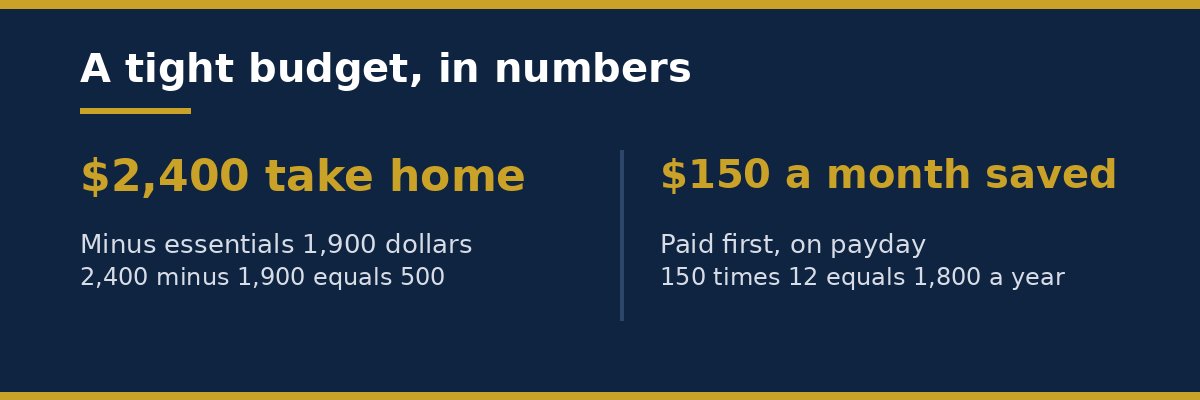
Maria takes home 2,400 dollars a month. Her essentials are rent 900 dollars, utilities 180 dollars, groceries 350 dollars, transport 200 dollars, phone 60 dollars, minimum debt payment 120 dollars, and insurance 90 dollars.
Add them: 900 + 180 = 1,080; 1,080 + 350 = 1,430; 1,430 + 200 = 1,630; 1,630 + 60 = 1,690; 1,690 + 120 = 1,810; 1,810 + 90 = 1,900. Her essentials are 1,900 dollars.
Subtract from income: 2,400 – 1,900 = 500. Maria has 500 dollars left. She gives it a job: savings, paid first, 150 dollars; fun and personal spending, 150 dollars; household items, 100 dollars; buffer for surprises, 100 dollars. Check: 150 + 150 + 100 + 100 = 500.
Over a year, her saving is 150 x 12 = 1,800 dollars, before any interest. If 150 dollars feels too high, start lower. Saving 50 dollars a month gives 50 x 12 = 600 dollars in a year. Saving 75 dollars a month gives 75 x 12 = 900 dollars in a year. Pick the number you can keep up for 12 months, then raise it later.
Step 4: Cut three flexible costs
Many budgets fail because they try to cut everything in the first week. Pick three flexible costs and change only those.
First, eating out. Lunch out five days a week at 10 dollars is 10 x 5 = 50 dollars a week, and 50 x 4 = 200 dollars a month in a four week month. Bring lunch from home three days and buy it twice, and the cost is 10 x 2 = 20 dollars a week, and 20 x 4 = 80 dollars a month. The saving is 200 – 80 = 120 dollars a month.
Second, small daily treats. A 4 dollar coffee five days a week is 4 x 5 = 20 dollars a week, and 20 x 4 = 80 dollars a month. Buy it twice a week instead, and the cost is 4 x 2 = 8 dollars a week, and 8 x 4 = 32 dollars a month. The saving is 80 – 32 = 48 dollars a month.
Third, subscriptions. Three services at 12 dollars each cost 12 x 3 = 36 dollars a month, and 36 x 12 = 432 dollars a year. Cancel one you rarely use, and you save 12 x 12 = 144 dollars a year. Keep the one you use most.
Also watch impulse buying. Wait 24 hours before buying something that is not essential. If you still want it after a day, and it fits your plan, buy it. If you forget about it, you saved that money. For more ideas, read our guide on how to stop impulse buying. Try your three changes for one month, then add up what you saved.

Step 5: Lower big costs and build a buffer
Big costs give larger savings, but they take more time to change. Work on one at a time. Rent is usually the largest cost. If you can move, a smaller place or a roommate may help, but check the full cost of moving first. For utilities, turn off lights in empty rooms and wash clothes in cold water where the label allows it. For transport, compare driving costs with a bus or train pass, and walk or cycle for short trips where you can.
Check insurance and phone plans once a year. Compare your price with two or three other offers for the same cover or data. Do not drop cover you need just to save money.
Always pay at least the minimum on every debt on time. A missed payment can lead to extra fees and can hurt your credit record. Our guide on what happens if I miss a credit card payment explains the result in simple terms. Paying more than the minimum can help over time, but only after essentials and a small buffer are covered.
Build a small emergency buffer before you save for a large goal. Aim for 500 dollars first, then 1,000 dollars. If you save 50 dollars a month, you reach 500 dollars in 10 months, because 50 x 10 = 500. If you save 100 dollars a month, you reach it in 5 months, because 100 x 5 = 500. Keep the buffer in a separate account, use it only for a real surprise, and rebuild it the next month if you use it.
Step 6: Make saving automatic and track progress
Willpower alone is not a reliable plan. Set up an automatic transfer to savings on payday if your bank allows it. Even 25 dollars is a start. Review the transfer every three months. If your income has risen, or a cost has fallen, raise it by 10 dollars or 25 dollars.
Once a month, write down three numbers: how much you saved, how much is in your buffer, and how much is in your goal savings. Compare them with last month. Even a small rise is progress.
If you slip in one month, do not give up the whole plan. Look at what happened, fix the next month, and keep going. One bad month does not erase the months that went well.
If your income rises, save half of the rise and use the other half for spending. That way, you enjoy the rise, and your savings grow too.
When money is very tight, pay housing, food, utilities, transport to work, and minimum debt payments first. For free help in the United States, see the budgeting page at USA.gov budgeting help and the free guides at consumerfinance.gov. Talk to bill providers early if a payment will be late. Many have payment plans for people who ask before the due date.
Once your buffer is in place, you can learn about longer term saving. Our guide on what is a simple first investment plan explains the idea in beginner language, without recommending a specific product. Cover essentials first, build a buffer second, and save steadily for your next goal third.
FAQ
How much should I save on a tight budget?
Start with an amount you can keep up every month, even if it is 25 dollars or 50 dollars. A steady small amount is better than a large amount you stop after one month. Raise it by 10 dollars or 25 dollars when your income rises or a cost falls.
What is the 50/30/20 rule, and does it work on a tight budget?
The rule suggests 50 percent for needs, 30 percent for wants, and 20 percent for saving and extra debt payments. On a tight budget, needs may take up more than 50 percent, so the split may not fit. Use it as a guide, not a strict rule. Saving 5 percent or 10 percent to start is a strong result.
Should I pay off debt or save first?
Do both, in a simple order. Pay at least the minimum on every debt on time, then build a small buffer of 500 dollars to 1,000 dollars, then put extra money toward debt. A small buffer first stops one surprise from forcing you back into debt.
How can I save money on food?
Plan meals for the week, shop with a list, buy store brands where they work for you, cook in larger amounts and freeze the extra portions, and cut back on takeaway and delivery fees. See our guide on how to save money on groceries for more detail.
What if I have no money left after essentials?
Focus first on the big costs and on income. Check rent, transport, and phone costs for a cheaper option, and look for extra hours or a short term job. Use the free budgeting help linked above, and talk to bill providers early if a payment will be late. Even 10 dollars a month to savings, once the gap closes, restarts the habit.
Conclusion
Saving money on a tight budget starts with small, steady steps, not a large income. Find out where your money goes, pay yourself first with an amount you can keep up, build a simple plan, and cut three flexible costs to start. Work through the example with your own numbers, build a small buffer, and make saving automatic.
Progress may feel slow at first. That is normal. A small amount saved every month adds up to a real sum, and the habit you build now will serve you when your income rises. Start today: write down your income, list your essential costs, and move your first small amount to savings on your next payday.
This article is for general information and education only. It is not legal or financial advice.
