

How Do I Make Money From Renting Out Things I Own?
Your car sits unused most of the day. Your garage holds boxes you never touch. Your camera, your RV, your baby gear, and your spare room do the same. Renting those things out turns idle assets into income, without buying anything new. You list what you already own on a marketplace, a renter pays to use it, and the platform takes a fee.
It can clear real money, but almost none of it is passive, and almost all of it is local. The income is set by demand near the asset, not by the asset itself. A driveway is worth 50 to 300 dollars a month near a stadium, a hospital, or a transit stop, and roughly nothing in a quiet subdivision. A fenced yard earns on Sniffspot in a dense neighbourhood and sits empty where every dog already has a yard. This guide shows what each thing pays, what the platforms keep, how to start, and the insurance, tax, and rules questions to answer first. It is educational only. It is not financial or legal advice, and it does not promise any income.
The Three Kinds of Rentals: Car, Space, and Gear
Peer-to-peer rental splits into three kinds of marketplace. Your car goes on Turo or Getaround. Your space goes on Neighbor for storage and parking, Airbnb for rooms, Swimply for pools, or Hipcamp for land. Your gear goes on Hygglo, which absorbed Fat Llama in November 2025, for cameras, drones, tools, and party gear, or on BabyQuip for baby gear, or RVshare and Outdoorsy for RVs.
What Each Thing Pays
Here are realistic monthly ranges from guides checked in 2026.
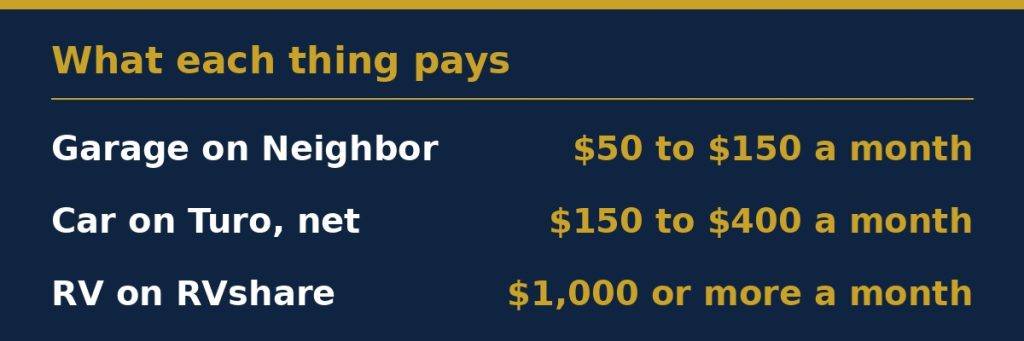
A car on Turo can gross 500 to 1,000 dollars a month in a busy market, but a single-car host nets closer to 150 to 400 dollars after cleaning, depreciation, deductibles, and downtime. Turo hosts keep 60 to 90 percent of the trip price, depending on the earnings plan. Cars listed on Turo are booked an average of 15 days a month, earning around 874 dollars a month. To be eligible, a vehicle must usually be a 2010 model year or newer and have less than 130,000 miles, and most leased vehicles are not eligible.
A garage, driveway, closet, or shed on Neighbor typically brings 50 to 150 dollars a month for almost no work, and a quiet long-term renter is often 100 to 250 dollars a month. Neighbor keeps 4.9 percent plus 0.30 dollars every month when you get paid.
A fenced yard on Sniffspot can earn 50 to 300 dollars a month at one to three hours a week, and top urban yards can reach 1,000 dollars or more. Land or a campsite on Hipcamp can earn 100 to 500 dollars a month in season from one or two simple sites. A distinctive room or space on Peerspace can earn 200 to 2,000 dollars a month, depending on the city and booking volume, but every booking needs setup and reset, so it is not passive.
A camera body on Hygglo may rent for 20 to 60 dollars a day, minus a 20 percent lender commission. An RV on RVshare or Outdoorsy can earn 1,000 dollars or more a month, minus roughly 20 to 25 percent, and it is seasonal. Baby gear on BabyQuip can earn an average of about 1,000 dollars a month for quality providers, with some earning 10,000 dollars or more, but that takes delivery and pickup work. A spare room on Airbnb varies widely by city: one bedroom in Austin, Texas, rented for 18 nights a month, generates about 900 dollars a month, while one in Los Angeles rented for nine nights generates about 954 dollars a month, and Airbnb’s host service fee is about 3 percent for most hosts.
A Worked Example: Renting a Garage on Neighbor
Here is the full math for the simplest rental of all: a garage on Neighbor. These are example numbers, to show how the fee works. Your rent will depend on your area.
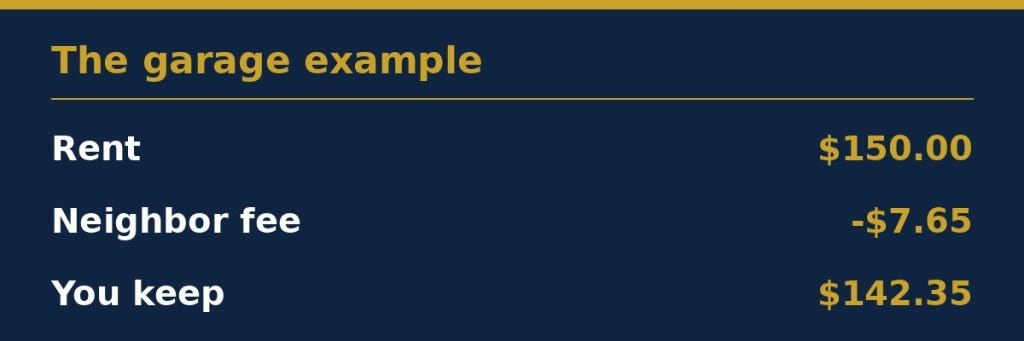
You rent your garage for 150 dollars a month. Neighbor takes 4.9 percent plus 0.30 dollars when you get paid. The fee is 4.9 percent of 150 dollars, which is 7.35 dollars, plus 0.30 dollars, which is 7.65 dollars in total. You keep 150.00 minus 7.65, which is 142.35 dollars a month, or about 1,708 dollars a year, for a space that was earning nothing.
How to Start Renting Out Things You Own in 5 Steps
Step 1: Pick the asset with local demand
Walk through your home and list what you own that sits unused: the car, the garage, the driveway, the spare room, the camera, the tools, the baby gear, the RV, the yard. Then check demand near you, not demand in general. Search each platform for your area and see what is listed, what it charges, and how often it is booked. If five garages near you are listed at 100 dollars a month and none has a review, there may be no demand. If every driveway near the hospital is booked, yours has a chance. What Is the Simplest Side Income for Beginners? helps you pick an idea that fits your life, and How Do I Choose a Side Income That Fits My Skills? matches an idea to what you can actually do.
Step 2: Check the rules and your insurance first
Before you accept a single booking, check three things. First, your lease, your HOA rules, or your local short-term-rental laws: some forbid renting out a room, a driveway, or a yard, and fines cost more than the income. Second, your insurance: ask your insurer the paid-guest-use question in plain words, and find out whether your car, home, or renter policy covers a paying guest or a paying renter, and what it does not cover. Third, the platform’s own protection: Turo covers your car with insurance and vets the drivers, and other platforms have their own host protection, but the terms, the deductibles, and the caps change often, so read the current terms before you list.
Step 3: Price it from real listings, not from hope
Look at what similar assets near you actually charge, and price in the same range. A new listing with no reviews should start at or slightly below the local average, not above it. Price too high and you get no bookings. Price too low and you get bookings that do not cover your costs. Remember the fee: Neighbor takes 4.9 percent plus 0.30 dollars, Turo takes 10 to 40 percent depending on the plan, and Hygglo takes 20 percent. Work out what you keep, not what the renter pays, and make sure the net is worth your time. How Do I Avoid Side Income Scams? explains how to spot a bad deal before you take it.
Step 4: Photograph it well and write a clear listing
Good photos are the listing. Clean the asset, photograph it in daylight, and show the size, the condition, and the access. For a garage, show the door, the floor, and the height. For a car, show the outside, the inside, and the mileage. For gear, show the item, the accessories, and any damage. Write a short, honest description: what it is, where it is, when it is available, and what the renter may and may not do. Honest listings get better reviews, and better reviews get more bookings.
Step 5: Run it well and keep records
Answer messages fast, keep the asset clean, and hand it over on time. After each rental, check the condition, note any damage, and leave an honest review. Keep a record of every payment, every fee, every cleaning cost, and every repair, from day one. That record is your tax file and your profit check. How Do I Track Side Income for Tax in Simple Terms? explains what to track and why it matters, and How Much Time Does a Side Income Really Take? helps you judge whether the hours are worth the money.
Insurance, Rules, and Taxes: The Three Questions
Insurance is the first question, and the most ignored. Your personal car or home policy may not cover paid use, and a claim during a paid rental can be refused. Ask your insurer directly, in writing, whether paid guest use is covered, and what the gap is. The platform’s protection is not the same as your own insurance, and it has limits and deductibles. If the gap is big, get a quote for a policy that covers it, and add the cost to your math before you list.
Rules are the second question. A lease, an HOA, or a city can forbid short-term rentals, parking rentals, or pool rentals, and a neighbour’s complaint can end the income. Check the rules for your exact address, not for your city in general, and check them again if you move or the rules change. Some platforms check, and some do not, but the fine lands on you, not on the platform.
Taxes are the third question. Rental income is income, and you must report it. Keep records of every payment and every cost, because the costs, such as cleaning, repairs, and platform fees, reduce the taxable amount. If you rent a room in your home for fewer than 15 days a year, the 14-day rule may mean the income is not taxable, but the rules are specific, and they differ by country and state. Check your local tax rules, and talk to a tax professional if the amounts grow. Can I Start Side Income While Working Full-Time? explains how a side income fits around a job, and How Can I Start a Side Income With No Money? lists ideas that need no upfront spend.
Common Mistakes to Avoid
The first mistake is judging the income on the gross payout. A car that grosses 900 dollars a month is not a 900 dollar income. After the platform share, cleaning, depreciation, and repairs, the net can be half that, or less. Judge every rental on the net, after all costs, and track it for a month before you decide it works.
The second mistake is buying an asset to rent it out. A new camera, a new RV, or a new fence bought to chase rental income rarely pays for itself. Rent out what you already own. If you do not own it, the income is not a side income. It is a business with a loan.
The third mistake is skipping insurance and rules. A renter who damages your car, a guest who is hurt in your pool, or a city fine for an illegal rental can cost more than a year of income. Ask the insurer, read the rules, and read the platform terms, before the first booking.
The fourth mistake is underpricing to get bookings. A new listing should start near the local average, not far below it. Prices that are too low attract renters who treat the asset badly, and they leave no margin for cleaning and repairs.
The fifth mistake is treating it as passive. A garage on Neighbor is close to passive, but a car on Turo, a room on Airbnb, or baby gear on BabyQuip needs messages, cleaning, handover, and pickup. Count the hours, and make sure the net per hour is worth it.
Frequently Asked Questions
What is the easiest thing to rent out for money?
A garage, driveway, or storage space on Neighbor. It typically brings 50 to 150 dollars a month for almost no work, and the fee is only 4.9 percent plus 0.30 dollars. It is the closest thing to genuinely passive income on this list, if there is demand near you.
How much can I make renting out my car on Turo?
A car can gross 500 to 1,000 dollars a month in a busy market, but a single-car host nets closer to 150 to 400 dollars after cleaning, depreciation, deductibles, and downtime. Turo hosts keep 60 to 90 percent of the trip price, depending on the plan, and cars are booked an average of 15 days a month.
Do I need insurance to rent out my things?
Yes, in practice. Your personal policy may not cover paid use, so ask your insurer the paid-guest-use question before you list. Platforms offer their own protection, but it has limits and deductibles, and it is not the same as your own insurance. Read the current terms before you accept a booking.
Is renting out my things taxable?
Yes, rental income is income, and you must report it. Keep records of every payment and every cost, because costs such as cleaning, repairs, and platform fees reduce the taxable amount. If you rent a room in your home for fewer than 15 days a year, the 14-day rule may apply, but check your local tax rules.
Can I rent out things I do not own?
No. Renting out something you do not own is not a side income, and most platforms require you to own the asset. Buying an asset to rent it out is a different decision, and it rarely pays for itself on rental income alone.
What should I rent out first?
The thing you already own that has demand near you and needs the least work. For most people, that is a garage or driveway on Neighbor. If you have a car you do not use much, Turo can earn more, but it needs more hours. Start with one asset, test it for a month, and only add a second one if the first one works.
Conclusion
Renting out things you own is one of the simplest side incomes, because you start with what you already have. A garage can earn about 142 dollars a month after fees. A car can net 150 to 400 dollars a month. A camera, an RV, baby gear, or a spare room can earn more, but they ask for more hours. The income is set by demand near you, not by the asset itself, so check your local market before you list.
Start with one asset, one platform, and one month. Check the rules and your insurance first. Price from real listings, photograph the asset well, and judge the result on the net, after fees, cleaning, wear, and insurance. If the net is worth the hours, keep it. If it is not, stop, and try the next idea. What Side Income Can I Start in One Weekend? lists ideas you can test fast, and the best one is the one that fits your home, your hours, and your area.
This article is for general information and education only. It is not legal or financial advice.
