
How Do I Start a Print-on-Demand Side Income?
Print on demand is a way to sell custom t-shirts, mugs, posters, and other products without holding any stock. You make a design, list it in a shop, and a printing partner prints and ships each item only after a customer pays. You never buy boxes of shirts, and you never pack a parcel. You keep the difference between the price the customer pays and the cost of printing, shipping, and platform fees.
It is a real side income, but it is not free money. The margin on each sale is thin, the market is crowded, and your design and your marketing decide whether it pays. This guide explains how it works, what one sale actually earns, what it costs to start, and the steps to launch your first designs. It is educational only. It is not financial advice, and it does not promise any income.
What Is Print on Demand, and How Does It Work?
Print on demand, often shortened to POD, is a model where a print company produces a product with your design only after someone orders it, then ships it straight to the buyer under your store’s name. You create the design and find the customer. The provider handles the blank product, the printing, the packing, and the shipping.
Every order follows the same five steps, whatever partner or shop you use:
- You create a design, such as a graphic, a slogan, an illustration, or a pattern.
- You upload the design to a print partner, such as Printful or Printify, and apply it to products in their catalogue: t-shirts, hoodies, mugs, phone cases, posters, tote bags, and stickers.
- You list those products in your shop, on Etsy, Shopify, or another platform, at a price you choose.
- A customer buys one, and pays you the retail price. Your shop sends the order to the print partner automatically.
- The partner prints the item, packs it, and ships it to the customer. The partner then charges your card for the base cost of the product plus shipping.
Two details surprise most first-time sellers. First, the customer pays you before the printer charges you, so testing a design never ties up cash in stock. But your platform pays out later, so a busy week can briefly run on your own cash. Second, the partner ships under your name, but you own the customer problem. A late parcel, a wrong size, or a faded print lands in your inbox, not theirs. You file the reprint request with the partner and answer the customer yourself.
Print on demand sits between two other models. Like a brand with inventory, you own the design. Like a dropshipper, you carry no stock. The trade-off is that you pay a much higher price per item than someone who prints in bulk, so your margin per sale is thin.
What Does One Sale Actually Earn? A Worked Example
Here is the full math for one t-shirt, using prices checked in November 2026. These are example numbers, to show how the costs add up. Prices change, so check them on the day you set your own prices.
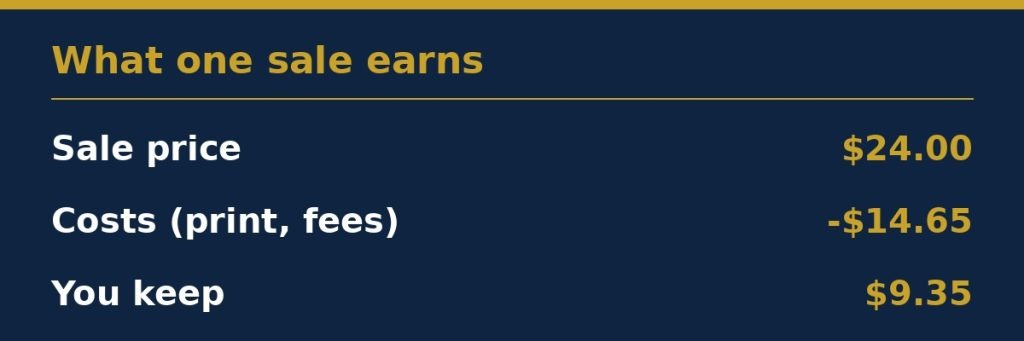
You sell a Bella+Canvas 3001 t-shirt for 24 dollars on Etsy. The buyer pays 24 dollars, plus shipping, which is charged separately. Here is where the 24 dollars goes:
- Printful base price for the shirt: 11.92 dollars
- Etsy listing fee: 0.20 dollars
- Etsy transaction fee, 6.5 percent of 24 dollars: 1.56 dollars
- Etsy payment processing, 3 percent plus 0.25 dollars: 0.97 dollars
- Total costs: 11.92 plus 0.20 plus 1.56 plus 0.97 equals 14.65 dollars
- You keep: 24.00 minus 14.65 equals 9.35 dollars
You keep 9.35 dollars from a 24 dollar sale, before ads, before samples, and before your own time. That is about 39 percent of the price. Printful’s own guide says most print-on-demand sellers make margins of 20 to 40 percent, and basic t-shirts can fall as low as 10 percent. A 28 dollar shirt with shipping charged separately can leave roughly 12 to 15 dollars before ads, on similar math.
Ads can erase most of that profit. One 10 dollar ad-driven sale cuts the profit on that same shirt from about 14.82 dollars to about 4.82 dollars. That is why sellers who rely on paid ads often make little, even when sales look strong. Free traffic, from search, social media, or an audience you already have, is what makes the margin work.
What Does It Cost to Start?
You can open a print-on-demand shop for under 100 dollars, and the main print providers are free to join. Here is a realistic starter budget, with prices checked in November 2026:
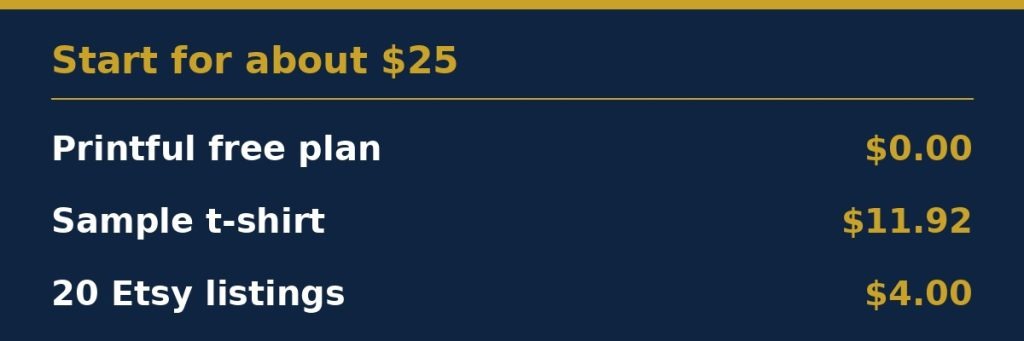
- Printful free plan: 0 dollars a month, no monthly fee. Printify also has a free plan, and its Premium plan costs 24.99 dollars a month billed yearly, and takes up to 20 percent off most products.
- One sample t-shirt: 11.92 dollars, plus shipping and taxes. Order at least one sample, so you can check the print quality and photograph the real product.
- Etsy listings: 0.20 dollars each. Twenty listings cost 4.00 dollars.
- Total to start on Etsy: about 24 dollars, for one sample and twenty listings, before shipping and taxes.
The real early costs are samples and, if you choose your own store, a monthly plan. The ongoing cost is per order, and that is what decides whether you make money. There is no fee for a design that never sells, which is the whole point: you can test ten designs for the price of one sample and a few listing fees, and only the winners cost you anything more.
How to Start a Print-on-Demand Side Income in 6 Steps
Step 1: Pick an audience before a product
Do not start with a shirt. Start with a group of people. Nurses, new parents, gardeners, cyclists, teachers, gamers: a narrow audience with a shared joke, a shared pride, or a shared problem. A design for everyone sells to no one. A design for one clear group has a chance to be found, shared, and bought. If you already have an audience, from a hobby, a job, or a social account, start there. How Do I Choose a Side Income That Fits My Skills? helps you match an idea to what you can actually do, and How Do I Turn a Hobby Into Side Income? shows how a hobby can become the audience.
Step 2: Make ten original designs
Make ten designs for that one audience, not one design for ten audiences. Use a free tool such as Canva, or hire a designer for your best idea. Keep the designs simple: bold text, one clear image, and colours that print well on a dark and a light shirt.
Step 3: Check every design for rights
This step protects your shop. Do not use a brand name, a sports team, a cartoon character, a celebrity, or a song lyric without permission. Copyright does not protect names, titles, slogans, or short phrases, but trademarks often do, and marketplaces close shops for trademark problems fast. Check each design before you list it: search the phrase, check the trademark database for your country, and if you are unsure, do not use it.
Step 4: Choose a print partner
The two best-known partners are Printful and Printify. Printful prints in-house, which gives more consistent quality, and its free plan has no monthly fee. Printify connects you with many print providers who compete on price, so base costs can be lower, from 6 to 10 dollars for a t-shirt, but quality varies by provider. Printful lists about 610 products on its free plan, and Printify advertises more than 2,000. Start with one partner and one product, a t-shirt, and add more products only after the first one sells.
Step 5: Order samples
Order a sample of your best design before you list it widely. Check the print quality, the colours, the size, and the feel of the shirt. Photograph the real product for your listings, because buyers trust real photos more than mock-ups.
Step 6: Connect a store, list, and bring buyers
Connect your print partner to your shop. Etsy is the easiest place to start, because buyers already search there, and a listing costs 0.20 dollars. Shopify gives you more control, but you must bring your own buyers, and it has a monthly fee. How Do I Start a Side Hustle Step by Step? walks through launching any side income, and How Do I Make Money Online for Beginners? explains the basics of selling online.
Where Should You Sell?
Etsy is the best first shop for most beginners. Buyers search Etsy for gifts and personal items, which is exactly what print on demand sells.
Shopify is the next step, for sellers who have an audience of their own. You control the shop, the branding, and the customer list, but you pay a monthly fee and you must bring every buyer yourself. Amazon Merch and Redbubble handle the shop for you, but the margins are thinner and you have less control over price and branding.
Start on Etsy. Learn what sells. Move to your own shop only when you have designs that sell and an audience that follows you.
Is Print on Demand Worth It? An Honest Answer
Print on demand is worth it if you treat it as a slow business, not a quick win. The honest version is this: you can start for about 25 dollars, you keep about 9 dollars per t-shirt sale, and most sellers make margins of 20 to 40 percent. To earn 500 dollars a month, you need about 54 sales at 9.35 dollars each. That takes designs people want, listings buyers can find, and months of steady work.
It suits people who can draw, write, or design, and who know a group of people well. It does not suit people who want income this week, because the first sales are slow, and the learning is in the first ten designs, not the first ten dollars. It also suits people who already sell something else: if you sell digital products, a print-on-demand shop can sell the same designs on physical products, and the two incomes support each other.
Compare it honestly with other side incomes. Freelancing pays faster, because a client pays for your time, but it needs clients, and How Do I Find My First Freelance Client? explains how to get them. Affiliate marketing pays only when someone buys through your link, and What Is Affiliate Marketing, and Can Beginners Earn From It? explains how that works. Print on demand pays slowly, but each design can sell many times without more work from you. That is its real advantage, and its real limit: the work is upfront, and the income comes later, if it comes at all.
Common Mistakes to Avoid
The first mistake is using someone else’s brand, team, or character in a design. Marketplaces close shops for this, and one complaint can end the whole shop. Make original designs, and check every one for rights.
The second mistake is never ordering a sample.
The third mistake is spending on ads before you know what sells. Ads can erase the whole margin, as the worked example showed. Get ten designs listed, see which ones sell on their own, and only then spend on ads for the winners.
The fourth mistake is listing too many products. Ten designs on one product, a t-shirt, teach you more than one design on ten products. Master one product first, then add mugs, posters, and hoodies for the designs that already sell.
The fifth mistake is pricing too low. A 20 dollar shirt leaves almost nothing after the base price and fees. Price for the margin you need, not for the cheapest price in the search results.
Frequently Asked Questions
How much money do I need to start print on demand?
About 25 dollars. The main print providers are free to join, an Etsy listing costs 0.20 dollars, and one sample t-shirt costs about 11.92 dollars plus shipping and taxes. The ongoing cost is per order, so a design that never sells costs you almost nothing.
How much can I make from print on demand?
It depends on volume. On the worked example in this guide, one 24 dollar t-shirt sale on Etsy leaves about 9.35 dollars after the base price and fees, before ads. Ten sales a month is about 94 dollars. A hundred sales a month is about 935 dollars. Most sellers make margins of 20 to 40 percent, and reaching a hundred sales a month takes months of work.
Do I need to be a designer to start?
No, but you need designs people want. You can make simple text and graphic designs in a free tool such as Canva, or hire a designer for your best ideas. Simple, bold designs usually sell better than complicated ones, and they print better too.
Which is better, Printful or Printify?
Printful prints in-house, so quality is more consistent, and its free plan has no monthly fee. Printify connects you with many providers who compete on price, so base costs can be lower, but quality varies by provider. Start with one, learn it, and only add the other if you need a product or a price the first one cannot give you.
Can I sell print on demand with no skills?
You need at least one skill: design, writing, or knowing an audience well. If you have none of those yet, start by learning simple design in a free tool, or pick an audience you already know from a job or a hobby. What Side Income Can I Start With No Skills? lists options that need less skill to start.
Do I need a business licence to sell print on demand?
It depends on where you live and how much you sell.
Conclusion
Print on demand is a simple idea: you make the design, a partner prints and ships it, and you keep the margin. You can start for about 25 dollars, you keep about 9 dollars from a 24 dollar t-shirt sale, and you never hold stock. That is the honest promise, and it is enough, if you treat it as a business.
Start with one audience, ten original designs, and one product. Order a sample. List on Etsy. Learn what sells, and only then spend on ads or add products. The sellers who make money from print on demand are not the ones with the most designs. They are the ones with the clearest audience, the cleanest designs, and the patience to let ten small tests teach them what to make next.
This article is for general information and education only. It is not legal or financial advice.
