


How Do I Open a Joint Savings Account?
How do I open a joint savings account?
To open a joint savings account, choose a bank and a savings account together, gather a photo ID and Social Security number for each owner, apply together online or in a branch, fund the account, and set up online access for both owners. The application itself usually takes 15 to 30 minutes when both people have their documents ready. The step that matters most comes before the paperwork: agree with the other owner on what the account is for, who can withdraw, and how you will handle disagreements.
This post is educational only. It is not financial advice. It does not recommend any bank or account, and it does not promise any return.
What a joint savings account is
A joint savings account is a savings account owned by two or more people. Each owner is a legal owner of the whole balance, not just their own share. That means each owner can usually deposit, withdraw, and close the account on their own, unless the account is set up to need both signatures.
Couples open joint savings accounts for shared goals: an emergency fund, a house deposit, a holiday, or a baby fund. Parents open one with an adult child to help manage money or save together. Business partners sometimes open one for a shared project fund. The account works like a normal savings account in most ways: it earns interest, it can be a high-yield account, and it is insured the same way.
The difference is trust. Because each owner can withdraw the whole balance, a joint account only works when both owners trust each other completely with all of the money. If that trust is not there, a joint account is the wrong tool, and separate accounts with transfers between them are safer.
Before you apply: the conversation first
Open the account after the conversation, not before it. Sit down together and agree on five things in plain words.
First, what is the account for? Write the goal and the target amount: for example, a 9,000 dollar emergency fund, or a 12,000 dollar house deposit in one year. A goal with a number is easier to protect than a vague shared pot.
Second, how much will each person put in, and how often? Equal amounts are simple, but they are not the only fair split. If one person earns more, you may agree on a split by income, for example 60 percent and 40 percent. Write it down either way.
Third, who can withdraw, and for what? Most joint accounts let either owner withdraw alone. If you want both signatures for withdrawals, ask the bank whether that option exists before you apply, because many banks do not offer it on savings accounts. Agree that money comes out only for the stated goal, or for a true emergency you both agree on.
Fourth, how will you check the balance together? Agree on a monthly check-in, even a short one, where you both look at the balance and the deposits. Small regular checks prevent big surprises.
Fifth, what happens if the relationship changes? This is the uncomfortable question, and it is the most important one. If you split up, either owner can usually withdraw the whole balance. Talk about it now, while things are good, and write down what you agreed.
If you cannot agree on these five points, do not open the account yet. Keep saving separately and revisit the conversation later.
How to open a joint savings account in five steps
Step 1: Choose the bank and the account
Decide together whether you want a joint savings account or a joint checking account. A savings account fits a shared goal you are building toward. A checking account fits shared bills and everyday spending. This guide is about savings.
Then compare banks. An online bank often pays a higher interest rate because it has no branches to run. A traditional bank with branches lets you both walk in and leave with a working account the same day. A credit union is member owned and often charges lower fees and pays slightly higher interest. Confirm the bank is FDIC insured or the credit union is NCUA insured. To compare the two kinds of institution, read our guide.
Check the rate, the monthly fee, the minimum balance, and the minimum opening deposit. Many joint savings accounts open with 0 to 100 dollars. Check whether the rate is an introductory rate that falls after a few months.
Step 2: Gather documents for both owners
Under federal Customer Identification Program rules, the bank must verify the identity of every owner, not just the first applicant. Each owner usually needs a full legal name, date of birth, residential street address, and a taxpayer identification number, which is a Social Security number or an Individual Taxpayer Identification Number.
Each owner also needs an unexpired government-issued photo ID, such as a driver licence, state ID, or passport. Some banks ask for proof of address, such as a utility bill, lease, or bank statement dated within the last 60 days. If one of you changed your name recently, bring the document that shows the change, such as a marriage certificate or court order.
Many banks also run a banking history check through ChexSystems or a similar agency. A history of unpaid overdrafts or closed accounts can affect whether both owners are accepted, so check your own record before you apply if you are unsure.
Step 3: Apply together, online or in person
Online, one person usually starts as the primary applicant, and the bank emails or texts the other person a secure link to enter their own details. The process usually takes five to fifteen minutes with documents in hand. In person, both owners visit a branch together with their IDs, and the bank opens the account on the spot.
During the application you will choose the ownership type, and this choice matters. The most common type is joint tenancy with right of survivorship, often shortened to JTWROS. If one owner dies, the surviving owner keeps the whole account, and the money usually passes outside probate. The other common type is tenancy in common, where each owner has a share, and a deceased owner’s share passes to their estate. Ask the bank which type it uses by default, and confirm it is the one you want. Ownership rules vary by state, so confirm the details with your bank.
You will also set up beneficiaries if the bank allows it, and decide whether both owners get a debit card and online access. For a savings account, cards are less common than for checking, but online access for both owners is standard.
Step 4: Fund the account
You can fund the account by electronic transfer from another bank, by debit card, by check, or with cash in a branch. Most banks need only a small opening deposit, often 0 to 100 dollars, to activate the account. Then set up the regular deposits you agreed on, ideally as an automatic transfer on payday, so the saving happens before spending.
Step 5: Set up access and the first check-in
Make sure both owners can log in, see the balance, and get alerts. Turn on alerts for withdrawals above an amount you both agree on, so neither person is surprised. Then hold the first monthly check-in: confirm the deposits arrived, confirm the balance matches the plan, and confirm the goal is still the same.
How joint savings insurance works
A joint account at an FDIC insured bank gets its own coverage. Each co-owner’s shares of all their joint accounts at one bank are insured up to 250,000 dollars, so a joint account with two owners can be covered up to 500,000 dollars.
Worked example: Maya and Jon save 12,000 dollars in one year
Maya and Jon want a 12,000 dollar house deposit fund in one year. They open a joint savings account and agree to deposit 500 dollars each per month. That is 1,000 dollars a month combined. After 12 months they have 12,000 dollars in deposits.
Their account pays 4.00 percent interest in this example. Interest on a growing balance is roughly 480 dollars over the year if the full 12,000 dollars sat there all year, but their money arrives month by month, so the real interest is lower, about 260 dollars, because early deposits earn for twelve months and later deposits earn for only a month or two. The exact figure depends on the bank’s compounding, but the point is simple: the deposits do the heavy work, and the interest is a bonus.
Now compare that with saving alone. If Maya saved 500 dollars a month on her own, she would have 6,000 dollars after a year. Together, they reach the goal in one year instead of two. That is the real advantage of a joint account: two incomes aimed at one goal, with one balance to watch.
The risk is just as clear. Either owner can withdraw the whole 12,000 dollars alone. If Jon withdraws it all for a car, Maya has no bank rule to stop him. That is why the conversation before the paperwork matters more than the interest rate.

Joint account or authorized user: which one fits?
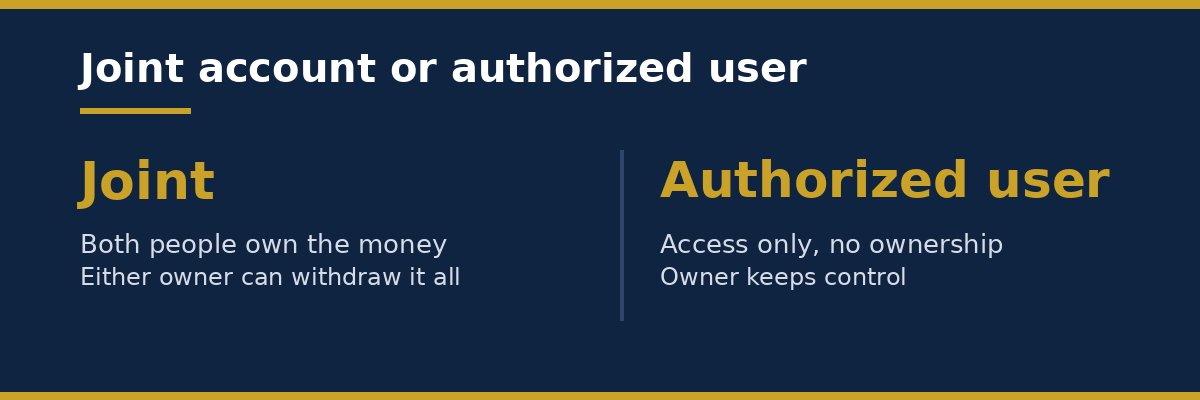
A joint account is not the only way to share access. An authorized user, or a power of attorney, can be a better fit in some situations.
An authorized user can use the account but does not own the money, and cannot close the account or claim the balance. A power of attorney lets someone act for you, for example if you are ill or abroad, without making them an owner. It can be limited to banking, and it can be cancelled.
Choose a joint account when both people truly own the goal and the money together, such as a couple saving for a house. Choose an authorized user or power of attorney when one person owns the money and the other only needs access to help.
Risks to watch before you sign
The first risk is full access. Each owner can withdraw the entire balance. Only open a joint account with someone you trust completely with all of the money.
The second risk is a co-owner’s debts. If one owner owes money, a creditor may be able to claim funds in the joint account, depending on state law. The money is also at risk in a divorce, where it is usually treated as shared property.
The third risk is tax and benefits. Interest earned is usually reported under the primary owner’s Social Security number, so agree who reports it. A large joint balance can also affect eligibility for some benefits, so check before you open the account if either owner receives means-tested help.
The fourth risk is the ownership type. If the account is not set up with right of survivorship, a deceased owner’s share may go through probate and cause delay for the survivor. Confirm the ownership type in writing at the time you open the account.
Common mistakes to avoid
The first mistake is opening the account before agreeing the rules. The paperwork is easy, and that is the trap. Agree the goal, the amounts, and the withdrawal rule first.
The second mistake is choosing the bank on rate alone. A slightly higher rate is worth little if only one owner can log in easily, or if the bank charges a monthly fee that eats the interest. Check access for both owners and the fee first.
The third mistake is forgetting the ownership type. Many people do not know whether their account has right of survivorship until it matters. Ask at the time of opening and keep the answer with your other important papers.
The fourth mistake is skipping the check-in. A joint account without regular shared checks is just two people hoping the other is saving. Put the check-in on the calendar before you leave the bank.
Frequently asked questions
Do both people need to be present to open a joint savings account?
Usually both owners need to be involved, but not always in the same room. Online, one person starts and the other gets a secure link. In person, both visit the branch together. Both owners must provide ID and a Social Security number either way.
What documents do I need to open a joint savings account?
Each owner needs an unexpired government photo ID, a full legal name, date of birth, residential address, and a Social Security number or ITIN. Some banks also ask for proof of address. Bring originals in person, and clear photos or scans online.
How much money is insured in a joint savings account?
At an FDIC insured bank, each co-owner’s shares of all joint accounts at that bank are insured up to 250,000 dollars, so a two-owner joint account can be covered up to 500,000 dollars. The same principle applies at NCUA insured credit unions.
Can one owner withdraw all the money from a joint savings account?
In most joint accounts, yes. Each owner is a legal owner of the whole balance and can usually withdraw it alone, unless the account is set up to need both signatures. Ask the bank whether a both-signatures option exists before you apply.
What happens to a joint savings account if one owner dies?
It depends on the ownership type. With joint tenancy with right of survivorship, the surviving owner keeps the whole account. With tenancy in common, the deceased owner’s share passes to their estate. Confirm the type when you open the account.
Conclusion, and your first step today
Opening a joint savings account takes five steps and about half an hour, but the real work is the conversation before the paperwork: agree the goal, the amounts, the withdrawal rule, and what happens if things change. Then pick an insured bank, gather ID for both owners, apply together, fund it, and set up the first monthly check-in.
Your first step is simple. Sit down with the other owner and write down the goal, the target amount, and how much each of you will deposit each month. If you agree easily, gather your IDs and apply. If you disagree, keep saving separately until you do.
This post is educational only. It is not financial advice.
Sources
- Kikoff, How to Open a Joint Bank Account (200, verified 2026-11-29). Source for the five steps, documents needed, and joint FDIC coverage up to 500,000 dollars for two owners.
- LegalClarity, How to Set Up a Joint Savings Account: Steps and Legal Risks (200, verified 2026-11-29). Source for Customer Identification Program rules, ownership types including JTWROS and tenancy in common, and ChexSystems checks.
- The Motley Fool, Joint Bank Accounts: What They Are and How to Open One (content read via search results 2026-11-29; URL as returned by search). Source for the steps to choose a bank, gather documents, apply, and fund the account.
- Wealth Partners Services, How to Open a Joint Bank Account in 2026 (content read via search results 2026-11-29). Source for online application flow, opening deposits of 0 to 100 dollars, and the five to fifteen minute online process.
