

How Do I Earn Side Income From Proofreading?
How do I earn side income from proofreading?
You earn side income from proofreading by finding people who need written work checked, and charging them to catch the errors. Proofreaders read finished text and fix typos, grammar mistakes, punctuation errors, and inconsistent formatting before it is published. You need a sharp eye for detail, solid grammar, and a computer, but no degree and no large startup cost. Beginners often earn 15 to 25 dollars an hour, while experienced proofreaders on freelance platforms typically earn 18 to 35 dollars an hour, according to Upwork. This guide explains the skills, the tools, the rates, and the exact steps to find your first paying client.
This post is educational only. It is not financial advice, and it does not promise any income. Rates vary by skill, speed, niche, and country.
What proofreading is, and what it is not
Proofreading is the final check before a text goes out. The writing and editing are already done. Your job is to catch what is left: a misspelled word, a missing comma, a heading that does not match the style of the others, a number written two different ways, or a sentence that reads awkwardly because a word is missing. You do not rewrite the text, and you do not change what the author means. You make the finished text clean and consistent.
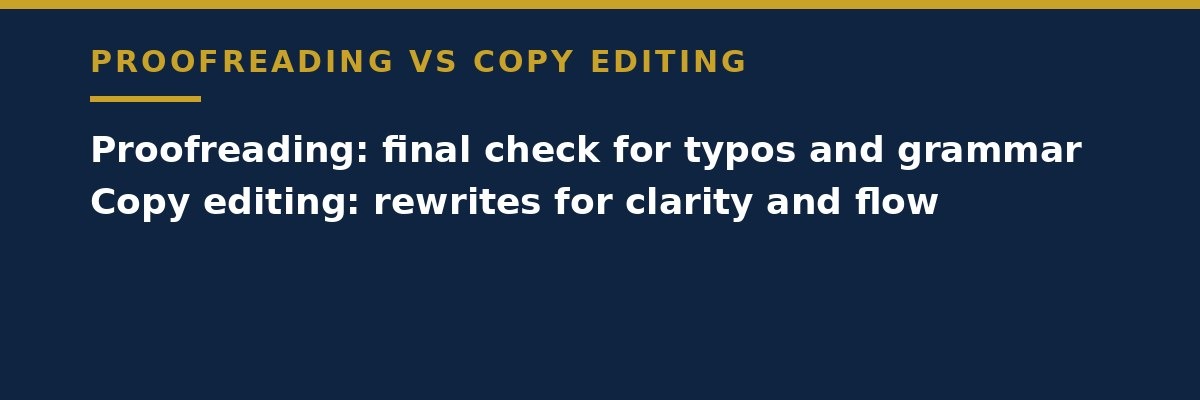
Proofreading is often confused with copy editing, but the two are different jobs. A copy editor works earlier in the process and can change sentences for clarity, fix the flow, check facts, and reorganise paragraphs. A proofreader works last and changes as little as possible, only what is clearly wrong.
Common documents that need proofreading include blog posts, books and manuscripts, academic papers, business reports, marketing copy, newsletters, website pages, and transcripts. Some proofreaders also check AI-generated drafts, fixing the errors and awkward phrases that AI tools leave behind.
The skills you actually need
You do not need a degree in English to get paid for proofreading. What you do need is a solid grasp of grammar, punctuation, and spelling, and the patience to read carefully line by line. A good proofreader reads slowly, checks every word, and does not assume a sentence is correct just because it looks familiar.
Four skills matter most. First, grammar and punctuation: you should know the rules well enough to explain why something is wrong, not just feel that it looks wrong. Second, style guide familiarity: most clients follow a style guide, and the big ones are AP for news and business, Chicago for books, and APA and MLA for academic work. You do not need to memorise them, but you should know how to look a rule up quickly. Third, consistency checking: catching when a document writes “website” on page two and “web site” on page ten, or switches between date formats. Fourth, attention to detail under time pressure: clients pay for accuracy, and a missed error is the fastest way to lose a client.
You can test yourself before you start charging. Take a page of text, introduce ten small errors, then try to find them all in one careful read. If you find most of them, you have the eye. Speed matters too, but accuracy matters more.
The tools of the trade
Professional proofreaders use a small set of tools, and most of them are cheap or free. Microsoft Word with Track Changes is the standard for most clients, because it shows every edit clearly. Google Docs works the same way for clients who prefer it. A grammar checker such as Grammarly or ProWritingAid is useful as a second pair of eyes, but it is not a replacement for your own reading. These tools miss errors and sometimes suggest wrong fixes, so always check their suggestions yourself.
PerfectIt is a popular tool for consistency checking in longer documents, and it catches things like mixed spellings and inconsistent capitalisation. A style guide subscription, such as the Chicago Manual of Style or the AP Stylebook, costs around 30 to 40 dollars a year and is worth it once you have paying clients.
Your total startup cost can be close to zero if you already have a computer and internet access. A realistic budget is 0 to 200 dollars for tools and a style guide, and you can start with the free versions of everything and upgrade only when the work pays for it.
How much proofreaders earn
Proofreading pay is usually quoted per word, per page, or per hour, and the right unit depends on the job. The Editorial Freelancers Association surveyed more than 1,100 working editors about what they charged in 2025, and published the results in its 2026 rate chart. For proofreading, the median ranges were 1.2 to 2.0 cents per word for fiction, or 35 to 45 dollars an hour, and 2.0 to 3.0 cents per word for nonfiction, or 40 to 55 dollars an hour. Technical and medical material pays more. These are medians reported by experienced editors, not a promise of what a beginner will earn, and the association states clearly that it does not set rates.
Beginners usually earn less. Side Hustle Academy reports that beginners typically make 15 to 25 dollars an hour, while experienced proofreaders in specialised niches, such as legal or medical documents, can earn 50 to 75 dollars an hour or more. Upwork reports that freelance proofreaders on its platform typically earn 18 to 35 dollars an hour, depending on niche and experience.
Per-word rates are the easiest way to quote a job. At 1.5 cents per word, a 5,000-word document earns 75 dollars. A fast proofreader can finish 5,000 words in 60 to 90 minutes. But a slow or difficult document takes longer, so always read a sample before you quote a fixed price.
How to price your first jobs
New proofreaders often undercharge because they are afraid to ask for a fair rate. A better approach is to pick one pricing method, quote it clearly, and raise it as you gain reviews and speed.
Per-word pricing is the simplest for clients to understand. Start at 1 to 1.5 cents per word for general work, and raise the rate as you gain experience. Per-page pricing works well for books and manuscripts: a standard page is 250 words, and 3 to 7 dollars per page is common for general proofreading. Hourly pricing suits ongoing work with a regular client, and 15 to 25 dollars an hour is a realistic starting range for a beginner.
Always agree the price in writing before you start, and agree what counts as a word or a page. Ask for a sample of the document first, so you can judge how many errors it has and how long it will take. A messy document takes far longer than a clean one, and your price should reflect that. If a client wants a rush turnaround, charge more. And never work for free as a test beyond a short sample of a few hundred words.
Where to find your first clients
There are three main routes to your first paying client: freelance platforms, proofreading companies, and direct clients.
Freelance platforms are the fastest start. Upwork and Fiverr let you create a profile, list proofreading as a service, and apply for jobs. Your first jobs will be small and low paid, because you have no reviews yet. Take them, do excellent work, and ask each client for a review. After five or ten good reviews, you can raise your rate. To learn how to find your first freelance client, read our guide. To learn how to price your first service, read our guide.
Proofreading companies hire freelancers to handle their overflow work. Examples include Scribendi, ProofreadingPal, and Reedsy. These companies usually ask you to pass a test before they send you work, and they pay a set rate per word or per job. The pay is lower than direct clients, but the work is steady, and it is a good way to build speed and experience.
Direct clients pay the best rates, but they take longer to find. Authors, students, small businesses, and bloggers all need proofreading. You can find them in writing groups, on social media, at local business events, or by offering a free sample to a blogger whose posts have visible errors. One direct client who sends you regular work is worth more than ten one-off platform jobs. To learn how to turn a skill into side income in general, read our guide.
Your first month, step by step
Week one is preparation. Test your grammar and proofreading skills with free exercises, and fix the weak spots. Choose one niche to start with, such as blog posts or student essays, because a clear niche makes your profile easier to find. Set up your tools: Word with Track Changes, a grammar checker, and a style guide.
Week two is your portfolio. Proofread three or four short sample documents and save the before and after versions, with the client’s permission if the text is not yours. Write a short profile that says what you proofread, how fast you work, and what you charge.
Week three is outreach. Create profiles on one or two freelance platforms, and apply for five to ten small jobs that match your niche. Write each application to the specific job, mentioning one real detail from the posting, instead of sending the same message to everyone.
Week four is delivery. Do the first jobs carefully, deliver on time, and ask for a review. Keep a simple record of what you charged, how long each job took, and what you earned per hour.
Worked example: Sara earns 400 dollars a month in five hours a week
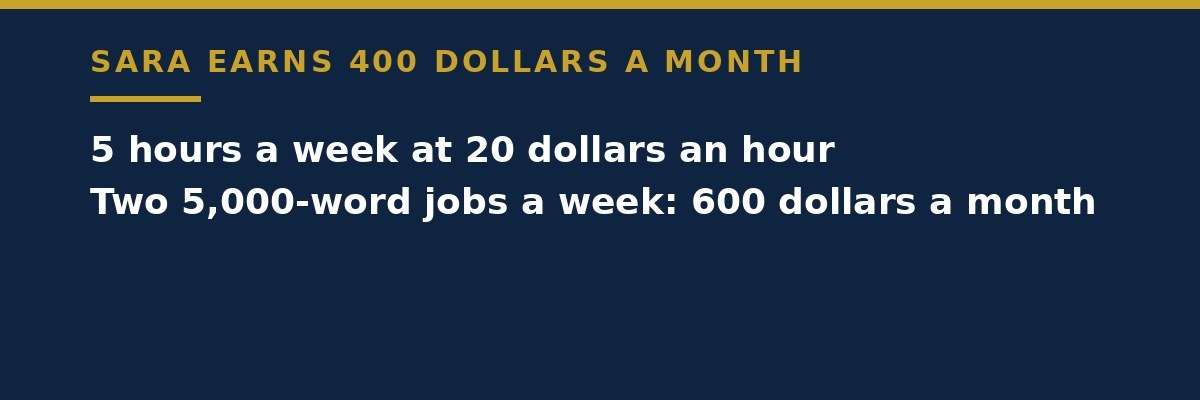
Sara works full time and wants side income in the evenings. She starts proofreading blog posts and short articles at 20 dollars an hour, which is inside the usual beginner range of 15 to 25 dollars an hour. She works five hours a week.
Five hours a week at 20 dollars an hour equals 100 dollars a week. Over a four-week month, that is 400 dollars. That is a realistic first target, and it matches what Side Hustle Academy reports: many proofreaders earn an extra 500 to 2,000 dollars a month working evenings and weekends once they build a client base.
Sara can also price by the word. At 1.5 cents per word, a 5,000-word article earns 75 dollars. If she completes two such articles a week, that is 150 dollars a week, or about 600 dollars over a four-week month. The per-word route pays more once she gets faster, because her speed rises while her price per word stays the same.
After six months, Sara raises her rate to 25 dollars an hour and starts taking on nonfiction book chapters, where the Editorial Freelancers Association median is 2.0 to 3.0 cents per word. At five hours a week, she now earns 125 dollars a week, or 500 dollars over a four-week month.
Mistakes and scams to avoid
The first mistake is charging too little for too long. If every client accepts your price without hesitation, your price is probably too low. Raise it by a small amount with each new client until some say no, then hold it there for a while.
The second mistake is accepting work you cannot do well. Legal and medical documents need specialist knowledge, and a mistake there can cost the client far more than your fee.
Watch out for scams. A real client never asks you to pay a fee to join, to buy training before you can work, or to send money to receive a payment. A common scam is a fake client who sends a large cheque and asks you to send part of it back before the cheque clears. The cheque bounces, and your money is gone. Never accept a job that requires you to pay first. To learn the warning signs in detail, read our guide. To compare proofreading with writing or design work, read our guide.
Frequently asked questions
Do I need a degree to become a proofreader?
No. Clients care about accuracy, not qualifications. A degree in English can help, but a strong grammar test result, a clean portfolio, and good reviews matter more. Some niches, like academic or legal proofreading, do need specialist knowledge, but general proofreading does not need a degree.
How much can a beginner proofreader earn?
Beginners typically earn 15 to 25 dollars an hour, according to Side Hustle Academy, or 18 to 35 dollars an hour on Upwork once they have some reviews. Your first jobs will pay the least, and your rate should rise as you gain reviews, speed, and a niche.
What is the difference between proofreading and copy editing?
Proofreading is the final check for typos, grammar, punctuation, and consistency, and it changes as little as possible. Copy editing happens earlier, and it can rewrite sentences, improve flow, and check facts. Proofreading is easier to start, while copy editing usually pays more.
How do I get proofreading clients with no experience?
Start with a portfolio of sample work, then apply for small jobs on freelance platforms and ask every client for a review. Offer a short free sample of a few hundred words to show your skill.
Is proofreading still worth it with AI tools available?
Yes, but the work is changing. AI tools write more text than ever, and that text still needs a human to check it, because AI makes confident mistakes with facts, names, and tone. Proofreaders who check AI-generated drafts still find steady work.
Conclusion, and your first step today
You earn side income from proofreading by offering a clear service, charging a fair rate, and finding clients who need clean text. The skills are grammar, consistency, and attention to detail. The tools are cheap. The pay starts around 15 to 25 dollars an hour for beginners and rises with experience, reviews, and a niche, with experienced editors reporting medians of 35 to 55 dollars an hour in the Editorial Freelancers Association 2026 survey.
Your first step is simple. Proofread three short samples this week and save the before and after versions. Then create a profile on one freelance platform, and apply for five small jobs in your niche.
This post is educational only. It is not financial advice, and it does not promise any income.
Sources
- Side Hustle Academy, How to Earn Money Proofreading Online (200, verified 2026-11-29). Source for beginner rates of 15 to 25 dollars an hour, specialist rates of 50 to 75 dollars an hour, and the step by step start.
- Upwork, 11 Proofreading Side Hustle Ideas for 2026 (found in Google search results 2026-11-29; direct curl returned 403, the site blocks automated requests). Source for freelance proofreaders typically earning 18 to 35 dollars an hour on Upwork, and for proofreading versus copy editing. Cited from search results, with the access problem noted plainly.
- Hustlers Library, How to Start a Freelance Proofreading Business (2026 Guide) (200, verified 2026-11-29). Source for per-word rates of 0.01 to 0.03 dollars, per-page rates of 3 to 7 dollars, and startup costs of 0 to 200 dollars.
- The Penny Hoarder, Make up to $57K Working From Home as a Freelance Proofreader (200, verified 2026-11-29). Source for proofreading as a work from home job, and for salary benchmarks from Salary.com and ZipRecruiter.
- Editor World, Book Editing Rates in 2026: EFA Benchmarks (200, verified 2026-11-29). Source for the Editorial Freelancers Association 2026 rate chart medians: fiction proofreading 1.2 to 2.0 cents per word and 35 to 45 dollars an hour, nonfiction proofreading 2.0 to 3.0 cents per word and 40 to 55 dollars an hour, based on a survey of more than 1,100 members.
