

How Do I Budget When I Eat Out?
You budget when you eat out by giving eating out its own monthly number, splitting that number into weeks, and deciding before you go how each meal fits inside it. Start with what you spent last month, pick a lower number you can live with, and treat that number as a hard limit, not a guess. Then use simple moves to make the number stretch further. Eating out stays in your life. It just stops being the part of your budget you never see coming.
This post is educational only. It is not financial advice.
Why eating out breaks so many budgets
Eating out is one of the biggest flexible costs in most household budgets, and one of the easiest to underestimate. A single dinner feels small. Ten small dinners in a month do not. The cost also hides in places people forget to count: the coffee on the way to work, the lunch near the office, the delivery fee, the tip, and the drink that costs almost as much as the food.
The numbers back this up. The Bureau of Labor Statistics reports that the average American household spent 3,945 dollars on food away from home in 2024, which is about 329 dollars a month, and nearly 39 percent of everything it spent on food. That is the average across all households, so a household that eats out often can spend far more. Eating out also breaks budgets because it is tied to feelings: a hard day or a friend in town can turn into a restaurant visit. A budget gives those feelings a boundary without taking the pleasure away.
First, decide what counts as eating out
Before you set a number, decide what belongs in it. Most people count sit-down restaurants, fast food, cafes, takeaway, and delivery orders, including delivery fees and tips. Work lunches belong here too, unless your employer pays for them. A 12 dollar lunch five days a week is 240 dollars a month, and that is not a small extra.
Coffee is the question most people argue about. Decide once, and keep the same rule every month. If coffee is a daily habit, give it its own small line or count it in eating out, but do not leave it uncounted. Groceries are a separate category. The rule matters more than the choice. What you measure is what you can control. To cut food spending without cutting meals, read our guide.
Find your real number before you set a target
Do not guess your eating out spending. Look it up. Open your bank and card statements for the last 30 days and add up every restaurant, cafe, bar, and delivery charge. Include cash and payment apps, and include the tip and the delivery fee, because that is what left your pocket. The CFPB spending tracker recommends recording expenses for at least two weeks or a month, and the FTC budget guide says to record daily spending and compare it with the plan at the end of the month.
Most people are surprised by the total. That surprise is useful. It tells you the gap between what you thought you spent and what you really spent. To track spending without a spreadsheet, read our guide. Write the real number down. If it is 480 dollars, say 480 dollars. A budget built on a pretend number will fail in the second week, and you will blame yourself instead of the number.
Set your eating out number in three steps
First, list your take-home pay, then subtract your fixed bills, your debt payments, and the savings you have already chosen. The 50/30/20 rule is one simple split for this step. What is left is the money for all flexible spending: groceries, transport, fun, clothes, and eating out. If that remainder is small, your eating out number must be small too. Do not set an eating out target first and hope the rest fits.
Second, pick a target lower than your real number, but not so low that you quit. If you spent 480 dollars last month, a target of 240 dollars is a strong cut. A target of 50 dollars is a crash diet, and crash diets end in a blowout dinner. A cut of about one third to one half is realistic for most people. You can tighten it later, once the new habits feel normal.
Third, write the number into your monthly budget as its own line, next to groceries and savings. A number that lives only in your head is a wish. A number written in the budget is a plan.
Turn one monthly number into weekly choices
A monthly number is too big to feel. A weekly number is something you can use at the door of a restaurant. Divide your monthly cap by 4.33 for a more exact split. A 240 dollar monthly cap is about 55 dollars a week. A 200 dollar cap is about 46 dollars a week.
Give each week its own envelope, real or digital. When the week is over, what is left rolls into the next week. For a full weekly budget method, read our guide. When a week is empty, you cook at home until the next week starts. This is the same idea as cash envelopes, and it works because the limit is visible before you order, not after the bill arrives. You can also split the month by type of meal: four dinners out, four work lunches, and two takeaway nights, each with its own amount. Pick one method and use it for at least a month before you judge it.
Five simple ways to cut the bill without cutting the fun
First, order the lunch menu instead of dinner. The same restaurant often charges much less at lunch, because portions are smaller and the menu is built for the office crowd. SoFi makes the same point: restaurant lunch menus tend to be cheaper because the portions are smaller. When you want to try an expensive place, go at lunch. You get the same kitchen at a lower price.
Second, share a plate. Many restaurants serve portions that are too big for one person. Split a main course and a starter with a friend, and you both eat well for about half the price each. Check first whether the restaurant charges a plate-sharing fee. If the portions are small, share a starter instead and order your own main.
Third, treat drinks as a separate decision. Drinks often add more to the bill than people expect, and specialty cocktails are usually the priciest items on the menu. Decide before you go how many drinks you will have. Ask for tap water, which many restaurants in the United States serve at no charge. Choose draft beer or wine by the glass over cocktails.
Fourth, use timing. Happy hour can cut the price of food and drinks on certain weekdays, usually just before or after standard dinnertime. Some restaurants offer deals on slow days, like Mondays.
Fifth, check the bill before you pay. Mistakes happen: a dish you did not order, a double charge, or a wrong price. Read the bill line by line. If you pay by card, take a photo of the receipt with the tip written on it, then check that the charge on your statement matches. This is not about being cheap. It is about paying for what you actually ate.

Delivery, work lunches, and coffee: the quiet leaks
Delivery is the most expensive way to eat out, because you pay for the food, the delivery fee, the service fee, and the tip. A 15 dollar meal can easily become a 25 dollar order. Give delivery its own limit inside your eating out cap, such as two orders a week. When the delivery money is gone, cook or pick up the food yourself. Also, turn off delivery app notifications.
Work lunches leak the same way. Five 12 dollar lunches a week is 60 dollars a week, or about 240 dollars a month. Try bringing lunch three days a week and buying it twice. That alone can cut the cost by more than half. Cook extra at dinner and pack the leftovers, and set a work lunch limit of about 15 dollars a meal. Coffee is the same story: a 5 dollar coffee every workday is about 100 dollars a month. Make coffee at home most days and keep the cafe coffee for twice a week.
What to do when you overspend
You will overspend in some month. A friend visits, a celebration comes up, or a hard week turns into three takeaway nights. That does not mean the budget failed. First, find out by how much, and in which week it happened. Then move money, openly, from another flexible category to cover it. For the full fix when any category goes over, read our guide. If eating out went 60 dollars over, take 60 dollars from fun money or clothes for that month. Do not take it from savings or from rent. Moving money between flexible categories is the budget working, not failing.
Second, do not punish yourself by setting next month to zero. A zero month after an overspend almost always ends in a bigger blowout. Keep next month realistic, and add one change only, like one fewer delivery order a week.
Worked example: Maya cuts eating out from 480 dollars to 240 dollars
Maya takes home 3,400 dollars a month. Last month she added up her statements and found she spent 480 dollars on eating out: dinners with friends, work lunches, coffee, and delivery. She wants to cut that in half, to 240 dollars, and save the difference.
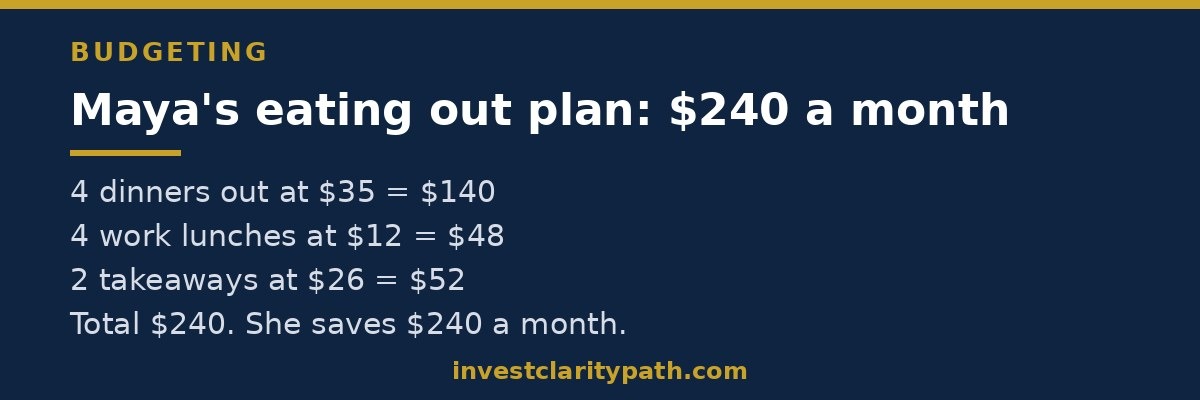
Her 240 dollar plan has three parts. Four dinners out at 35 dollars each come to 140 dollars. Four work lunches at 12 dollars each come to 48 dollars. Two takeaway nights at 26 dollars each come to 52 dollars. Add them up: 140 plus 48 plus 52 equals 240 dollars. The plan fits the cap exactly. She splits it into weeks: about 55 dollars a week, and any leftover rolls forward.
She also changes how she orders. At dinner she shares a starter with her friend and drinks tap water instead of a cocktail, which saves about 10 dollars a meal, or 40 dollars across her four dinners. She brings lunch from home three days a week, and she limits delivery to two orders a month. At the end of the month, Maya spent 240 dollars instead of 480 dollars. She saved 240 dollars in one month, which is 2,880 dollars in a year, and she puts it straight into her emergency fund on payday. She still ate out 10 times in the month. She just planned each one, and the plan held.
Common mistakes to avoid
The first mistake is setting the target from a national average instead of your own spending. The average household spent about 329 dollars a month on food away from home in 2024, but that average covers households of different sizes, in different cities, with different habits. Your number is the one in your statements. Use that.
The second mistake is forgetting the extras. The tip, the tax, the delivery fee, and the drink are part of the meal. Count what left your pocket, not what the menu said. The third mistake is making the budget so tight that the first invitation breaks it. Build one flexible meal into the plan each month.
The fourth mistake is tracking nothing during the month and adding it up at the end. A budget you check once a month is a history lesson, not a plan. Check your eating out total once a week. To build a monthly budget that fits your whole pay, read our guide.
Frequently asked questions
How much should I budget for eating out per month?
There is no single right number. The Bureau of Labor Statistics reports the average American household spent 3,945 dollars on food away from home in 2024, about 329 dollars a month. Your number should come from your own statements: add up last month, pick a target lower than that by about one third to one half, and adjust it after a month of trying it.
How do I stop overspending on eating out?
Give eating out its own monthly number, split it into weeks, and check the total once a week. Decide before you go what you will order, use the lunch menu, share plates, and limit drinks and delivery. When the weekly amount is gone, cook at home until the next week starts.
Is it cheaper to eat out at lunch or dinner?
Lunch is usually cheaper. The same restaurant often serves smaller portions at lunch and offers lunch specials built for the office crowd. If you want to try an expensive restaurant, go at lunch.
How can I eat out on a 50 dollar a week budget?
A 50 dollar week can cover one dinner out at about 30 dollars and one work lunch at about 12 dollars, with a little left over. Cook the rest of your meals at home, bring lunch to work most days, and use happy hour or lunch specials for the meals out.
Should I use cash for eating out?
Cash can help, because you can see the money leave and you cannot spend more than you carry. Put your weekly eating out amount in an envelope or a separate account, and when it is empty, the eating out for that week is done. Cards work too, if you check the total once a week.
Conclusion, and your first step today
Budgeting when you eat out means giving eating out its own number, splitting it into weeks, and planning each meal before you order. Find your real spending in last month statements, pick a target lower than that by about one third to one half, and use lunch menus, shared plates, fewer drinks, and less delivery to make the number stretch. When you overspend, move money openly from another flexible category and keep going. The goal is to enjoy eating out without it quietly eating your budget.
Your first step today is simple. Add up last month eating out from your bank and card statements, and write the total down. Then pick a target for this month and split it into weeks. That one number turns every restaurant visit from a surprise into a choice.
This post is educational only. It is not financial advice.
Sources
- Fidelity, How to eat out on a budget
- SoFi, Tips for Eating Out at Restaurants While on a Budget
- Bureau of Labor Statistics, Consumer Expenditures 2024, as reported by Fidelity and by Monely
- CFPB spending tracker and FTC consumer.gov budget guide, as described in the iPro article on budgeting for eating out
